
Welcome to the latest edition of Woy Magazine’s biweekly newsletter, providing you with must-know news and commentary on Haiti and our Diaspora.
We can’t do this work without you. We have introduced a paid subscription option for our newsletter. Consider switching your free subscription to a paid one to support our work! Click the button below.
Text within this block will maintain its original spacing when published
Souke tèt pa pase kou
Shaking your head won’t break your neck
(Haitian proverb)
*We translate the Haitian proverbs literally (word-for-word) to challenge you to reflect on and discover the spirit and poetry of the proverb for yourself. Did you understand today’s proverb?
CHAY LA | Main Story
The story at the center of this issue
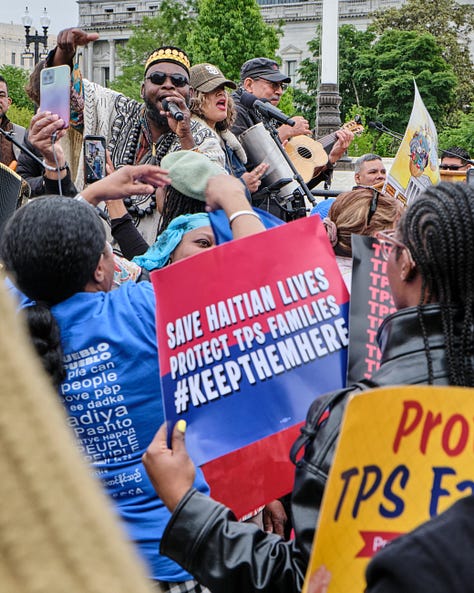
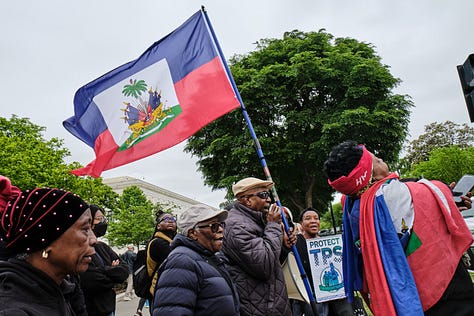
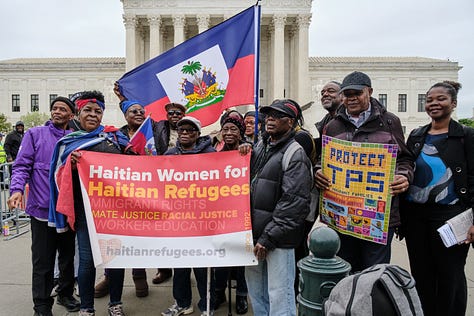
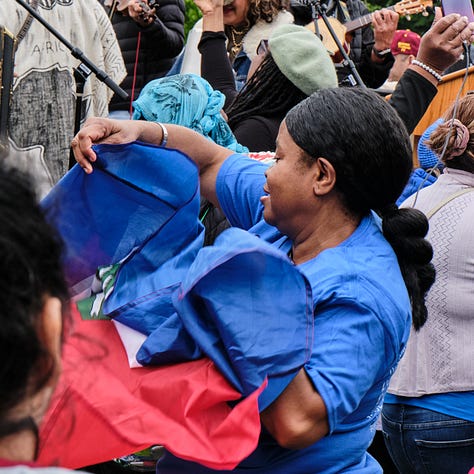


Representatives from organizations such as UndocuBlack, Haitian Bridge Alliance, Haitian Women for Haitian Refugees, and the National TPS Alliance rallied in front of the Supreme Court building on April 29 while the court heard oral arguments regarding the termination of Temporary Protected Status (TPS) for Haiti and Syria. The proceedings focused on two primary legal questions: whether the decision to end these protections was fueled by racism and whether the former Secretary of Homeland Security, Kristi Noem, adhered to the required administrative procedures for ending them. At stake is the potential mass deportation of thousands of individuals currently residing legally in the U.S. under the program.
The rally also featured performances by Haitian artists, Paul Beaubrun and Sherlee Skai.
“The true reason for the termination [of TPS status] is the president’s racial animus toward non-white immigrants and bare dislike of Haitians in particular,” Pipoly said. “The secretary herself described people from Haiti” and from other non-white countries as “killers, leeches, saying, ‘We don’t want them, not one,’” while “simultaneously enacting another humanitarian form of relief for white and only white South Africans.” (Source: NPR)
Ninaj Raoul, former director of Haitian Women for Haitian Refugees, explained that while this hearing concerns the 350,000 currently protected under TPS, the fight will have to continue to defend the 150,000 whose TPS applications were simply never processed by the Trump administration, effectively terminating their status before legal challenges could intervene.
POLITIK/POLEMIK
The latest from Haiti's political landscape: conflicts, scandals, moves worth watching
People in Okap have long been fed up with the neglect they have endured, particularly those living on the outskirts of the city near the Vètyè monument, where the road has been flooded for months.
Starting in Vètyè on April 28 and expanding across the city the following two days, residents blocked major roads to demand immediate infrastructure repairs, including road construction and canal clean-ups to prevent flooding. In response, the Minister of Environment, who was in Okap last week, returned, along with three other ministers, with the mission this time to evaluate the city’s needs and provide solutions. They joined the crowd of protestors and were met with chants of “Mare vole yo pou mwen,” which translates to “Help me catch the thieves.”
Waste management is a persistent challenge for Okap's local authorities, whose new mayor, Angie Bell, was sworn in in 2025. Mayor Bell has been vocal about the lack of support from the central government in waste management. The situation has sparked a debate over the social contract between the state and its citizens, specifically regarding the government’s failure to provide essential services, and the civic duty to pay taxes. The protests have also fueled long-standing criticism of the central government’s “predatory” economic reliance on hubs like Okap.
ANN REFLECHI | LET’S REFLECT
Let’s zoom out and analyze. What do the latest events tell us about the Haiti we’re building toward?
In the last newsletter, we discussed what transitional justice (TJ) is, Haiti’s experience with it, and the work of Haitian civil society organizations to educate the public about it. In this newsletter, we’ll continue by highlighting how some Haitians are currently engaging with TJ, some enthusiastically and others with caution. But first, its critiques. The main critiques of transitional justice center on its human rights foundation, specifically: (1) that the human rights framework is Western and doesn’t draw on other cultures, (2) human rights prioritizes civil and political rights over the right to economic well-being, and (3) it centers the individual over the community. In view of these limitations, to what extent can transitional justice work in non-Western countries? Is this yet another foreign imposition that doesn’t fit into the Haitian context?
A group called Mouvement pour la Vérité, la Justice, la Réparation et la Sécurité, led by activist Nixon Boumba, draws on the Guatemalan model to offer recommendations for Haiti. Boumba is careful to distinguish his work from transitional justice as a framework, preferring instead to speak of transformation and justice. Below is a condensed version of our conversation. We had a chance to speak to him about it. Below is a revised/condensed version of his reflections.
Woy Magazine: How were you introduced to transitional justice, and how has your learning process led you to adapt some of its mechanisms?
Boumba: I don’t really consider what I’m proposing to be transitional justice, but I have traveled to Guatemala many times over the years. I found similarities between our situation and theirs. I also have a very good Guatemalan friend who shared their personal experience with me. Our everyday lives have become criminalized in so many ways. We would like to understand why that is the case. Guatemalans lived with extremely high levels of violence for several years as well. They want us to believe that the only options are to send an army to kill all those in the gangs, when we know violence is a trap. Another option we’ve been given is dialogue with the gangs to achieve amnesty for the perpetrators, which is another trap. In reality, the gangs play the role that the army used to play on behalf of the state. The problem isn’t the gangs, it’s the impunity that covers those in government. We’re seeking the truth that can help us get from a justice that is captured to a justice that is free.
What’s interesting about the Guatemalan case is that the International Commission against Impunity in Guatemala (CICIG) conducted investigations that led to the dismantling of criminal networks. We need a similar approach.
Woy Magazine: What transitional justice proposal do you have for this current crisis?
Boumba: First, we have made an observation that the gangs aren’t the root of the problem, but rather the fusion between the state and criminality. We need to understand how this happens.
Second, we need an independent commission to investigate and provide an X-ray of this fusion between the state and criminal networks. We need to know how the police are involved. A full vetting of the justice sector is necessary, as is vetting of other government agencies, such as customs and the national pensions agency (ONA). Guatemala’s commission was backed by the US and the UN. The commission we think Haiti needs shouldn’t be backed by those actors. That’s an important difference.
Third, we need a special court of judges, chosen from among existing judges who are not corrupt, and it can include civilians as well. Revealing the truth is very important, but so is paying for the harms committed. For instance, politicians found guilty by the special court need to pay with real consequences. I’m not talking about a few months in jail. They need to be banished from running for public office forever. Business leaders found to be working with the gangs need to be excluded from certain opportunities.
We need to create a system where investments can be made into neighborhoods destroyed by the violence. Some of the funds for these investments can come from those who got rich from this criminality. The investigation should allow us to track the money and make them return it to the Haitian people. Major investments in education, health, infrastructure, and water are needed. We need to rebuild schools, Lopital Jeneral, and community centers — and the funding should come from those responsible, not from USAID or foreign donors. Dialogue with the victims of these crimes and repair is very important.
Last, we need to break Haiti’s isolation. Haiti's recent decision to collaborate with Mexico and Colombia on these regional issues is a step in the right direction. We propose establishing a Latin American and Caribbean coalition among countries to address transnational organized crime and other issues. This coalition would work together to set up mechanisms of control and surveillance to counter drug trafficking, arms trafficking, forced displacement, and human trafficking. This body could represent a unified force capable of standing up to the United States.
KILTIRÈL
Culture, art, tradition, and the Haitian imagination
May 1st is Labor and Agriculture Day in Haiti, serving as both a celebration of the country’s workforce and a moment to reflect on its agrarian roots.
The day carries particular significance for practitioners of Vodou, who honor Kouzen Zaka (Azaka Mede), the patron lwa of agriculture. Often depicted as a hardworking peasant carrying a dyakout and wearing a denim shirt and straw hat, Zaka embodies the resilience of the Haitian farmer.
On this day, altars are adorned with the fruits of the harvest, corn, yams, and coffee, as devotees offer prayers for fertile land and protection of the food supply.
No posts
Comments
Nothing yet. Say the first thing.
Sign in to join the conversation.