
A grandmother appeared in a dream the night before we met for our next WWJ session, and by morning she had inspired the topic on the table. Seven topics had been offered that day: privilege, money, parenting, old age, patriarchy inside religion, marginalisation within the Process Work community, and the group chose the eighth: death, and how we integrate people after they die. Tanja's grandmother had been dreaming her way into the room.
Do the dead want war to stop?
Kiril had written the question down in the chat: if the dead in Ukraine and Russia could speak, would they ask for the war to end? “Are there people who can channel their voices?” Nobody answered this.
What surfaced instead was a different kind of knowledge, carried in from Kenya. TinTin described a practice she grew up with: “Elders pour drinks, libations to the ground, to signify their knowledge of their ancestors, and also seek help, guidance or forgiveness.” Many of us were curiously listening and learning that relating to ancestors can be a cultural heritage.
Kiril named the asymmetry directly: “Contacting ancestors and being chosen by spirits is mainstream in African cultures. People experiencing such things in European cultures have no one to turn to tell about their experience, and are afraid to be considered mentally ill.”
Zaida from Kenya responded: “Getting aware of the differences in our cultures; that is such an amazing experience.”
A little death, to hear
Stephanie wrote that in difficult life moments, dying and the dead play an important role for her: “Sometimes I feel, I don’t have another choice: I have to die a little, be a little dead, to hear what wants to emerge.” Lately, in such a period, she found herself also asking her dead grandfather for advice, the way she has for twenty years since his funeral. He showed her a book. Thick. Gold-edged. Not yet written.
A German word appears in her piece of writing: ‘verrückt’, meaning not in the right place. That is what people think about your mental state when you admit you talk to your dead.
Cynthia does that too. She was away at boarding school, with no phone within reach, when her aunt died suddenly of a heart attack; she only learned of it when her family arrived to bring her to the funeral. But some part of her already knew. She’d also woken a night crying, a voice insisting “Your mother is dead.” It was five years earlier, a warning she didn’t understand until her actual mother died. Now: “And I still talk to my late mother as if she’s seated right beside me... in her motherly, protective fashion, she follows through.”
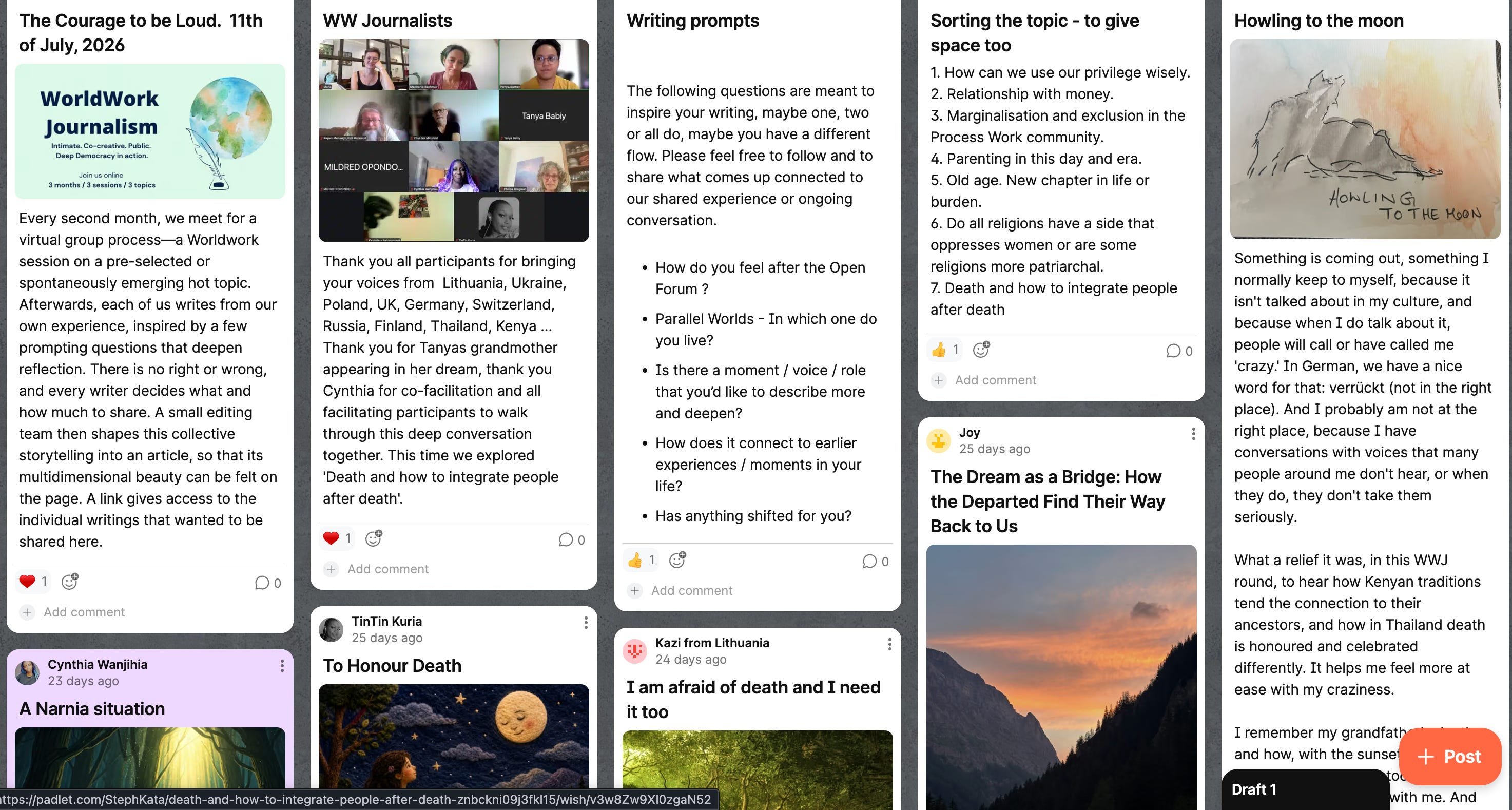
Link to padlet - with the original writings of some participants.
Time to live
Maria took a different position: “I have enough of death. I want to let it go and connect to life.”
It was Maria’s number, over a million dead in the war between Russia and Ukraine, that lodged itself in Philipa, joining from the UK. “I found it hard to come back and reconnect to the group and what people were saying... my ancestors who came as refugees to the UK from the lands that are now at war... I am also coming back to the sadness and love for all our ancestors, fighters, warriors, who are dying in wars right now.”
Maria had also been pulled toward a different story of war that day, one of refusal. Perry shared about Prince Vessantara, the old Jataka hero who gave up his throne rather than return to war, and to a proverb carried through temple festivals in Thailand, about where power actually sits: “the power doesn’t lie solely in the front legs of the elephant; rather, the hind legs of the Erawan elephant must march first.”
Iina traced it further back, into the family line, into a grief her great-grandparents had no container for: “There was little to no container for grief or other difficult emotions to be processed at the time... I feel I have chosen this path. Or it chose me.”
And Tanya, whose grandmother had started the whole conversation from inside a dream, found the frame that held the rest of it: “Death is not an ending, but a transition of energy... They are in the synchronicities, the symbols, the sudden knowings, and the deep, wordless connections that arise in our lives.” She named the ones who don’t always get remembered, grandmothers, but also “soldiers protecting their countries, or civilians that were killed by bombing... they are part of a bigger process, and need our attention.”
A dream kept since 1979
Zbyszek brought something much older than the session itself, a dream recorded on March 18, 1979. He’d been reading Bergson, Heidegger, Jung the day before; that night, sinking past the edge of waking, he found himself flying through his own aorta toward his heart, its walls “made of thicker darkness,” until the passage forked: left, or an even deeper dark to the right. Then the impact: “You’ll die.” And the riposte, immediate: “It is said that not quite... you can imagine it wrong.” What followed was an image he still returns to, decades on: “I divide into two parts; one dies, the other connects with the Soul of the World.”
Relationship Work beyond Life
Nobody in the room resolved what an ancestor’s silence means, or whether the dead want the war to end. What this gathering offered instead was permission to speak about something that gets you called crazy in some languages. The grandfather’s book is still being written.
Maria put it, and maybe it’s the only summary the room ever needed: “My takeaway is a diversity of relationship work with the dead. How enriching, burdening, supporting, sad they can be.”
How is your relationship with death and dead people?
We look forward to engaging with you in the comments section!
In addition to commenting, we invite you to join the conversation here on Substack regularly by subscribing. We are grateful for every comment, as it enriches our conversations and supports this tender plant’s growth.
Cynthia Wanjihia is a passionate Process Work student as well as a Cyber Security student. She is open-minded in world work as well as inter-generational relationships, hoping to relate to all and create a safe space to feel heard and share their story.
Stephanie Bachmair (B.ONFIRE/DD Alliance) is a content creator, facilitator, leadership coach, and process work diplomat. She supports individuals, teams, and organisations in exploring and crafting their stories, telling them with impact, relating to their audience, and increasing their transformative power through dialogue and deep democracy facilitation.
“How this is made: Every WWJ piece begins in a real room, real people, real voices, flowing into real personal writing, often in more than one language. After each session, we gather what participants wrote, and work the raw material into shape with AI as an editorial tool, structuring, drafting, tightening. The final line, and everything it’s built to hold, is human. No sentence here replaces a real voice. The tool helps us bring them together.”
Worldwork is an application of Processwork, also known as process-oriented psychology. As a psychological and conflict-resolution approach developed by Arnold Mindell in the 1970s, it’s based on the principles of Jungian psychology, Taoism, and systems theory, and it is used in various settings, including therapy, organisational development, community building, and conflict resolution. At its core, Worldwork aims to explore and understand both individual and collective processes to address conflicts, promote personal growth, and create more harmonious relationships within groups and communities. It focuses on raising awareness of marginalised or overlooked perspectives, as well as the deeper layers of consciousness within individuals and groups.
In case you are interested in joining the next Worldwork Journalism group (1 session planned beginning September), please write to info@b-onfire.com
If you are interested in knowing more & experiencing process work, there are some Deep Democracy events coming up soon:
Dream Lab – monthly virtual practice space with focus on night dreams. Every third Saturday, 8–9 am (CET) - next one 15th of August.
Next Deep Democracy Intensive with Max and Ellen Schupbach : Swimming upwards - 7-Day Deep Democracy Intensive in Tangier, Morocco + worldwide online. From the 12th to the 16th of October. Register & find more info here.
More Writing/Reading/Podcast … B.Onfire Insights&Conversations is a separate publication here on Substack, or you can subscribe to our joint monthly newsletter.

Thanks for reading Worldwork Journalism! Subscribe for free to receive new posts and support our work.
Comments
Nothing yet. Say the first thing.
Sign in to join the conversation.