
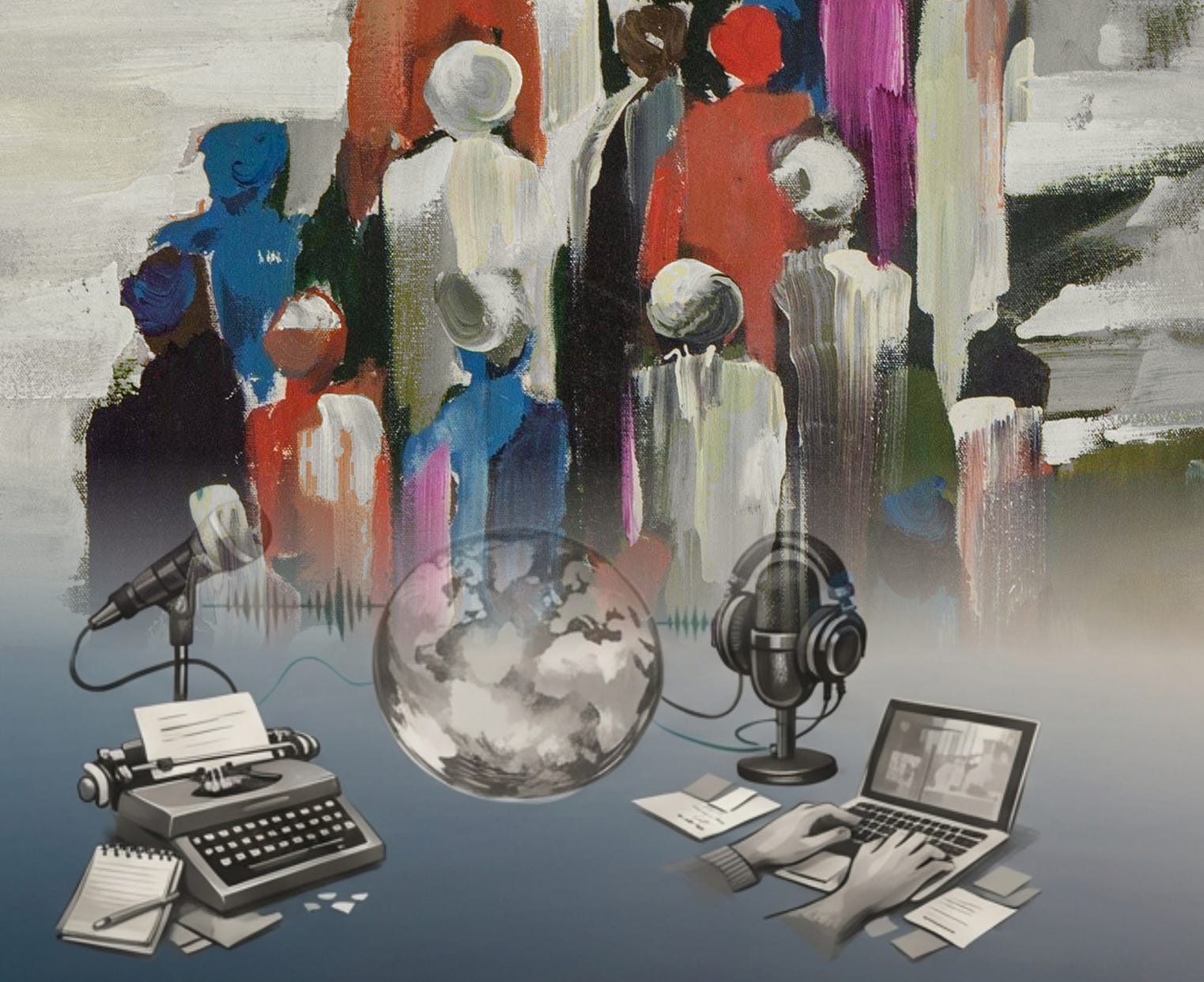
There’s a particular kind of charge that rises in a room, a heat, before anyone quite knows why, when a voice breaks from what the group has quietly been agreeing on. In Deep Democracy facilitation, we call this a hot spot. And the room doesn’t flinch. It holds the tension; it deepens the sides. It listens. It shifts. It ripples.
That is what Worldwork Journalism lives on and lives for.
Everyone who has sat in a WWJ session says some version of the same thing afterwards: something happened in that room. What that something was is never quite the same twice; it lands differently in each person, and through the writing after the dialogue this ‘something’ becomes visible, often also the first time to the person who wrote it.
Process work has always moved on many levels at once: inside a person, between people, and through the wider field around them. This report tries to do the same, turning what starts as a felt shift in the room into something that can also be read as data by people who were never there. These are two different worlds, and bridging them is the point: it’s what makes this work legible to the people whose support it needs to continue.
Worldwork Journalism (WWJ) blends process work with collective writing and public dialogue: participants step into different perspectives on a shared topic, write from inside them, and the results are published on Substack. Since the first cycle in July 2023, WWJ has run five cycles and published more than twenty-five articles, read more than 3,000 times in the past year alone, almost entirely pro bono for its first two years. Earlier this year, the International Association for Process-Oriented Psychology (IAPOP) awarded WWJ its first grant, a first vote of confidence from outside our own pro-bono circle. Thank you.
This piece draws on three sources gathered in April 2026: a community impact survey of 30 respondents, written testimonials from long-term participants (the “Elixir” group), and the full Substack analytics history of the project. The complete numbers (survey breakdown, every article, methodology) live in the full impact report, linked at the end. Here, the short version.
In April 2026, a structured impact survey went out to WWJ participants and Substack readers. Over thirty people responded within a week, from twelve countries, across all five cycles. Ninety-seven per cent said they would recommend WWJ to someone from a very different background or country, and across every dimension we asked about, from encountering perspectives they wouldn’t find elsewhere to holding tension without needing to resolve it, average scores landed between 4.4 and 4.8 out of 5. Most people who show up once don’t leave, either: nineteen of the thirty-one respondents are both participants and Substack readers; only four have never sat in a session at all.
We asked people to rate their experience on a five-point scale to get some data. And we asked them what shifted, to get a sense of their personal truth.
“I became even more aware of how something that seems minor or irrelevant for one group of people is a major issue for another. How systemic oppression is ever-present and creates walls both inside us and between us.” — Ivan, Spain
“In WWJ I could hear people from another bubble as people and understand deeply — which de-escalated my difficult emotions towards them.” — Gabrysia, Poland
“To be in touch with a global/international circle of people makes me feel as ‘one humanity on Earth’ and to ‘fall in love with complexity’. I am longing for more Belonging without Othering.” — Fabian, Germany
“The same sentence may land as comfort in one body, and as criticism in another. A pause may feel spacious to one, and heavy with meaning to someone else.” — Shirlz, Australia
“This is so unique — cultivating journalists across cultures, war zones, Global North and South. Please, more and on TV!” — Julia, Australia
Some communities are measured in numbers. Others are measured in who stays. In April 2026, ten long-standing WWJ participants from nine countries, people who have returned across multiple cycles, were asked three questions about their experience. Every single one responded within 48 hours, without a reminder.
“WWJ is one of the few spaces where complexity isn’t flattened. It stays in the heat long enough for something deeper to emerge. I return for the discipline, the community, and the reminder that systems change starts by refusing to reduce the field.” — Mildred, Kenya
“I stopped needing everyone to agree before I could act. WWJ taught me that tension isn’t failure, it’s data. I move through the world with more range.” — Mildred, Kenya
“My approach to curriculum design became more human-centric. Personally, it deepened my capacity for stillness — a practice I now integrate into both my leadership style and my life.” — Perry, Thailand
“Every time a shift happens during a WWJ session, it ripples into my everyday reality, I become more conscious of my own patterns, stories and reactions.” — Kazimiera, Lithuania
“Worldwork Journalism is a place where borders melt and time dissolves and the voices across the globe vibrate in a unique polyphony.” — Marina, Ukraine/Germany
“Through WWJ I’ve had the gift of experiencing the diversity that each role/voice brings in. A space where all voices matter and unheard voices finally get heard.” — Cynthia, Germany
Every WWJ session ends the same way: with the room's internal dialogue turned into individual writing about the personal experience, and this leads into a public article on Substack. Since launching in July 2023, the newsletter has grown to more than 200 subscribers and more than twenty-five published pieces: on political polarisation, intergenerational conflict, war and identity, elections, historical memory, hope and hopelessness. Open rates run as high as 53–66 per cent per piece, well above Substack’s own average of 44 per cent and more than double the typical email newsletter benchmark of 20–25 per cent. Each piece is polyphonic by design: many voices, one shared topic, no single narrator claiming the final word.
Three years, five cycles, twelve-plus countries, and one recurring discovery: when people are permitted to write as the perspectives that usually get talked over, not just talk about them, something in the room softens. Not because the conflict disappears, but because, as one participant put it, tension stops being treated as failure and starts being treated as data.
Ninety-seven per cent of the people who’ve been through it say they’d recommend it to someone from a completely different world than their own. In a moment when most feeds are optimised to keep people in their own bubble, that number is worth sitting with.
This past Saturday, a new group sat with all of that again, this time turning toward something most public conversation avoids almost entirely: how we relate to death, and what it might mean to let the dead stay present rather than filing them away. That article is still being written. It will publish here within the week. The report closes; the practice doesn’t.
The full numbers behind this piece, the complete survey breakdown, all published articles, and methodology are gathered in the full WWJ Impact Report.
We are looking forward to engaging with you in the comment section!
In addition to commenting, we invite you to join the conversation here on Substack regularly by subscribing. We are grateful for every comment, as it enriches our conversations and supports this tender plant’s growth.
Worldwork is an application of Processwork, also known as process-oriented psychology. As a psychological and conflict-resolution approach developed by Arnold Mindell in the 1970s, it’s based on the principles of Jungian psychology, Taoism, and systems theory, and it is used in various settings, including therapy, organisational development, community building, and conflict resolution. At its core, Worldwork aims to explore and understand both individual and collective processes to address conflicts, promote personal growth, and create more harmonious relationships within groups and communities. It focuses on bringing awareness to marginalised or ignored perspectives, as well as the deeper layers of consciousness within individuals and groups.
Cynthia Wanjihia is a passionate Process Work student as well as a Cyber Security student. She is open-minded in world work as well as inter-generational relationships, hoping to relate to all and create a safe space to feel heard and share their story.
Stephanie Bachmair (B.ONFIRE/DD Alliance) is a content creator, facilitator, leadership coach, and process work diplomat. She supports individuals, teams, and organisations in exploring and crafting their stories, telling them with impact, relating to their audience, and increasing their transformative power through dialogue and deep democracy facilitation.
In case you are interested to join the next group of Worldwork Journalists group (1 session planned on the weekend 12/13 of sept), please write to info@b-onfire.com
If you are interested in knowing more & experiencing process work, there are some Deep Democracy tevents coming up soon:
Dream Lab – monthly virtual practice space with focu on night dreams. Every third Saturday, 8–9 am (CET) - next one 15th of August.
Inner & Outer Resilience, 2-day Processwork Seminar on Inner and Outer Resilience, in Helsinki | 15-16 Aug.
Next Deep Democracy Intensive with Max and Ellen Schupbach : Swimming upwards - 7-Day Deep Democracy Intensive in Tangier, Morocco + worldwide online. From the 12th to the 16th of October. Register & find more info here.
More Writing/Reading/Podcast … B.Onfire Insights&Conversations is a separate publication here on Substack, or you can subscribe to our joint monthly newsletter.

Thanks for reading Worldwork Journalism! Subscribe for free to receive new posts and support our work.
Comments
Nothing yet. Say the first thing.
Sign in to join the conversation.