
Last time I described what I consider videogame World Design is, and this time I want to cover some of the ways in pre-production you can begin to build that stage for the game to play out on.
So if we are building the stage for the performance then where do we start? Well that largely depends on the scale and scope of the game world and the potential for that space needed.
Following are some of my thoughts and approaches on this subject ( which of course invites the disclaimer of these being my personal notes and not any representation of past or present employers )
I’ve worked on a range of game worlds from large open world to Metroidvania inspired to more linear narrative-focussed experiences. All of these have differing scales of possibility and potential required from their worlds depending on the activities they should hold and how emergent to curated the experience should be.
On a per-project basis the amount a creative direction or game direction that exists at the start of the project can vary greatly. This direction helps to inform the world or at least offer first steps or foundational principals as a starting point. If story-driven there may be significant parts of worldbuilding offered from the narrative, or if more systemic and sandboxy core game design features may offer a seed to grow your world around.
The terror of the blank page ( or theoretical empty sites ) is something I remember facing as an architecture student and later when tutoring others in architectural design even when parts or all of a brief existed. Designing in a void is a challenge so developing a toolkit of processes and approaches to tackle this when approaching initial world design is important.
Research and inspiration are of course the basic response to the need for a starting point. Especially when creating something grounded or relatable it’s the foundation for the work required.
On-site reference trips are something of a luxury reserved usually for AAA budget titles, but incredibly valuable for capturing the feel of a place that is much harder to capture through collected images. Of course not every project’s world has a real-world analogue but inspiration can often still be found by casting the net wide and exposing yourself to a range of references.
Architecture and urban environments especially benefit from extensive research and reference gathering. The details and proportions that lend realism and sense of truthful construction can often be difficult to create, especially for an art team that lacks architectural training. Keen observation of the reference is essential to pick up on those details that sell the groundedness or avoid feeling wrong to the observer, especially in more familiar places such as cities or homes. Players will experience architecture daily and this makes it easy to end up in a kind of architectural ‘uncanny valley’ where the sense of place you’re trying to achieve is missing its mark and feels off because some of the details or proportions show a lack of understanding or critical observation of how the world is built.
Condensing and editing a real place or reference can be a skill also. If you look at something like a GTA map there are many decisions on what are valid landmarks and traits of a place that should be translated into the snowglobe version of that location. It requires a lot of research into what are the visual and cultural elements that should survive through to the virtual version ( and those reference trips if based on a real location help immensely )
Reference use is foundational, and probably doesn’t warrant much more discussion, it should be good practice for most cases.
There is a counterpoint to this; there is a trap in drawing too directly from reference for layout when it comes to videogames. We have to remember that the function of real architecture is often for a different set of criteria, efficiency and functionality to that of providing entertainment in a videogame.
As an example I’d say the overuse of corridors and connective spaces in level design can lead to a problematic spatial experience for players. Depending on the gameplay it can be a hard balance to give the feeling and groundedness of a real world location while making it an engaging space to play within. It can also lead to a loss of sightlines and corridor twists and turns can lead to disorientation in the player.
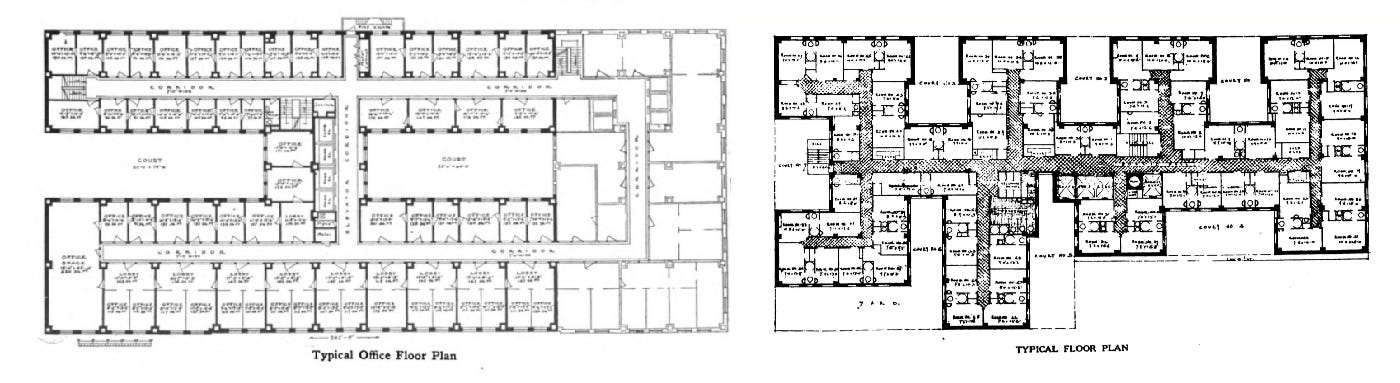
An office, hospital or government building may be dominated by corridor spines and separate disconnected room spaces, but as a location for gameplay adhering to reality may be too constrictive. Floorplans don’t always have to fit within a building’s footprint or envelope in a virtual space, whereas in real architecture a corridor may be a way to efficiently connect spaces internally and still allow rooms to utilize the more valuable external walls for light and views.
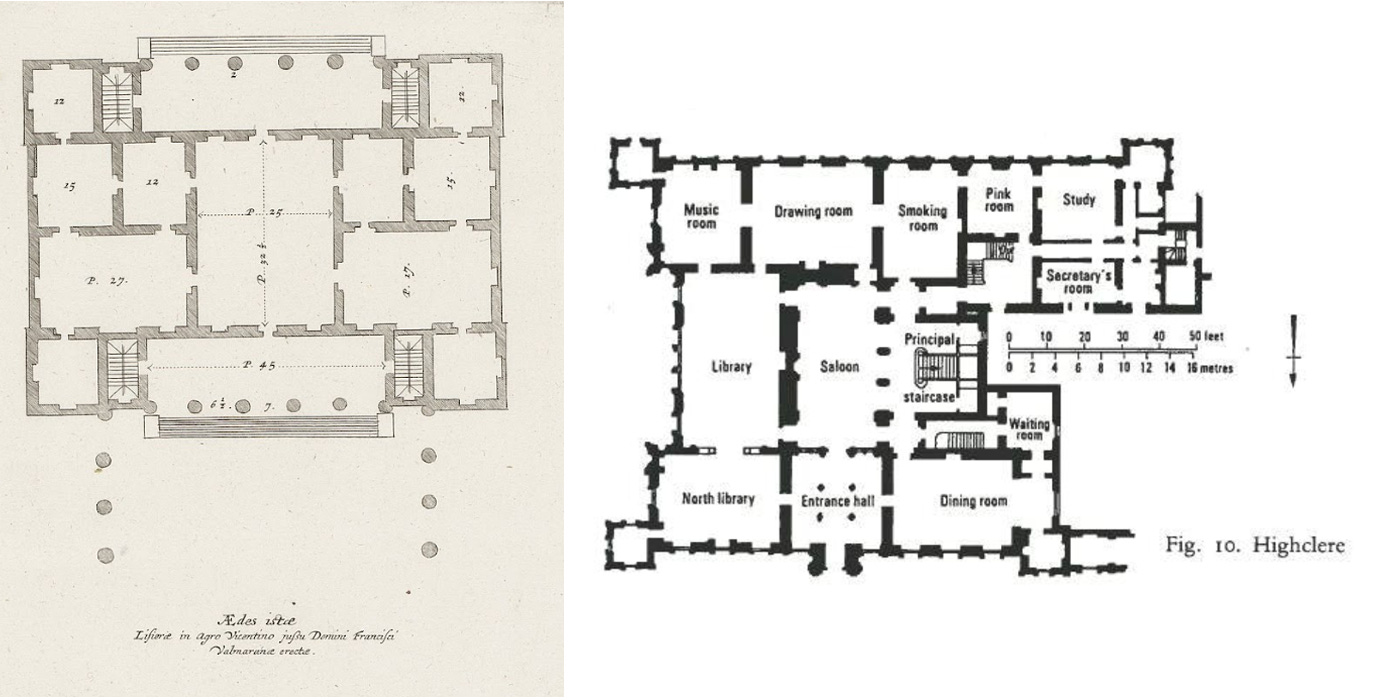
Corridors themselves are an interesting case when it comes to architecture. They haven’t always been how spaces would connect. In fact in Palladian houses or mansion designs corridors would be absent between main rooms, instead relying on direct connections so the spaces would flow into one another by connected functions. Corridors and connective spaces were used as a way to allow staff to move around the house unseen. We can apply this to level design also, using corridors sparingly to fulfill a function rather than a purely architectural feature of the plan.
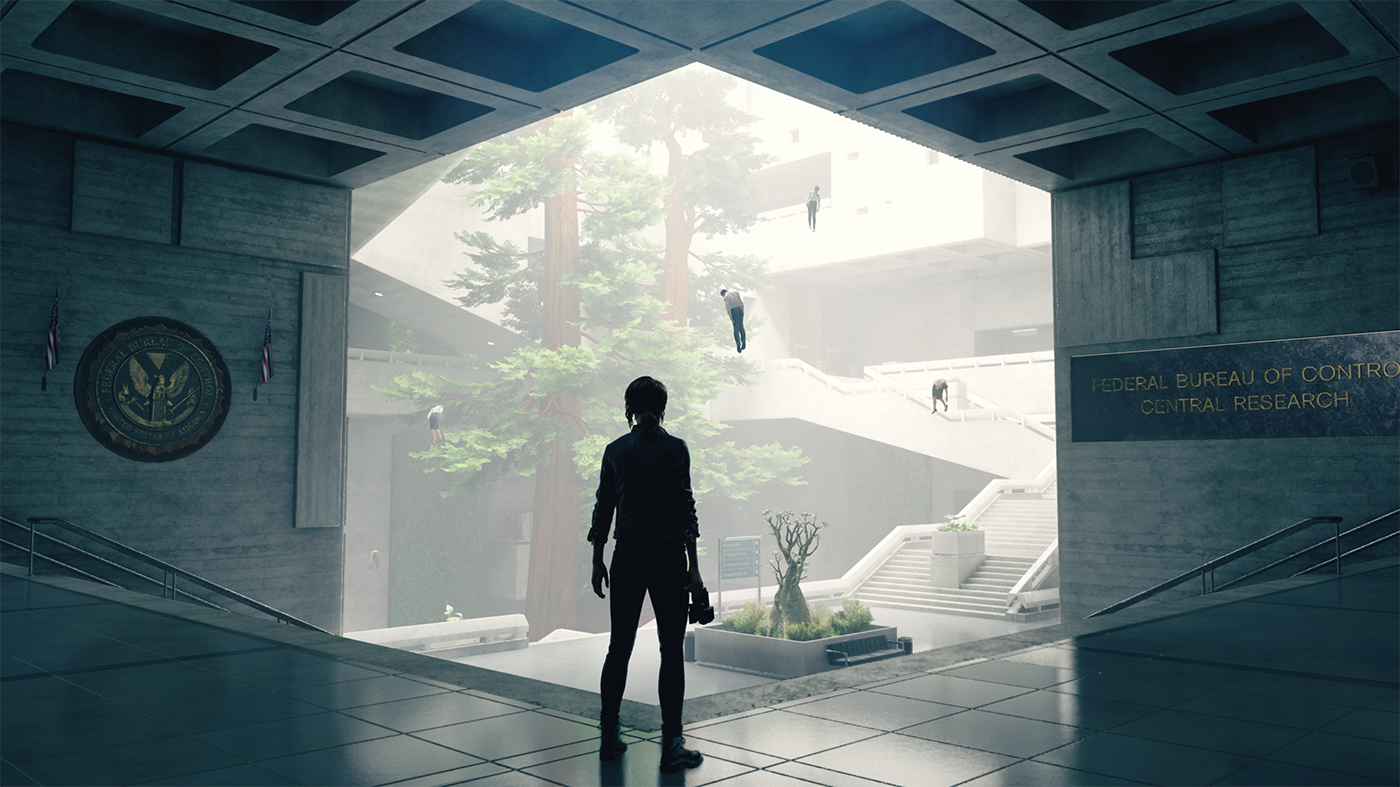
One of the projects I was involved with we partially adopted this architectural strategy as a way to decrease the amount of corridors in the world’s layout ( it was entirely set within the interior of an endless building ). Connecting spaces directly also allowed for more corner diagonal approaches ( often a more interesting way to present a space for the player and work with their field of view to survey the entire space upon entry ). Central hub spaces linking outward to other rooms would allow movement through the level with corridors used when needed for difficult connection solutions or for player control. All this helped to create a more pleasing architectural world that helped serve the player’s abilities and gameplay design’s needs for space.
Corridors have their use for player control ( approach and vista alignment ) and spatial pacing ( squeeze-and-release type staging before a larger space ) but their use should be carefully considered and weighed against the player experience.
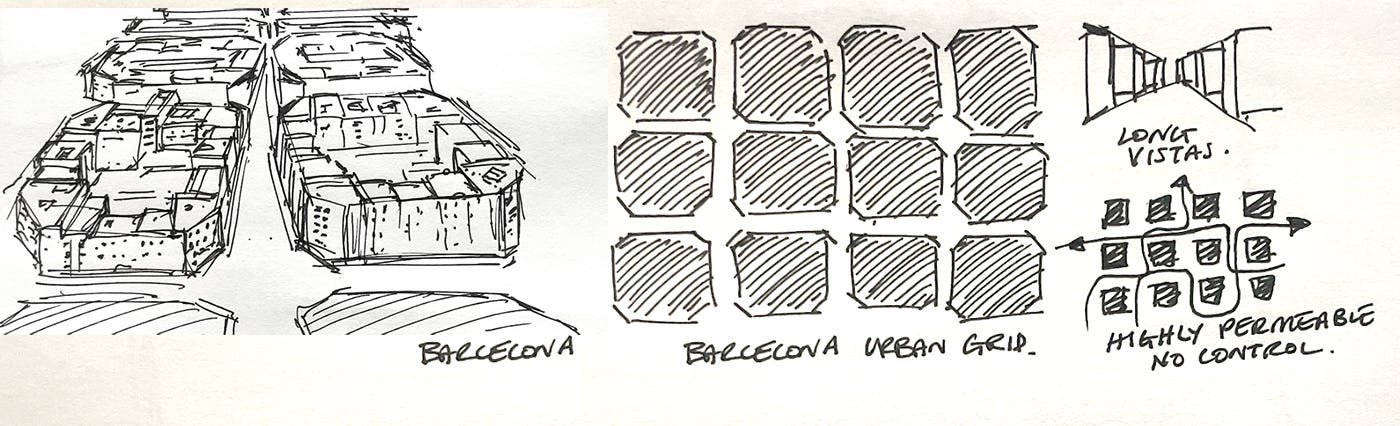
Other examples would be city grids, which though realistic create quite boring spaces to traverse for a videogame; they’re highly permeable ( great for real life cities, but lacking in potential for control and pacing for level design ) and create very problematic straight vistas ( that can cause performance issues also when rendering the world as it lacks occlusion from structures ).
Beyond reference though, what other approaches help with those first steps for overall layout?
For me it is often the relationships between places, their story and how they are structured can be additional initial steps to crafting the world design when needed.
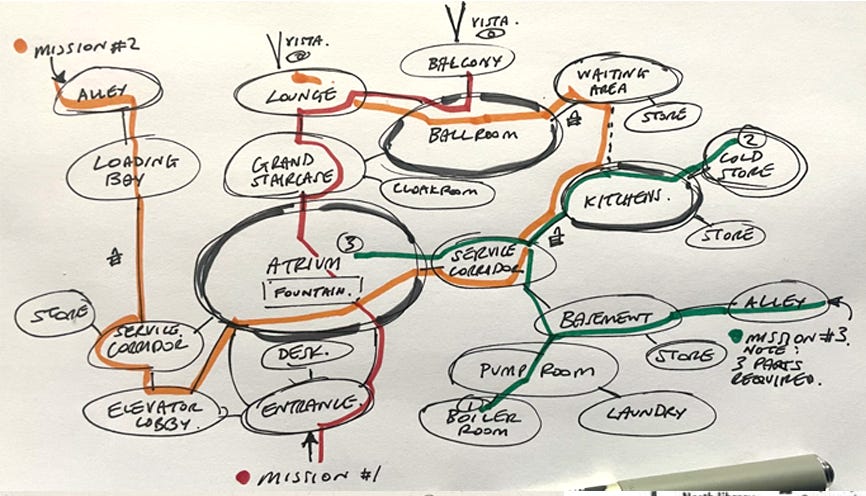
Spatial flow or bubble diagrams are often a way architects can start to build a picture of the relationships between activities or spaces that can inform their design.
I’ve used them in projects ( and architectural design ) before and in conjunction with level designers to plan the hierarchy of spaces, vistas and connections in the world. Bubbles would be scaled to reflect relative scope or importance, unique versus modular spaces marked and connections made. Vistas can be marked too to note visual as well as physical connections.
These spatial diagrams can be used to plot story or mission routes through the connections, planning efficient use and reuse of the spaces created and provide pacing cues.
Depending on the type of gameworld needed ( for example open world or metroidvania ) this will help create more permeable spaces than some of the more linear intestinal tracts of corridors and rooms that can happen if we rush straight to physically blocking out mission flows.
In fact this can be a good thing as it abstracts the level designer to focus on the flow, pacing and relationships of the space and not be distracted with the visual design of the spaces.
Of course this abstraction can also work against us here, as it is essentially 2d it becomes challenging to represent or think in three dimensions, something I will dive into another time on why working with plans and 2d layouts versus three dimensional blockout work can have pros and cons.
Those connections between the places can be important too though and not just lines drawn to link bubbles. Sometimes the space between is a big part of the experience; the classic ‘it’s the journey not the destination’. For example the distances may be defined by the method of travel in an open world game, the speed of travel and how much space for systemic or emergent experiences you wish the player to have. Think of GTA or The Witcher as good examples of this, just long enough to enjoy the travel, to get distracted or pulled by attractors along the way, but not overly long it feels like a chore. Again it’s balance; leave enough space for your roadside attractions but balance the granularity and frequency of them carefully so it does not become packed with distractions and tasks to the point a player only sees busywork and pointless padding to their experience.
Of course another starting point is through worldbuilding; that is, storytelling made physical.
There’s several ways to approach this. I am usually wary of heavy worldbuilding and world bibles, of building an exhaustive history of the world you seek to build. It’s a functional preproduction document; these things should be built with purpose and be more focussed on what those building the world will need from it ( same can be said somewhat for art bibles too ). Build more of a framework that can be robustly expanded upon where the project’s needs arise, and give the team a chance to do some of the work in taking that foundation and growing it.
When also considering your audience there is so much they can infer from what space you leave around the necessary parts of a world’s story which leads to more engagement and immersion into the world. There is no need to explain everything in granular detail.
If your world is influenced by a particular culture, the core philosophies or principles should be communicated clearly, these pillars are tools you will give the team to work with.
One approach I’ve used is to introduce a transformative device that can become a core influence over the architecture and design of the world.
The term I’ve used for this is ‘technological lore’, something that will underpin the built substance and reasoning of the world and be expressed in differing ways.
Two examples I can think of for this type of device are the automobile and the cotton mill.
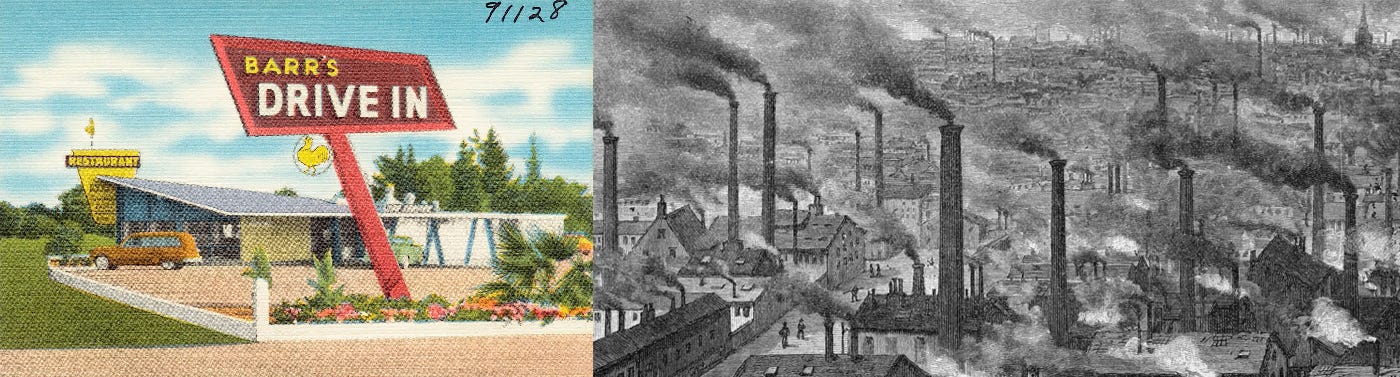
The architecture of the drive thru and drive-in cinema are examples of the impact of the car on architecture of the mid 20th century. A technology was embraced and transformative to some parts of architecture and world design ( roads supersede other travel and shrink the spaces between ). The populuxe design of Googie architecture further captured the speed and romanticism of road travel and the automobile, seen in roadside architecture such as diners and motels.
The advent of the industrial revolution dramatically altered the landscape of England forever, creating smoking forests of chimneys and mills, and workers housing organised around those.
These kinds of drivers in the world need to be persuasive and expressed in various ways to be truly effective. More than aesthetic, if it touches the activities of its inhabitants or the player’s gameplay it will help build a sense of cohesion within the world.
A common device seen in games is of course the world altering event that causes a post-apocalyptic state to the world. That too can often be attributed to a form of technological lore, be it a pervasive fantasy of cold-war 1950s atomic power ( Fallout series ) or replacement robot analogues of nature ( Horizon Zero Dawn ). These can be seen to create ranges of cultural responses within the world with their own formal expression.
This approach also has a large impact on the resources found within the world and their visual design. Depending on the game this is something that will be interwoven to the game direction and economy of the game design itself and should be a heavily collaborative effort to allow the flexibility the design team may need from what can be found or is valuable to the player and other characters and their factions.
There are more complex theories on how change impacts the world but what we are looking for is something that drives a functional and visual change that can be leveraged by both art direction, narrative and game design.
Often there will be a combination of some or all of these things I’ve covered will comprise those first steps into building the early rough shape of the world design. Making games is a complex process and balancing the needs of all the disciplines in a project for a world can be challenging.
Getting the world off to a solid start, identifying its guiding principals and structures will help ensure a successful initial foundation to the world and hopefully an effective pre-production for the project. If the pre-production gives the team the tools and world layout to work with in production then it should hopefully minimise bigger changes or additions needed later or at least be able to accommodate them without too much catastrophic changes.
No posts
Comments
Nothing yet. Say the first thing.
Sign in to join the conversation.