

Vice President JD Vance has made his objective clear. “Let me say very simply,” he announced at January’s March for Life rally in Washington, D.C., “I want more babies in the United States of America.” President Trump is all in, declaring himself the “fertilization president.” The administration worries that a declining national birthrate could undermine the country’s economy, military, and even cultural vibrancy—a concern often shaped by discredited white nationalist ideas like eugenics and the so-called ‘great replacement’ theory.
Despite these troubling undercurrents, the administration’s pronatalist agenda marches on with policy proposals like expanded child tax credits, baby bonuses, and motherhood medals. Notably absent are the supports that actually help working parents: national paid parental leave, childcare subsidies, and improved healthcare access that could lower the crushing costs of childbirth.
Critics have rightly highlighted how incentivizing motherhood without addressing healthcare gaps or workplace supports harms women, especially women of color who face dramatically higher maternal mortality rates and workplace discrimination. Yet there’s a less examined problem with this approach: these pro-birth policies might actually harm the very men conservatives claim to champion.
The dominant conservative pro-birth framework sets men up to fail – as providers, as parents, and as partners – by casting them in outdated roles in a production that no longer supports the plot. By offering motherhood medals while rejecting paid parental leave, these policies reinforce strict work-family boundaries that assume a male breadwinner and female homemaker. But our economy is no longer set up for this.
According to the Economic Policy Institute’s Family Budget Calculator, the annual cost of living for a family of two adults and one child in the New York metro area is $131,154. Yet the median annual wage in New York is only $58,560. This disparity isn't unique to the Northeast. In my hometown of rural Madison County, Georgia (that voted three to one in favor of Trump over Harris), the cost of living for the same family is $78,154, while the median state wage is $47,020. A $2,000 tax credit or even a $5,000 baby bonus doesn’t come close to bridging these gaps. One wage cannot support today’s families. And with Trump now urging Americans to “hang tough” through the economic fallout of his own tariff policies, there’s little indication this mismatch will resolve anytime soon.
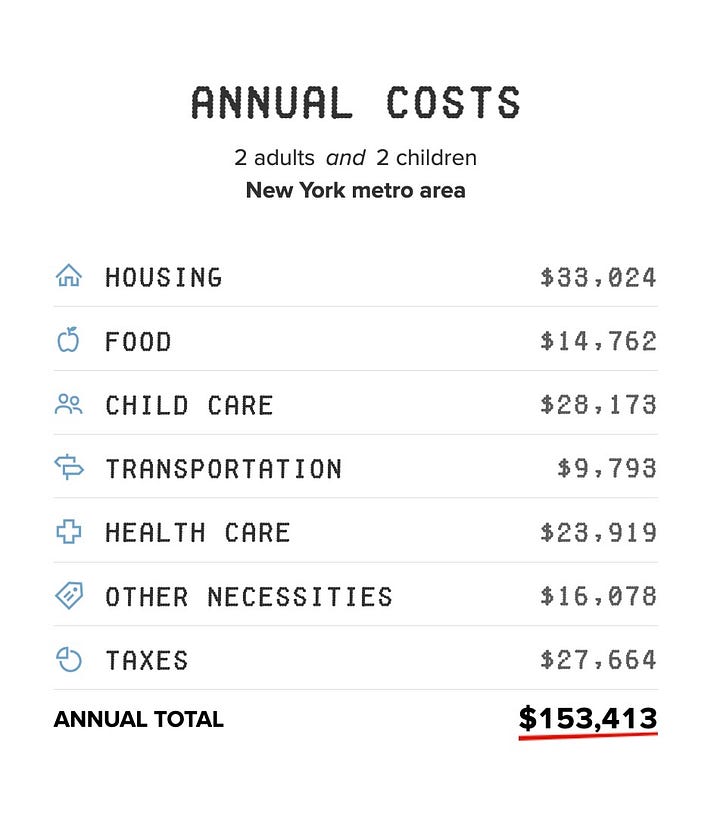
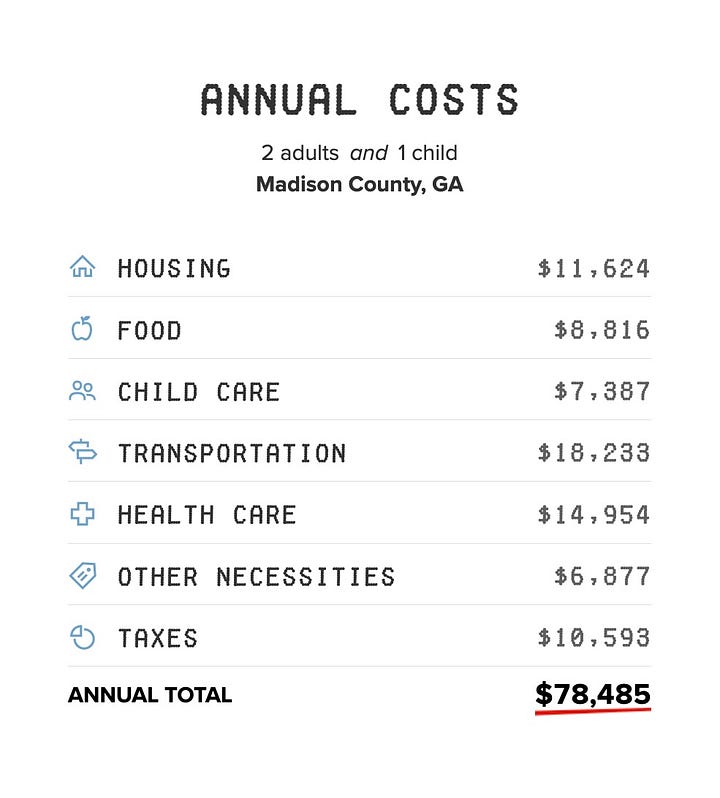
This economic reality reveals who these policies really serve. Trump claims to be an advocate for the working class, but his pro-baby agenda seems designed only for the elite. Elon Musk – formerly one of the administration’s most vocal advocates of pro-birth policies and father of 14 biological children – is literally the richest man in the world. And while JD Vance came from a working-class background, he didn’t start his family until after both he and his wife graduated from Yale Law School and secured elite careers – he as a lawyer at the prestigious firm Sidley Austin (where salaries typically start around $200K+) and later as a venture capitalist for billionaire Peter Thiel, she as a Supreme Court clerk (also known for garnering six-figure salaries and prestigious bonuses once they leave for corporate practice). All before having children.
Conservatives have long advised the economically disadvantaged to delay childbearing until they can afford it, often shaming those who don’t follow this guidance. Yet their current pro-birth push abandons this principle entirely, encouraging family formation without addressing the economic barriers they once acknowledged. These policies assume the financial security that only the wealthy possess, setting ordinary men up for the very provider failure conservatives claim to deplore.
These policies also fail to set men up to participate meaningfully in their children’s lives beyond a provider role. The absence of supports for working parents within the administration’s pronatalist agenda signals to employers that family responsibilities are someone else’s problem, empowering them to demand total devotion from workers. The administration’s backing of widespread return-to-office mandates exemplifies this mindset. When employers feel they own workers’ time entirely, they often promote overwork conditions that undermine personal health and relationships – notably at a time when many are voicing concerns about men’s loneliness and well-being.
James, a consultant I interviewed for a sociological paper on overwork, explained how the intensity of his job and frequent work travel made it difficult to spend quality time with his kids – time that research shows benefits both fathers and children. “It’s very limited time in the morning and in the evenings,” he explained. “They wake up at 6:30 and we’re off to school at 8:00. That’s an hour and a half there. Then in the evenings, I don’t know if I’m going to be home in time to see them half the time… often they’re already asleep and in bed.” As James sought to maximize time with his children, other aspects of his life suffered. “The personal life has definitely suffered. The social life has definitely suffered,” he chuckled. “It’s one of those deals where you have to pick and choose… if it’s an hour at the gym, that’s an hour I won’t be able to see my kids.”
These policies also set heterosexual men up for relationship failure. When policies treat women primarily as reproductive vessels rather than equal partners, they promote relationship models that modern women increasingly reject. The majority of women today work by necessity or choice, and according to General Social Survey data, 66% of women disagree that it’s better for men to work while women tend the home. Men embracing these traditional frameworks often find themselves struggling in the dating market, and as a result turn to misogynistic influencers who fuel their anger and further alienate potential partners.
Certainly, some women prefer traditional arrangements, but these policies fail even them. The tradwife lifestyle promoted on social media requires substantial resources: quality healthcare without employer insurance, organic food on a single income, and time for elaborate home projects without childcare support. It’s a luxury lifestyle masquerading as traditional values – one that demands either inherited wealth or a high-earning husband – the latter once again leaving working-class men out in the cold.
The greatest irony is that conservatives who claim to champion both traditional masculinity and family formation are achieving neither. By clinging to economic and social models from a bygone era, they’re creating the very male crisis they claim to want to solve. If they truly want more babies and stronger men, they need policies that work in 2025, not 1955.
No posts
Comments
Nothing yet. Say the first thing.
Sign in to join the conversation.