
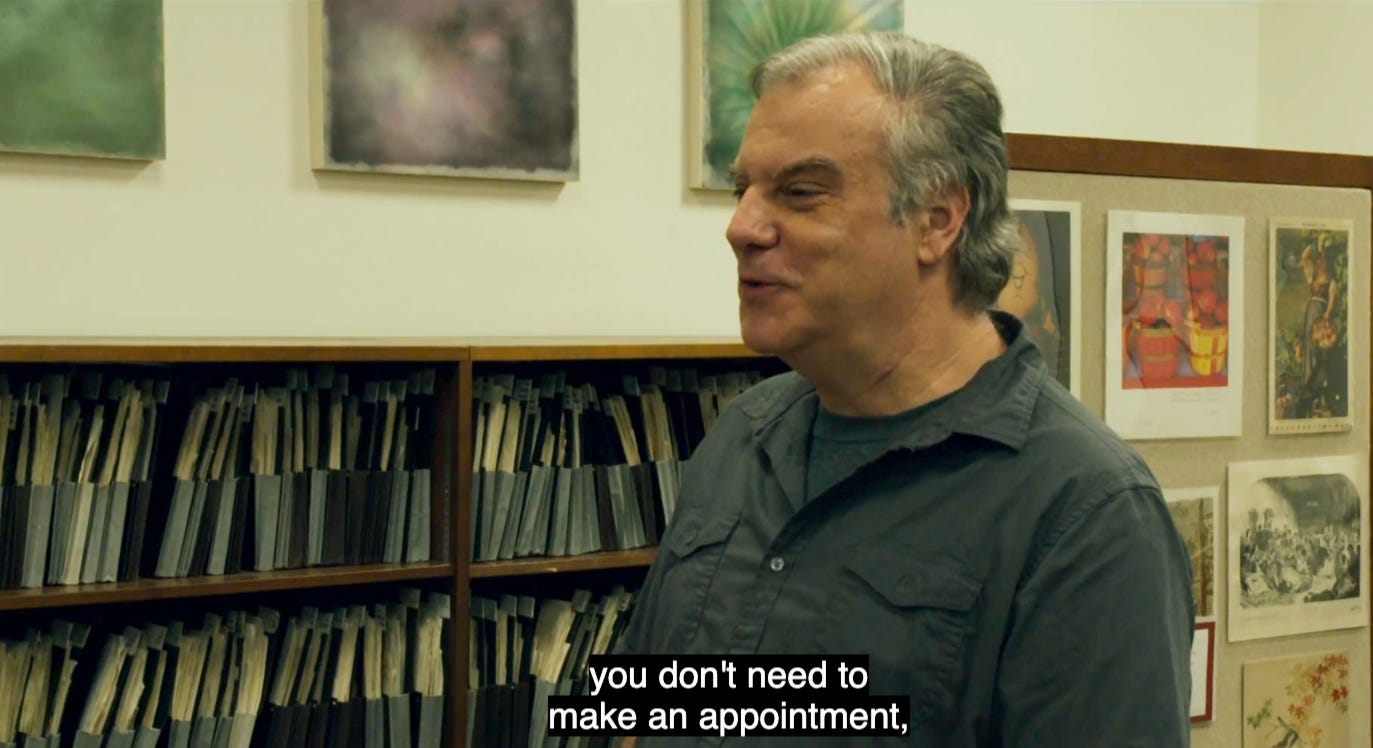
I’ve seen eight documentaries by the late filmmaker Frederick Wiseman over the past few months. The second one was about the New York Public Library, and a scene from it has really stayed with me.
The scene introduces you to the people who look after the library’s incredible picture collection, where you can walk in without an appointment and browse over a million prints, clippings and photos. Unusually, the collection is organised by subject, which makes it perfect for researchers in creative fields, such as costume design. Comb through its 12,000 subjects, and you’ll see headings like “accidents – coal mining”, “bellboys”, “gardening tools”, “New York City gangs” and “voodooism”.
London contains similar temples of research. While this publication has covered libraries, reading rooms, radical bookshops and a shop people mistake for an archive, this is my first newsletter about archives proper.
Going to an archive and requesting items from its catalogue was an eye-opening experience for me. I want to go back to every place on this list, to look at more things and do deeper research. I also found out about other archives by speaking to staff at the three that I visited for this piece, which I plan to cover too.
For now, I’ve focused on how these places work. I was initially drawn to this trio because of their distinct study spaces, and the third entry is a library rather than an archive, with one of London’s most beautiful reading rooms. I want to make more people aware of these brilliant free spaces and their collections, as well as how easy they are to access.
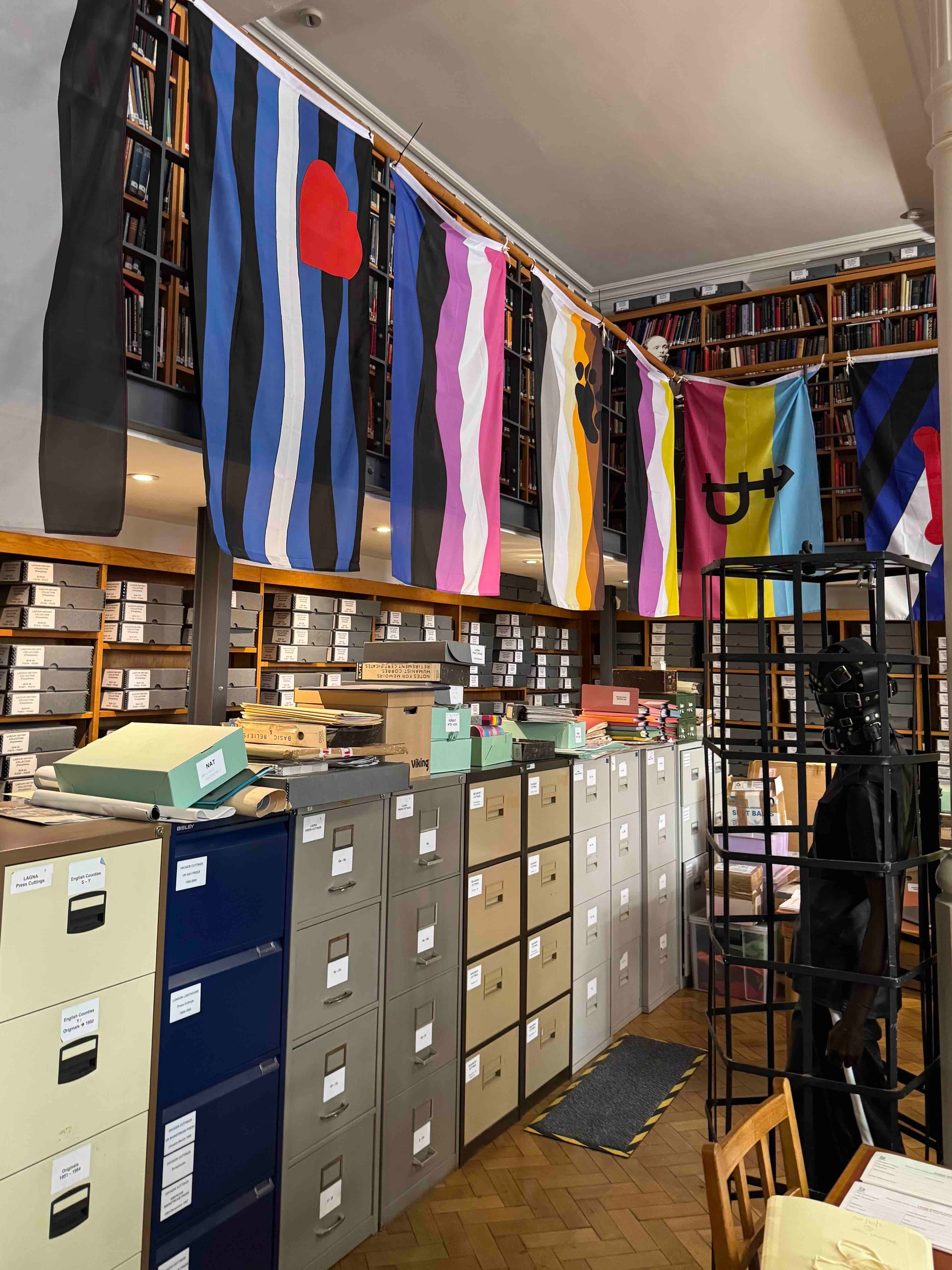
“Are you here to use the archives?” a friendly member of staff said the first time I stepped into the researchers’ area of the Bishopsgate Institute. I heard them greet over half a dozen people this way during my stay, as visitors entered this remarkable storeroom of maps, books, pamphlets, photographs and press cuttings, seconds from Liverpool Street station. Like me, none of them had booked in advance.
The hundreds of thousands of items in this collection relate to everyday people, as well as “individuals and organisations who have strived for social, political and cultural change.” This involves a lot of London history, so it’s basically my dream place. You can also find material about protest, feminism, socialist history, LGBTQIA+ history, the co-operative movement, the British fetish community and more.
The Bishopsgate Institute makes me feel optimistic about London. And as an operation, I was particularly impressed by how unstuffy it is. Staff talk you through how things work in a relaxed way. They’re happy to guide your research and answer your questions, of which I had loads. It’s an open-plan space – you’re in their office really – and you hear them joke around together as they work.
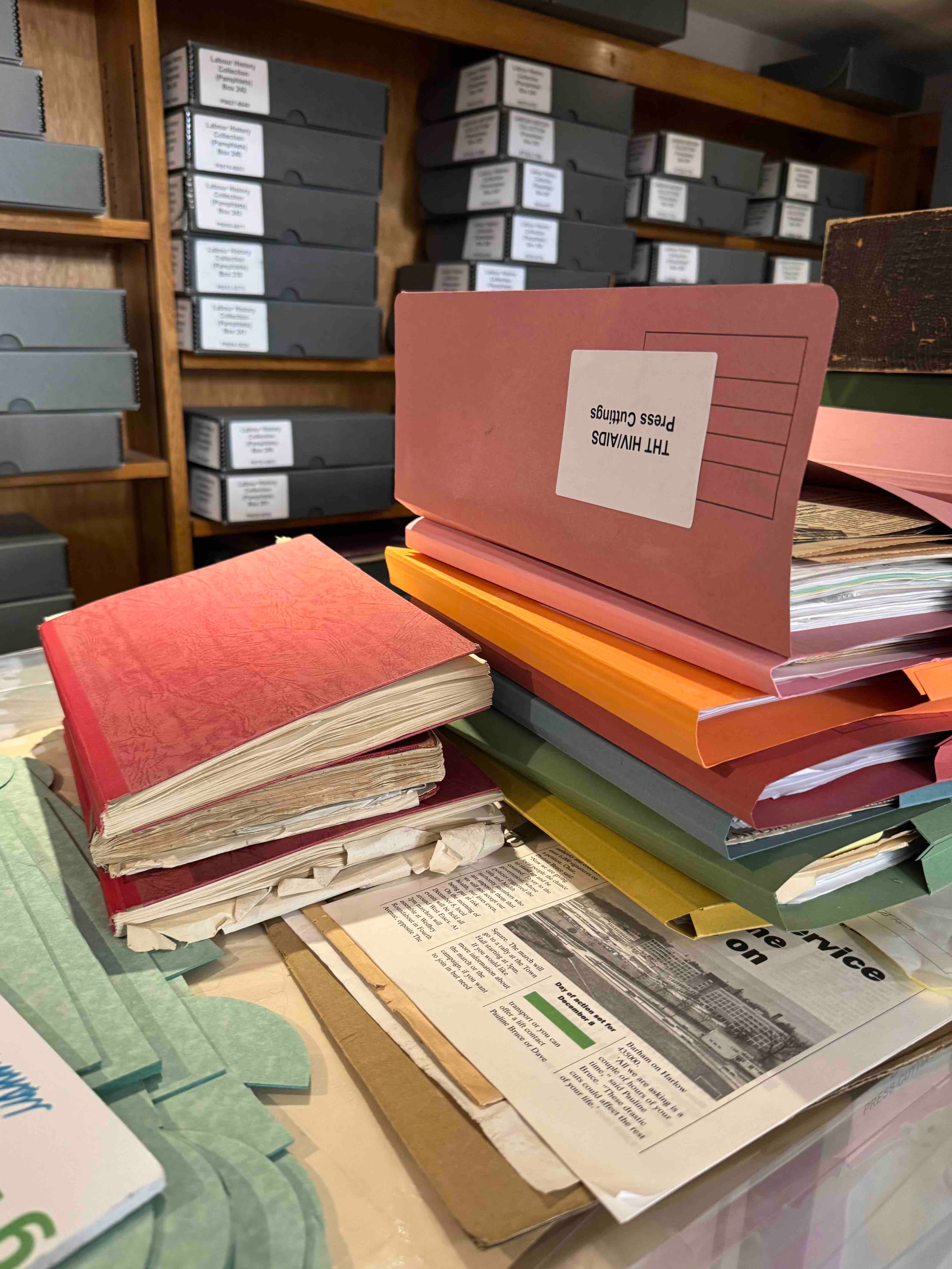
Rather than browsing its shelves, you find items here by searching the online catalogue and filling out a request by hand. On my first visit, I typed in “restaurants” and came across a pamphlet from 1943 assessing the community value of British Restaurants, the state-run canteens rolled out during World War Two. I made a request for that, as well as a 10-year-old paper bag from St. John Bread and Wine. When I handed over my request forms, I was surprised to find that staff retrieve the items for you immediately.
As this was happening, I was shown to a researcher table, surrounded by boxes, filing cabinets, a Tom of Finland cutout and a caged mannequin wearing a bondage hood. Shortly afterwards, a member of staff came over with the British Restaurants booklet, which made me realise that local government departments used to publish quite zine-like items. The St. John bag came in a paper folder, tied with a white ribbon.
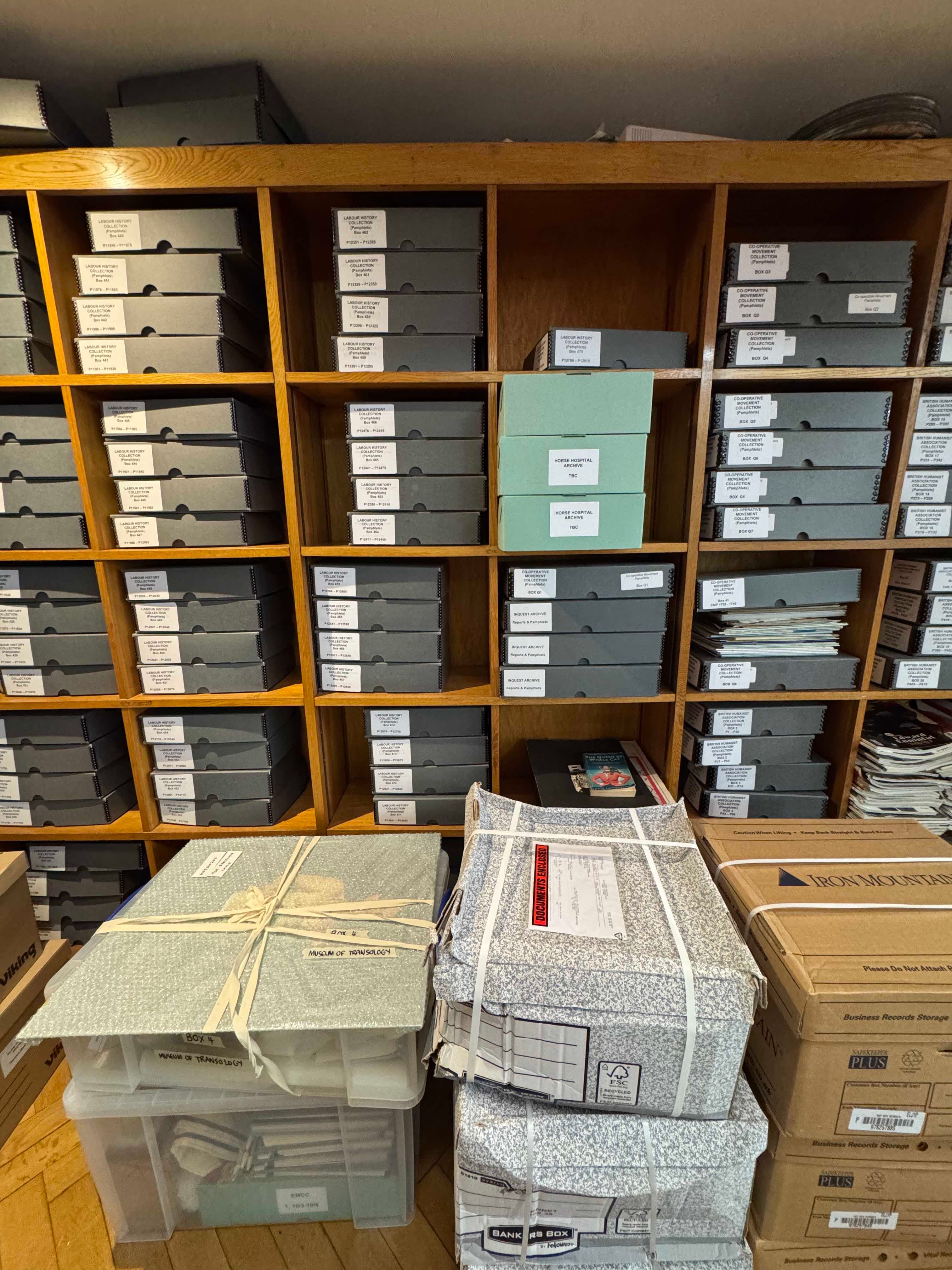
While I was there, a younger person came in to use the researchers’ area as a workspace rather than for its collection, and was politely turned away. The institute does have a dedicated reading room, but unlike the researchers’ service, you need to book to use it. These two spaces are only small parts of this fantastic Victorian complex. The Bishopsgate Institute puts on social dances, acts as a wedding venue and even hosts exams. As I left, I passed a hall laid out with reclining chairs, in which people were giving blood.
230 Bishopsgate, London EC2M 4QH
MayDay Rooms is next to London’s most beautiful church. The archive technically wasn’t open the day I visited, as staff were doing a big sort-out, which they’d announced on social media and I’d missed. But they still invited me up to floor two when I rang the buzzer, and a member of staff kindly showed me around anyway.
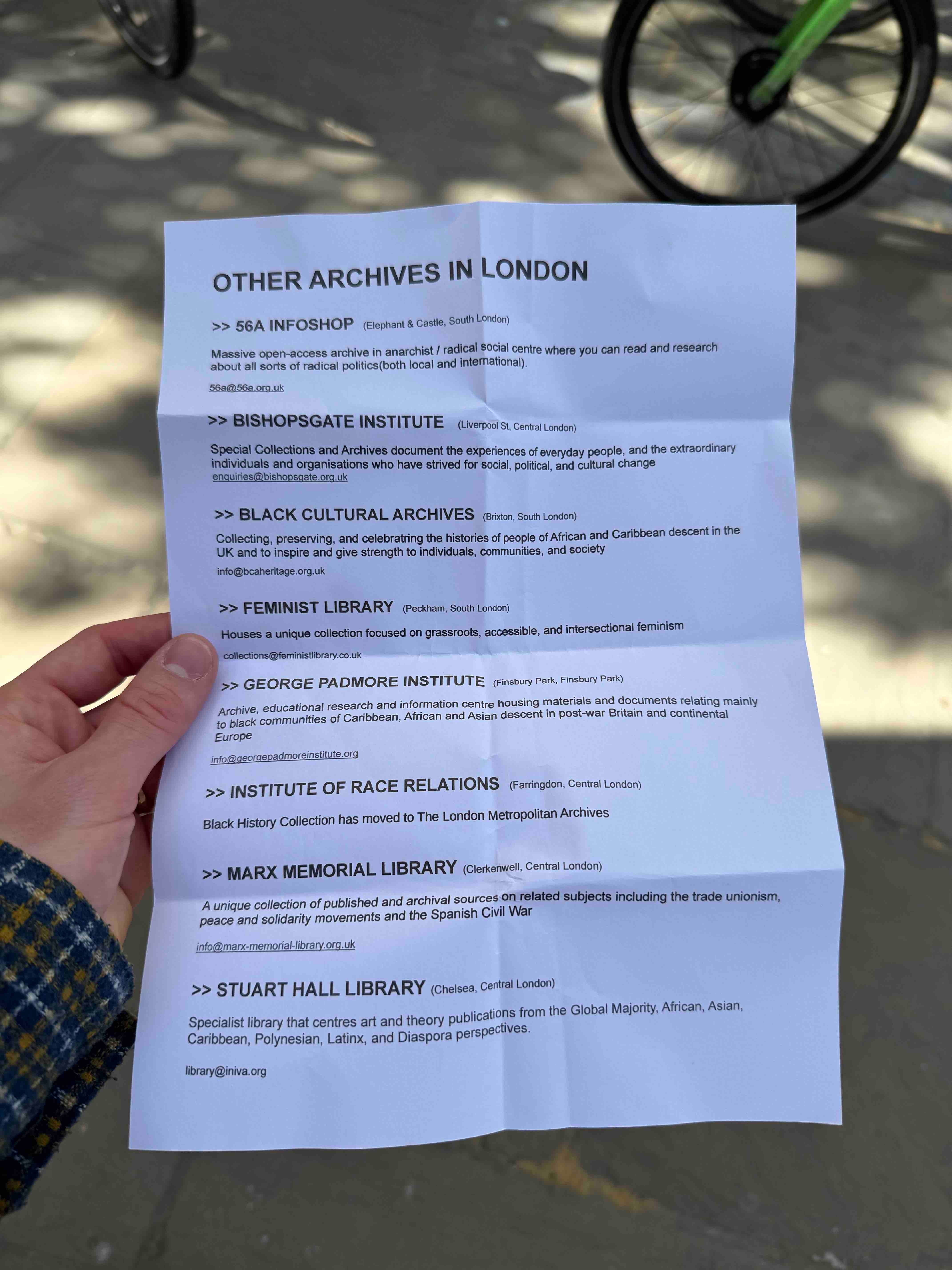
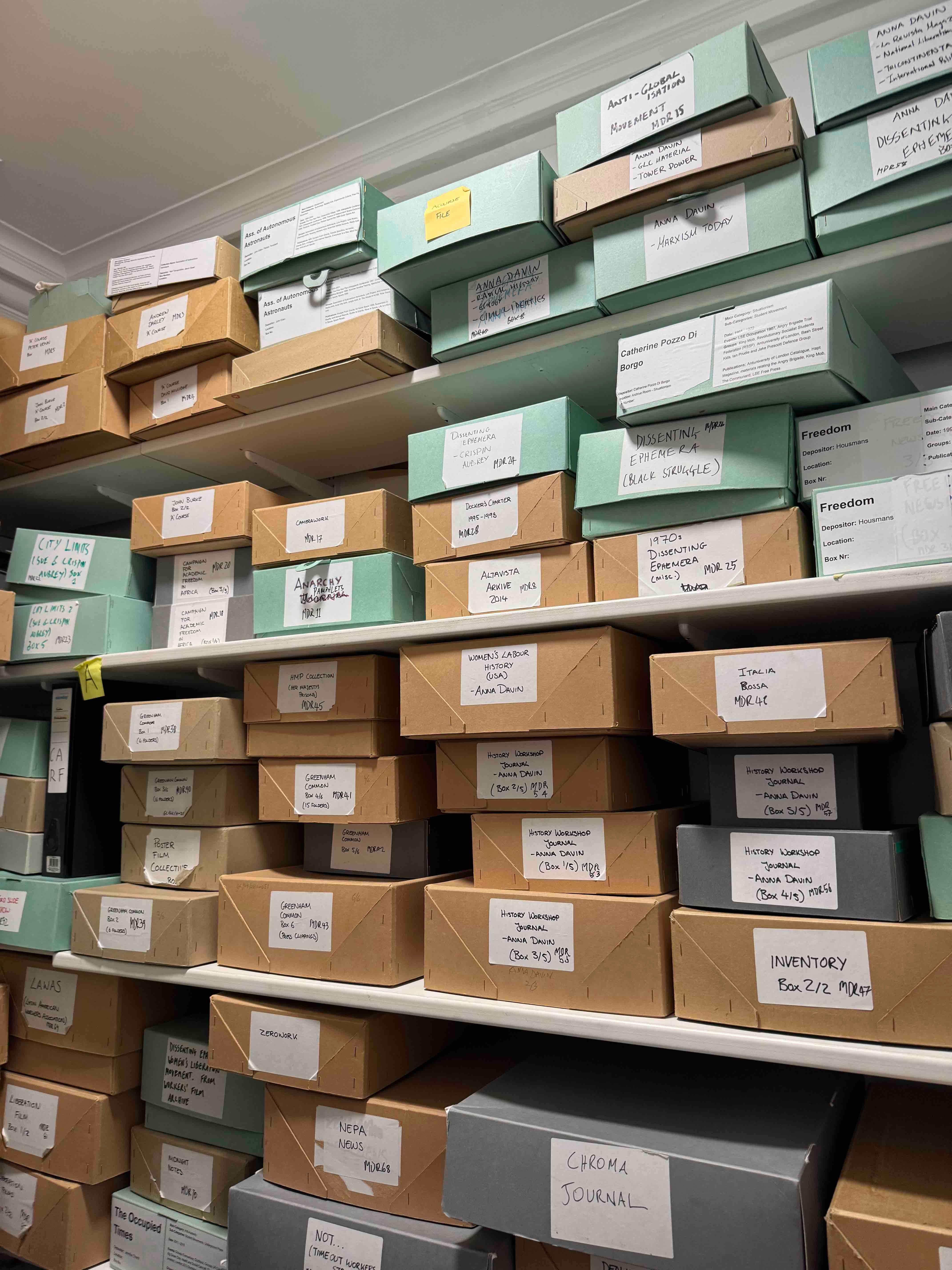
When I mentioned that I’d been to the Bishopsgate Institute the day before, he gave me a list of other archives in London. I remarked on 56a Infoshop and he said, “definitely check that out.” This guy then took me into a cupboard full of grey, brown and teal boxes, which seems to form the bulk of the collection. These boxes had labels like “LAWAS”, “poll tax rebellion” and “London Psychogeographic Association”. MayDay Rooms’ collection focuses on social struggles, radical art and acts of resistance. It goes beyond printed matter to include buttons, t-shirts, moving images and audio recordings as well.
After that, the guy took me to the meeting space downstairs, which is available at no charge to unfunded groups involved in radical political organising and/or radical self-education. I mentioned that I’d been to an event where someone from 56a Infoshop read his Vittles piece about food in squats, at which point I realised that this member of staff was that very person. We spoke more about the history of MayDay Rooms, the funding it receives from the Sainsbury family and how the archive works.
He downplayed the catalogue’s searchability, but it looks like a decent enough system to me. It sounds even more informal than the Bishopsgate Institute: you just say what you’re interested in and someone gives you boxes to look through. I love that you can also just show up here without making an appointment, as I did.
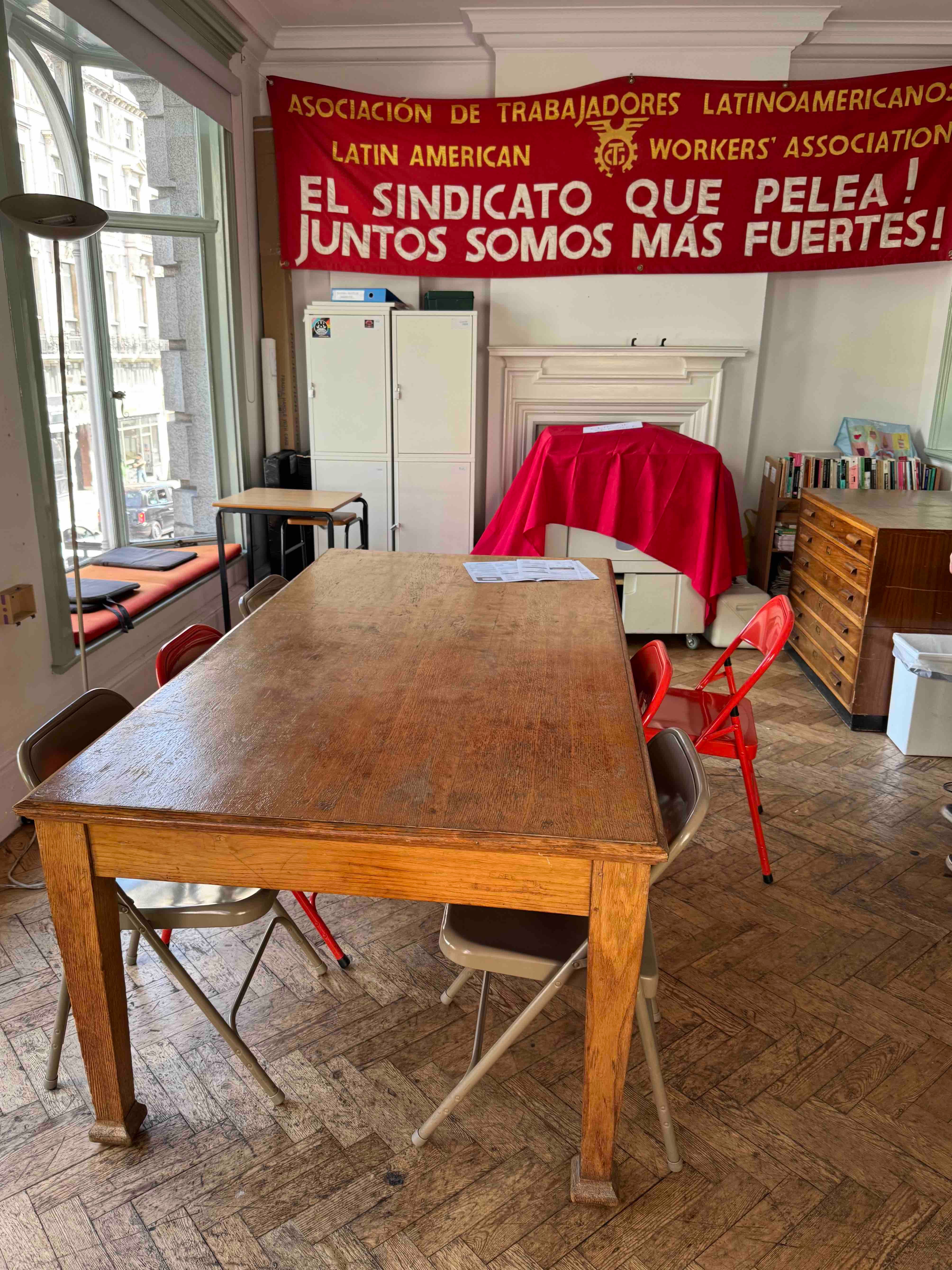
Reading up on MayDay Rooms later, I was struck by its fairness and transparency, as well the other facilities available. All PAYE staff are paid the same rate, regardless of the type of labour. The meeting space is open to funded groups and non-political organisations; there’s a screening room and a communal kitchen too. I can’t wait to go back and request some boxes to rummage through.
88 Fleet St, London EC4Y 1DH
Comments
Nothing yet. Say the first thing.
Sign in to join the conversation.