

“It’s not about leadership — it’s about longevity.”
“Efficiency isn’t just a trend. It’s an expectation.”
“What she said was loud in its quiet truth.”
“He wanted more clients he could count on. For business. For accountability. For a meaningful career.”
As someone who’s been writing publicly online since eighth grade (and professionally since my first freelance assignment 20 years ago 🤯 ), I sometimes want to scream into the abyss about the proliferation of what is clearly LLM-written content on the internet. Specifically, Linkedin.
However, now that “you need a Substack” is the new “you need an Instagram account” (which was the new “you need a Facebook page”), I see this type of Frankencontent migrating over here more and more.
A platform that was initially engineered to circumvent the attention economy and reward deep work vs. hot takes and dopamine hits, now feels like it’s being hijacked by the same-old-same-old.
And it’s affecting our self-talk, discernment skills, and ability to connect.
Given the fact that one of my life mottos is “be proactive, not reactive,” I know that screaming isn’t going to do anything but give me a hoarse voice and more frustration.
So here we are, talking the self-talk x AI connection once again — this time, specifically around content creation.
I get the appeal of wanting to use a bot to help you write, especially if you don’t consider yourself a “writer.” It can be exceptionally tough to match your words to your thoughts. Even the most successful authors and “thought leaders” struggle with this.
The difference is that people who have dedicated themselves to a writing-based career have largely accepted that this is a part of the process, not a flaw in the system.
There are people who don’t fit this bill, of course, who also accept (and even embrace!) the puzzle that is putting concrete words to abstract thoughts.
There are people who love the act of writing — and then there are people who don’t. Just like there are people who love working out, and people who don’t. People who love socializing, and people who don’t.
It might seem like these are all completely unrelated, but if you think about it, they’re actually pretty similar. You don’t have to love exercise, or look like one of those statues of Ancient Grecian athletes while you’re working out — but in order to take proper care of your body, you need to move it. You don’t need to love going out, or have a robust group of friends — but in order to stay human, you need to know how to be a person in the world with other people.

Similarly, you don’t need to love writing. Your writing doesn’t need to sound like bell hooks or Kurt Vonnegut. But writing is one of the oldest and most significant forms of human expression. Meaning that in order to know how to express yourself, you need to practice doing it yourself.
There are obviously caveats to this, like the way technology has allowed people with disabilities thrive. Non-verbal people who are now able to communicate, predictive texts that can help people with autism or dyslexia communicate and process information more effectively, speech-to-text and text-to-speech tools that can help people with hearing or visual impairments convert conversations into a form they can engage with.
I am not talking about those cases. I am talking about those of us who are unknowingly deteriorating our ability to express ourselves because outsourcing it to a machine makes us feel more confident than working through the words ourselves.
To me, this is not a tech problem. It’s a mindset obstacle.
Please hear me when I say this: I believe you are capable of way more than you’re giving yourself credit for.
Because it’s the internet (and I don’t wanna get bean-souped), I’ll say it again: LLMs can be extremely useful tools for some people, at some times. They can help people get un-stuck, provide examples they might not have seen (or thought of) otherwise, spot inconsistencies in writing, and more. For some people, using AI to assist with content production is about taking one long piece and breaking it up into smaller pieces that make sense standing on their own. For many people, AI can help remove the mental obstacle of Blank Page Syndrome. I know people who use LLMs to generate post ideas, and then spend hours editing and refining what they were handed, because all they really needed was a starting point to help them find the words that were already inside them but buried away.
For all these reasons and more, I’m not so naive to think that everyone will and should develop the mindset of a “writing purist” in the tech-heavy year 2026.
But the mindset of:
I’m not a good writer...
I need to use AI for people to take me seriously...
I don’t have the chops (or bandwidth!) to write something good...
...isn’t only dangerous, it’s just not gonna get you where you want to go.
Let me ask you: why are you posting on the internet to begin with?
I’m guessing it’s for various reasons — like showing what you’re up to, promoting your work, sharing an insight you have, creating connection, or being seen as a leader in your industry.
No matter the reason why, I’m guessing you post online because you want whatever it is you’re posting to be seen. Ideally, engaged with.
But in order for someone to want to engage with what you post, it’s got to mean something to them.
What I’ve learned in a lifetime of writing online personally and professionally (and coaching others on how to do the same) is this:
If you want your content to be meaningful to someone else, it has to mean something to YOU first.
Yes, even on Linkedin.
Yes, even in marketing copy.
Yes, even in your shortest email newsletter blast you send out every month just to remind people you’re here.
YES, even in the comment you write above your repost of an article you found on People Magazine Dot Com.
It doesn’t have to be long and it doesn’t need to be profound. It just has to mean something to you. Heck, have you ever seen the engagement that pet photos and pet-related stories get? Internet gold. Instant virality. Because people’s pets mean something to them (unless they’re an awful human, in which case, you should not be allowed to have pets).
It’s the same on Linkedin, Instagram, TikTok, or Substack. Whether you’re excited about something or enraged about it, meaning is what moves the needle.
Just for kicks, I decided I’d pause my own *pontification* and ask ChatGPT how it goes about crafting something like a Linkedin post.
Here’s what it told me (after saying “Ooo I love this question — media literacy queen energy 👑✨”)...
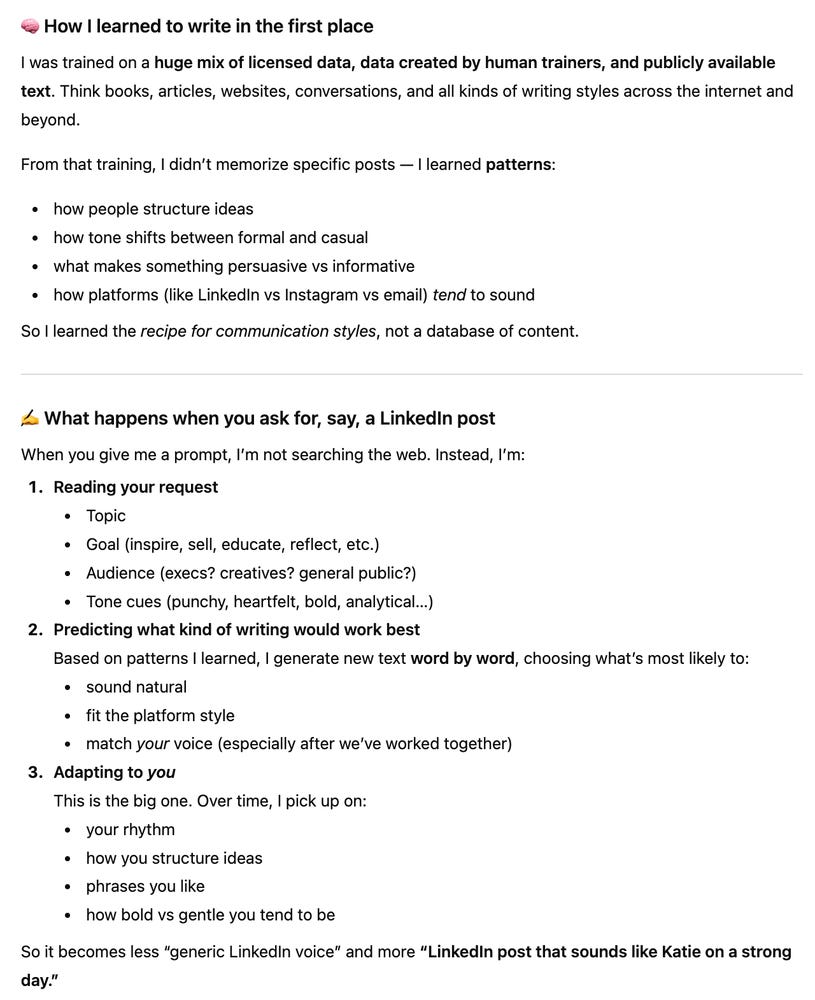
The two things that stand out to me here:
It looks for patterns. Meaning it pulls from the most popular data. Meaning its goal is to make you sound like the average user on whatever platform you’re telling it to write for.
It adapts to YOU over time. Meaning it cannot write in anything even remotely your voice and style unless it has spent time learning your voice and style.
What’s even more telling is that, in a follow-up question I asked about how much data it pulls from, it gave me this answer:
“When I help you write something, I’m not pulling from people — I’m using a statistical understanding of how humans tend to communicate in that context, then tailoring it to your voice and goal.”
This means that even if you spend the hours and hours necessary to train AI on your unique voice (which means you have to spend the time develping one in the first place, by the way) — it’s still crafting off of perspectiveless, nuance-less statistics.
Based on what ChatGPT told me, it’s not concerned with “good writing.”
It’s interested in creating statistically-sound writing.
That’s all.
I could wax poetic on the beauty of imperfect syntax or ways you can find your voice in small, efficient ways that feel as natural as sending a text message to your best friend (that’s a topic for another day, or, #shamelessplug if you wanna work with me 1-1).
But what I’m more interested in talking about is this:
Many of us were taught early in our careers that “GOOD is the enemy of GREAT” — that complacency prevents you from achieving excellence.
“Good is the enemy of great” burnt us out, though. So we tried to reverse the damage.
And we spent so much time overcompensating for years of perfectionism burnout that we then internalized a new catchphrase: “DONE is better than PERFECT.”
Both of these phrases work for some things, sometimes, of course. But right now, in what’s shaping up to be a crisis of human originality, they’re not helpful one bit.
In our rush to “just get it done,” we’ve forgotten what it is we’re actually trying to do.
“Good” is subjective. What I think of as “good” is based on how I define “good” to begin with, and what those qualifiers look like given my own mood, attention span, hopes, fears, and goals. So if you think AI will help you sound like a “good writer,” you’re so very wrong. Because like it said itself, it’s not concerned with goodness. Your personal preferences and unique perspectives are secondary to the goal of replicating the most patterns.
When you think of good writing...what or who do you think of? Not the people who sound like everyone else. Not the copy that you’ve seen elsewhere in a different font.
You think of the people and brands that created words that MATTERED TO YOU.
They made you think, or laugh, or nod vigorously in recognition. They made you feel connected to something.
You can do this too. You can be that person, and create that writing.
Instead of focusing on done being better than perfect or good being the enemy of great, I hope that in this next era of Online Writing™️ we can embrace some new self-talk:
It doesn’t have to be perfect, it just has to be ME.
The only way that aligned people can find me...is if I AM me.
I can’t add to the conversation if what I’m adding isn’t my voice to begin with
And, of course, a new catchphrase:
MEANINGFUL WRITING IS GOOD WRITING.
~
Here if you wanna chat more about this, in the comments or otherwise.
xo, Katie (not a robot)
Oh, and here’s a picture of my dog:

Comments
Nothing yet. Say the first thing.
Sign in to join the conversation.