
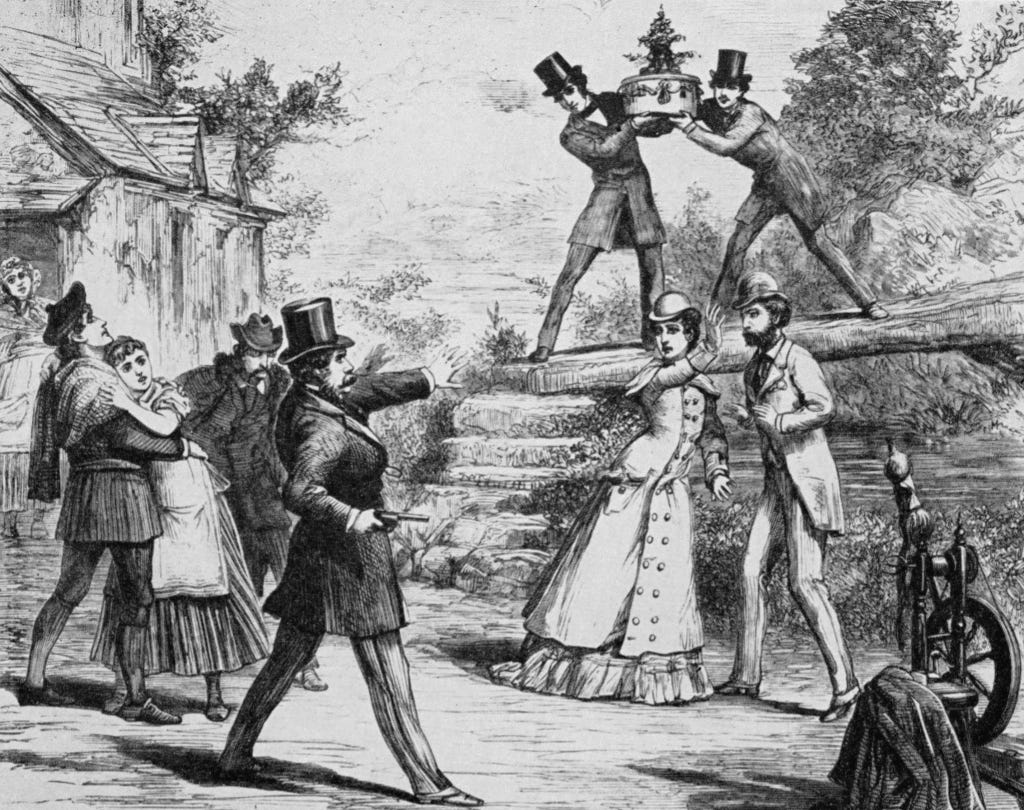
In the distant days of Roosevelt,
When the USA's full force was felt
From shining sea to foreign shore
In the dismal days of the Second World War;
They devised a nuclear implement
That on Nippon's homeland twice was sent
'Till the foreign devil's doom was spelt,
Back in the days of Roosevelt.
THE ACTING PRESIDENT;
OR, THE KING OF CARTHAGE.
A comic opera in two acts.
Written by Kendall Weber and composed by Warren Schweppes.
Produced by the Ouachita Strolling Players, with permission of His Majesty’s Royal Opera Company, Hot Springs, K. Ozarks.
Proprietor and Manager: Dan McShane.
In this new and original comic opera inspired by the works of Gilbert and Sullivan, we invite you to come and follow the exploits of John Goodbody, a state librarian from the metropolis of Carthage, Alabama, the capital of the United States of America (Population: 1,000). Goodbody is hopelessly infatuated with Venessa Vernon, the daughter of Victor Vernon, the tyrannical Acting President of the United States.
In trying to pursue her, Goodbody follows a curious course of events that reveals that he, and not Vernon, is in fact the rightful President. The unwitting statesman suddenly finds himself at the head of a conspiracy to depose the detested despot.
Sponsored by Monticello Premier Cutlery Co.
The Shangri-La Examiner. Wednesday, July 27, 2059.
Shangri-La, the shining beacon of Midwestern civilization, is all abuzz with talk of The Acting President, the newest piece in the growing repertoire of the Ozark-based operatic duo Weber and Schweppes. While unruly westerners pollute the airwaves with X-Ray dross that says little with a whole lot of effort, our autocratic eastern neighbors have made no small effort in providing genteel yet whimsical theatrical entertainment that is suitable for viewers of all ages. The operetta—which can be likened to a Broadway-style musical—premiered at the Shangri-La Performing Arts Center last weekend, and has received acclaim and criticism alike from spectators.
The Acting President, in the words of Weber’s progenitor W.S. Gilbert, “blends instruction with amusement;” it serves not only as a musical comedy, complete with love plots and frantic “patter-songs,” but also as a sharp piece of political satire that points fingers squarely at the Dodge City Convention. The work mocks the Dodge City government’s pretentions of ruling the entirety of the former United States of America and alleges that their political system is even more authoritarian and abusive than the regime of Ozark autocrat “Mad King” Malcolm, despite flouting the airs of star-spangled democracy. The piece’s harshest critics allege that it is no more than a piece of monarchist propaganda straight out of the Hot Springs state department—a charge that’s hard to dodge, considering Weber & Schweppes’ reliance on generous patrons from the Ozark nobility.
Not only does this debate continue to grow stronger, but it has left the music halls for the grand political arena of Government House. The Promethean question has long since dominated the floor of the Legislative Council, ever since it was proposed by LegCo Member Dallas Stacks. If passed, Stacks’ controversial bill would sell 25% of the state-run Shangri-La Petroleum and Natural Gas Corporation to the Dodge City branch of Promethean Energy, a petroleum titan closely linked to the Dodge City government itself. Opponents of the bill are concerned that it would surrender Shangri-La’s sovereignty over to Dodge City and rope them into an unnecessary war against the East Kansas Jayhawkers. These dissenters made their opinions clear through the brutal attack on Stacks’ life outside his own home, which left the Legislator in a critical condition from which he has not yet recovered.
Stacks’ political allies suspect foul play, and are pointing fingers at foreign agents. East Kansas seems the likeliest perpetrator, but some are wary of the New Tulsa Evangelicals and the ambitious Ozark Kingdom. What ties this issue to The Acting President is the startling intersection between the opera’s premiere and the police’s ongoing investigation into Stacks’ attackers. Last night’s performance was attended by several high-profile state visitors from the Ozark realm: Dean Sutton, the “Duke of Jonesboro” and one-time Acting Governor of Arkansas (Jonesboro Government), and Josh Rector, the Ozarks’ Assistant Secretary of State and head of the Bureau of Oklahoman Affairs. These blue-blooded officials brushed shoulders with Shangri-La locals in the coveted box seats of the Performing Arts Center, watching the night’s entertainment when police arrived upon the scene. A statement by the SLPD reports that witnesses identified Stacks’ attackers in the PAC that night. The police search failed to turn up any suspects, but it did disrupt the Strolling Players’ performance of Cox & Box as their afterpiece. The Ozark delegation departed shortly afterward, ushered out by curt apologies from the police. Mr. Sutton declined to give any comments to the Examiner.
With simmering tensions on the Arkansan frontier, a pro-Dodge City LegCo Member crippled for life, and criminal disturbances at a major Ozark-sponsored cultural event, one cannot help but wonder what Hot Springs’ role in all these occurrences may be.
The Shangri-La Family Companion. Saturday, August 1, 2059.
Much can be said about the satirical themes of Weber & Schweppes’ comic opera The Acting President, and still more can be said of the political intrigue surrounding its introduction to Shangri-La. It was with great pomp and circumstance that the Ouachita Strolling Players—a second-rate musical troupe by the standards of Hot Springs, yet a star-studded ensemble for Shangri-La—introduced the work to us last weekend. I would have preferred to have seen the Royal Opera Company perform it in Hot Springs, or even to have heard them on the radio. The latter option may soon be feasible for the people of Shangri-La, as “Mad King” Malcolm’s 7/31 broadcast demonstrated that the Ozarks’ Royal Broadcasting Service can now extend its range into neighboring states. That such a biting geopolitical hit piece was premiered so close to the 30th anniversary of the Great War says much about Hot Springs’ ambitions and the potentially volatile actions they will take to increase their soft cultural power over the central United States. But, as a music critic and a lover of grand opera, comic opera, and classical music, I will undertake to overlook the political drama and focus only on the strength of Weber’s writing, Schweppes’ composition, and the performance of the Strolling Players.
The operetta’s greatest merits lie in Schweppes’ composition. His craft has improved greatly since Cajun Magnolia, his previous composition. The Acting President contains Schweppes’ most brilliant and subtle work yet. His usage of leitmotifs is far richer, his harmony is on point, and the Ballet of the Russian Submariners towards the end of Act II puts the Hot Springs Royal Ballet to shame. Not only does Schweppes keep pace with Weber’s absurd, rapid-fire libretto, but the union of words and music is so seamless you would be forgiven for forgetting this was a two-man collaboration. The Ozark cultural scene has long lamented that its most valuable musical talent has so far wasted his career on silly comedies, but the increasing complexity of his orchestration, combined with the growing scope of Weber’s plots, indicates that Hot Springs may yet have its own Wagner in the coming years.
It is more difficult to pass the same praise onto Kendall Weber. Though the libretto is undeniably scintillating and is his best work yet, Weber’s strength as a librettist has not increased in proportion with the growth of his partner. He combines absurdist comedy with a sharp, satirical edge, ruthlessly lampooning the liberal-democratic absurdities of the great American pretender-states. Yet his plotting leaves something to be desired. Considering the immense resources at his disposal, Weber still couldn’t write something fundamentally original.
A careful operatic scholar will find what is essentially the best parts of The Grand Duke (Gilbert & Sullivan’s maligned final opera) and His Excellency (a very obscure piece by Gilbert without the aid of Sullivan, replaced by the far less talented F. Osmond Carr) melted into a crucible and cleansed of impurities. In essence, Weber is taking Victorian-era plotlines and jokes and updating them for a modern, American, post-nuclear audience. For fans of the 19th Century classics, this feels like a welcome return to form. For those seeking something new, I’m afraid you’ll have to keep waiting.
As for the performance we saw in Shangri-La last week, the Ouachita Strolling Players did about as well as could be expected. They are a decidedly “music hall-grade” outfit, with good diction, acceptable voices, and strong, emotive performances. They lack the endurance or projective power of proper opera singers, however, and coasted through the Act II finale on momentum alone. The tarantella was a great hit with the crowds, but the Players perhaps humored them too far, and had clearly tuckered themselves out with the third encore. I caught a few botched lines here and there, a slight voice crack from the tenor during a sensitive ballad, and at one point the baritone playing Mr. McIntosh forgot a stack of important forged documents and had to go backstage to look for them.
For all their faults, the Strolling Players still have some strong merits. The stage direction was excellent, and the use of 19th Century sets and costumes adds to the ironic seriousness that defines Weber’s libretti and the Gilbertian plots from which they are derived. Ouachita lived up to that legacy and played it straight. They did not ham it up. They could have thrown all dramatic tension out the window for a cheap laugh, like those Pirates of Penzance revivals from the late 20th Century. The turn-of-the-millennium pleb-ification of Gilbert & Sullivan can be written off as a pragmatic concession, necessary to preserve a dying art form in the age of television and personal computers. But we now live in 2059, and do not have the excuse of electric screens rotting everyone’s brains. The public deserves a strong, straightforward performance without annoying gimmicks, and that is fortunately what the people of Shangri-La received last week at the Performing Arts Center.
I feel obliged to commend the Strolling Players’ most impressive asset, that being Ms. Anna McCandless, who filled the role of Veronica Vernon, the Acting President’s eldest daughter. Despite her mezzo-soprano range, McCandless sports a prima donna attitude, and won the audience’s affections with her charming performance and euphonic voice. That pair of dark eyes, comely face, and prim, feminine gait stole a great deal of attention away from the actual leading lady, who I imagine was much heart by the relative loss of face. A talent like McCandless honestly has no place in a music hall troupe like the Ouachita Strolling Players (I mean no offense to the company’s talented performers, but McCandless is in a league of her own), and deserves a spot at the Royal Opera Company.
Hopefully we may someday see all these great talents in their proper places. I long for the day when I can relate to you the triumph of a grand, epic performance composed by Schweppes, with an original and fascinating plot worthy of Weber’s wit, and a suitably prominent mezzo-soprano role for Ms. McCandless to fill.
—Derek Hammond-Stroud, T.W.1
OR, THE KING OF CARTHAGE.
A COMIC OPERA IN TWO ACTS.
JOHN GOODBODY (a librarian) — Tenor
VICTOR VERNON (the Acting President of the United States) — Comic Baritone
EDMUND MCINTOSH (a notary public) —Lyric Baritone
MARSHALL MATTIS (the Mayor of Carthage) — Bass Baritone
HANNIBAL AUGUSTUS (a former warlord) — Bass
JAMES PALADIN (Adjutant-General of the Alabama National Guard) — Baritone
YURI YURIEVICH GODUNOV (a Russian submarine captain) — Baritone
VERONICA VERNON (Victor’s eldest daughter) — Mezzo-Soprano
VANESSA VERNON (Victor’s youngest daughter) — Soprano
MARIA BEAUREGARD (the Acting Governor of Alabama) — Contralto
OLGA YURIEVNA GODUNOV (a Russian submariner) — Mezzo-Soprano
Chorus of CITIZENS, NATIONAL GUARDSMEN, RUSSIAN SUBMARINERS, etc.
SCENE: The public square of Carthage, Alabama
TIME: The present-day
The action begins as the city of Carthage, Alabama dedicates its newly-opened library to Victor Vernon, the Acting President of the United States (“Fire the cannon, ring the bells”). Though the townsfolk detest their despotic leader, the Mayor of Carthage, Marshall Mattis, urges them to celebrate, lest they provoke the President’s wrath. He reminds them that Vernon, despite only ruling over a town of 1,000 inhabitants, is the rightful President of the United States, and proceeds to narrate the history of the Vernon administration (“In the distant days of Roosevelt”). Vernon was the Acting Secretary of Veterans Affairs under President George Washington Lee, the head of the short-lived Walla Walla government. When Lee was presumed dead following the Imperial Russian Navy’s nuclear strike on Walla Walla, only Vernon survived to serve as his successor. Mattis bestows the Presidential Medal of Freedom on behalf of the Acting President to the town librarian, John Goodbody, for his preservation of antebellum texts and documents.
After the crowd’s departure, notary public Edmund McIntosh congratulates Goodbody, his best friend, on the award. Goodbody hopes that his decoration will impress the President’s younger daughter Vanessa, who has thus far spurned his romantic advances. McIntosh, likewise, has long loved her elder sister Veronica. Their hopes are dashed when the President’s daughters appear and berate the two men as hopeless plebeians, forever out of their league.
While Goodbody and McIntosh sink with dejection, the presidential daughters greet their arriving father, President Vernon. A host of Alabama National Guardsmen accompany the Acting President as he parades through the streets of Carthage (“His Excellency all-sublime”). Unimpressed by his cool public reception, Vernon threatens to punish the townsfolk by unleashing Hannibal Augustus, a fearsome former warlord whom he has defeated and keeps in his custody. Hannibal is the sole remaining native inhabitant of Carthage—the other nine hundred and ninety-nine residents of Carthage are all refugees, classified by the government as “displaced persons” who cannot vote and lack legal protections. Because Vernon has showered him with awards and benefits, Hannibal consistently votes for him in unanimous presidential elections. Together, Hannibal and Vernon’s close political alliance keeps the populace in check and Vernon’s rule uncontested.
The President then issues a series of despotic decrees and demands from the townsfolk to further sate his wrath (“My gracious people”). He first demeans the National Guardsmen by forcing them to dance as ballerinas, which the citizenry finds hilarious and the soldiers’ expense (“Ballet of the Cotton Guardsmen”). To Goodbody, he demands the librarian draft more documents to support his claim to the Presidency; the national elections are to be held this evening, and while he has a 100% lead in the polls thus far, he wants to make sure that he does not trip at the finish line.
To McIntosh, he gives another directive. He explains that, when he was still a cabinet secretary, he hoped to strengthen his position by wooing the corpulent and foul-tempered Acting Governor of Alabama, Maria Beauregard. In order to prevent having to actually marry her, the pre-nuptial contract included a very long period of engagement. As that period is nearly drawing to a close, he asks McIntosh to forge documents that will trick the Governor into marrying Marshall Mattis instead.
With the threatening Hannibal looming over them, all three officials acquiesce to President Vernon’s demands, and the Presidential train departs.
With the President retired to his office, the remaining cast attempts to work out their complicated interpersonal arrangements.
First, Vanessa lingers behind to confess her love to Goodbody. She reveals that she has always loved him, but was prevented from revealing her feelings due to her father’s strict decree that no First Family member may marry a displaced person. This leaves the uncouth and unmannered Hannibal as the only suitable bachelor, who has only remained single so far because he cannot choose between Vanessa and Veronica. Vanessa and Goodbody contemplate eloping together, but agree that the rest of the country has descended into savage barbarism and is not worth living in, even for the sake of love. They lament their plight and depart.
McIntosh enters next, encountering Veronica Vernon. She initially appears to have returned his affections for her, but she later laughs in his face and reveals that it was all a practical joke orchestrated by her father. McIntosh scorns her for her cruelty as she departs.
After her exit, Mattis enters to confide in McIntosh, his attorney (as the only public defender in the country, McIntosh is technically everyone’s attorney). While anxiously awaiting his meeting with Governor Beauregard, Mattis tells McIntosh that he finds her appearance and personality appalling, but wants to marry her to increase his social standing. McIntosh hands Mattis the forged documents that Vernon gave him, insinuating that Beauregard wants to marry Mattis and gift him her prodigious estate.
Mattis attempts to woo Beauregard when she appears, but the Governor is shocked at the false documents and disgustedly rejects him. Upon inspecting the marriage documents, Mattis and Beauregard both learn that this misunderstanding was the doing of President Vernon, for which McIntosh profusely apologizes.
Mattis, Beauregard and McIntosh all voice their frustration with the Acting President and are soon joined by the equally displeased Goodbody and Vanessa. They are suddenly approached by Olga Yurievna Godunov, a Russian submariner who was sent to infiltrate the United States by her mother country. She explains that all enlisted sailors in the Imperial Russian Navy are women, so that the crews can sustain their population indefinitely. She further reveals that, ever since the ballet incident, the Alabama National Guard has reached the brink of mutiny. They are ready to overthrow the Acting President, but lack a viable candidate to replace him with. McIntosh leaps forward and declares that he has a solution: he’s discovered that, through a complicated series of legal quibbles, Goodbody is actually the rightful US Secretary of Education, and thus the sixteenth in line to succeed the late President Lee, while Vernon is only seventeenth. The plotters all vow to install Goodbody as President and depart.
As the townsfolk assemble in the town square for elections, the President greets them with much fanfare. He opens the polls to Hannibal, the only registered voter, and excitedly anticipates the capture of Alabama’s electoral college votes. Before Hannibal can cast his ballot, the election is interrupted by the arrival of the plotters, now commanding the National Guard. Vernon is outraged at the disturbance and orders the Guardsmen to arrest the plotters. When the Guardsmen refuse to budge, he calls on Hannibal to punish them. The Guardsmen shrink in fear, but McIntosh reveals the document that affirms Goodbody as the rightful President, stopping Hannibal in his tracks. Won over by the argument, Hannibal votes for Goodbody, who ascends to the Presidency in a landslide election. Vernon calls for a recount, but is arrested by the Guardsmen on Goodbody’s orders. Victor and his daughters fall on their knees and beg for mercy (Vanessa’s pleas being feigned), and the people of Carthage all hail Goodbody as the President of the United States.
SCENE: the same — moonlight. Several days have elapsed.
After the electoral college (consisting of Hannibal) confirms the vote, the townsfolk again gather to witness Goodbody’s inauguration. The Guardsmen drudge Victor Vernon out of captivity and force him to watch as McIntosh swears Goodbody in as the President of the United States. Goodbody is quick to exercise his new powers and delightfully fills all the positions of government with his friends and supporters. He appoints McIntosh as Chief Justice of the Supreme Court and Mattis as Speaker of the House of Representatives. His appointees proceed to pass every piece of legislation proposed by the new President. These include elected officers for the National Guard, an updated school curriculum that will discard all propaganda promoting Vernon’s cult of personality, and the abolition of the hated “displaced person” status. Furthermore, he arranges betrothals between himself and Vanessa, and McIntosh and Veronica, while demoting Victor to the rank of Private in the National Guard. The townsfolk rejoice and all depart in good spirits—except for Victor and Hannibal.
Mattis revels in his new position as Speaker of the House, before he is cornered by Governor Beauregard. Now that he ranks above her, their relationship is reversed; she wants to marry him, while he wants nothing to do with her. She legally outwits him by presenting McIntosh’s forged documents saying that he is engaged to marry her. Since McIntosh is now head of the Supreme Court, his decisions are binding law; Mattis regretfully relents and Beauregard carries him off to be married.
McIntosh later meets with Veronica, now his fiancé, and behaves coldly toward her in response to her prior treatment of him. She breaks down and tearfully confesses that she really did love him, and only rejected him to appease her father. McIntosh himself breaks down to console her; she consequently rises from her knees once more and laughs at him for losing his composure. McIntosh resumes his haughty stance and carries her off himself.
The demoted Vernon, now in National Guard fatigues, meets with Hannibal. The ex-warlord resents President Goodbody for giving everybody else citizenship, depriving him of his unique privileges. The pair conspires to overthrow the government. Hannibal begins with the National Guard. While they initially refuse to back his plans for a military coup, Hannibal intimidates the soldiers into voting for him as their commissioned officer. Adjutant-General James Paladin tries to resist the move, but the timid Guardsmen remove him from office and instate Hannibal as their commander. Hannibal and Vernon then force the Guard to march on the town square and unseat Goodbody in a military coup.
Goodbody and Vanessa celebrate their engagement with an impassioned duet before they are interrupted by McIntosh, Veronica, Mattis, and Beauregard. The six dance together with reckless abandon in a lively tarantella before they are interrupted by Vernon’s putschists. McIntosh, fearing such an emergency, has prepared and calls on Olga to come to his aid. Olga and the all-female crew of the Russian submarine Matryoshka spring out to apprehend the Guardsmen, but the lonely women are all captivated by the rugged masculinity of Hannibal and the soldiers. The Guardsmen and submariners pair off in a ballet, but Hannibal alone remains loyal to Vernon’s cause and is still willing to fight.
Having been abandoned by the Guard and the sailors, Goodbody resigns himself to his fate, before Captain Yuri Yurievich Godunov of the Matryoshka appears. He reveals that he is, in fact, George Washington Lee, the President of the United States who was kidnapped by the crew of the Matryoshka years ago. After the death of the Matryoshka’s previous captain, Lee was the only remaining male left to command the ship and became a naturalized Russian citizen—all of the Matryoshka’s crew are actually his daughters, as the original crew members all passed away or retired. He has since resigned his claim to the Presidency, but has something more to share: John Goodbody is really his son, John Adams Lee, a descendant of Robert E. Lee and thus, by extension, George Washington jure uxoris.2
Faced with this new knowledge, the people of Carthage vote for their new President in a snap election. Hannibal casts the first vote, announcing that he will eagerly participate in one of America’s proudest democratic traditions: voting for an entrenched political dynasty. The rest of the populace follows suit, and Goodbody is elected President in a landslide victory once again. Hannibal, Vernon, and the Guardsmen are presidentially pardoned, though Vernon chafes at having to maintain his lowly enlisted rank in the National Guard. Goodbody pairs off with Vanessa, McIntosh with Veronica, Mattis with Beauregard, Hannibal with Olga, and the Guardsmen with the Russian sailors, and all rejoice as the curtain falls.
THE END.
Click here to read the master post of the series, with links at the bottom of the page to all other Fallen Continent entries.
Previous Article: The Pretender States
Next Article: Making Waves (Part 2)
Robert E. Lee’s wife, Mary Anna Custis Lee, was the great-granddaughter of Martha Washington, the wife of George Washington.
No posts
Comments
Nothing yet. Say the first thing.
Sign in to join the conversation.