

I stumbled upon this interesting interview on 4th Estate’s website recently, and it has changed my thinking about the often controversial version of Thomas Cromwell as portrayed in Wolf Hall Trilogy. Hilary is asked:
“How did you go about finding a voice for Cromwell and getting under his skin?
Because they were so often dictated, letters, personal or impersonal, can give you a sense of the rhythm and vocabulary of the character’s spoken voice, and hence their mode of thought. So you look at those, and you look at what other people have said about your character. The main person who tells us about Cromwell is the Spanish-Imperial Ambassador, Chapuys, who was his enemy, but he was also his neighbour in the city and someone whom Cromwell saw a great deal of.
Chapuys was a very astute observer. He tells us how, when you were talking to Cromwell, he would fasten his eyes on your face, to calculate minutely the effect his words were having on you. He also paints a portrait of Cromwell as a very open-handed, generous, affable host, a man with whom it was wonderful to have a conversation.”
Unlocking Cromwell: An interview with Dame Hilary Mantel, April 29, 2015, 4th Estate
This is a quietly revealing insight into one of the primary influences on Mantel in the creation of her Cromwell, and it seemed worth exploring further. I found myself looking into Eustace Chapuys himself, and how his activities at the Tudor court might have informed Mantel’s writing. In doing so, I expected to find a substantial biography. There is none. The only recent work centred on him is by one of our Wolf Hall Weekend 2024 speakers, Dr Lauren Mackay: Inside the Tudor Court: Henry VIII and His Six Wives through the Eyes of the Spanish Ambassador. Mackay’s book approaches the period through Chapuys’ letters, and provides a fresh perspective on Henry, his court and the Tudor period in general.
It may be worth pausing to recall who Chapuys was before considering his role in shaping Mantel’s Thomas Cromwell. Born in Savoy and trained as a lawyer, Chapuys entered imperial service and was appointed ambassador to the court of Henry VIII in 1529, representing the interests of Charles V. He remained in England for over fifteen years, during which time he became both a skilled diplomat and a deeply invested partisan—particularly in his unwavering support for Catherine of Aragon. His proximity to the court, combined with his legal training and political acuity, made him an exceptionally perceptive observer. Yet everything he saw was filtered through allegiance and the demands of reporting back to an emperor. What survives of him—his dense, regular dispatches—is therefore not a neutral record, but a sustained act of interpretation under pressure.
The surviving record of his correspondence is substantial, but mostly encountered through calendared summaries and extracts rather than neat published volumes of complete letters. Chapuys’ dispatches to Charles V survive chiefly in the diplomatic papers of the Habsburg/Spanish imperial archive tradition, especially material preserved at Simancas and elsewhere. In English, they are most commonly accessed through the nineteenth-century series Calendar of Letters, Despatches, and State Papers Relating to the Negotiations Between England and Spain, usually referred to as the Calendar of State Papers, Spain.
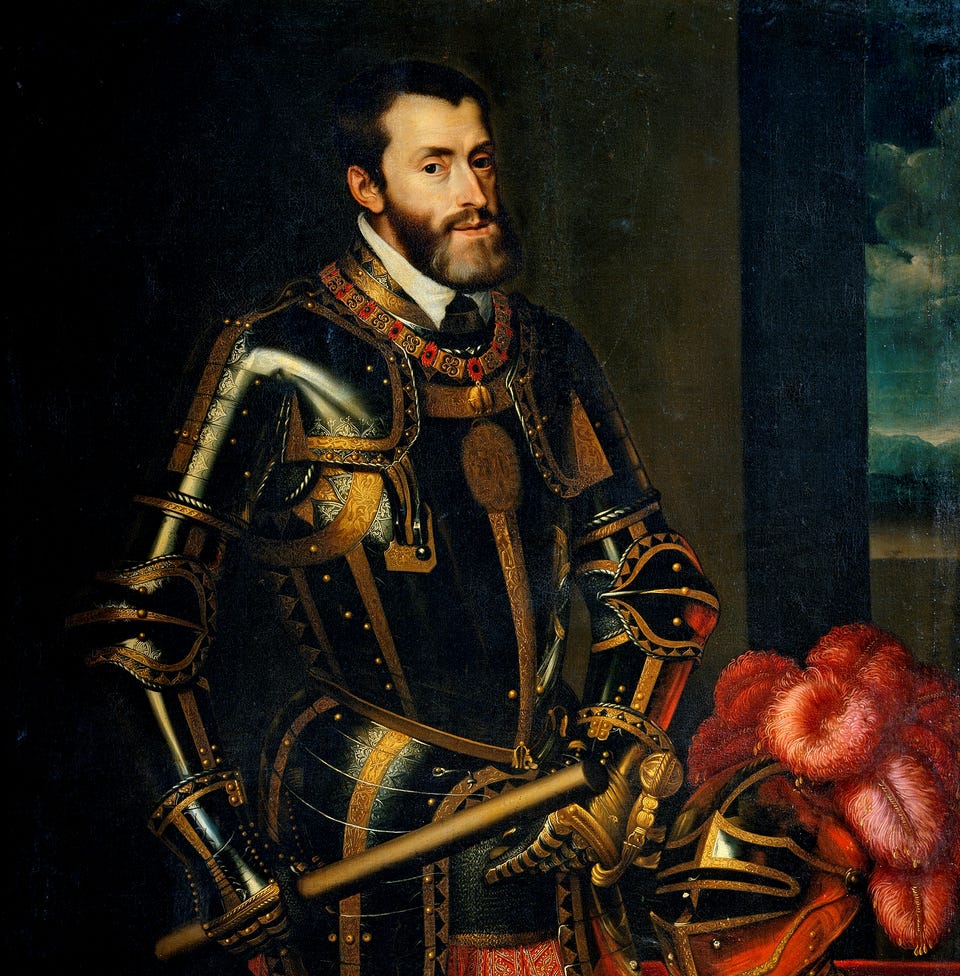
My thinking about the value of Chapuys to Mantel’s creation of her Cromwell is she is not saying: Chapuys tells us the truth about Cromwell. She is doing something subtler: Chapuys shows us how Cromwell looked to an intelligent enemy.
And that may be the real freshness. Mantel’s Cromwell is not created by wiping away hostile testimony. He is created by reading hostile testimony properly: noticing where it distorts, but also where it accidentally reveals.
Let’s look at the novel and see where Chapuys first enters in Part Three, Chapter One, “Three-Card Trick”, set in the winter of 1529–30. Mantel introduces him at a dinner at Antonio Bonvisi’s house, where Cromwell and Thomas More are already in conversation…
Comments
Nothing yet. Say the first thing.
Sign in to join the conversation.