
If you’ve ever felt like you just don’t fit into your work…
That you’re meant for a creative path…
And worry you started too late, or whether your ideas matter or not…
Hideo Kojima’s life is the antidote.
Hideo Kojima is a modern auteur. One of the few who can get away with such an unconventional title.
He created one of the largest video game franchises of all time and permanently reshaped his field by bringing a new depth to it.
The worlds he created, people still obsess over decades later.
The games he made critics don’t even know how to classify.
He broke the rules at every turn and got rewarded for it.
But that’s not what fascinates me about him.
What fascinates me is how he became… himself. Because nothing about his early life suggested he would become the Hideo Kojima we know today.
He studied economics.
He worked a corporate job he hated.
He was fired.
He had no technical skills.
He lied to his family about working in video games because it sounded embarrassing.
He was ridiculed inside the company that would eventually depend on him.
And yet… he changed an entire industry.
Today I want to share four lessons from Kojima’s creative life that can change how you see your own.
Whether you’re building a business, writing a book, making art, or simply trying to find your path… these four principles can become anchors.
The first is the most important.
Kojima did not start in video games. He started at a normal corporate job in Japan, like many Japanese salarymen. His duties were whatever grunt work they needed done. As they often are. And it was not for him.
He knew that, but he shouldered that burden anyway, until one day, he was let go.
They could have fired him with an email, or in silence, or laid the blame on him. But instead, he was met with kindness by the HR woman working at the same company as him.
In his offboarding meeting with her, the HR woman acknowledged the elephant in the room.
She said, “Hideo, you’re a creative person. You should do creative work.”
Obviously, Hideo knew he was creative.
But no one had ever said that to him.
Sometimes, all it takes is someone naming what you already knew but were scared to admit.
That validation was all he needed to take a chance on himself.
He looked up what video game companies were publicly listed on the Japanese stock exchange, because he assumed they’d be more stable… and he found only one:
Konami.
That’s how he picked the company that would define his career. Not strategy. Not genius. There was only one choice.
He applied… and he got the job.
But he knew his friends and family wouldn’t understand.
He had gone to school to study economics, so he told them he worked at a financial firm.
He had a lot of shame around it at first, and even when they began to find out the truth, he was mocked for it.
During a friend’s wedding reception, the other guests laughed at him when the groom introduced him by saying, “Kojima’s a very talented and otherwise likable person. But I am sorry to say that, for some unknown reason, he has decided to join a video game company.”
Everyone laughed.
But of course, Kojima knew that unknown reason…
It was who he was.
Not a choice like everyone else interpreted it to be.
Luckily for him, that’s the first recipe for success: knowing who you are.
Here’s the thing:
You can’t expect others to understand the part of you you’re still becoming.
Kojima didn’t need approval. He needed alignment.
And alignment begins with telling the truth about what you are.
And then, once you know who you are…
You just have to put yourself into a system that will let you be who you are.
Kojima wasn’t hired as a designer, director, or programmer.
He was hired as a planner. The lowest rung.
But he was happy, at least internally, to have a foot in the door.
Besides this step in the right direction…
His coworkers weren’t so happy.
They criticized him for not having any technical skills.
Instead of coming over to his desk and saying, “Hi.’
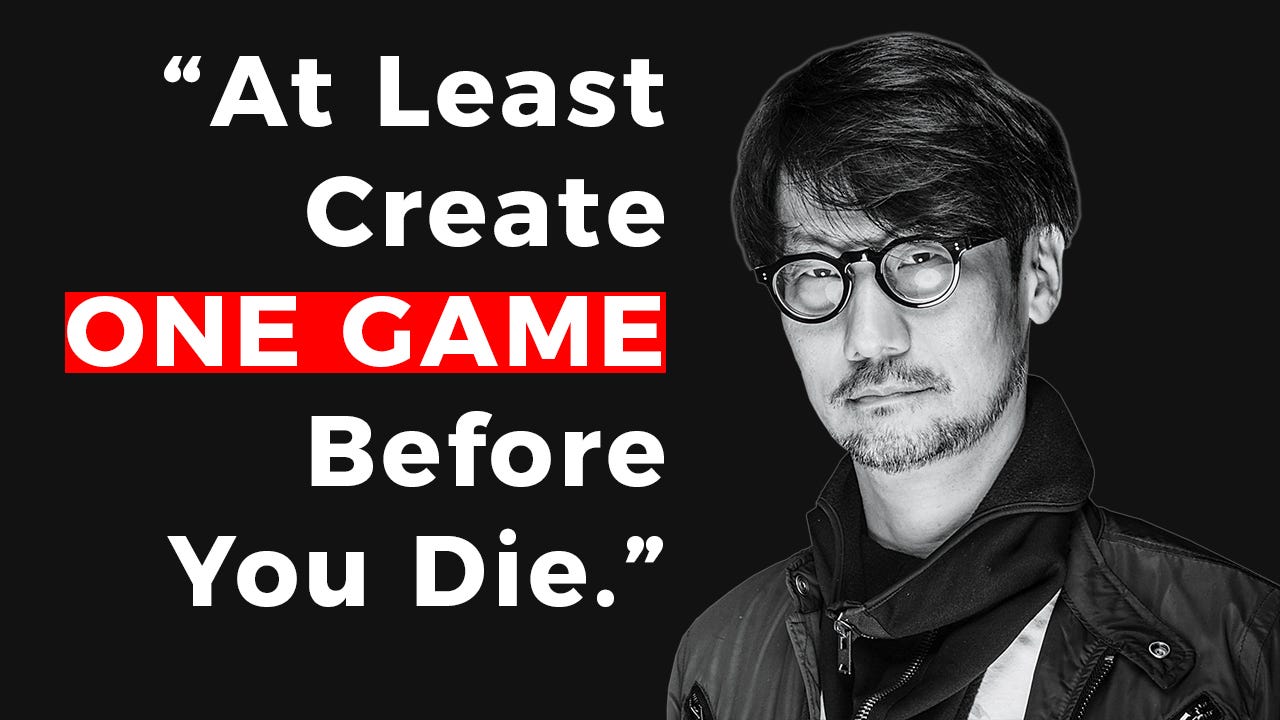
They mocked him and would tell him often, “At least complete one game before you die.”
Imagine hearing that from your colleagues.
That’s the kind of toxic work environment that would shut most people down or drive them to quit.
Kojima did something different.
He took it literally.
He wore the shame and sought to add value where he could.
Soon, he was given the chance to be the assistant director of a small game called Penguin Adventure.
He wasn’t the lead. It wasn’t glamorous. But he poured himself into it:
Added action to a funny little penguin game
Added in-depth RPG elements not seen before
Added multiple endings
Pushed against every technical limitation (even getting frustrated by how few colors they had to work with)
And the result… was a critical success.
Even today, the game is remembered for its depth — something no one expected from a “penguin game.”
That depth was something Konami wanted… and so when a senior associate needed a replacement to take over for the new project, Metal Gear… Kojima was tapped.
A small penguin game opened the door to Metal Gear.
And Metal Gear opened the door to the next 29 years of his creative life — a franchise now worth 2.5 billion.
The lesson?
Create the thing in front of you with everything you have to give, so that what you create speaks for you.
In that way, you are represented by what you make.
And your next opportunity is embedded in your current project.
Even if it feels as small and silly as a penguin game.
Now, let’s explore what makes Kojima’s ideas feel so different.
I picked up Kojima’s autobiographical book, The Creative Gene, hoping to find lessons about:
- Adding depth to your work
- Coming up with ingenious ideas
- How to know when to break the rules
Instead, I was surprised to see it essentially contained two lessons. The last two lessons of this newsletter.
The first was simply to: read books.
Not the advice anyone wants to hear. It’s kind of like being told to work out and eat better if you want to get fit. We know that already.
What was interesting, though, was why books hold so much value to Kojima.
Kojima had a lonely childhood. His father died young. He had no role models.
He had no adults around, he could ask what to do…
So he found them in books.
Even now, he carries a stack of books everywhere. He feels off-balance if he doesn’t have a few with him.
Why?
Because stories let you live entire lives without leaving your chair.
He says:
“Stories allow you to experience places you could never go… You can become a different person entirely.”
Books expanded his identity.
They taught him what was possible.
They shaped his worlds.
They filled the gaps left by his environment.
And most importantly, they connected him to others.
A weird quirk of Kojima’s is that he goes to bookstores every day.
Even still.
He says a bookstore shows you the world unfiltered.
That online, everything you see is algorithmically tailored to you.
But a bookstore shows you what humanity, as a whole, is thinking, loving, fearing, and consuming, without being filtered for you.
It reconnects you to the culture you’re a part of and creating for.
And he values this experience so much that every time he buys a book, he keeps the original receipt inside it as a physical timestamp of when that idea entered his life.
If Lesson 2 is “You Are What You Create.”
Lesson 3 is, “What You Create Comes From What You Consume.”
Books… widen the channel.
And they are the source of Kojima’s deepest philosophy.
This belief runs through everything Kojima makes.
It’s how his book begins and ends.
It’s the entire emotional core of Death Stranding…
The game he left Konami to create, and founded Kojima Productions for.
It’s how he starts and finishes his book, The Creative Gene.
It’s why he creates: to connect with people when he feels isolated. And to give others who are isolated someone to connect to.
Kojima believes in the power of memes.
Not the internet kind, but the Richard Dawkins definition:
Memes are units of meaning passed from one person to another, across time and culture.
Stories, ideas, customs, moods… these are all memes.
And every creative act is an act of connection.
Kojima wrote,
“The world is connected with ME + ME. Memes are propagated when people connect with each other. Stories dwell inside everyone and everything, no matter who or what they are. The act of reading stories, telling them, and sharing them with others is the way that ME + ME connect across time and place.”
“Stories dwell inside everyone, and everything. And the meaning of those stories will change based on the time and circumstances in which they are read.”
Kojima’s philosophy of memes isn’t based solely on appreciating how things were, but ensuring that, in enjoying memes, new ones can be created.
Interestingly, he does credit marketing and studying what has worked in the past, and reusing them as having played a hand in his success. But he also says that’s playing it safe and boring. And comes with some level of risk.
Kojima spends much of his time consuming art, books, movies, and media, so he keeps his sensibility for what a hit is sharp. That way, he knows what ideas to reuse and what ideas no longer make sense in the culture as it stands now.
He calls this sense knowing how to find the “one winner in ten.”
And if you want to create memes that shape the future, that’s exactly what you must do.
You must find the new connection worth pursuing.
The spark worth fanning.
Because in his view, and I agree:
We are not complete on our own. Creativity requires collision… between your genes and someone else’s memes.
Kojima didn’t follow a straight path. He started in the wrong places.
He didn’t start with confidence.
He didn’t even have the right skills.
Even when he ended up where he wanted to be… everyone rejected him.
And yet, he changed everything for gaming and created memes that will last centuries after him.
Because he embodied these four truths:
Know who you are.
Add as much value as you can to what is right in front of you.
Keep widening your mind through the worlds of others.
And remember that creativity is connection. It’s “ME + ME.”
If you’re a creative person, feeling uncertain or alone…
It only took one person to tell Kojima he was creative, and that was enough to change the trajectory of his life.
Maybe today, this can be your version of that conversation.
A reminder to connect what you have to give with what others have created before.
P.S. If these lessons resonated with you, I’m running a free workshop on finding your creative path and sustaining momentum.
It’s designed for people who know they’re meant for something more but aren’t sure how to begin or self-actualize.
Comments
Nothing yet. Say the first thing.
Sign in to join the conversation.