
The H1-B program is an obvious way to think through the near-term impacts of generative AI. A supply shock from foreign workers who are good at software engineering is analogous to a supply shock from a new technology which is good at software engineering. But I haven’t heard this discussed, and seen even less data. So I welcome this NBER paper by Hainmueller (Stanford) et al which looks at this question: Long-run Effects of H-1B Immigration on the U.S. Economy.
The paper claims:
H-1B exposure raised incomes for natives and pre-existing immigrants, with gains concentrated in non-STEM occupations.
Income gains are consistent with a productivity shock rather than a labor supply shock.
Productivity gains arise from better task execution rather than patentable invention.
The truth is different and easier to see in the main figure:
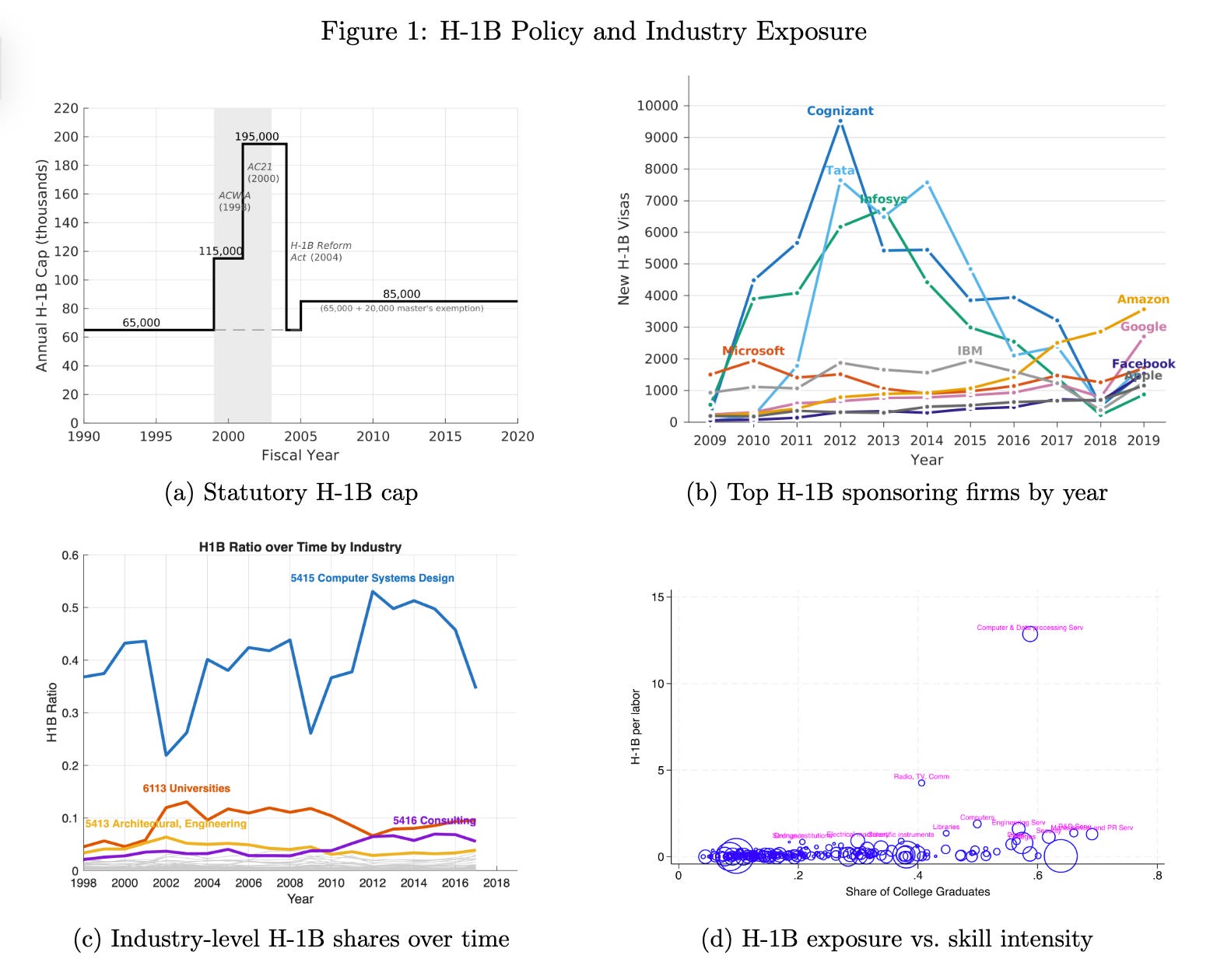
As one can see, the H1-B surge happened in ~2001, and a decade later, the big IT outsourcing shops, Cognizant, Tata, and Infosys, had built a massive operational and business arbitrage model around hiring and training cheap labor in India, and contracting it out to firms in the US. While these jobs are coded as “Computer Systems Design”, in practice they were building IT systems in banks, insurance companies, and other legacy industries, and quite different from the staff software engineer job at Google or Facebook.
So what actually happened?
Just as supply balances out demand, H1-B workers did depress STEM wages, particularly for native college graduates (−0.12 log points per pp of exposure). They also complemented non-STEM coworkers, and this effect was larger, but the measured impact aligned with folk intuition.
The paper assumes that final demand for technology was constant in dollar terms (Cobb-Douglas) and this is ridiculous. Corporate spending on IT exploded during this period due to YTK, ERP, the internet, etc. which drove demand, and the H1-B mills met this demand and bid down STEM wages. So the labor supply shock causality has not been ruled out.
The task execution vs innovation is as good as can be expected (patents are a poor measure of innovation) but it underscores what actually happened. Non technology companies (banks, retailers, insurance companies etc.) needed IT work and hired foreigners on H1-B programs instead of native-born consultants or training their own native-born employees. The tech boom raised demand, H1-Bs absorbed it at flat wages (Table OA.3: the marginal STEM hire is an immigrant) and non-STEM incumbents captured the rents associated with the boom. The demand was simply met by elastic immigrant supply, and not through productivity and competition offsetting, which is why wages remained flat.
Right now, AI demand is being driven by infra-marginal projects: experiments, toys, tinkering. People are figuring out how to use these tools, and the tools are figuring out how to be more useful to people. These won’t show up in productivity figures.
The next wave will be marginal work in incumbents which they might have outsourced it in the past: database maintenance, ports, and various kinds of IT administration. Simpler stitched-together SaaS systems, utility ware, or anything where the build vs buy decision is ~$20 will move to AI tools as well. This will primarily impact entry-level work, benefit incumbents who will see lower costs, and flatten demand for routine technology labor. Technology firms, who never relied on low-cost, low-skill IT labor will use AI to further improve their internal tooling, which has often been excellent anyway, as they continue to invest in the productivity of their employees.
The vast network of SaaS companies are the die-and-tool businesses of the technology industry, and they substituted for many internal systems built by H1-Bs. The coming wave of AI may disrupt this again, with those same companies bringing the technology in-house once more, as the build-vs-rent equation swings back to in-house solutions. But figuring all this out requires vertically integrated firms, so I hope incumbents will insource IT labor again to rebuild their internal processes with home grown, custom tools.
No posts
Comments
Nothing yet. Say the first thing.
Sign in to join the conversation.