
Ben Landau-Taylor inspired me to read Thorstein Veblen’s THE THEORY OF THE LEISURE CLASS and, almost 150 years later, what a treasure it remains. Veblen struck me as being somewhat misanthropic, often wrong, but usually trenchant.
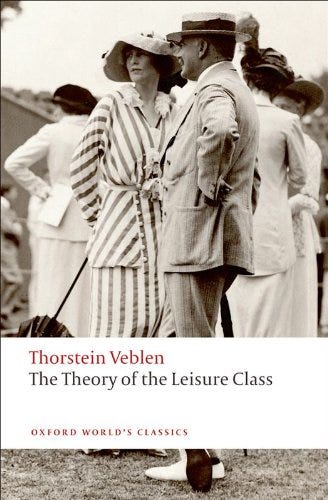
He’s best known for his theory of “conspicuous consumption” which argues people purchase goods not because they are needed, but to inspire envy in others. He’s less well know for his theory of “conspicuous leisure” which argues that people put a great deal of effort into not-work, again, to telegraph their status. Triathlons and charity are examples such activity, being wholly unproductive.
Here are his thoughts on the utility of objects:
“The utility of articles valued for their beauty depends closely upon the expensiveness of the articles. A homely illustration will bring out this dependence. A hand-wrought silver spoon, of a commercial value of some ten to twenty dollars, is not ordinarily more serviceable—in the first sense of the word—than a machine-made spoon of the same material. It may not even be more serviceable than a machine-made spoon of some “base” metal, such as aluminum, the value of which may be no more than some ten to twenty cents. The former of the two utensils is, in fact, commonly a less effective contrivance for its ostensible purpose than the latter. The objection is of course ready to hand that, in taking this view of the matter, one of the chief uses, if not the chief use, of the costlier spoon is ignored; the hand-wrought spoon gratifies our taste, our sense of the beautiful, while that made by machinery out of the base metal has no useful office beyond a brute efficiency… if a close inspection should show that the supposed hand-wrought spoon were in reality only a very clever citation of hand-wrought goods, but an imitation so cleverly wrought as to give the same impression of line and surface to any but a minute examination by a trained eye, the utility of the article, including the gratification which the user derives from its contemplation as an object of beauty, would immediately decline by some eighty or ninety per cent, or even more…”
Does this sound like attitudes towards AI?
When people declare AI produced work to be “slop” they are, in some cases, to some degree, finding the work less valuable because it’s been produced in a more efficient way in order to better do a job. This is the logic of the leisure class which prizes prowess, but eschews diligence. Items, the more useless the better, should be very hard to make, to maximize their value. Useful items can be made efficiently, but just understand they hold no status.
Veblen has shaky historic reasons for why this is the case, but it perhaps explains why we find an individual wearing a Patagonia R1 jacket with Meta RayBans, an iWatch, an Oura ring, and various other useful pieces of technology, focused on efficiently improving their health etc. so profoundly uncool. These items reflect working class values, which center on direct functional utility, instead of aristocratic leisure class values, centered on seizure and risk.
AI generated output, when it produces work that used to be prized as a function of prowess, denigrates that work, much as a wooden, factory made spoon denigrates the hand-wrought silver spoon it replaces. For people who cared about that signaling value, such a change in status may be unacceptable. For others, it’s clearly an efficiency and an improvement. You can sense this status anxiety most clearly amongst programmers who valued the craftsmanship of writing good code and resist the fact that AI is revealing what it always was: a productive, functional utility (aka a working class output).
Some may assert that this is always why the technology industry never had the glamor of law, finance, or journalism, even though it was well remunerated: it was always too directly useful and productive.
Another example is this remarkable IG clip:
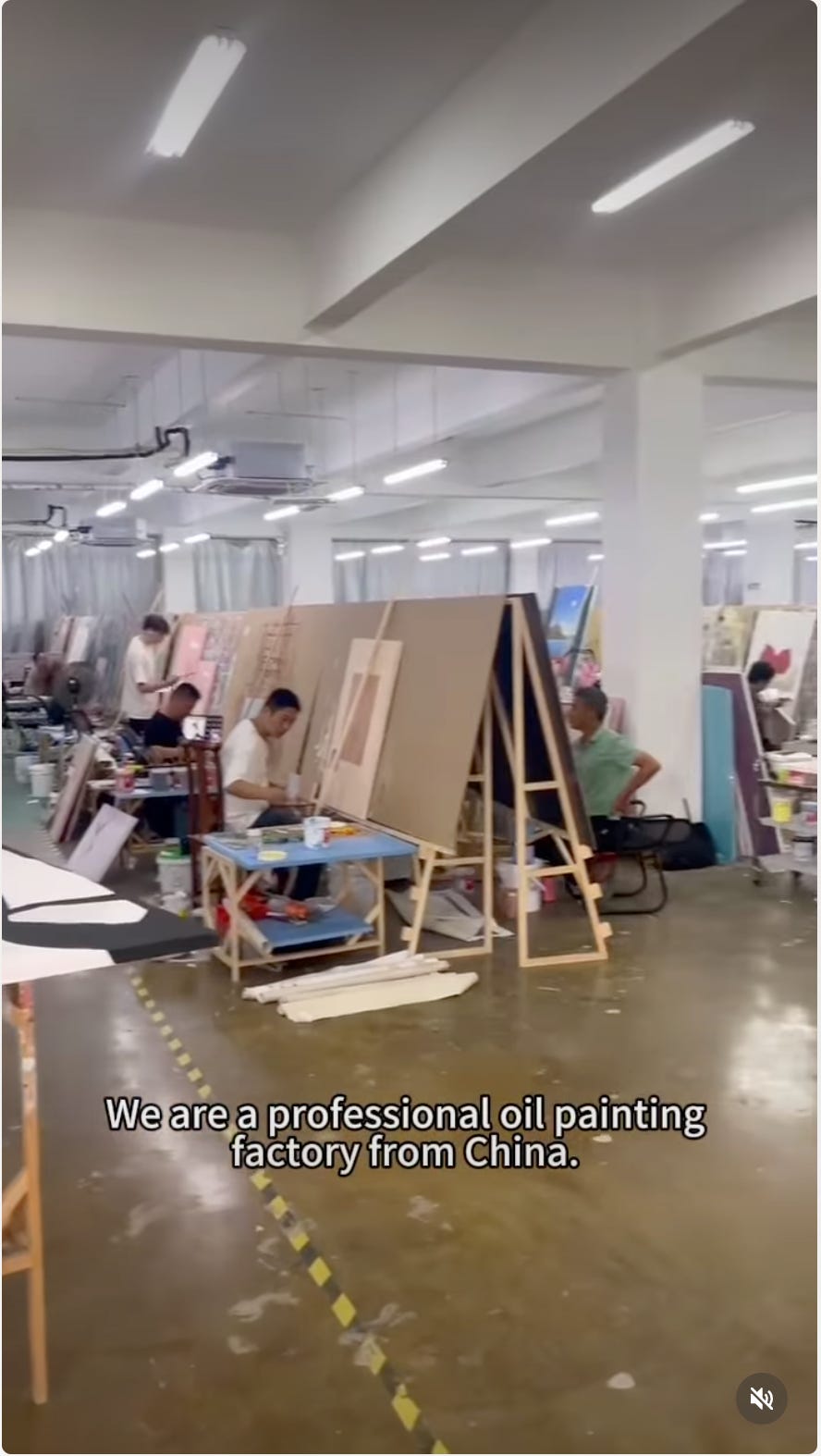
It shows a oil painting factory in China where a number of skilled craftsmen crank out oil paintings with the size, style, and subject the buyer desires. The work is very good, the skill level is high, and it is 100% hand made. And yet I’m not sure people would value this more highly than they would AI generated output. Even though we know famous Renaissance artists used studios, the utilitarian functionality of the assembly line fundamentally de-values art for any who hold it as a status symbol. (While a real estate agent or interior decorator wanting to fill a 5’ x 3’ wall may have no problem).
The word “taste” has been thrown around with some abandon, I think we have a far attenuated understanding of what we elevate in status and what we dismiss compared to what Veblen and his compatriots had figured out in 1899. It is this confusion that thinks AI will replace all human work, because it does not appreciate how status, and the desire to instill envy in others, is all too human. It is this blindspot that keeps us from seeing how much of what we do now, perhaps especially those who aren’t interested in flashy spending, is the equally invidious and class-bound conspicuous leisure. Once we understand the logic of the leisure class, “taste” becomes obvious: it’s the prowess needed to elevate that which is useless, and difficult to produce.
Aside from White Lotus, I struggle to think of another piece of popular entertainment that looks at our modern leisure class at all. All the more remarkable given how turn-if-the-century literature was focused on little else. I look forward to a contemporary Thackeray or Amis emerging, but in the meanwhile will wait until the next Mike White joint.

No posts
Comments
Nothing yet. Say the first thing.
Sign in to join the conversation.