
A concept of a work plan.
While all the rage in some political circles in the mid-2020s, I knew a concept of a plan wasn’t going to work for what now lay before me as the upcoming growing season approached.
We had been in the valley for five months, spending the winter settling into our new home. When not engaged in our version of homesteading, I digested books and online sources, familiarizing myself with the elements involved in planting a vineyard from scratch. I also spent time talking and learning from local growers. In early 2021, the COVID-19 pandemic continued to cast a shadow over in-person interactions, so my outreach was primarily by phone. The discussions proved essential, but the calls were limited in growing personal relationships and networks.
I hoped the upcoming season might loosen things up.
I had a detailed plan in hand, as discussed in Chapter 3, “Planning the Vineyard,” for the as-yet-titled book about my wine encore vineyard and winemaking endeavors.
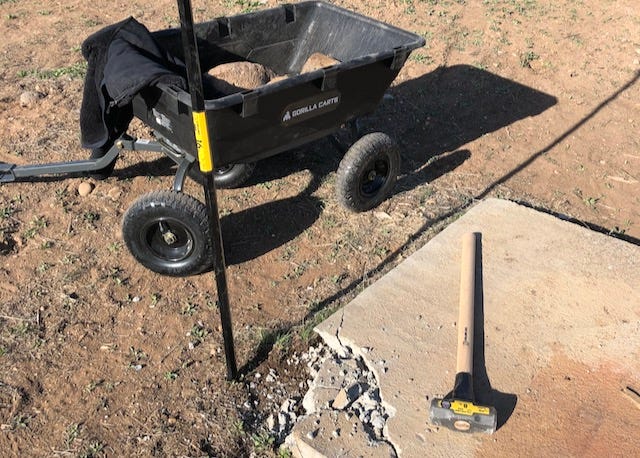
If there was doubt that do-it-yourself (DIY) ran in my veins, planting the vineyard could prove the point. I had no specialized heavy equipment to handle the rough terrain, nor friendly hands to divvy up the workload. Items commonly found at the local hardware store, including a shovel, heavy digging bar, sledgehammer, rake, hoe, and a rubber-wheeled hand-pulled cart that could be emptied like a dump truck, were the tools of my trade.
Creating garden spaces on our “farm in the city” in Denver was old hat for me; how could this be more challenging?
It turns out that the site—located on the edge of a rocky mesa in semi-arid western Colorado at 5,900 feet elevation, which had never been tilled or used for agriculture—provided the answer. As discovered during my due diligence, the ground to be planted was clay-rich, composed of stones, small and large. Weeds provided the ground cover. As the first growing season proved, the site experienced intense sun, sudden heavy rains when moisture arrived, frequent lightning, whether or not accompanied by rain, and constant wind on both clear and stormy days.
I was exhilarated but also anxious.
Exhilarated, because my wine encore dream of having a vineyard and using the grapes to make wine was finally upon me. Circle of life for vines and wines, so to speak.
Anxious, since it was new territory and I was shouldering the work. I’ve always been a physically strong and determined guy, but at 66, my limits could be tested.
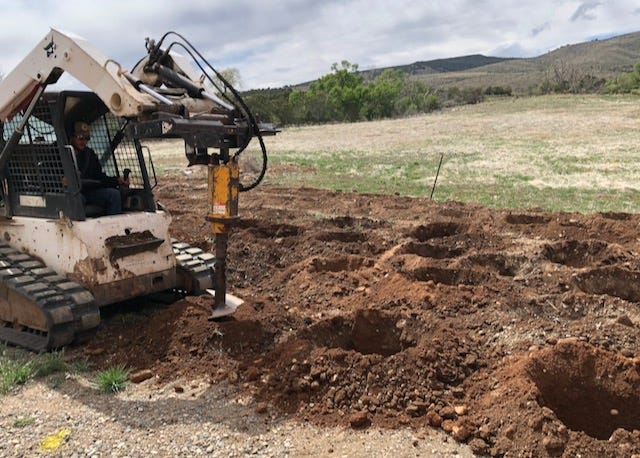
The pre-planting task list was extensive. The future vineyard floor had to be cleared, then staked and marked to show where each vine would be planted. I needed to schedule a local farmer to drill (i.e., dig) planting holes using heavy equipment fitted with a 24-inch auger. Compost had to be ordered to blend with the native soil when planting. Because dry farming isn’t feasible in western Colorado, I needed to gather the supplies required to install a ground-level drip irrigation lines for the vine rows. While the rootstock had been ordered in the dead of winter, materials to support the vines as they grew during the first-year was required.
Why a 24-inch auger? Healthy root growth is of upmost importance during the first season. In more forgiving soils, vine planting holes are often dug by hand or with a one- or two-person gas-powered post-hole digger using a 6- to 12-inch auger. My soil, however, is far less forgiving, with a higher clay content and numerous stones.
A local grower advised that it wasn’t necessary to rip up the site to a depth of two to three feet to loosen the soil for easier digging and root spread. Instead, he recommended digging deep, wide holes using a backhoe fitted with a small bucket. I ultimately decided that a large auger could accomplish the same task more efficiently.
Similar reasoning also drove the need to mix compost into the existing soil when planting. The resulting enriched soil would help break up the site’s high clay and stone content, and better support healthy root growth.
I didn’t have a sense of the level of hours involved in site prep, but I knew time was of the essence. For the moment, the weather was cooperating. This was my first spring in the valley, but I understood the potential for cold and wet heavy snow wasn’t out of the question.
Should mud make an appearance for a few days, the schedule would suffer.
Beyond the site prep, I had a broader vision for the vineyard. Knowing a wildlife fence would be built in the fall to restrict roaming hoofed animals, I began envisioning the site as a growing, green oasis. Such a refuge would take a few years to fill out—not unlike vines maturing to produce grapes.
My imagination ran the gamut: roses at the ends of vine rows, raised garden-bed planters full of vegetables and associated terracing, fruits such as strawberries, raspberries, and blackberries, and various perennials from lavender to butterfly bushes.
But first things first, time to clear the site.
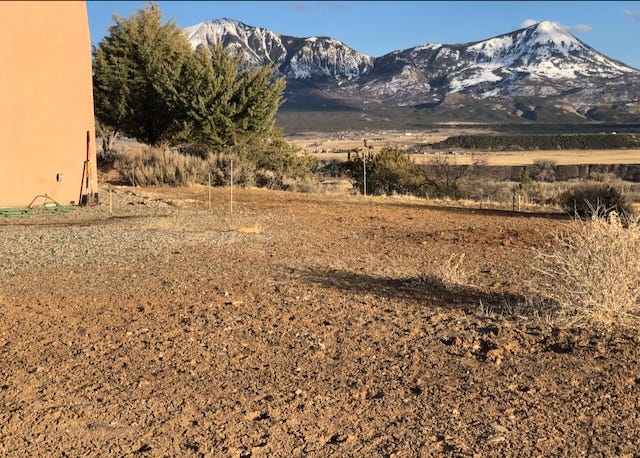
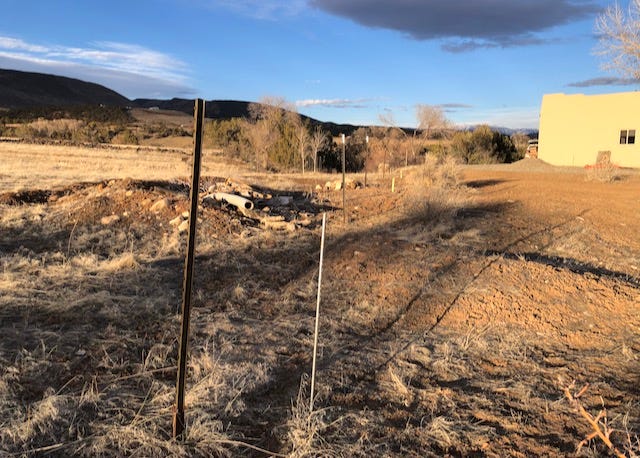
It was irregularly shaped, approximately 7,500 square feet—a bit under a sixth of an acre. A detached structure, which we call the shop, anchored the site. The location was expansive to the west of the shop, but it narrowed as the land wrapped around it to the south and east. Around the interior edges, there were clumps of sagebrush. There was also a small concrete pad with several surrounding piles of leftover material from previous construction projects. A section of the site contained a large gravel pile, and rocks lay everywhere.
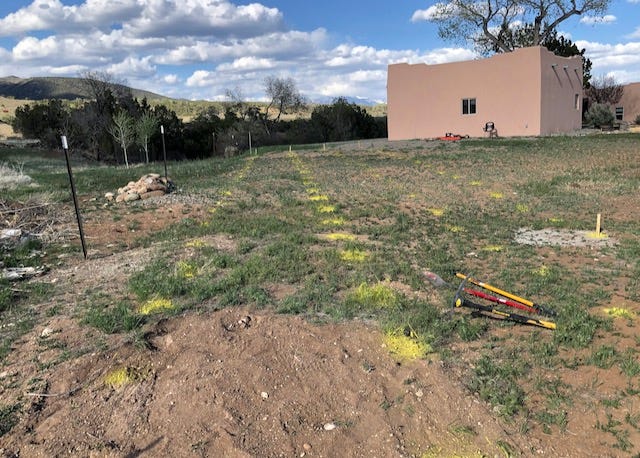
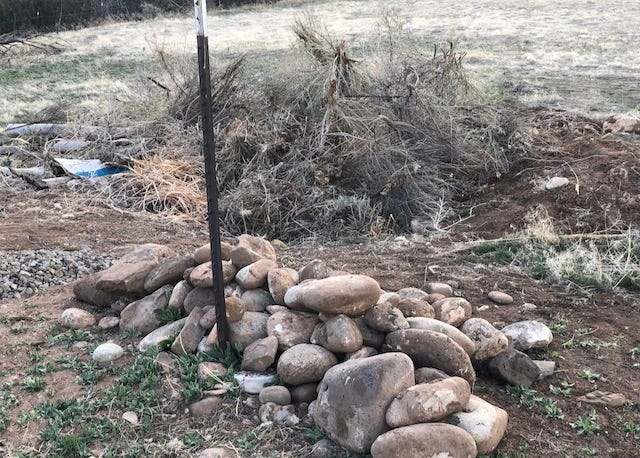
As it turned out, removing the sagebrush, construction materials, and concrete pad was the easiest part of the operation. The gravel and stones, however, were a different matter. The work was grueling and took several days. I had to move the gravel pile and rake the remaining gravel into small piles. I shoveled the gravel into the cart and moved it to a nearby spot. I also transferred the larger stones to a growing pile along the site boundary. It made sense to keep the removed gravel and stones nearby and accessible; they might yet serve a purpose around the vineyard.
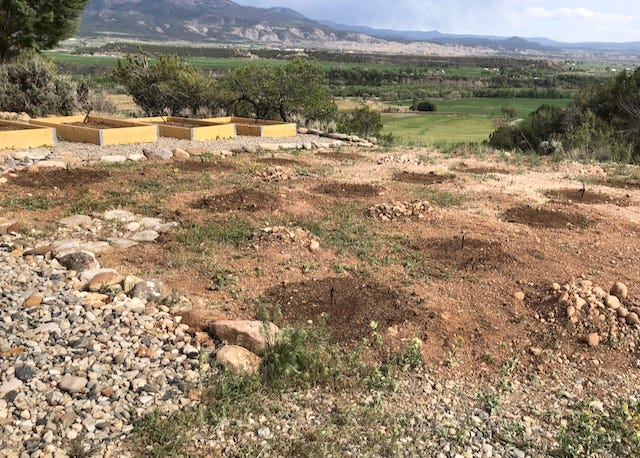
I had decided to plant the vines on four-foot centers along north-to-south-running rows, with aisles six to eight feet wide. The aisle width varied due to the site’s terrain and configuration. I ran twine between stakes to mark the eleven rows, and used yellow spray paint to identify each hole. When done, the official vine count was 120, 20 less than ordered.
There were a few days available to build four raised vegetable beds along the east side of the site, and it made sense to use the stones and gravel moved during site prep to define the space.
I got to work.
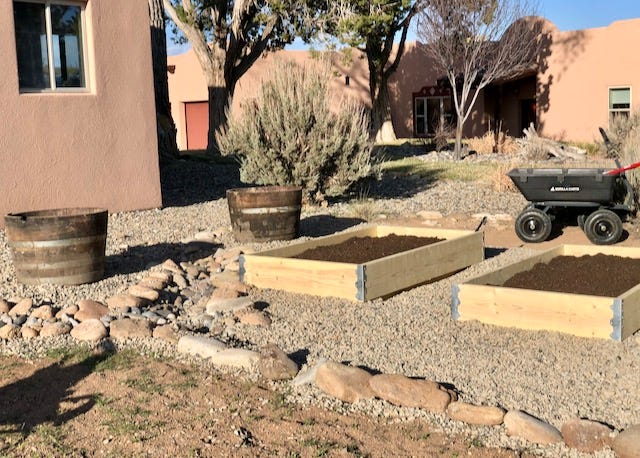
As the raised beds neared completion, the day of the dig arrived. The fun began when the truck and trailer carrying the equipment failed to make it up the steeper portion of my drive. After some thought-provoking head-scratching, we decided to drive the skid-steer loader off the trailer and up the drive, which lightened the truck's load enough to help it breach the steep incline.
With the equipment ready and the job begun, we found the auger cut through the soil easily—until it couldn’t.
I was thrilled with the look of the upended soil, but less thrilled about the large stones that forced the operator to move the auger slightly backward, forward, or even to the side. Many rocks were too heavy and large for the auger to budge. We couldn’t risk breaking the auger tip. It was a rental, and purchasing a new auger would be an unwelcome expense. In several cases, the operator could shift the auger a bit, then “belch out” a stone with the dirt.
My responsibilities included ensuring the operator began each dig with the auger positioned on a marked spot, removing large rocks from the tops of dirt mounds, or jumping into a hole to retrieve a large rock.
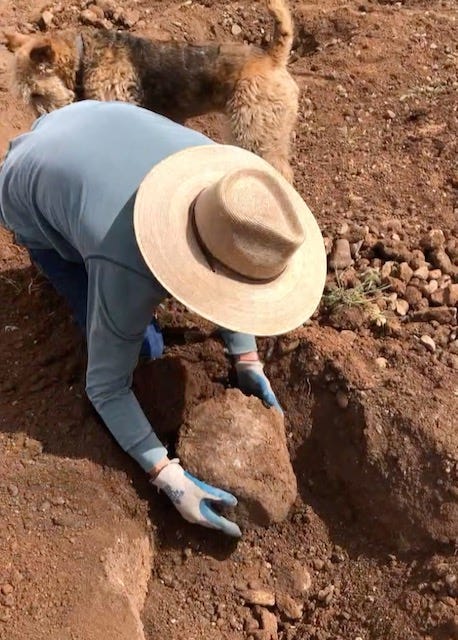
Another issue became apparent as the operator worked the holes. There were veins of caliche in several spots. I learned from a local grower during the planning stage that caliche was a possibility. I hadn’t come across it till now. Caliche is common in the arid southwest. It is a layer of white calcium carbonate, highly alkaline. In concentrated amounts, it is detrimental to plant growth. In the ground, caliche often presents as a hard layer. A couple of holes looked as if someone had dumped a sheet of drywall in the ground. I hoped to lessen the negative impact by restricting the amount of caliche that reentered the holes during planting and by using more compost when backfilling.
Thanks for reading the fourth chapter of my wine encore book! This post is public so feel free to share it.
At the end of the day, my visual survey of the completed work revealed that many holes were off-kilter, either within the row or between vines. The auger had to shift too much, dodging large rocks.
Perfectly spaced and aligned vines were not in my vineyard’s future.
The one saving grace, notwithstanding, is that the holes were large, and I could position the vines when planting in each hole to help align them.
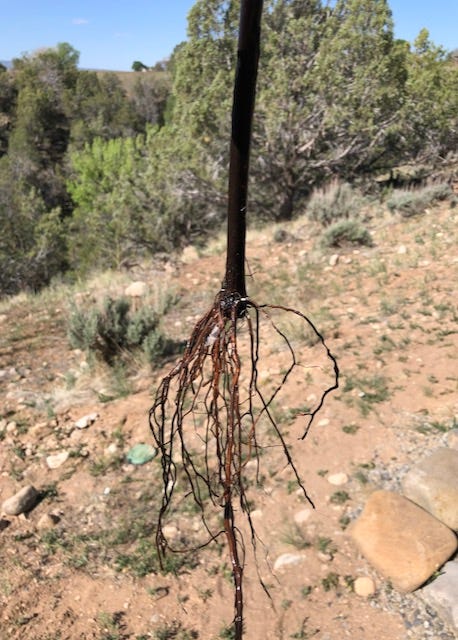
The real work began a few days later with the arrival of the grafted rootstocks. My goal was to plant 25 to 30 vines a day. The holes were huge. Mixing the soil while backfilling and limiting the number of stones and caliche returning to each hole would take time.
Each day began early, with the immersion of the day’s rootstock in water-filled five-gallon buckets. After two hours of soaking, I’d dip the roots of each vine in a growth stimulant before planting. As I backfilled each hole with the native soil and compost mix, I’d water it as I built up the soil to remove air pockets and ensure complete saturation.
With planting completed, laying the drip irrigation lines was up next. I had learned to install and maintain drip lines in my garden beds in Denver. The vineyard application wasn’t all that different. Because of our frequent travel schedule, thirsty vines couldn’t rely on me to manually turn on the water to fill the irrigation lines. My situation required a faucet timer supporting multiple zones.
Using a faucet timer wasn’t a long-term solution. It was a stopgap application.
There was an existing irrigation pit with four zones for the broader property landscape outside the vineyard perimeter. I needed to install new zones in a pit specific to the vineyard—the number of the zones to be determined but I believed four might do it.
Due to my overburdened schedule, I decided to defer the task for a year.
Why multiple zones? Two reasons.
First, water pressure. Irrigation lines must be limited to the length required to maintain a specific range of water pressure. In particular, 15-30 psi (pounds per square inch), with 25 psi best for drip emitters.
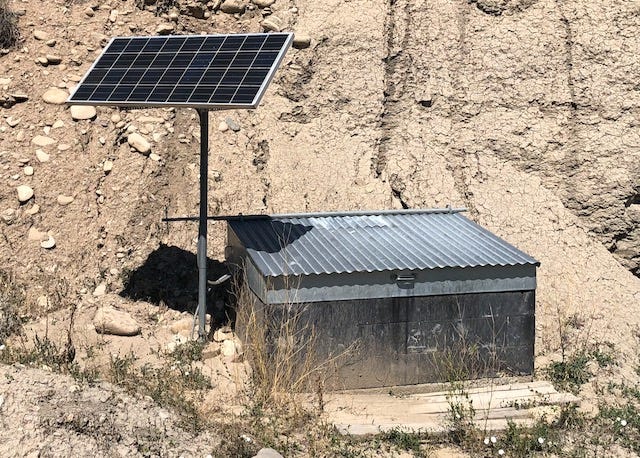
The second reason involved the limits of our water system. A spring located in an adjacent ravine provides water for our property. A low-flow 1-gallon-per-minute solar pump moves the spring water uphill to a 1,500-gallon cistern in the shop. The water is used to meet domestic and irrigation needs. Because there is a risk of using more water than the pump provides to the cistern when irrigating the vineyard, especially on cloudy days, multiple zones help distribute use more evenly over several days.
With further calculations and experiments using the faucet timer, I found three zones did the trick on both counts for the vineyard. A fourth zone would supply water to garden beds and additional plantings. I could now lay the lines for each zone, placing one-gallon pressure-compensating drip emitters at the base of each vine.
Now what to do with the leftover grafted rootstock? Of the original 140 plants, 70 were Pinot Noir, and 70 were Riesling. I decided to plant all 70 Pinot and 50 Riesling, leaving 20 Riesling unaccounted for. I hate waste, and discarding the Riesling would be a sin.
At the time, there was no way to know that what I did next would lead to building a local network of growers and friends.
My first call was to The Storm Cellar, a nearby winery and grower who had provided advice during my planning stage. I knew Riesling was one of their cornerstone varietals, and they might be interested in the leftover rootstock. Come to find out, they had no need, since they were in the middle of planting several hundred Riesling rootstock themselves.
However, they provided the name of another local grower, a hobbyist like me, who might have an interest. As it turned out, his vineyard was fully planted, but he knew someone looking to fill gaps in their vineyard. Introductions were made, and the rootstock was transferred.
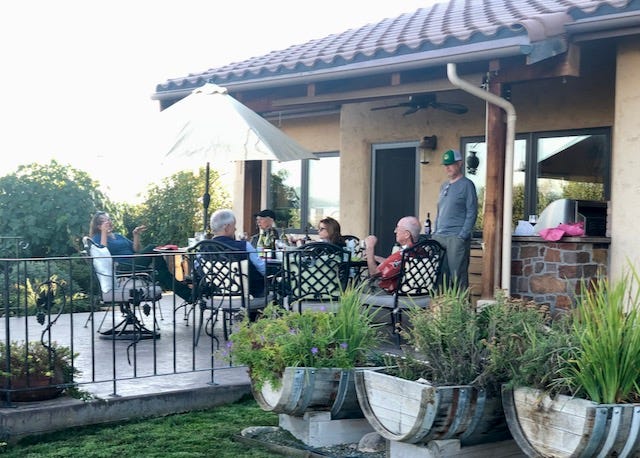
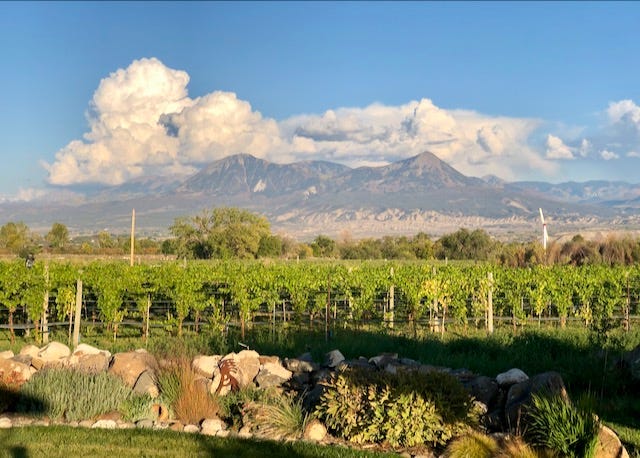
Over the summer, the two introductions garnered us invites to several wine enthusiast dinners and tastings. We hosted a gathering as well. Things were finally loosening up as we began to make new acquaintances and get a feel for the broader community.
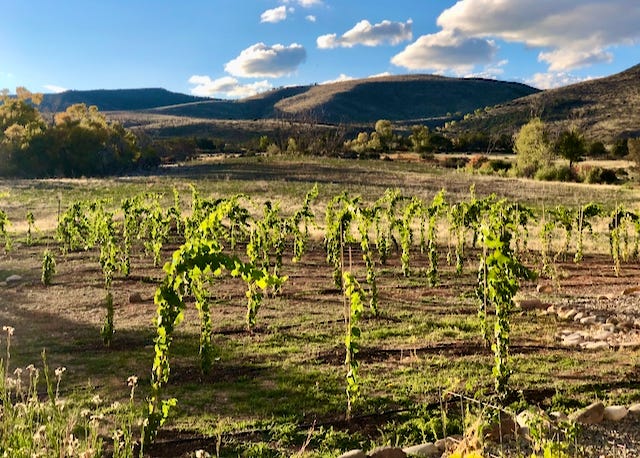
With vines in the ground, we had three weeks of travel planned. While it was worrisome to be gone for this extended period right after getting the rootstock in the ground, there was no greater joy than coming back to green leaves springing from upright-growing vines. Weeds had fortuitously taken advantage of the loose soil around the new emerging vines. In many cases, new vine growth was hidden by the weeds' height.
Hand pulling and hoeing were in my immediate future.
Next, the vines needed structure and protection from the elements and local critters. To balance my workload, I had decided to defer installing a trellis for the vines until the following spring; first-year growth wouldn’t benefit from it anyway. For this season, bamboo poles to support the growing vines and three-foot-tall grow tubes to protect them from insects and small furry creatures would suffice.
In particular, the adjacent field to the west contained a prairie dog town, and the little ones loved exploring around the base of the new vines. Rabbits were also part of the local rotation.
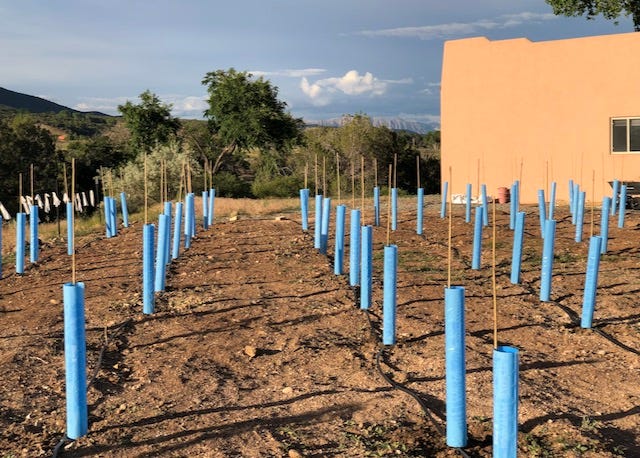
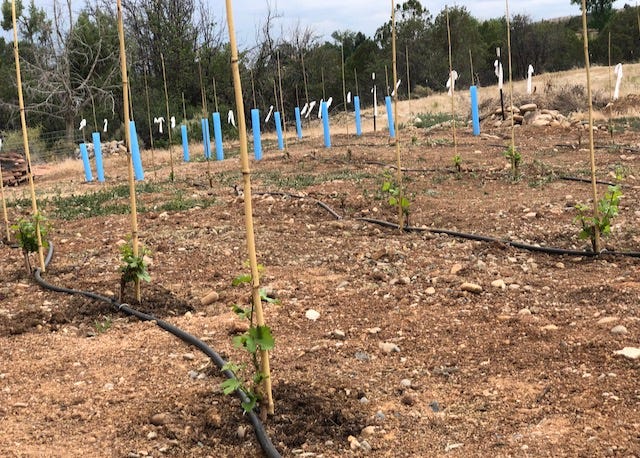
By late June, all the elements needed for summer growth were in place. For much of the remaining season, weeding became my primary task. Because weed roots can interfere with the development of young vine roots, they had to be kept in check.
You might ask why vine pruning wasn’t on my list of summer chores. The reason is simple: in the first year, leaf and root development—not vine structure—is paramount.
Vine pruning takes center stage beginning in the second year. In our part of the world, first-year vines are typically cut back to just above the graft union at the start of the second season, leaving only a few buds for new growth. If the roots developed well during the first year, the new above-ground growth in the second year is strong and rapid.
By the end of summer, most vines had grown out of the top of the grow tubes. At this point, the tubes needed to be removed. If left in place, winter moisture could collect and freeze at the bottom of the tubes, compromising the graft unions near the ground.
The next task involved mounding soil around the vines' bases to protect the vulnerable unions from upcoming single-digit winter temperatures.
The last undertaking before the end of the fall was to install a wildlife fence. Fences protect from deer and elk and are typically 7 to 9′ tall. Without it, wildlife would be munching on the vines throughout the winter.
And if there wasn’t a better reason, due to Colorado’s free-range laws, you must fence cattle out; otherwise, they’ll rummage through and destroy property without consequences. We were keenly aware of the possibility after a visit by two bulls earlier in the year.
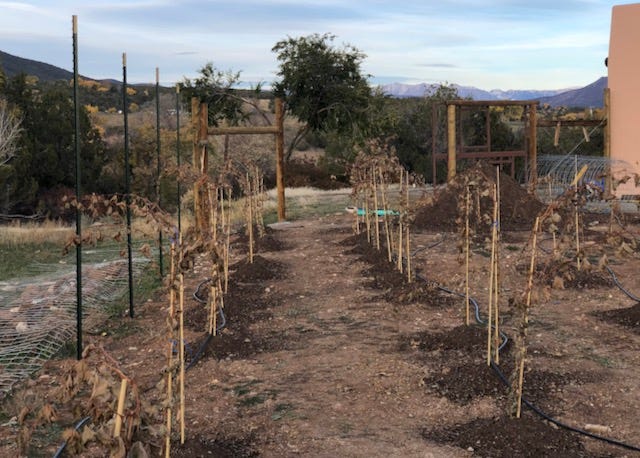
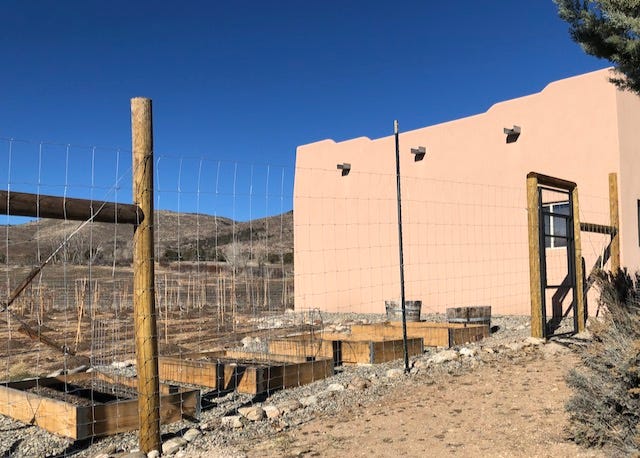
Playing my DIY card was impractical for large-scale fence building. I found local and experienced people who performed the task admirably. As the team was wrapping up, the first fall freeze hit.
Thank goodness, the year’s activities had kept on schedule, with the vineyard now protected and readied for winter.
As the vines entered dormancy, with my outdoor ventures restricted to wildlife viewing, it was time to reflect on the year’s progress.
Having a work plan made all the difference—a mere concept of a plan could have spelled disaster. Through the process, I learned and documented what had to be done by when. The year had been both mentally and physically taxing—just the kind of challenge I welcomed at this stage of my life, fulfilling my wine encore.
I was also humbled—by the graciousness of everyone who helped and shared in the adventure; by the friends I made; by my wife’s unwavering support; by what is possible; by nature itself; and by everything I learned, including the mistakes made—or, in my preferred vernacular, the lessons learned.
Ultimately, if you can’t learn from your mistakes and pass those lessons on to others, you diminish the ultimate goals, undermining future successes.
Expect to find my “lessons learned” in a future chapter.
No posts
Comments
Nothing yet. Say the first thing.
Sign in to join the conversation.