
I enrolled at a well-known art school in a small, then still economically depressed, former mill and factory city in New England in September of 1979. I began my college career six months to the day after my nineteenth birthday and turned twenty early in the second semester of that first year, well behind the students from my own age cohort who were by then either sophomores or juniors. I’d been held back twice in elementary and middle school, the first time in third grade due to poor academic performance (it was a combination of a crippling math deficiency and a near-pathological aversion to homework that got me). The second stall happened in seventh grade — in the year when Richard Nixon trounced George McGovern to win his second, ill-fated presidential term — after a long sojourn in a ragtag and completely undisciplined Hippy “Free School”, also located (in an abandoned bowling alley) in that same old mill town. While there, I majored in wandering the streets, panhandling change for cheeseburgers and bottomless cups of diner coffee, and attending the frequent anti-Vietnam War protests on nearby college and university campuses. My parents, who were embroiled at the time in an acrimonious separation and divorce, were more or less in the wind, so I spent many of my free hours with a close pal’s sprawling family of siblings and foster kids, and even lived for a while in a communal house shared by a gang of thirty-something grad students pursuing their masters in teaching degrees, two of whom worked at my school.
Between those Free School days and the launching of my college career, there elapsed about seven years of early artistic practice and study, both self-directed and working with several outstanding teachers, all of them college and university level arts instructors. This phase unfolded both in and out of actual schools and other extra-curricular programs, in the studios and shops of artist family members and some of their colleagues, for whom I worked as a paid apprentice from time to time. In this way, I found employment throughout my teenage summers as a graphic designer, a set painter on movies, a house painter and construction worker, a restorer of Colonial era headstones, and later as an assistant pressman in my uncle’s offset printing shop. By the time I got to college, I’d also graduated from a radically alternative co-ed boarding school in Vermont, founded in the 1940s by some Black Mountain School people, where art, literature and philosophy were all encouraged and sex, drugs and Rock and Roll reigned supreme. All this experience brought me to the realms of higher education as a slightly older and rather jaded freshman, as well as a more experienced maker than many of my classmates, including those a year or two ahead of me. I was in no sense a master of anything, mind you; other kids at the school were both more skilled and gifted, but I did know more or less know how to paint in oils, as well as to do a variety of printmaking techniques, from etching to monotype, aquatint and wood engraving. I was also already fully committed to painting, and so mostly ignored a worthy — but to me largely superfluous — Foundation Program that had been put in place to expose incoming freshmen to a variety of disciplinary paths prior to choosing a major. I already knew what I wanted to do with my life and consequently needed no help in figuring that one out.
I tell this story of my early studies because it bears on how I responded to the mindset and tastes prevailing among my teachers and fellow students on my arrival at art school. The most salient of which, though also the most challenging to describe, was an insistent, yet largely unspoken hierarchy of types of work considered in that milieu to be respectively acceptable or unacceptable to pursue. As a comparatively traditional, albeit Modernist-leaning representational oil painter, almost everything I liked to do, or hoped or try my hand at, was at that point — and in that particular program — rapidly becoming un-acceptable.
American art and design colleges, some that had, like mine, been founded originally as training schools for industrial artisans, didn’t begin to grow into what they are today until after the Second World War, when soldiers returning from Europe and the Pacific went back to college on the GI Bill in search of careers. Throughout the 1950s and 60s, the US was engaged in an aggressively imperial project of cultural exportation, for which the Modernist art that evolved here between the Great Depression and postwar eras — along with our cars, films and music — became a billboard to the rest of the world of our presumptively global economic dominance. It has even been revealed in recent years that the CIA engaged in a program in the Cold War years to promote modern American art for this very purpose, and likely saw its potential to do so after Jackson Pollock was made famous when the popular, glossy picture magazine LIFE published its notorious profile of the artist under the cheeky headline “Is he the greatest living painter in the United States?” What it was perhaps also suggesting, between the lines, was that Pollock might actually be the greatest living painter anywhere. Within a couple of years of that publication, the first fine arts masters degree program was planned at Harvard University, with others soon to follow across the country, many with a clear mission to inculcate a new generation of artists with the intellectually highfalutin gospel of this distinctly American avant-garde.
Despite the high-minded rhetoric of our Modernist movements at mid-century, the mission of their academic dissemination in the postwar years was neither a purely intellectual nor a solely aesthetic project, however much some of the artists and teachers involved may have hoped that it would be. It was also a fully commercial venture from the minute that LIFE commoditized Pollock and his work as fashionably branded emblems of our global domination. By the time I entered my school’s painting department in my sophomore year, the top college and university arts programs here in the US were in the process of transforming themselves from places where the history, methods and ideas of art were mainly taught as a template for subsequently independent artistic explorations, and into a sort of business school for the building of “important” and also potentially lucrative careers, like Pollock’s, in the marketplace then coming to be known as “The Art World”.
Since the mid 1980s, this system, along with all the preparatory arts programs across the country that now regularly feed it with fresh student blood, has increasingly mirrored the professional pipeline running from MBA programs at schools like Harvard, Wharton, and Columbia into urban financial centers in New York, Chicago and San Francisco. Not surprisingly, the products of this MFA track soon began to cater directly to the tastes, proclivities, values (and wallets) of the MBAs. The contemporary art market, which had gotten a big postwar jolt with Ab-Ex painters like Pollock, Frankenthaler, Rothko and DeKooning, then skyrocketed on both sides of the Atlantic through the second half of the century, fired by the easily-monetized celebrity of a parade of innovators in cyclically, and imitatively, “ground-breaking” artistic movements — from 1960s and 70s Pop Art and the Neo Expressionism of the 1980s, to the YBAs (Young British Artists) and Yale and Columbia-groomed MFA art stars of the ‘90s. It has long struck me that LIFE’s Pollock profile was ground zero for the whole rapidly metastasizing organism of international art fairs, giant corporate galleries and the ever-churning racket of top-tier auction houses like Sotheby’s, and Christies that we know today. Without that system, there would be no Jasper Johns, no Andy Warhol, Jeff Koons, Gerhardt Richter, Cecily Brown, Damian Hirst, Lisa Yuskevage, Dana Schutz or any number of other artists whose hyper-celebritized status has less to do with any intrinsic quality in the things they actually make — which certainly sometimes exists — than with the malleability of a cannily-conceived brand to a market trading on the fashionably fresh and seemingly momentous; all of it fed by a smokescreen of critically predictive art-historical gravitas to which its speculatively inflated dollar values are routinely pinned.
Not only did none of this appeal to me aesthetically as a young guy, but I also became convinced, right at the starting gate, that the whole scheme hung on a conforming acquiescence on the part of the starry-eyed students who were being primed in the classroom to hunger after their own little slices of Andy Warhol’s promised fifteen-minute pie of fame. All of this felt antithetical to the sincerely experimental spirit of creative non-conformity that prevailed through the early pre-war years of Modernism and from which, at least to me, the most moving and genuinely original art of our time has always grown.
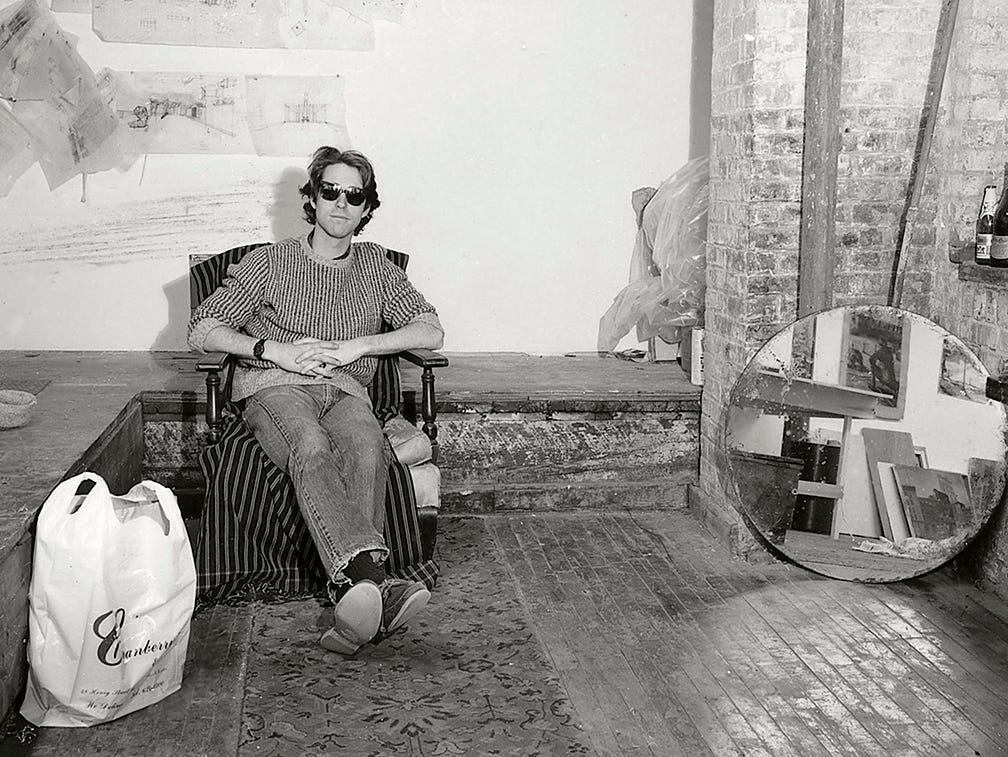
I finally dropped out of art school at age twenty-two when my distaste for the whole enterprise at last outweighed any anticipated benefit from seeing the program though. I moved instead to New York, where I rented a raw industrial loft space on the Brooklyn waterfront with a former classmate, and began to look my future squarely in the eye. The problem was how to make the best art, meaning the most personally challenging, contemporarily conscious and skillfully executed work that I could (which had always been my goal) while doing so outside the Art World system described above, and which I had just rejected. Still very much a student, but no longer pursuing my studies in somebody else’s program, I began to look around for useful templates of a different way to think about and make my pictures, as well as a different path to turning that work to the problem of making a living, without which income I wouldn’t be able to continue to do it with the focus and persistence upon which all my aspirations depended.
Part Two of this series can be found here:
·
Jun 14

The Art World of which I so often write in this forum is not the same thing as the world of art. The first, as I described it in part one, is a closely gate-kept, academically enabled and critically validated engine of commerce. The second is the whole globe-encircling community of individuals who make a great many different kinds of art in a sincerely …
No posts
Comments
Nothing yet. Say the first thing.
Sign in to join the conversation.