
Welcome! This bi-weekly newsletter, published by the Windfall Trust, curates the most important developments in AI economics research and policy. Each issue features key research and updates, along with in-depth analysis and quick links to relevant opportunities and recent news.
Workers in the highest-risk category already use ChatGPT at 3× the rate of lower-risk workers, yet the latter have seen unemployment rise more, according to OpenAI. This suggests demand elasticity, not displacement, may dominate
Alex Bores, a candidate for Congress in NYC who is the prime target of the AI industry’s Leading the Future super PAC, published an AI dividend plan financed by a token tax. This token tax makes AI inference less attractive relative to human work, but tokens are a bad proxy for automation. Taxing inference tokens may also incentivize labs to hide reasoning within model weights rather than generate it as a visible chain of thought.
A field experiment with 515 startups finds that discovering where to deploy AI — not access to the technology itself — is the binding constraint on firm-level productivity gains.
Will the future economy run on human connection? Alex Imas (Chicago Booth) argues yes, that scarcity of genuine human involvement will anchor a “relational sector” of teachers, therapists, and craftspeople. However, Phil Trammell (Stanford) pushes back in the comments: historically, new wealth flows to entirely new product categories, not to paying humans to be human. Jason Abaluck (Yale) goes further, arguing that most goods on Imas’s list are valued for their quality, not their human origin, and that transformative AI could reshape preference formation itself. Stefan Schubert’s summary covers the full exchange. OpenAI tried to measure demand elasticity in its new framework, but the gap between the concept’s importance and its measurement remains large.
Alex Richmond (OpenAI) published an AI Jobs Transition Framework that pushes back against overinterpretations of AI exposure as job displacement. The document is both a serious empirical contribution and a piece of policy positioning. Together, the 921-occupation classification and the usage-pattern data from ChatGPT provide researchers with the cleanest operationalization of exposure available.
Richmond reports that workers in the highest-risk occupational category use AI roughly three times as much as workers in lower-risk categories, yet the latter see larger increases in unemployment. According to OpenAI’s own CPS analysis (Table 1, p. 21), the “high automation risk” category saw unemployment rise by +0.3 pp from Q1 2024 to Q1 2026, compared to +0.6 pp for the “less immediate change” category — though that residual category may include construction, transportation, and other cyclically sensitive occupations, which could explain the larger increase through non-AI channels.
The implied mechanism is demand elasticity. When AI reduces the cost of a service, total demand for that service can grow enough to offset the labor-saving effect at the task level. This is consistent with Makridis and Johnston’s industry-level evidence showing 3.9% higher job growth per standard deviation of AI exposure.
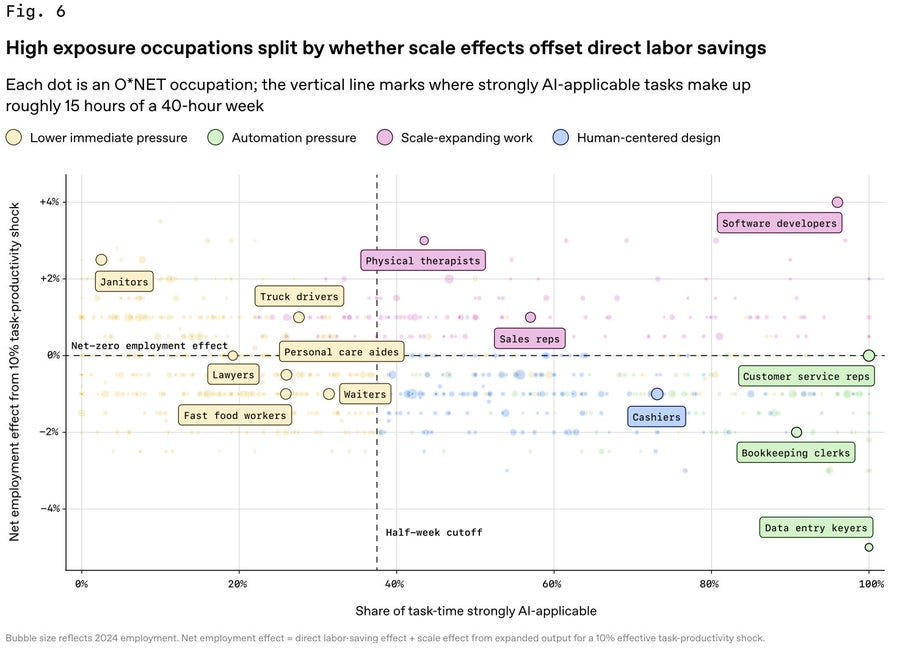
The 4 categories of jobs, with the y-axis accounting for demand elasticity
For each category, OpenAI recommends different policy responses: reskilling and transition assistance for high-risk jobs, staffing standards for occupations such as lawyers and teachers undergoing reorganization, and capacity-building for occupations that may grow. OpenAI’s broader industrial-policy vision, covered by TechCrunch, includes public wealth funds and a shift in the tax burden from labor to capital.
Our analysis: The framework relies heavily on its LLM-generated numbers. GPT-5.4 identifies “the relevant output” of each occupation and estimates its demand elasticity, yet occupations produce joint outputs in collaboration with other occupations, making this conceptually unclear. It’s tough to disentangle the contributions of software engineers and product managers to a joint product, and even tougher to estimate separate demand elasticities for them.
The cutoffs for the decision tree are never reported, rendering the categorization provided by OpenAI unverifiable: small threshold changes could shift millions of workers between archetypes, and no robustness analysis is provided.
The framework indicates where AI could affect jobs, not where it actually does. Firm-level adoption is heterogeneous in ways that occupation-level measures cannot capture (see the Kim et al. experiment below). And where human input is classified as necessary, that necessity is itself downstream of regulatory and consumer choices that may shift with AI, as Abaluck argues.
Finally, there is also a political economy perspective: OpenAI is positioning itself for the upcoming economic policy debate, and a framework that casts current trends as manageable serves that positioning.
Lucas Irwin (Oxford) et al. propose usage-based surcharges on model inference — so-called token taxes — to mitigate three economic risks of transformative AI: the erosion of the labor tax base, gradual disempowerment of citizens as states become less dependent on workers for revenue, and widening global inequality driven by compute concentration. Compared to existing robot tax proposals, the authors claim enforceability through cloud providers is easier, and that token taxes capture value where AI is used rather than where models are hosted.
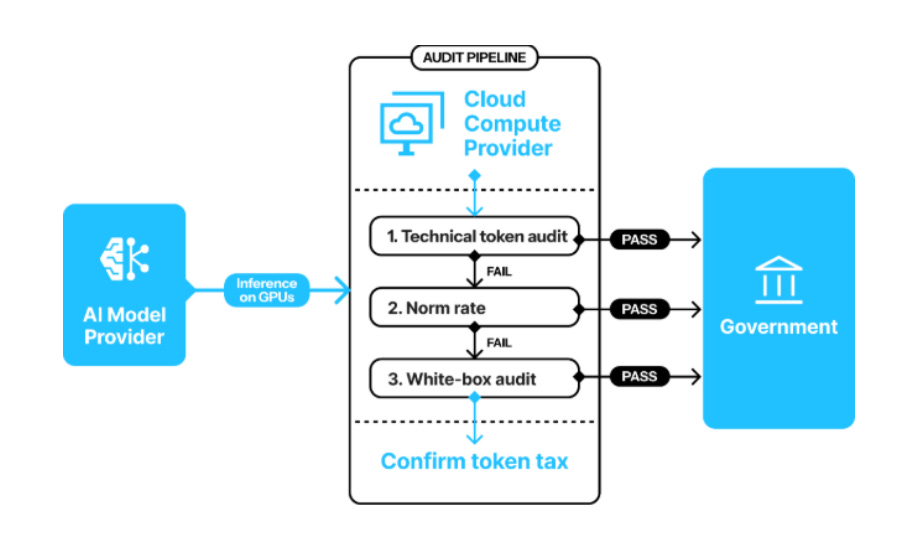
The auditing mechanism behind a token tax.
Our analysis: The paper contains no formal model, simulation, or welfare calculation. The tax incidence depends critically on the demand elasticity of AI inference — the same object OpenAI struggles to measure. Reduced usage doesn’t address safety risks, which don’t scale with token volume. And the relationship to automation is weak: a research lab running millions of tokens for protein folding and a firm using AI to replace customer service workers would face the same per-token tax, despite radically different labor market implications.
There is also a less obvious problem. Taxing inference tokens creates incentives to compress or eliminate chain-of-thought reasoning. Labs would invest in distillation (training smaller models to replicate reasoning outputs without intermediate steps), shifting computation from inference-time tokens into model weights. This could reduce the tax base and make AI reasoning less observable — undermining the interpretability that safety researchers and regulators depend on.
Kim, Kim, and Koning (INSEAD/HBS) provide the clearest experimental evidence to date on why task-level AI productivity gains fail to aggregate to firm-level outcomes. They ran a pre-registered field experiment on 515 high-growth startups across the Middle East and Africa, Asia-Pacific, Europe, and the Americas as part of the INSEAD AI Founder Sprint.
Both treatment and control groups received identical resources, such as $25,000 in API credits, technical AI training, and mentorship. However, treated founders received case studies on how AI-native firms have reorganized their production processes, while control firms received the standard entrepreneurship curriculum.
The headline finding is counterintuitive: treated firms grew faster while demanding fewer resources. They reduced their anticipated capital requirements by 39.5% (~$220,000 per firm; p < 0.05), with no change in labor demand, even as they generated 1.9× higher revenue (p < 0.1) and were 18% more likely to acquire paying customers (p < 0.01).
Treated firms identified 44% more AI use cases (2.7 additional, p < 0.01), concentrated in product development and strategy rather than in routine applications such as email drafting. They completed 12% more tasks, driven entirely by internal work (building, prototyping) rather than external activity (pitching, networking). Revenue gains were concentrated above the 90th percentile of the distribution — most firms saw modest or zero revenue effects, but the few that comprehensively reorganized production experienced compounding gains.
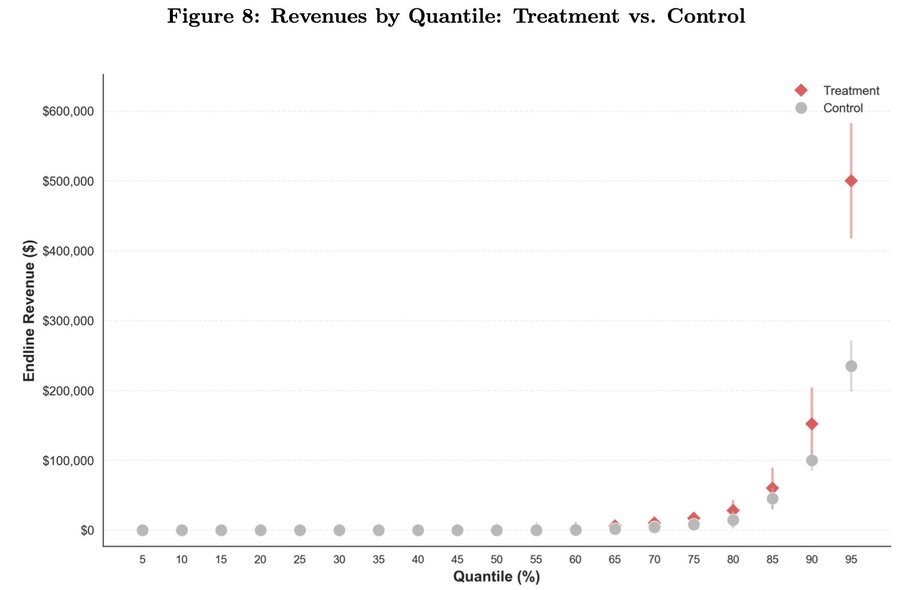
The treatment increases with revenue.
Our analysis: This paper empirically addresses what may be the most important open question in AI economics: why task-level productivity gains have not yet aggregated into firm-level or macroeconomic outcomes. Multiple recent models (as covered in Briefs #1 and #8) have tried to explain this difference through various mechanisms, providing evidence for the O-Ring theory. Most firms see modest or zero gains, but the few that comprehensively reorganize production experience compounding effects.
For open-ended activities, AI may increase output disparity. This differs from smaller-scale studies on specific tasks, where AI helped less-skilled participants catch up. This paper indicates that search, not capability or access, is the main bottleneck for productivity growth from AI.
But these large-growth startups might benefit more from adopting AI than established companies do. Restructuring takes longer there because legacy systems and existing workflows create switching costs. Self-reported outcomes compound this, since coached founders may recognize and label more applications without necessarily implementing more, though the authors’ blinded coding protocol partially mitigates this.
If you found this analysis useful, share it with a colleague who should be following this research.
Labor Market & Employment
Metaculus started its Labor Automation Forecasting Hub, a continuously updated view of how AI may reshape the US labor market through 2035. It expects overall employment to fall by 2.6% until 2035.
Christos Makridis (Arizona State) and Andrew Johnston (Texas) report that US industries with higher exposure to generative AI from 2017 to 2024 saw 10% higher productivity growth, 3.9% higher job growth, and 4.8% higher wage growth per standard deviation of exposure.
Kris Gulati (Berkeley) proposes WAGE-Bench, a benchmark of willingness to accept tasks with or without AI assistance.
Tufts’ American AI Jobs Index predicts that urban, mostly coastal, innovation hubs are more vulnerable to AI-driven job loss than growing Southern cities.
Lee Tucker (Census Bureau) uses administrative data to show an immediate 12% decrease in early-career hiring for the most exposed quintile.
Ernie Tedeschi (Stripe) uses travel agents as a case study in automation, which mostly occurred during recessions.
Anthropic surveyed 81,000 users, showing that more exposed roles are more worried about job displacement.
AI Capabilities & Infrastructure
Michael Blank (Stanford) et al.’s off-work AI productivity study finds 76% to 176% efficiency gains on digital home tasks, none of which show up in GDP. This suggests that AI frees up leisure time by raising the efficiency of productive digital household activities.
Anand Shah (MIT) and Joshua Levy (Southern California) find evidence of LLMs enabling people to file lawsuits without lawyers (filing “pro se”) at historically unprecedented rates in federal courts.
Stanford HAI’s 2026 AI Index tracks Humanity’s Last Exam accuracy rising from 8.8% a year ago to above 50% for Claude Opus 4.6 and Gemini 3.1 Pro.
The venture capitalist firm a16z estimates that ⅔ of AI adoption is coding.
Market Power & Risk
PwC’s 2026 AI Performance Study reports 74% of AI’s measured economic value captured by 20% of firms.
BCG’s AI Will Reshape More Jobs Than It Replaces constructs a four-bucket role-level frame that mirrors OpenAI’s taxonomy.
Fortune’s profile of Imas reports that Morgan Stanley has cited his relational-sector argument on research desks, an early sign of uptake among financial market analysts.
Research Opportunities
AI in Social Science Conference, Chicago, 8 to 9 October. Paper deadline 1 May.
NeurIPS 2026 Position Paper Track, Sydney, 6 to 12 December. Full paper deadline 6 May AoE.
5th Zurich Workshop in AI and Applied Economics, 11 to 12 September. Submission deadline 8 May.
NBER Economic Perspectives on AI in China. Paper deadline 4 June.
NBER AI, Digitization and Financial Markets. Paper deadline 17 June.
OpenAI pilot fellowships and research grants tied to the Industrial Policy for the Intelligence Age document. Up to $100,000 cash and $1 million in API credits.
NBER Economics of AI Conference, Toronto, 23 to 24 September. Invitation only.
Thanks to Deric Cheng and Joel Christoph for contributing to this week’s newsletter.
Comments
Nothing yet. Say the first thing.
Sign in to join the conversation.