
The newest buzz word in bank earnings calls is “tokenized deposits.” Less than three years ago, there were zero mentions of the technology, but now 40% of major banks are talking about it.1
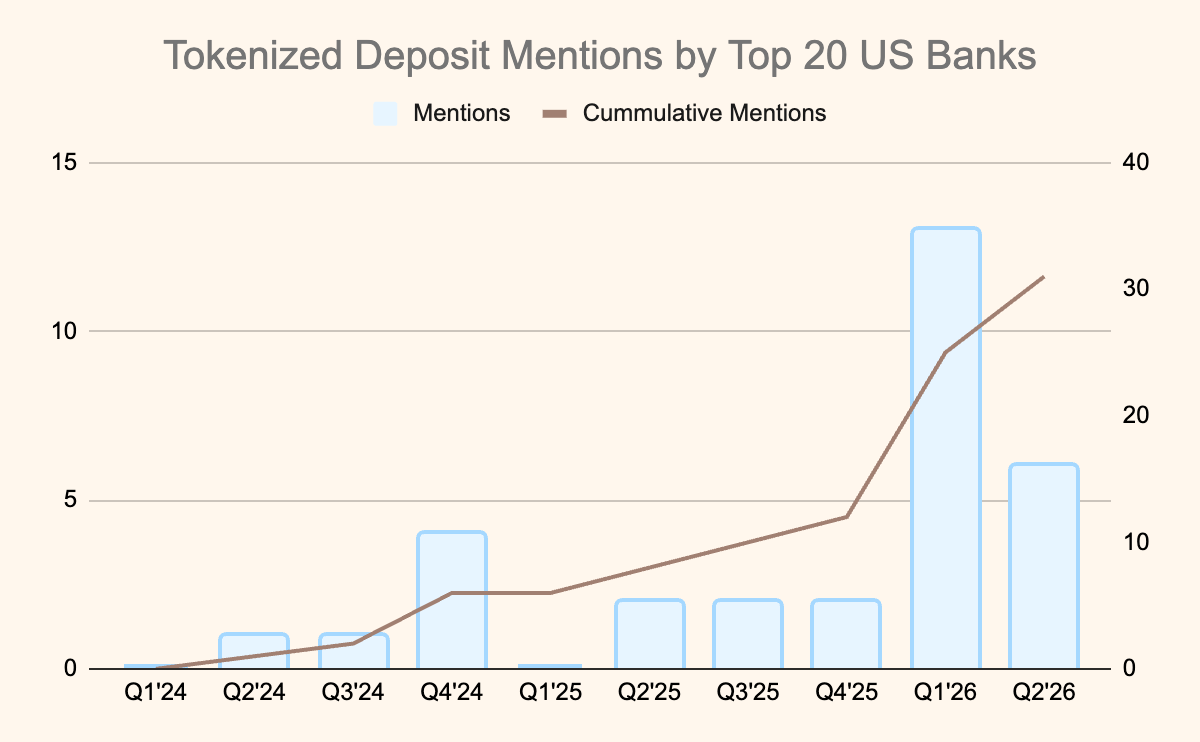
JP Morgan, Citi, and State Street have all launched tokenized deposit services.2 The Clearing House unveiled a 17-bank consortium back in June. Just last week, Wells Fargo announced that it would be introducing tokenized deposits for their commercial clients in the US and UK.
Tokenized deposits has the chance to rewrite the rules of how our money moves and our relationships with banks. By turning banks’ ledger books into programmable software, we’re likely entering an era where the concept of bank and the services they offer will fundamentally shift.
As usual, I started looking to the past to find out what happened the last time the banking and financial industry saw such a shift. What I landed on was in the mid-1800s with the creation of demand deposits. This ended the fractured era of free banking and created a unified standard for fund transfer across the U.S.
In this story, tokenized deposits are the new wildcat scrip. Yesterday’s credit discount will be tomorrow’s API bridge fee. All the tokens redeemable for the same dollar; but every bank has their own ledger, their own rules, and their own language. This will create a fractured market requiring consortiums to help manage and, ultimately, legislation to settle. If history is any guide, we’re likely to follow this pattern:
Changes in laws and technology lead to market innovations
Large, well-capitalized players individually chart a path forward
Small operators enter and rapidly expand + fragment the market
A fractured network leads to regional consortiums and self-regulation ← We Are Here
Governments enact legislation to consolidate and formalize self-regulation
Repeat
What follows is a brief history of free banking in the US, what happened to it, and how it reshaped the financial landscape. Then we’ll see how well tokenized deposits do and don’t fit the historical model before taking a look at what to expect over the next few years as the market evolves.
In 1831, President Andrew Jackson successfully blocked the Second National Bank of the US from having its charter removed. This act killed centralized currency and ended an era of banking monopolies. This ushered in the era of “free” banking, opening up credit to a rapidly expanding United States.3
“Free” banking wasn’t unregulated. Instead, it meant anyone who met a predefined set of requirements could apply for and receive a charter. Each state set its own standards for charter applications and approvals. Approved banks could then issue their own currency which could (in theory) be redeemed at par for gold and silver. These notes were backed by state, federal, and some corporate bonds. One last requirement was that banks could not have multiple branches outside their home city or county.
This may seem wild to us today, but remember that most people stayed in the same place and conducted commerce locally. Having a local scrip kept the money supply flexible to meet local needs and limited the blast radius of booms-busts cycles.
Large cities like New York or highly connected regions like New England could handle multiple large banks issuing scrip. Most of the currency could be exchanged one for one (“at par”) thanks to the quality of the banks’ assets. However, the variety of notes created some challenges with commerce. The banks settled this by creating clearinghouses like New York Clearing House and the Suffolk System — self-regulating organizations that held near-par banking together.
The story was vastly different on the frontier…

In the far flung frontier of Michigan, Illinois, and Missouri; big cities were few but the need for banking services was growing by the day. Less-than-honest financiers would open branches in remote locations on the frontier and issue more currency than they were allowed to by law. They bet was that most people would not travel “where only wildcats prowled” to collect on the notes. This led to too much credit being issued followed by a collapse, leaving anyone holding the notes at a significant loss.
The lack of trust in the quality and authenticity of these notes made par banking nearly impossible. The phrase “your money’s no good here” wasn’t the joke it is today, it was sound business practice. Notes circulated outside of their local area were traded at steep discounts that grew proportional with distance.
All of this came to an end with the passage of the National Currency Act of 1863 and National Bank Act of 1864. These created a national charter system under the Office of the Comptroller of the Currency (OCC)4 and introduced a 10% tax on state-bank issued currency. Critics claimed that these laws would relegate state-charter banking to a “forgotten relic.” Instead, they innovated and completely reshaped commerce in the US for the next 130 years.
State banks shifted from issuing unique currency notes to issuing deposits of dollars available on demand (“demand deposits”). They rapidly expanded the use of checks to fill the role of paper currency. These demand deposit checks became the dominant medium of exchange in the United States from 1880 through to 2010.
Tokenized deposits may unseat demand deposit accounts and the electronic check (i.e., ACH & RTP/FedNow). These tools have been the backbone of commerce in the U.S. for nearly two centuries. If this is to come to pass, banks, fintechs, and regulators must avoid the pitfalls of wildcat banking while also speed-running several decades of financial innovation.
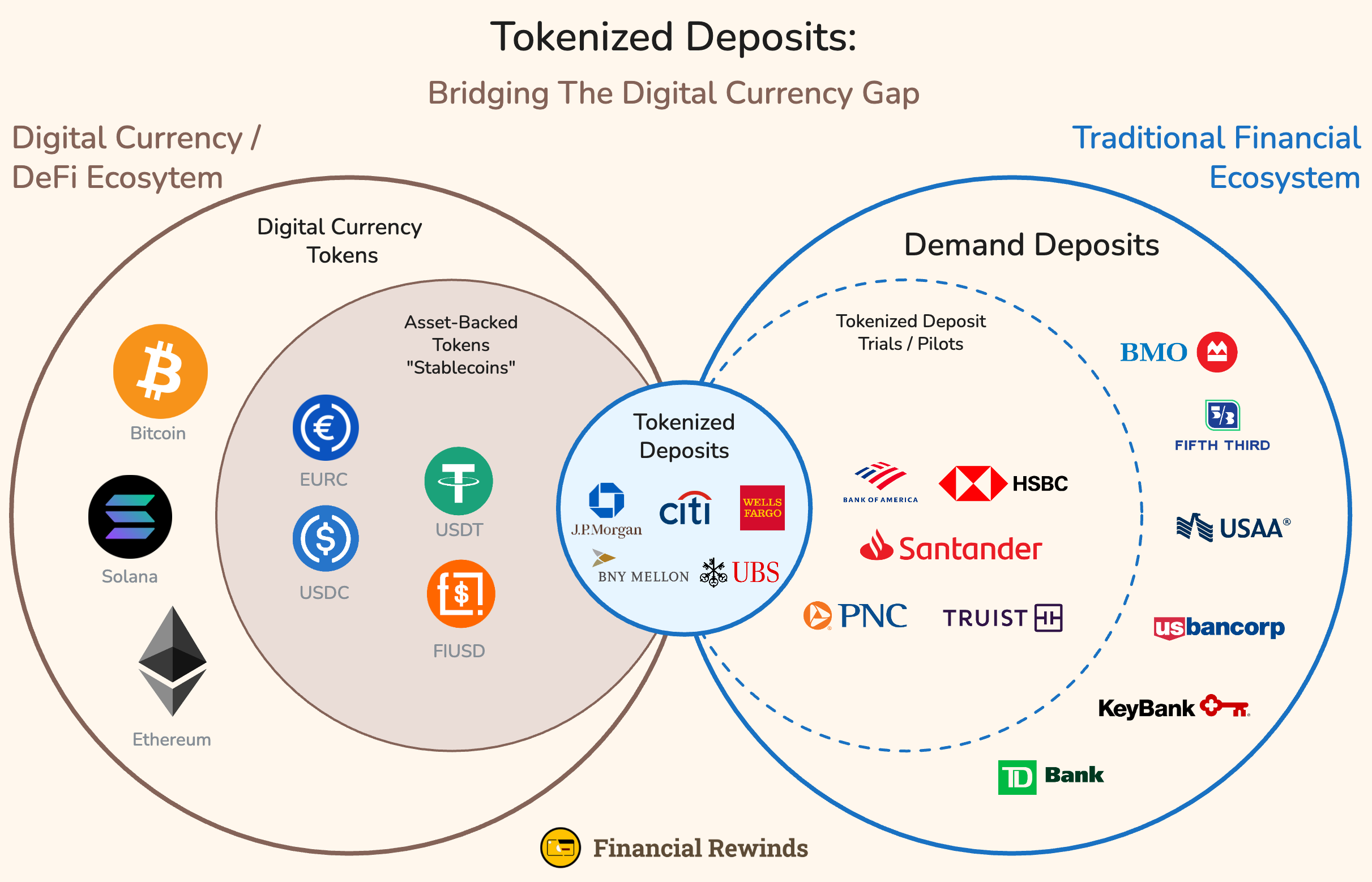
Right now tokenized deposits are another entry into the broader category of digital currencies. They are pushback from banks who have seen deposits trickle out into stablecoins. The GENIUS Act defined the guidelines for banks to bridge the traditional financial system of demand deposits with the decentralized financial system of crypto and stablecoins. However, the situation isn’t as neat and tidy as the graphic above makes it seem.
Tokenized deposits aren’t creating new currencies, per se. They are like a regulated wildcat scrip — at least until more legislative CLARITY is provided. Rather than being redeemable for gold and silver, the tokens represent demand deposits sitting in a bank account. They can be exchanged at par for any other tokenized deposit, but the fragmentation in this era is technical rather than monetary. This has two important implications for the historical pattern.
First, token exchanges, like the moneychangers and correspondents of old, will do great in this environment. They’ll be able to seamlessly connect banks on different platforms (for a fee of course), unlocking faster programmable payments — at least until the market consolidates or the government steps in like the Fed did for check processing in 1913.
This “language barrier” will likely follow the large vs. small split seen with free-banking. This time, however, its likely to be the large, Tier 1 banks out spending the smaller regional and community banks. The large banks have the resources and balance sheets to support the new paradigm, leaving small banks operating at a “discount” due to higher processing fees and licensed tech stacks.5
The second implication is that large banks and first movers may want fragmentation. In the free banking era, the proliferation of currency notes was an accident of policy rather than intentional move. This led to regional consortiums and SROs, but the environment of tokenized deposits is like to organize by network or standard instead of geography.
We’ll close out by taking a look at three broad categories to get a sense of where this could go in the future: Programmable Payments, Stablecoins & CBDCs, and the Future of Banks.
Tokenized deposits are “programmable” in the sense that you can establish rules for how and when they are used. They’re effectively a mini-accounts payable department writing electronic checks. Checks, of course, were the first “programmable” payment instrument: you had to specify receiver, amount, and purpose (though the memo line is a crude instruction at best).
Tokenized deposit schemes can become multi-rail and unlock (near) real-time global clearing thanks to bundling the payment and settlement into a single event. This speed brings innovation, but also risk. We’ve also seen centuries of check innovation and fraud. A tokenized world may see participants finding and acting on arbitrage opportunities. For example:
Fraudsters may find incompatible terms or different field mappings across different bank systems. These could then be used to side-step AML/KYC via creative transaction routing already seen in money laundering schemes.
Companies and correspondent banks could program payments to maximize their own yield. This would come at the expense of the receiver’s operating budget.
Tokenized deposits creates an existential problem for stablecoin issuers like Circle (USDC and EURC). The company saw a 15% drop in market value following the Open USD consortium announcement. Tokenized deposits, like wildcat scrip, also creates a headache for central banks and market regulators who want to maintain control of money supply.
Central bankers are starting to seriously consider issuing central bank digital currencies (CBDCs). This would be like the US treasury stepping in to issue greenbacks in the 1860s. It would unify all banks in a market to a common standard, streamlining commerce across the country. If a tokenized deposit scheme were widely adopted, it could enable a truly global banking system.
We’ll conclude by asking the question:
With tokenized deposits (and CBDCs peeking over the horizon), do we still need so many banks?
Tokenized deposits could be the final nail in the coffin for state-chartered banks. The 24/7 real-time movement could do to US community banks what the UK’s CASS has threatened to do to the kingdom’s smaller financial institutions. However, small US banks are resourceful, and the death of state-chartered banks has been just around the corner for the last 160 years.
Remember, the 1863 banking act was supposed to make them “a forgotten relic.” Instead they innovated with checks and demand deposits. The repeal of Glass-Stegall6 in the 1990s was supposed to kill them, yet the Durbin rule made them essential to many modern fintechs. Crypto was supposed to end banking altogether, but we still pay taxes, and someone has to be the custodian of that fiat currency.
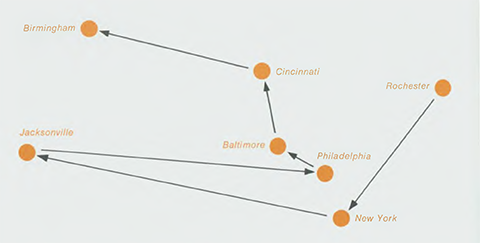
Yes, tokenized deposits could kill smaller banks, but it could also decouple people from mega banks. What’s more likely in the near-ish term is that we end up with a disjointed token processing system to reflect the bifurcated (really, trifurcated) regulatory system in the US. It remains to be seen if we repeating the famous “Journey of a Check” seen below.
For now, there’s much left to see. Most deployments are generally still limited to major banks and have generally been focused on internal transfers and pilot tests. As Steve Klebe and Allen Lipis both explained, new payment innovations take years, even decades, to gain widespread adoption. The big banks will continue to lead the way with big R&D budgets and expansive balance sheets. The small FIs will do what they always do: adapt to meet the moment.
Major Sources:
Allan Greenspan Speech: https://www.federalreserve.gov/boarddocs/speeches/1998/19980502.htm
Federal Reserve History:7
https://www.federalreservehistory.org/essays/national-banking-acts
The graph is based on searches for “Tokenized Deposit”, “Distributed Ledger Technology”, and “Blockchain” across the public filings and earnings transcripts for the top 20 banks in the United States by assets.
Erin McCune wrote an entire book chapter on the subject. This post is, in part, a reply to her.
Easier access to credit was a necessity, especially on the frontier (where Jackson had fought and where many settlers were heading). Farming requires credit for supplies that cannot be repaid until the harvest. Less credit means less development which means less output — this is pre-industrial America, after all.
For those keeping track, we are up to 2 out of the 4 major US banking regulators (States and OCC). Carter Glass spearheaded the other two: the Federal Reserve in 1913 and the FDIC in 1933.
I promise I’m getting to it Tom.
If this sounds like a stretch, I would like to point you back to the founding of the modern credit card industry. After Diner’s Club and American Express got started, Bank of America’s BankAmericard quickly swallowed most of the market. BankAmericard, thanks to licensing deal, was poised to be the only game in town before a group of banks came together to form the Interbank Card Association. The latter group never quite caught up (due to myriad factors) and the divide is present to this day in the market shares of Visa and Mastercard, respectively.
Again, Tom, I promise I’m getting there soon.
There’s an entire side tangent I will make as a bonus post to this around the legally mandated matryoshka doll of banking relationships in the 1800s. Deposits were layered in a way that could turn a poor harvest in Kentucky into a bank run in Connecticut — though it was usually a canal or rail line.
Comments
Nothing yet. Say the first thing.
Sign in to join the conversation.