
I’ve spent the last three months combing through the personal notes of the most influential payments professional you’ve likely never heard of. Today’s subject created the way you get a paycheck, championed check imaging, and encouraged the development of ATMs that accept any debit card.
Dr. Allen Lipis has made an indelible mark on the payments world.
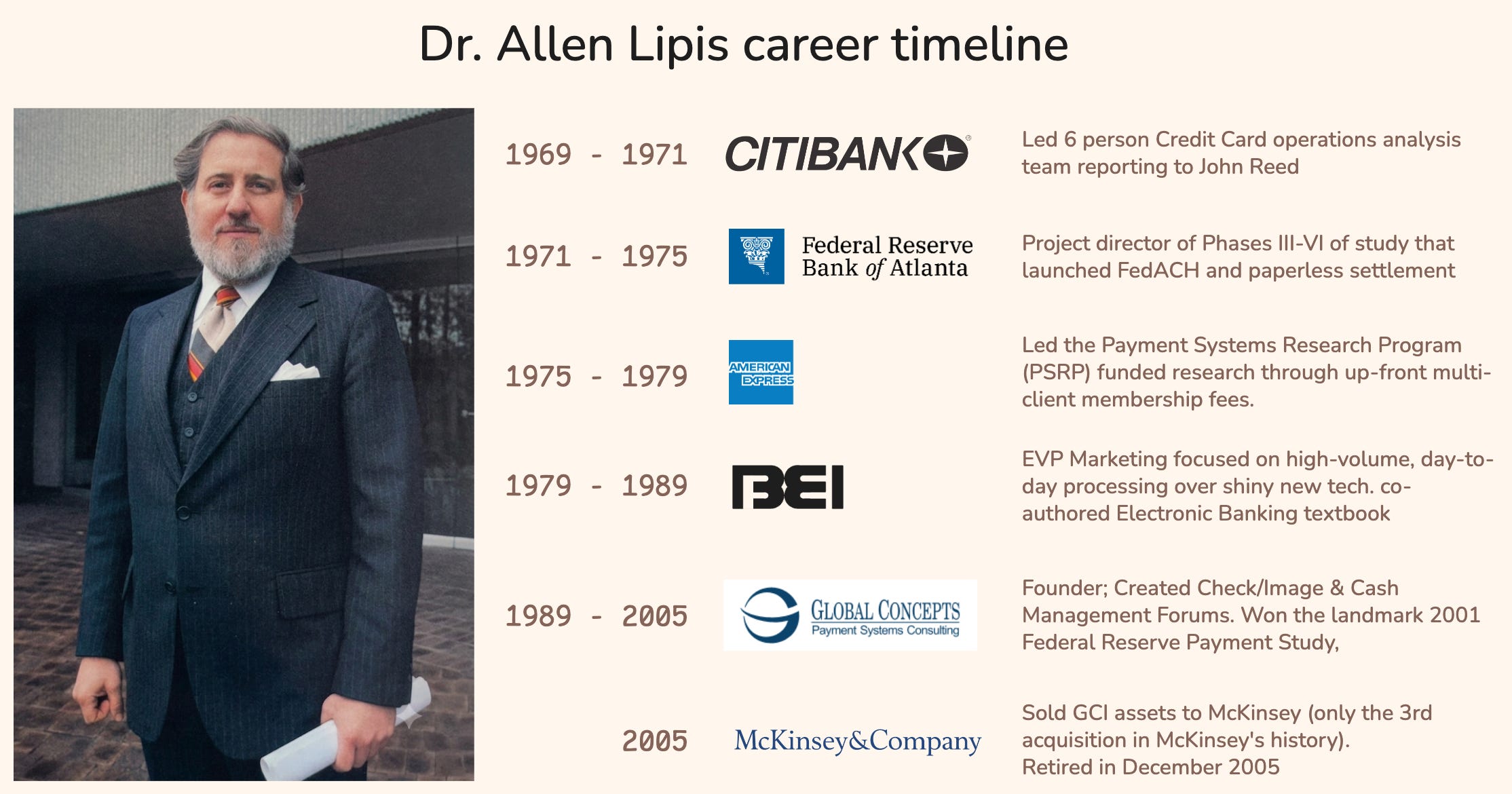
Lipis set the direction of electronic payments in 1971 by leading the Atlanta Payments Project, afterwards becoming an evangelist for electronic payments. He spun that success into a series of consulting and advisory firms, sprinkling his staff up and down Peachtree Street, aka “Transaction Alley”. He was an inaugural member of the EFT Hall of Fame. It’s no exaggeration to say that his influence made Atlanta a mecca for payments.
Lipis’s success is not some accident of history nor is it a “right place, right time” stroke of luck. He repeated his successes dozens of times across a nearly forty-year span. All it took was a method for identifying market moments and a system for acting on it. As he explains in his autobiography It’s All About Business:
In looking back on the banking industry, one study or one event can change an industry or a company. [...] These one-time big events occur more often than you think... On many occasions, the world is not as complex as it looks. It is not always obvious, but the more you know about a subject, the more obvious the direction will be.
Across weeks of emailing and hours of conversation, Dr. Lipis shared his story, his insight on current payment trends, and his playbook for building a successful firm. This post is as much about his life as it is about how to recreate his success in a new era of payments.
I’ve been trying to contact Dr. Allen Lipis for the last half decade. He was one of the few people still living that was in the room when ACH was created. His perspective, I felt, would bring the human element to the posts I’ve written about the Atlanta Payments Project (APP). Through a wonderful twist of fate, I came to know Glen Sarvady who got me in touch with Dr. Lipis. What started as a short chat quickly turned into a two hour phone call and invitation to visit his home.
When I arrived at his mid-century Atlanta bungalow, he ushered me into his office. Having retired in 2005, one would normally expect the 86 year-old Lipis to be slightly disconnected from current industry trends. Instead, he had two monitors open with financial charts, AI chatbots, and reports on stablecoins. Plopping the folder onto a desk, he wove a tale of market evolutions and how to manufacture what others might call luck.
My success was not an accident. It’s safe to say the chairman of the board for Big Deal Corporation will not “discover” you on the street and invite you to assume the role of president. If you want to be the boss of something… you will need to do a lot of the same things I did.
Many of the events that happened in my life were not of my doing. I was not in control, and I believed that luck played a major role in how my life unfolded. The key was to recognize an opportunity when it presented itself and then decide whether to take advantage of that opportunity or not.
Dr. Allen Lipis got into the payments field like many of us do: by accident and in his late 20s. He “reluctantly” joined NYC-based Citibank in 1968 after a previous business relationship dissolved. With a doctorate in Operations Research from Wharton, Lipis’ first assignment was to lead a research study of credit card operations. His goal was to determine whether Citibank or another system was cheaper and to recommend how they might work together.
Lipis always started by anchoring everyone on future improvement rather than judging past performance. This broke down barriers while he built trust by leaning on Citibank’s existing reputation and operational performance. The project produced a good report and the building blocks of his method for success. After another internal consulting project on check processing, he had developed a strong reputation with John Reed, future CEO of Citibank.
So, when Fed Governor George W. Mitchell called Reed asking for banking talent on APP, Lipis was immediately selected for the job. This “lucky break” changed Lipis’ career by bringing him to Atlanta, but it was Lipis who took advantage of it. Once in the Peach State, Lipis transformed the fledgling research project into a vision for the future by further refining the method.
The first order of business was getting local banks to contribute talent. Using the Fed’s influence, Lipis convinced several of Atlanta’s largest banks to join the Committee On Paperless Entries (COPE). Next, he had COPE members supply the talent and resources that would fuel APP with the promise that they could bring the results back into their home organizations. The result was a working ACH network, details on how to build an ATM/Debit card system, and a 1,300 page guide to a paperless future.
With the initial research and strategy complete, Lipis made a business out of marketing the results. He and other members of APP and COPE sold copies of the report, travelled around the country to present their results to bankers, and consulted with financial institutions on how to implement it. The road show built a network of future clients and employees that he would draw on once APP concluded in 1975. It also put Atlanta on the map according to a 1985 Atlanta Business Chronicle article:
When the [APP] study was published in 1972, the results drew international recognition. As a result of the study and the work that followed it for more than a decade, the city’s electronic banking research community became recognized throughout the industry as the foremost colony of payment system futurists in the nation.
Atlanta is a city Northern bankers have looked at to scope the future shape of retail transactions. The city is famous among bankers for its leadership in electronic payments, one of the most important and controversial topics in the industry today.
Lipis chose to stay in Atlanta rather than return to Citibank in New York, choosing to join Payment Systems Inc. (PSI) in order to build its Payment System Research Program (PSRP). PSRP had seventy member banks in 1975 and was generating substantial revenues, but relied on external consultants. Lipis applied his method to PSRP to build internal talent and increase the quality of the work.
After PSI was acquired by American Express, Lipis was given a budget to expand PSRP and hire on staff. He used his existing network to source talent from banks he’d worked with on APP. PSRP operated independently and developed a reputation within American Express for delivering quality results.
Lipis had developed a good product, and focused on “growing it aggressively” before launching anything new. There were conferences, multiple publications, research reports, and consulting generating more than $1 million in revenue. However, Lipis didn’t care much for consulting. So when a power struggle occurred in 1978, he handed over control of the consulting arm to someone else.
“It was the worst decision that I made in my entire professional career,” he later wrote.
Without consulting, Lipis faced a new boss and peer with vastly different views on how PSRP should be run. Disenchanted, he left PSRP in 1978 to form Electronic Banking Inc. (EBI) with fellow PSI & PSRP employee, Bob Cady.
Lipis and Cady co-founded EBI to conduct research on emerging electronic banking trends. Using their existing contacts and talent network, they launched a multi-client research study on telephone banking. There was a spark of initial demand for information about the new technology.
Eager to capitalize on their early success and replicate PSRP, Lipis expanded the team and with it EBI’s scope of work. They planned to launch an electronic bill payment forum, three new research studies, and multiple symposiums. By the end of 1980, EBI was generating more than $700,000, but had almost no profits thanks to all the increased overhead. By 1982, EBI was still generating sizable revenues but faced bankruptcy. This forced a sale to Bank Earnings International (BEI). Another stroke of (bad) luck, that Lipis would turn into one of the best opportunities.
Reflecting in his book decades later, Lipis describes several reasons EBI failed. Aside from growth outstripping poor cash flows, there were two key lessons Lipis learned that reshaped his method.
The first is that Lipis didn’t know how to sell. Executing a cold-start and bootstrapping require that everyone involved be able to step in and contribute across all functions. He admits, “once one of us failed, the company failed. I didn’t want to sell, and Bob didn’t want to do product development. There was just too much that depended on a single person.”
The second is that EBI was solving the right problems at the wrong time. EBI was too focused on future payment systems, rather than on present payment systems and their problems. “It takes 15 years for new banking systems to really take off,” he explained to me. Even though he was right – electronic banking did become the norm – finding the right problem is only half the challenge. Lipis writes:
If the program is too early, the potential members […] won’t see it as necessary. If the program is too late in the marketplace, then potential members will be involved with other consultants or committed to a direction they don’t think they can change...
BEI turned out to be the perfect place for Lipis to learn from his mistakes and move forward.
The Method Matures
BEI had several decades of experience focused not on the cutting edge, but on the mundane and “ordinary.” The company’s goal was in the name: improve bank earnings. They offered a broad range of services beyond just electronic banking. The fee model also differed from Lipis’ previous experience; it was contingent on a percentage of the actual earnings improvements rather than a single flat fee.
The eight years Lipis spent at BEI transformed the way he saw the business. He writes, “In my first company, I only felt comfortable consulting on services that I knew well…I only had expertise in a small area.” He learned that the only way to thrive was by trusting others to succeed where he couldn’t. This included establishing joint ventures with “other much larger companies” like Ross Perot’s EDS to serve as inbound channels.
Lipis learned to “launch new programs when the market needed it, and then find the expertise to manage it.” At BEI, when they saw an opportunity, then they would rush to it as quickly as possible. Such was the case when microcomputers (i.e. desktops) began entering the banking industry. Lipis launched a research program that generated nearly $500,000.
Following a merger in May 1986, BEI began moving away from bank consulting, and Lipis eventually moved over to lead marketing. By 1988 he had resolved to leave the company, and in 1989 he resigned to co-found Global Concepts Inc. (GCI) with Steve White.
A year later, Lipis met with a Unisys director at a banking conference while promoting GCI. It’s here that he first learned about check image technology and got the idea for GCI’s first big hit: the Image Forum. Lipis knew this was the right moment to get into the technology, because he understood the immediate impact it would have on bank operations. Lipis then used Unisys, IBM, and BancTec to lend legitimacy to the research in the US, but it was Lipis who would have to sell it.
Multiclient programs like the Image Forum are a a “chicken-and-egg” problem. To solve it, Lipis turned to a classic playground trick. He knew clients would only join if they knew others would join. He treated it like organizing a pickup game, explaining:
You have to tell prospect A that prospects B, C, and D are ready to join if prospect A will join and then tell prospect B that prospect A, C, and D are ready to join if prospect B joins, and so on. Once the nucleus is established, the program sells itself provided the subject matter is of interest to the participants.
The first forum was so successful that it put GCI on the map as the clear leader in an emerging field. Another Unisys leader approached Lipis about doing the same thing in the UK. Over the course of six months in London, he did it from a cold-start. As he explains it:
“I left the meeting with the realization that image technology was going to change cheque processing, that Global Concepts would be at the center of understanding that technology, that I now had an international company, and I could sell.”
Six years later in 1997, Lipis had bought out White, brought on Steve Ledford (among many others), and grown GCI to a multi-national force in the payments industry. GCI had advised Chemical Bank on checks and cards, Total Systems on their TS2 product, and Visa on their debit product relaunch. They’d even launched the Internet Forum to promote online banking and payment research. Through it all, though, Lipis didn’t forget his roots.
After spending 26 years trying to kill paper checks and replace it with electronic banking and ACH, Lipis publicly “repented” in his most famous speech, The Check is King. In it, he chastised himself and the audience for “flogging the ordinary [check] because it is so ordinary.”
“Little minds,” Lipis explains, “are interested in the extraordinary. Great minds are interested in the commonplace.”
He’d spent his career to that point trying to upend the existing system with expensive new technology. Electronic payments received all the marketing push and institutional backing. This competition forced check processing to get faster, cheaper, and even more profitable.
At his speech’s crescendo, he called on listeners to invert their way of thinking. Rather than putting all the advertising and policy into the new and disruptive, advertise the cheap and old while focusing on making the new system more efficient. “The most successful business man is the man who holds onto the old just as long as it is good,” he extolled. “And grabs the new just as soon as it is better.”
The “ordinary” things are “where the most money can be made and saved.” They contain the biggest problems, highest near-term impact, and greatest chance for success. He put it to me by saying, “I always ask, ‘is there a better way?’”
The largest contract in GCI history came from a landmark 2001 check-volume study for the Federal Reserve — a full circle moment that returned to the heart of the Atlanta Payments Project. In 2004, Lipis sold GCI to McKinsey & Company (only the third acquisition to that point) before retiring in 2005.
After nearly three hours of pouring through his notes, Dr. Lipis asked if I’d found what I came there for. Ostensibly, I had exactly what I’d set out to get in 2021. I had the quotes, the color, and the history; but it all felt stale. Glancing again at his monitor, the market was nearing close and another article on tokenized deposits was open on his browser. I finally replied, “no, not entirely. I do have one more question.”
I once again explained why I write about payments history: the past shapes our present and offers a pattern (or anti-pattern) for the future, but it is quickly forgotten. “You were at the center of several key shifts in the payments industry — electronic banking, check imaging, internet payments — how do you find the right people to talk to when the field is just starting out like with AI, stablecoins, or tokenized deposits?”
“There are no experts,” he said. Emerging fields, like electronic payments in the 1970s or tokenized deposits today, lack true domain experts — especially near the beginning. When rebuilding the team at APP, he knew there were no seasoned experts in electronic funds transfer (EFT), but there were experts in computer processing, in check clearing, and in treasury management.
He brought together cross-domain operators and made the fuzzy concept of electronic banking real. They had “an ability to imagine what the world of electronic banking might realistically look like.“ This group became the new experts — exactly what the industry needed at exactly the right time.
AI bank operations?
Stablecoin finance?
Tokenized deposits?
All of today’s latest excitements in banking and payments carry the buzz and excitement that new technology brings. Like ACH in 1975, we have created “sleeping giants” that have only just begun to stir. When asked if the market needed another APP or GCI study to crystalize a consensus vision for the future, Lipis paused.
Then he closed our conversation saying:
In the early stages of development, the market is trying to form consensus about the future. This requires cooperation between major players which is easier at the beginning because it drives down costs by streamlining operations. Eventually, however, this breaks down when the competitive edge becomes greater than the cooperative benefits.
Right now, the market is still forming. I’m too old; I’ve had my time. I think there’s an opportunity for someone — you, your readers, whoever — to do it again.
Stablecoins and agentic commerce are coalescing around some common standards. However, the environment is still fractured and lacking a clear winner: exactly like it was with ACH in the 1970s, ATM/debit cards in the 1980s, and internet banking in the 1990s. The tried and tested playbook is there, and the field is set. the only question now is who’s going to pick up the ball and run.
Comments
Nothing yet. Say the first thing.
Sign in to join the conversation.