
I asked the same question at four of the biggest fintech and payment conferences over the last year. Here were the expert’s replies:
“Our solution addresses a part of your question, but we need other companies to fully address it”
“We’re still exploring options”
”That’s not in our scope”
”It’s a ‘wait and see’ kind of situation”
”Good questions…um…”
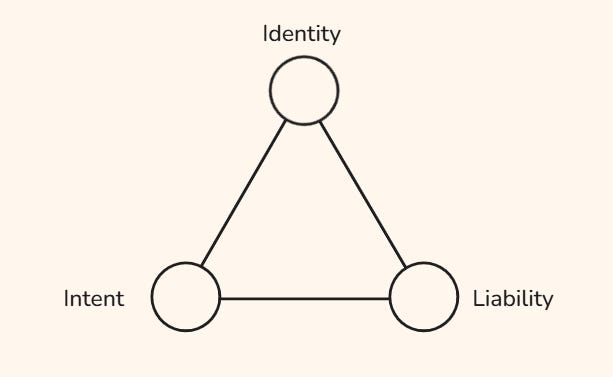
What was the question? How do we balance identity, intent, and liability in Agentic Commerce?
Identity: How do you establish who the humans and AI are?
Intent: How do you ensure the AI’s action is what the human/business wants?
Liability: Who’s responsible for the result when things go wrong?
There were plenty of answers for each part individually. American Express, Visa, and Mastercard are developing solutions to establish identity through “Know Your Agent” tools. The schemes and major merchants like Walmart and Amazon have launched wildly different solutions that shape how AI agents shop.1 AI model labs and banks have controls on liability in their terms of service.
Everyone has a part of the answer, but we haven’t stepped back to see the big picture. The challenge is that the three questions are linked. Solving for just one portion leaves gaps — the kinds that cause bad customer outcomes, reputational damage, and major fraud issues.
This is more than just a fun thought experiment. It’s a question that tugs at the heart of all commerce: How do we maintain trust when intermediaries are involved? No single person, company, or segment of the payment ecosystem is capable of answering it on their own.
Over the last eighteen months, hundreds of individual AI-powered solutions have been announced (and rolled back), but nothing has stuck. Even the card schemes have prioritized bespoke solutions over common standards (though that is changing) — for more, see Panagiotis’s FinTech Newsletter.
Everyone’s putting forward a vision of the future, but there’s a gap — a chasm, really — between this future and our present. Bridging this gap will require banks, fintechs, networks, model operators, and merchants all working together. Just like we’ve been doing for centuries.
What I asked the experts about, the Agentic Triangle, is built on three simple questions. They’re the same questions people asked about the first electronic transactions in the 1960s and 1970s. They’re the same questions people asked about correspondent banking. They’re the same questions asked when giving a teenager access to a spending card. Why? Because these questions are timeless and get at the heart of trusting others to act on our behalf.
AI Agents are the next evolution in a long line of solutions to commercial complexity. Before this we’ve developed smart contracts, machine-learning algorithms, and payment network rules. Historically, systems like correspondent banking and merchant guilds established human-centered rules and processes to manage the complexities of their respective age.
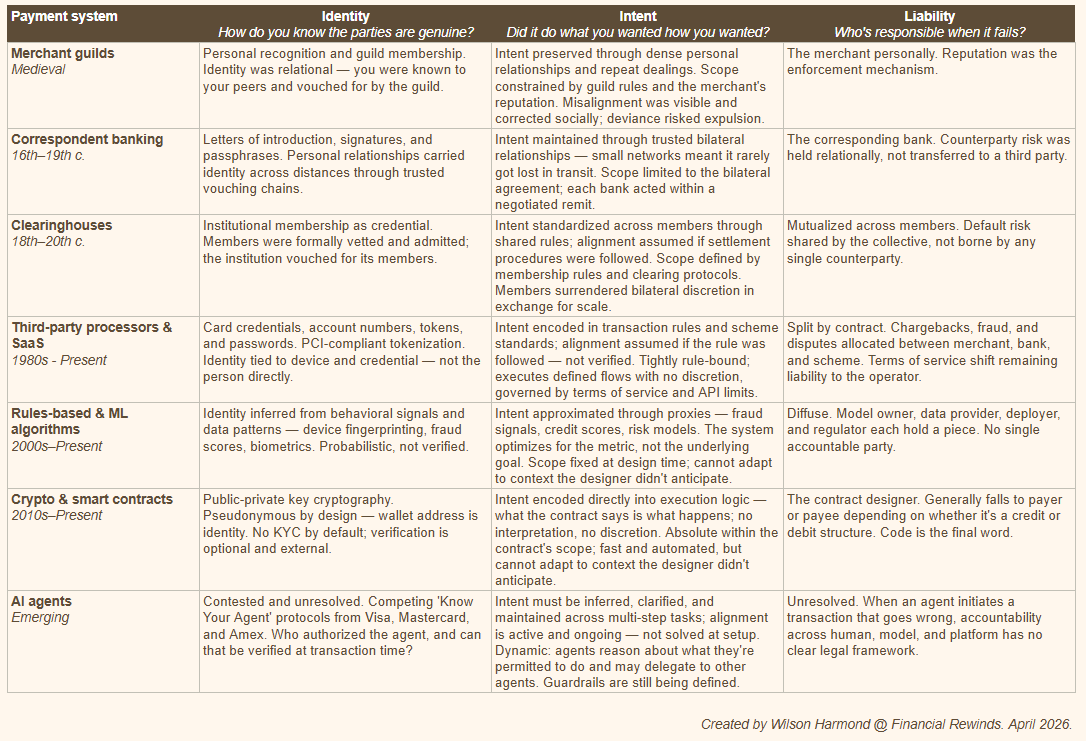
As trust has migrated from individuals to systems, we’ve put put process over character. This makes the system more scalable at the expense of personal trust. However, the rules we use today are still value judgements — even if it is written in code. What makes AI-based commerce difficult is that it breaks the historical trend. Trust is still migrating to a system, but it’s a system that’s evolved an individual “personality” and set of “skills”. It’s a technological step forward and a social step hundreds of years into the past.
Agentic AI is a step-change technological improvement. It is uniquely good at parsing large, complex systems and completing open-ended tasks (like finding a deal, bidding on a rare item). It’s also good at identifying opportunities and loopholes that a normal person, AP professional, or banker might not see. This could be because they don’t have the skill to see it, but more often it’s because a single person can’t comprehend the full scope and detail of every document.
The last decade was built on the narrative of big-data and endless possibility. However, a world of infinite choice is hard to navigate for personal finances and small businesses, let alone international banks and conglomerates.
Complexity, not technology, has long been the moat of financial services. AI removes that complexity. It can read through data and make a decision in real-time to reduce fraud, improve uplift, and reduce costs – things no human can do at scale. It makes the prospect of “programmable money” a reality rather than a Discord thread. Yet, agentic AI isn’t like the previous leaps forward.
Agentic AI is a step backward, socially. Rather than being strictly programmable and rules-based, AI agents are stochastic and heavily context-dependent. The model weights and prompts will produce different outputs if you’re doing online shopping vs. writing an essay. This changes the agent from lines of machine code to a genuine third-party connecting a payer and payee. In short, we’ve reinvented correspondent commerce.
Correspondent systems relied on both interpersonal trust and rules to be effective at establishing identity, maintaining intent, and transferring liability. It functions like a group of close friends playing a regional (or global) game of telephone. The friends all agree on a common way to communicate and trust the others to act in the group’s best interest. This is still the foundation of international bank transfers today.
Identity was based on signatures, passphrases, and personal relationships. These helped trust travel incredible distances from San Francisco to London to Cairo, Calcutta, and Canberra. Our modern equivalent looks like digital signatures, public-private key cryptography, and competing “Know Your Agent” protocols being put forth by networks, acquirers, and model operators.
Maintaining intent relied on close relationships between parties. Cultivating today’s web requires standard communication rules to avoid information decay — like those that enabled international wires, telex, and SWIFT to work.
It was enforced through both formal contracts and risk of reputational damage. The first requires an overarching authority that has the ability to enforce the rules — something networks and large banks are uniquely positioned to do at a global scale. The latter requires that we maintain enough viable alternatives, because reputation equals trust; and trust is the foundation of payments and finance. This keeps the interests of users and model operators (roughly) aligned.
Establishing liability also flows through legal contracts and terms. In correspondent banking, when things go, wrong liability is uniquely held by the furthest link in the chain. If an intermediary mishandles the transaction, they are liable for making it end receiver whole. However, AI users typically sign away most of their rights to pursue the model provider for claims, because they lack power to push back.
This is where banks, merchants, and their payment processors will need to step up. Each has a vested interest in not providing bad experiences to account holders and customers. The most extreme stance is to establish strong rules and directives such as “we won’t process your payments unless you use our bespoke solution.” The temperate middle ground is what happened with PCI DSS or EWS: major stakeholders coming together and agreeing to common standards and cooperation.
The biggest challenge the industry faces with Agentic Finance is that unless the entire industry coalesces around a unified standard, AI companies are going to play rules/regulation arbitrage. This is exactly the kind of game AI Agents are uniquely good at, assuming they’re willing to respect the rules in the first place. Assuming we get the rules right, we’re still left with implementing them
The emergence of vibe coding and operator-turned-founder has accelerated the need for solutions that “just take care of it.” History is littered with companies that tried to solve payments themselves, only to burn out the core business.2 This is why financial intermediaries – banks, networks, processors – are and will still be needed. Even if we write perfect rules, we will still have to deal with intermediaries, because our system is too complex.
Society has always resented intermediaries for being greedy “gatekeepers,” and now we’re building one that can’t be bribed, expelled from a guild, or sued. Despite the animosity, they have always been viewed as a necessary evil. This is why they often feature as villains in myth and literature — Hermes was the god of merchants, messengers, and thieves, after all.
We need to address the questions of the agentic triangle. This new financial channel won’t work if we don’t. However, we can’t do it in silos. The rules for this new class of intermediaries must be addressed at an industry level. If not, we may end up with a marketplace of pickpockets rather than helpful merchants.
With Amazon taking the very hard line of blocking external AI crawlers and banning outside agents vs. Walmart building common standards for navigating its site.
Many thanks to Jimmy Fong from ripper.dev for reviewing an early draft of this post and suggesting this thread.
Comments
Nothing yet. Say the first thing.
Sign in to join the conversation.