
Proof of Payment is about getting the inside story on payments innovations from the people with the receipts.
I created this series for me, because I couldn’t find what I wanted to learn. There’s lots of great content covering founding stories or how industry giants work, but there’s little on how to actually build something hard. How do you do you find great ideas in your company and how to you transform it into reality? How do you deliver hard truths? How do you deal with things when they blow up or go crazy?
Any time you mention the name Steve Klebe to someone in the payments industry, you get the same response. “He’s a great guy.” “Absolute legend in the field.” Once you spend time with him, it’s no surprise why these are the reactions.
First, the long-time Bay Area resident is incredibly generous with his time, expertise, and insights. Klebe and I spent hours on the phone and online talking and refining this draft. He spent his entire career teaching and mentoring people, and continues to do so as a board member and angel investor. He also helped stitch together the industry as a very active member of different industry trade groups.
Second, and more importantly, Klebe is one of the foundational figures in the modern payments industry. He sold some of the earliest POS terminals at VeriFone, facilitated the first internet payment transactions with CyberCash and CyberSource, and was instrumental to the many rebirths of Google’s payments division.
Throughout his career, Klebe rode waves of innovation and saw firsthand the disconnect between business expectations and market demands. He is proof that payments innovation isn’t driven by visionaries predicting the future. The future is built by operators who recognize what the market is already pulling towards and building it — whether insiders wanted it our not.
This post follows the beginning of Klebe’s career in payments at VeriFone in the mid-1980s through the internet revolution and dotcom bust at CyberCash and then CyberSource. We next jump to his time at Google in the 2010s where he navigated the wallet revolution. It concludes with how the lessons learned across 40 years of navigating payments innovation can be used by today’s founders and operators.
Formed in 1981, the company was the brainchild of William “Bill” Melton1 and was formed so merchants could verify cards were not lost or stolen in real-time over the phone (hence the name of the company and their first product). It was the perfect time: credit card fraud exploded from $15 million in 1981 to nearly $50 million in 19822. Verifone’s first authorization terminal, ZON, hit the market soon after. By 1985, the “little science experiment” out of Hawaii had hired its thirty-fifth employee, Steve Klebe, and the 40-year journey had begun.
“When I joined the company, I suggested strongly that they move HQ from Hawaii to the Bay Area,” Klebe explained. Verifone had just landed a contract to manufacture the Visa mini terminal (aka Zon Jr.) and had potential, but there was a problem. As Klebe put it, “a lot of people did not take companies that were based in Hawaii seriously.” It wasn’t because there weren’t talented engineers and business people there, but if a client needed to come visit HQ, “everyone else would consider it a boondoggle.” His argument won out, and management agreed to move HQ to California.
“The original ZON terminals would sometimes smoke and the code was hard coded to EPROMs. We were a distant third in a nascent POS terminal industry,” Klebe said of the early days of Verifone. His role was to compete against two industry giants GTE and Japan’s Omron using the lightweight, low-cost ZON Jr.
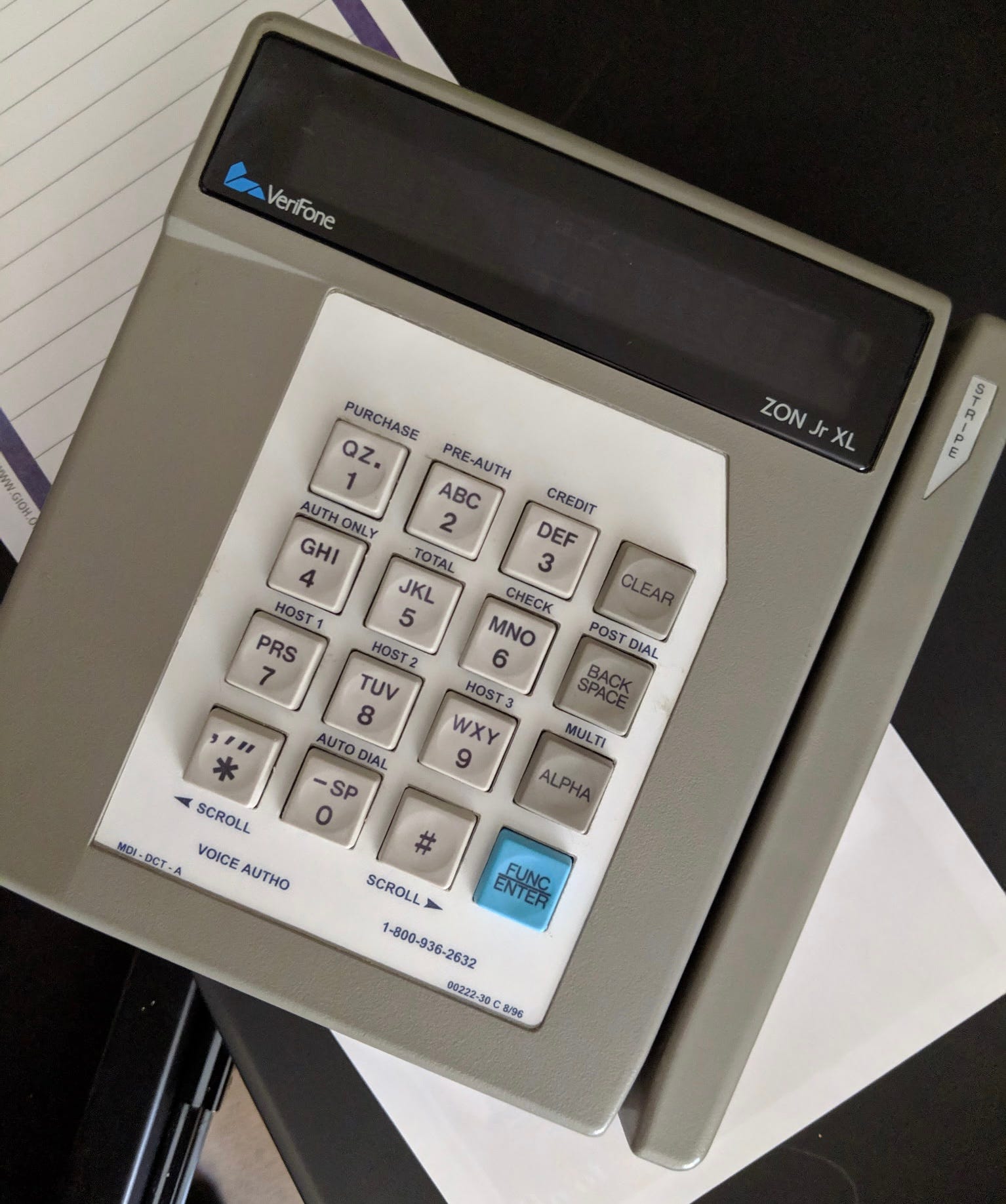
At the time, every terminal on the market came with an integrated telephone handset. Merchants needed it to talk with acquirers for voice authorizations, and the physical integration made sense given counter space constraints. So Verifone released the ZON Jr. without a handset, and merchants “panicked.” They were so conditioned to the old form factor that the absence of a phone felt like a missing feature, even though it was a design improvement.
Verifone ended up manufacturing an external handset adapter just to ease the transition, and continued growing. This was due in part to Klebe and the team at Verifone, but he cites another event as more consequential. As he told me, “The incentives that Visa and MasterCard put in place (TIRF and AID) for merchants to move off of the paper warning bulletins [were the real inflection point].”
By 1987, Klebe and others realized that everything needed for processing a payment was already in the authorization message. “Going from authorization-only terminals to electronic draft capture (EDC) was the single most transformational thing that happened to the card industry,” Klebe says of the move to EDC. “It completely changed the dynamics.”
Up to that point, most merchants had to do business with a bank down the street because they needed to deliver paper drafts from “knuckle-busters”. Banks then transported the drafts to places like First Data’s facility in Omaha to process the stacks of paper drafts through Recognition Equipment machines.
Aside from cutting the costs and processing times (10 days to 1 day), EDC made independent sales organizations (ISOs) possible. Banks and merchant acquirers could now have a salesforce signing merchants anywhere in the country. Banks like FNBO (First National Bank of Omaha) seized on the opportunity and sponsored ISOs throughout the country.
Klebe was one first to see the significance of this change and realized the significance of ISOs as a distribution channel.3 There were hiccups with the new channel and the rules needed work, but the growth was there. The ISOs were scrappy, aggressive, and often underfunded. To compensate, they charged high fees, especially for renting the terminals. These were used to drive sales commissions, which drove aggressive salespeople into every corner of the market.
Seeing the growth in terminal adoption, the card networks took their time putting new rules in place to govern ISOs. Adoption of the new terminals resulted in a dramatic increase in card acceptance and corresponding reduction in fraud.
Up to this point, Verifone had only ever sold to banks and directly to very large merchants. They had no processes set up to verify the ISO’s ability to pay for the terminals. Thanks to the buy-then-rent approach of sales teams and the lax card rules, Verifone was burned multiple times trying to sort out the new channel.
Throughout it all, Klebe put in the work along with a growing team of hard working and motivated people. They worked together to transform Verifone from a “laughing stock” to THE terminal provider.
Steve Klebe’s career is full of wild stories. These aren’t the fun stories you hear about. We always hear about how Verifone innovated: they broke into a market selling $200 terminals when the best anybody else could do was $700. Then they took the top spot in the market — doubling revenues from $15 million to $30 million in between 1985 and 1986.4 We rarely hear about what it took to get there, and, until now, we never hear about the guy sitting in the closet unscrewing 3,000 terminals.
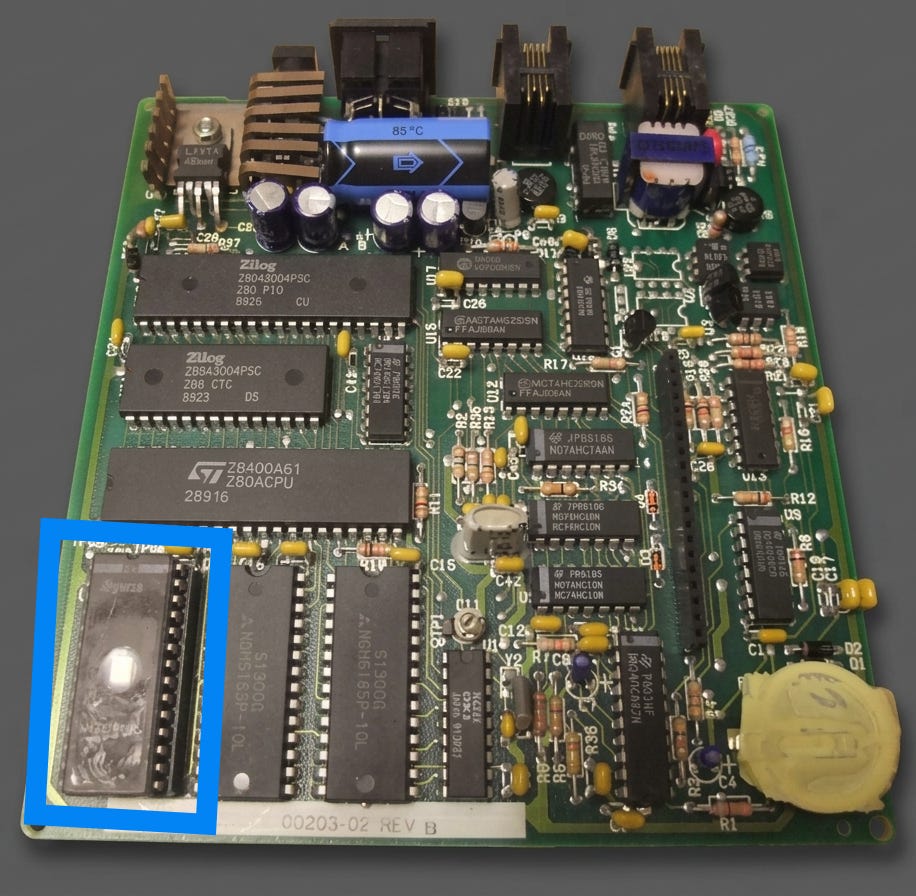
Steve had just closed a deal with First Interstate Bank in Los Angeles for 3,000 terminals — almost $600,000 in 1987 revenue. The original terminals had all the programming burnt into an EPROM. These memory chips contained all the routing logic, processing rules, and on-device security protocols. The logic on these chips were being tweaked constantly during these early years and there was just one problem — a serious bug had been found. As Klebe tells it:
The moment the terminals arrived at [First Interstate Bank’s] facilities, I got the word that there was a serious bug in the programming in the terminal. So I had Verifone ship me tubes and tubes of EPROMs that had a fix in it.
Luckily, I had a really good relationship with the folks at First Interstate, and I went down with these tubes under my arm and a screwdriver. I locked myself into the storage closet, where they kept all the terminals.
I was unscrewing the four screws from the back of the terminal, popping off the old EPROM with an EPROM puller, and setting the reprogrammed EPROM down. There were 24 legs to align before you could push it back in, then put the four screws back in, and plug it in to make sure you hadn’t messed up — all before putting it back in the case and taking out the next one.

Klebe then got on the plane back to Northern California, and First Interstate never knew what really had happened. He went on to buy an electric screwdriver, but as he told me, “my shoulder was never the same.” 5
Verifone went from ~5% market share to 85% market share between 1985 and 1989. As Klebe explained, “we were selling terminals like they were going out of style.” However, the business side of Verifone was facing issues.
The company came close to collapse at least three times, only kept alive by individual angels like John Porter or Tuck Newport and private investment firms. They injected much needed funding during the critical years between 1985 and 1987. These millions kept Verifone alive by covering the cash conversion cycle lags faced by a hardware manufacturer scaling fast. It was a hectic time with one investor at the time calling it “management by reactive panic.”6
“[Bill Melton’s] thinking was way ahead of where the market was and where the Visa/MasterCard rules were,” Klebe said. However, Melton was occasionally too far ahead of others. Eventually, Bill Melton handed the CEO title to Hatim Tyabji, a seasoned operator from Unisys in 1986. In 1989, Melton stepped down as chairman of Verifone. Tyabji helped streamline Verifone: opening manufacturing operations in Taiwan, taking the company public in 1990.
In that time, the company continued to grow — thanks in part to innovations and operational efficiencies like integrating printers with the terminal. It’s also during this time that Klebe migrated out of sales and into product and partnerships. By 1993, Verifone had survived the post-IPO chop, but Klebe had pushed the boundaries of internal politics one too many times. So, he moved on just as another wave of innovation was building — Internet commerce. Klebe reconnected with Bill Melton to join a new venture as head of Sales and Business Development.
CyberCash was launched out of Melton’s basement in Reston, Virginia with little more than a T1 data line and racks of servers. The founding team included Melton, Steve Crocker (one of the “fathers of the internet”7), Dan Lynch, and Bruce Wilson. Their founding obsession was unlocking the full potential of internet commerce by creating the digital wallet.
The industry, of course, thought little of it. CyberCash was the poster child of an internet startup: all-star founding team of industry veterans, a vision of an all-digital future, and a zero-revenue IPO. They sold investors on a dream, however that dream was built on installing the wallet with a 3.5-inch floppy disk or a 45-minute download over dial-up.
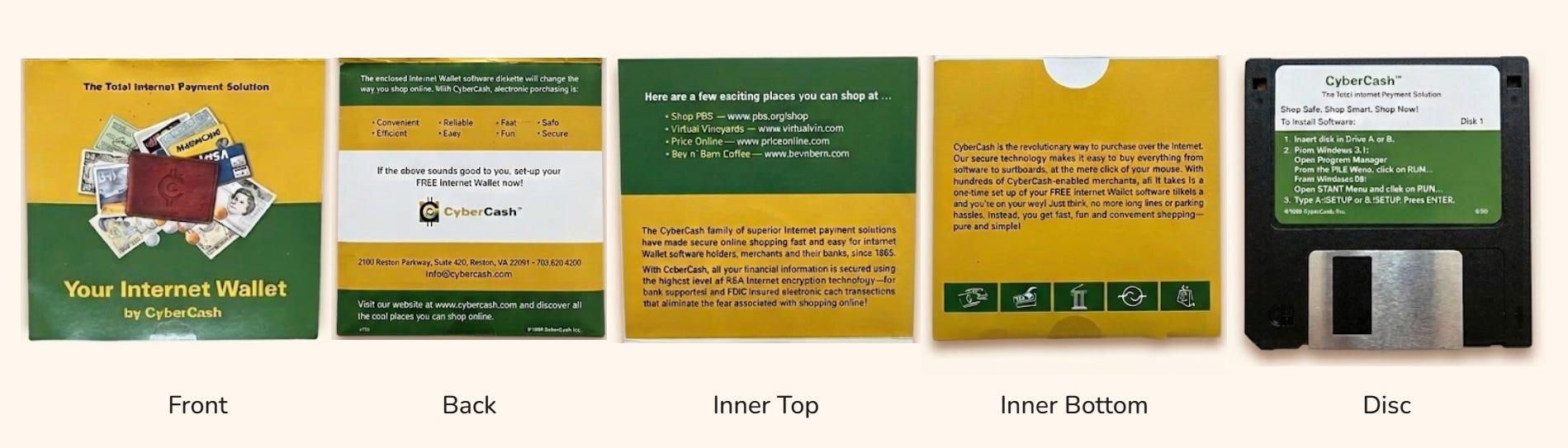
To make their first transactions, the consumer needed to have downloaded and/or installed the wallet from a set of floppy disks. The “two-sided marketplace” problem is hard to solve in the best situations, but even harder to solve when you don’t own the infrastructure and can’t force adoption. The team at CyberCash held firm: they saw the wallet as the only future. The market, however, just wanted an online payment gateway… and they got it.
CyberCash had built a bypass allowing merchants to submit card transactions without the wallet. It was intended for edge cases where the wallet didn’t work or to quickly process transactions. Merchants discovered this end-around and started using it exclusively. Klebe, against leadership’s direction, let it spread. As he explained:
I realized I wanted to give the market what it wanted instead of what I was being told. I was supposed to hide [the card processing] — I [told customers about] it on purpose. We became the de facto standard internet payment gateway.
PayPal eventually killed the CyberCash wallet model with its cloud-based approach. It too had benefitted from a happy accident — the company was created to enable Palm Pilot-to-Palm Pilot payments over the internet.8 Along the way, someone realized it could work just as well for beanie babies on eBay. “The rest,” as Klebe says, ”is history.” But Klebe’s history was far from over.
CyberSource was also an surprise success. It was originally the backend for Software.net, the first online store for downloading software. While at CyberCash, Klebe had met the founders of what was then Software.net and had convinced them to use CyberCash as their gateway. When Software.net realized they had an opportunity to operate independently of CyberCash they brought Steve on to run Sales & BD with the spinoff, CyberSource.
With the spinoff, CyberSource was extracted from being the back end of Software.net, it had additional functions that went beyond just acting as a payment gateway. This is why Klebe frames CyberSource as something closer to today’s payment orchestration platforms. — a full stack that included tax calculations, fraud screening, fulfillment messaging, and gateway functions.
CyberSource’s founders were software industry people who wanted to serve only the software industry. Klebe convinced them the market was too small. “The leaders of CyberSource had all come out of the software industry,” he explained. “I convinced them that that market was too small and they needed to go mainstream.” With Klebe’s help, they did more than just that.
Throughout his time at CyberSource, Klebe pushed leadership out of pure software and further into the mainstream market. Software.net (later known as Beyond.com) had built out a very simple fraud screening capability to fight online fraud — the same way Verifone fought in-person fraud almost two decades prior.
Once CyberSource pivoted to more mainstream clients, it was clear that the fraud solution was inadequate. Klebe had the idea to partner with one or more of the card networks. The networks would provide feedback on the final outcome of the transactions, and CyberSource could then tune the service to be more effective. He began pursuing each of the major networks at the time; Visa, MasterCard and American Express.
His push helped the company through the peak of the dot com bubble and the trough when it popped.9 His most significant CyberSource contribution was pursuing and securing the partnership with Visa that created CyberSource Fraud Screen, Enhanced by Visa in 2001 — setting the stage for a $2 billion acquisition in 2010.
CyberSource had a rudimentary fraud solution, but lacked the rigor needed to support online commerce at scale. For example, it screened for users with “@hotmail.com” addresses. Klebe also realized that the score lacked a feedback loop, because they didn’t see the actual outcomes. Klebe had the idea that partnering with the card networks could provide that fraud and dispute outcome data which could be used to tune the scoring and improve the model.
Klebe had been courting Visa, American Express, and Mastercard, with the latter backing out of the deal. The process was slow, but eventually Visa and American Express agreed to consider partnering with CyberSource. The management of CyberSource was growing impatient with the lack of a deal, but Klebe pressed on.
At the final stage, disclosure requirements forced both networks to learn about each other. Up to that point, Visa had never allowed another company to use their name in a product, let alone share the space with a competitor. Klebe tried to swing a joint deal with both of them, and Visa gave a hard no to a joint deal.
This left the company in a tough spot. American Express had offered $5 million in equity while Visa was only going to commit $1.5 million. Eventually, the deal went in front of the CyberSource board of directors and Klebe was there to defend his belief that Visa was the right partner. His basic line of reasoning:
Merchants did what Visa told them. They didn’t do what American Express told them. American Express had maybe 6% market share, and Visa had 60%. When it came to setting standards, Visa was absolutely the go-to player.
Klebe walked into the boardroom, ready to battle it out. A board member at the time had been an American Express senior executive, and she was adamant Amex was the right choice. After a back and forth meeting, Klebe successfully convinced CyberSource to walk away from $5 million in order to lock up the Visa relationship.10 For the next 3+ years whenever CyberSource was mentioned in the press, the Visa deal was referenced. As Klebe put it, “the rest is history.”
Similar to his time at Verifone and CyberCash, Klebe built “what the market was asking for” rather than what management believed was the future. Leadership believed that enterprise sales (like the kinds you make in enterprise software) were the only way to go. Klebe knew that independent software vendors (ISVs) and reseller channels would give the company greater reach. So Klebe built it in parallel as a skunkworks side-project without leadership buy-in.
By 2000, the ISV vertical had become a key part of CyberSource’s expansion strategy — appearing in the company’s first 10-K. An example of the benefits was when the company received a phone call on the 800 number. The caller said they were from the University of California system.
They explained that after PeopleSoft (now part of Oracle), their rep had told them that they had two choices for moving forward to integrate payments. They could either pay PeopleSoft millions through a professional services contract or they could sign up with CyberSource for $5k. The University System chose to turn on CyberSource.
Steve’s notion of signing up PeopleSoft all of sudden made sense. “All of a sudden,” Klebe quipped. ”My program was getting all sorts of support. We hired a whole separate team to go find other ISVs to sign.” CyberSource then committed to a broad ISV program which ultimately was a key attribute that made the company attractive to Visa as an acquisition. Which they did in 2002.
Klebe would continue expanding the ISV team and deepening the company’s partnerships before departing CyberSource in 2004. Thus began his “nomad years” that would see Klebe move between various companies while maintaining a leading role as a voice in the industry through a seat on the Electronic Transaction Association (ETA) board and involvement with several other industry trade groups.11
Klebe’s time between CyberSource and Google Pay was anything but idle. He held multiple roles across startups in the Bay Area. One particular standout was his stint as head of sales and business development at PassMark Security.12
PassMark had a novel approach to online bank security that Klebe believed “had struck the exact right balance of usability and stronger authentication.” They used cookies and security images/watermarks on the front-end, but also leveraged IP geo-location, velocity checking, scoring, and more to verify a user. Klebe joined in 2004 as employee number 3 and spent the first months calling on banks and FIs of all sizes from the giant Bank of America (BofA) to the Stanford Federal Credit Union.
“While there was some debate as to which size FIs and platforms we should focus on, I was confident that we needed to fill the funnel with lots of prospects of all sizes,” Klebe explains. From experience, Klebe knew that large banks would be important to long-term success but slow to adopt anything. He turned to small- and mid-sized FIs to “create push and pull with their service providers (i.e.; Fiserv, Certegy/Fidelity National Info, ORCC, etc.).”
The BofA opportunity ebbed back and forth. Then, the Stanford partnership was put on hold because Passmark’s management feared low adoption and having to abandon the product. Things looked bleak until the BofA relationship warmed back up thanks to an internal champion and the knowledge that the FFEIC was about to issue new guidelines compelling FIs to tighten up their login protections.
“We nurtured the relationship with a strong senior exec who became the champion for the product,” Klebe explains. The only thing they needed was a proof of concept, so “we rushed to get Stanford up and running.” That proof of concept end up being a turning point for the relationships and the company.
Klebe continued nurturing both relationships while building a substantial prospect list — enough to hire out an entire sales organization. With these initial successes, he used his industry contacts built up over 20 years to drive visibility through speaking engagements, favorable press, and other opportunities to “spread the vision.”
By Q3 of 2005, PassMark had deployed to more than 13 million of BofA’s online banking customers and signed our first major 3rd party infrastructure provider, Certegy. Once again, Klebe had found himself at the front of a new market that he had helped create. The industry took notice with RSA Security buying PassMark for $44 million in 2006.
After short stints at smaller companies and startups, Klebe joined a major company as the 45,000th employee trying to navigate the next great payments innovation — mobile wallets.
Osama Bedier who had been brought in earlier to run payments got the OK to hire some industry veterans.13 This was a big departure from Google’s standard playbook: hire smart tech generalists and let them figure it out. As Klebe explained:
Osama [Bedier] was smart enough to realize that in payments that really didn’t work. The extent of the nuance is so deep, and there are so many abstract concepts in payments. Just because you got an A+ at Stanford in computer science didn’t mean you were going to figure it out. So he went out and hired a team of payment veterans like me, Frank Young, Carol Grunberg, and others.
Klebe was approached by a recruiter in early 2011 and joined Google in November of 2011. His first assignment was the painful process of sunsetting Google Checkout. PayPal was “eating their lunch” because Checkout had been built by engineers who had limited to no payments experience. After first shutting down the ailing product, their focus was turned to mobile wallets.
The first Google Wallet was “a complete disaster.” Challenges with card provisioning on the phone was “like having a daily root canal.” Then, Bedier had a clever idea.
To solve the card provisioning problem, Bedier suggested using a proxy card that sat in front of the actual card. It was still tied to the same bank-end account, but with a completely different set of 16-digits. It was technically functional, but the card networks hated it. Visa and Mastercard wanted to see the actual card number traverse their network, not a proxy.14 Osama drove the acquisition of TxVia, the platform that was used to facilitate the proxy card.15
When they relaunched with the software-based provisioning approach, the marketing team was weary after two previous failures. They pushed to drop the Google name and use the Android brand to push the product. The result was Android Pay which launched in 2015. There was just one problem, Klebe explained:, “nobody knew what Android was. It was this software stack — nobody cared.”
After struggling to gain traction, the product eventually became Google Pay in 2018 after Android Pay and Google Wallet were merged. This led to the Google Pay team being led by VPs with varying levels of payments experience. Then in late 2019, a new leader, Caesar Sengupta, was brought in to steer Google’s payments division.
Sengupta had previously run Google’s Next Billion Users initiative out of Singapore and had launched Tez, later rebranded to Google Pay, in India. After taking the helm of the combined Google Pay, he announced a new service for the US market in late 2019, Plex.
Plex, originally called Cache, was intended to be a mobile-first banking platform where Google provided the user interface and data insights, while traditional banks provided the regulated financial infrastructure. Despite his reservations, Klebe did what he could to make the project work.
Deals were done with major financial institutions, notably Citibank and BMO Harris, along with smaller players like Stanford Federal Credit Union. These talks progressed slowly in part due to two key factors. First, the payments culture of India and Southeast Asia didn’t match up with the U.S. market. The second was that the product was being built by a team that lacked expertise in online banking.16
This diverted attention from the core Google Pay product which was at a critical point in 2019. Apple Pay, which launched after Google Wallet v1, kept the same name and (more importantly) owned the iPhone hardware and software. They were growing rapidly and quickly becoming “the Kleenex of mobile NFC payments.” Still, Klebe dutifully worked to make the various solutions work — despite the structural challenges.
Klebe was planning to retire from Google in February of 2020 on his 65th birthday – nearly 35 years since he’d first started at Verifone. Then, the pandemic hit. Faced with the option of sitting around at home or sitting around at home with work to do, he ended up sticking around Google a little longer. But the writing was on the wall, the leadership team was headed for disaster. Klebe tried striking a deal with FIS to utilize their modern banking platform to salvage Plex but the “not invented here” mentality prevailed. Plex was shuttered in April 2021 following Sengupta’s and the rest of the team’s departure.
In early 2021, an opportunity surfaced to join Stripe thanks to a former GPay colleague. She had joined Stripe after departing Google several years earlier and introduced Klebe to the team. Stripe created a role for him that didn’t previously exist: “Head of Enterprise Payment Performance.”
Stripe had hired a large team of Enterprise salespeople, but, once again, few knew about payments. Klebe’s role was to provide insights and guidance to the team by participating in sales calls, strategizing about what the real potential opportunities were, and reviewing RFPs. He described his time there as being “on a rocket ship.”
Between May 2021 and November 2022, Stripe grew from 3,500 to 9,000 employees during that period. “I didn’t even meet my manager, who was based in Seattle, until five months in,” Klebe said when describing the blistering pace of growth. Ultimately, Stripe (like many fintechs) realized they had over-extended during the pandemic. In November 2022, the company announced a round of layoffs. And Klebe’s retirement plan, only two years delayed, finally became a reality.
Steve Klebe is now happily retired and, according to his LinkedIn, “Living the dream!” Today he sits on the boards of Gr4vy (payments orchestration), GiftPass (digital gift card issuance and management), and RockPaperCoin (event planning invoice software) in addition to playing an active role in Band of Angels — a 50 year old group of 150 Silicon Valley angel investors that is the oldest angel group in the valley.
What you quickly learn after talking with Klebe is that he is intellectually humble despite, or perhaps because of, his decades of experience. Even after 40 years, Klebe deferred to people like Lauren Sickles at Stripe on network cost minutiae because she was simply a deeper expert in that sub-domain.
He’s got 7,000+ connections on LinkedIn and is a fervent believer in the law of reciprocity: “nobody ever refused to take my call. Because they knew that if they ever called me and needed something, then I would try my best to help them with whatever situation they were dealing with.”
Klebe is a “citizen of the payments world” whose career has spanned across three of the biggest innovations in recent payments history. First in POS card terminals (Verifone), online payments (CyberCash, CyberSource, later Stripe), and digital wallets (Google). Underlying it all is a hard-won intuition for what works and what doesn’t and, most importantly, why.
We closed our nearly three hours conversation with a few questions about where he thinks the industry might be heading next. (Emphasis added by me)
How do you identify ideas to pursue and which to leave behind? Who’s doing it best in your eyes?
“I’ve evolved a frame of mind which is it’s okay to be a fast follower and not get hooked into the crazes as they first happen. The smart folks right now are the ones who are staying abreast but are going to be fast followers.”
“When people are launching they feel obsessed that they have to be first to market. The products are typically not ready for prime time. They rush these things out, people get disillusioned, bad press, and the thing starts to unwind.”
With all the hype flying around about AI, stablecoins, and the like, where do you land on how quickly these are adopted?
“I have what I call the ‘Klebe Rule’: Whatever the pundits predict, it’ll take three to five times longer, and it’ll cost three to five times more than they’re articulating to actually have one of these things start making a material impact in the world.
When we were launching CyberCash, analysts predicted every shopping mall or physical store would be a ghost town within five years. Thirty years later, e-commerce is only roughly 20% of retail.”
What do you make of all the agentic commerce and cryptocurrency standards flying around?
“Until we are down to no more than two competing protocol approaches, it’s simply not going to matter. Right now we’re at three, maybe five. It’s browser wars all over again.”
How do you balance giving the market what it wants and what it actually needs?
“That’s part of the challenge: customers don’t always know what’s best for them either. There’s a slippery slope between idea generation from a bunch of smart people and listening to your customers.
Nobody asked for the Internet, right? Nobody said they desperately needed a mobile phone that had a browser built into it. So some of the biggest things that have happened are not because people were asking for it. That’s what has made being in the business world so wonderful – that tension, between those two realities [of giving the customer what they want and what they don’t yet know they want].”
What do you find interesting about payments? And why has it been so hard for non-payments people to get right?
“Payments is one of those phenomena that touches everybody, almost every day, yet 99.99% of the population just does it without consciousness – it just works. And then there’s the one tenth of 1% of us that focus on making it work.”
“In the U.S., we have 8,000 banks. Canada has 5 – The rest of the world: rarely more than 5. That alone makes U.S. payments incomparable to any other market. Cultural phenomena around payments in the U.S. have absolutely nothing to do with what goes on in Japan or most of Asia.”
The rate of innovation and change within payments and (more importantly) the media hype is right in-line with the ‘Klebe Rule’. For the billions invested in AI and stablecoins, the adoption rate remains low — agentic commerce accounts for just 0.001% of payments and stablecoins only 0.1%. As Klebe explained it, “If you go talk to somebody outside the FinTech bubble, they have no idea what any of this is. Nor do they care.” That’s not to say it doesn’t matter.
As Klebe notes, payments impacts everyone and new payments innovations will eventually spread to the general public. However, it’s going to take more than just fancy slide decks, slick advertising, and venture funds to make the products work “without consciousness.” It’s going to take winning the hearts and minds of bank executives, third party vendors, and those who work in payments but are “outside the fintech bubble.”
To do that, we in the industry are going to need several more Steve Klebe’s — people who actually drive change whose proof is found in the results. If we get a few more of those, the rest, as he often says, is history.
Bill Melton is a character who weaves throughout Klebe’s career in payments. deserves his own post. If anyone has a contact, it’d be a hoot to chat with him.
From a writeup Steve shared with me:
We were selling terminals for $100 to $300 and watching our customers, the credit card ISOs and FIs, renting those terminals out to their customers for $20 to $50/month on either month-to-month or 3 to 5 year leases making exponentially more than we were. While the economics were appealing on the surface, many of them were struggling with the logistics, not properly filing property tax, etc. I initiated the concept of VeriFone unveiling its own leasing program.
Leasing hardware that sold for such small amounts was not typical at the time and the concept flew in the face of a primary focus on manufacturing since a significant amount of the product and economic benefit was in the re-deployment of the terminals over and over and providing an easy upgrade path as our product line expanded.
Klebe and Wells Fargo’s Debora Rossi and Tim Nolton were behind the first fast food chain to accept cards — Carl’s Jr. At the grand unveiling in San Diego, in front of a host of TV cameras, the cameraman flipped on his camera and all the pin pads fried — they hadn’t been shielded against the electromagnetic interference. Shortly after, every terminal had to be recalled and retrofitted.
“Company’s Rise Is Built On Plastic.” The New York Times, 03 August, 1990, p. , https://www.nytimes.com/1990/08/03/business/company-s-rise-is-built-on-credit.html
But the company’s first products did not work as they were supposed to. The company was poorly managed, perennially short of capital and lived from crisis to crisis. It was ‘’management by reactive panic mode,’‘ said Frank J. Caufield, a partner in the venture capital firm of Kleiner, Perkins, Caufield & Byers, which invested in Verifone in 1985.
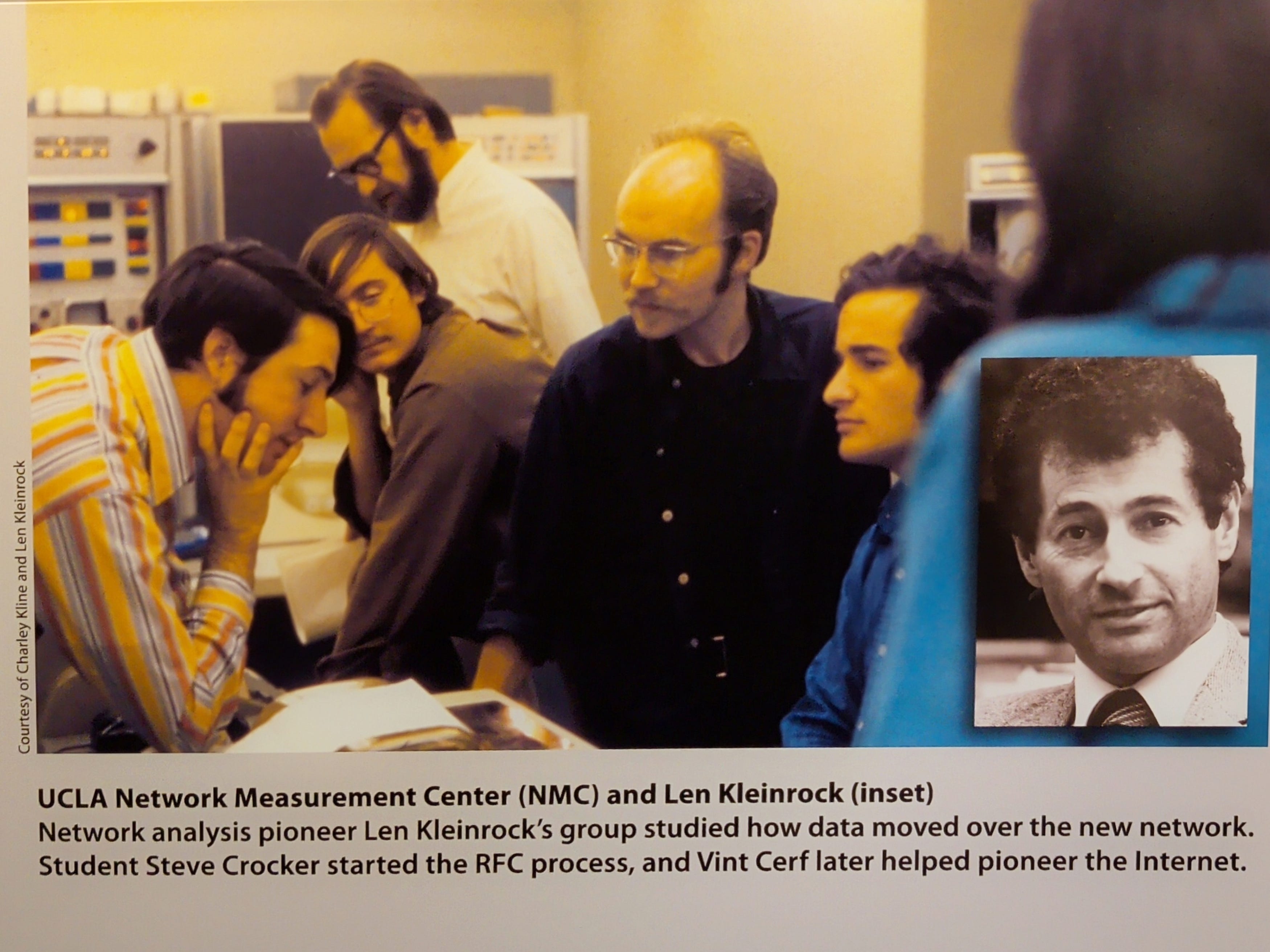
Steve provided this great clipping featuring Crocker (center)
This is why the P’s in PayPal are both capitalized.
CyberSource split from software.net (now Beyond.com) and managed to IPO in 1999 at the height of the dot com bubble. CyberSource went public at $11, ran to $81 on IPO, and settled around $56. They perfectly timed a secondary raise to build up a $150 million war chest. Then, the bubble burst and shares dropped to roughly $8 — below its cash on hand!
“Visa, Cybersource Join Forces to Combat Web Fraud.” American Banker, 02 September, 1999.
Visa U.S.A. announced a joint effort Wednesday with the Internet payment processor Cybersource Corp. to step up efforts to prevent fraud in electronic commerce.
The companies said they will develop and market an enhanced version of Cybersource’s Internet Fraud Screen, a predictive modeling system that lets a merchant assess the risk of a given transaction and decide if they wish to accept it.
Klebe is an advocate for people joining trade groups and expanding their networks. As he told Houston Business Radio in January 2026:
I decided early on that I wanted to go beyond the bubble of whatever company I was working for and get involved in industry trade groups. The interesting thing about
that, aside from just how powerful that can be……participating in those industry associations was massively important to me and really
ended up being important to the companies that I was working for. They didn't appreciate it at the time, but that's what led to a lot of speaking engagements. When you're introduced, it's “Steve Klebe, working for or representing CyberSource” or “ representing fill in the blank”.I grew up in the payments industry during a pivotal time in the industry and I got to understand at a level of detail that most people don't get. [I was] involved with how the plumbing worked.
Thanks to the Wayback Machine: https://web.archive.org/web/20040805033505/http://www.passmarksecurity.com/about/management.html
Management
Bill Harris, Chairman. Bill founded PassMark Security along with some associates with deep experience in the payments and security industry. Bill was formerly CEO of Intuit and of PayPal.
Louie Gasparini, Chief Technology Officer. Most recently SVP - Internet Transaction Systems at Wells Fargo, Louie has been delivering large-scale secure services since he led the development of the first on-line banking system introduced by Wells Fargo in 1996. Louie also served as CIO at Excite@Home delivering high-availability high-bandwidth services to millions of customers. Louie has been active within the security and authentication areas for the past 8 years, including participation with BITS, FSTC, Liberty Alliance and the Smart Card Alliance.
Mark Goines, Chief Marketing Officer. Mark has been involved in online financial transactions for fifteen years, first running Schwab’s early online trading software initiative, then managing TurboTax tax preparation software, then in charge of Quicken and Quicken.com.
Steve Klebe, Vice President Sales and Business Development. Steve joins Passmark after a successful career as VP of Strategic Alliances at Cybersource as well as senior positions at CyberCash, VeriFone and Atalla where he developed deep expertise in electronic payments, fraud and data security. Steve has been involved in electronic transactions for more than 20 years and leads PassMarks efforts to reach out to customers and partners to build awareness and distribution for the companies products and services.
Justin Bonar, Business Development. Justin has managed business and strategic development at Intuit, eStamp and Pitney Bowes, and leads PassMark’s New York office.
Craig Welch, Asia-Pacific Region. Craig has a long history working with financial institutions in Australia and Asia for companies such as Visa, DigiCash, and other e-commerce ventures. He is heading up PassMark’s Asia-Pacific activities.
This is the spiciest story in all of this. PayPal came after Bedier and Stephanie Tilenius (VP Commerce) claiming that they had stolen trade secrets. It deserves it’s own dive at some point. I imagine Jason Mikula would’ve had a field day covering this.
This concept was pre-tokenization, which is now the industry standard.
This is also how the founders of Money 20/20 came to work for Google. More on that here:
This included the exclusion of online bill pay, a feature which “a survey of millennials in the valley” showed wasn’t needed.
Comments
Nothing yet. Say the first thing.
Sign in to join the conversation.