
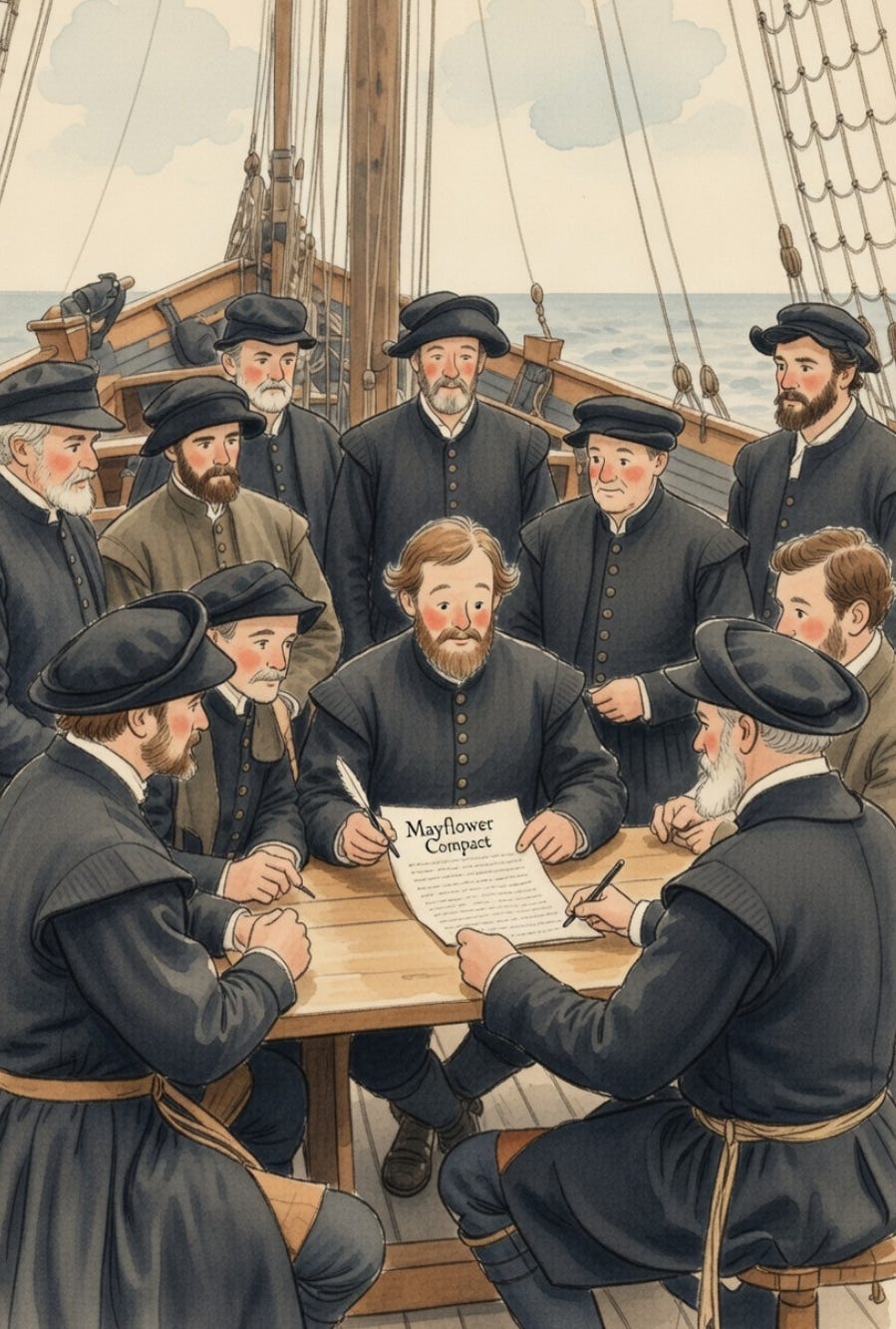
The joint-stock company, happily named the Merchant Adventurers, financed the Pilgrims’ voyage to America. Seventy investors bought stock, about 10£ a share, and raised 7000£ and the Pilgrims sailed west - they were supposed to land in Virginia, but weather and navigation back in those days… The Virginia Company had a royal charter, and it also was a trading company, and it had a right to be in Virginia. The Mayflower Compact came about because the Pilgrims knew they had no right to be where they were. They made it up as they went. The Merchant Adventurers didn’t exactly go broke, by 1640 the Plymouth plantation had paid back their debts, and the Merchant Adventurers had moved on and written off their losses.
The American War of Independence was largely fought so Americans could independently manage their own trade for their own benefit. The Americans needed government so they could trade, and Americans wanted to govern their trade themselves. Those early Americans found taxes and restrictions on their trade, “intolerable.” One could argue George Washington’s motivations to lead America’s War for Independence were mostly to end Great Britain’s imposition of mercantilist restrictions on the colonies’ trade. It was all too up close and personal for the owner of Mt. Vernon. Washington was one of the richest men in America in 1776. In his farewell address, Washington argued against political entanglements with foreign powers, precisely because it would inhibit free and open commerce with all nations. In short, Americans and America can’t be understood apart from their historical commercial interests and their appetite for trading.
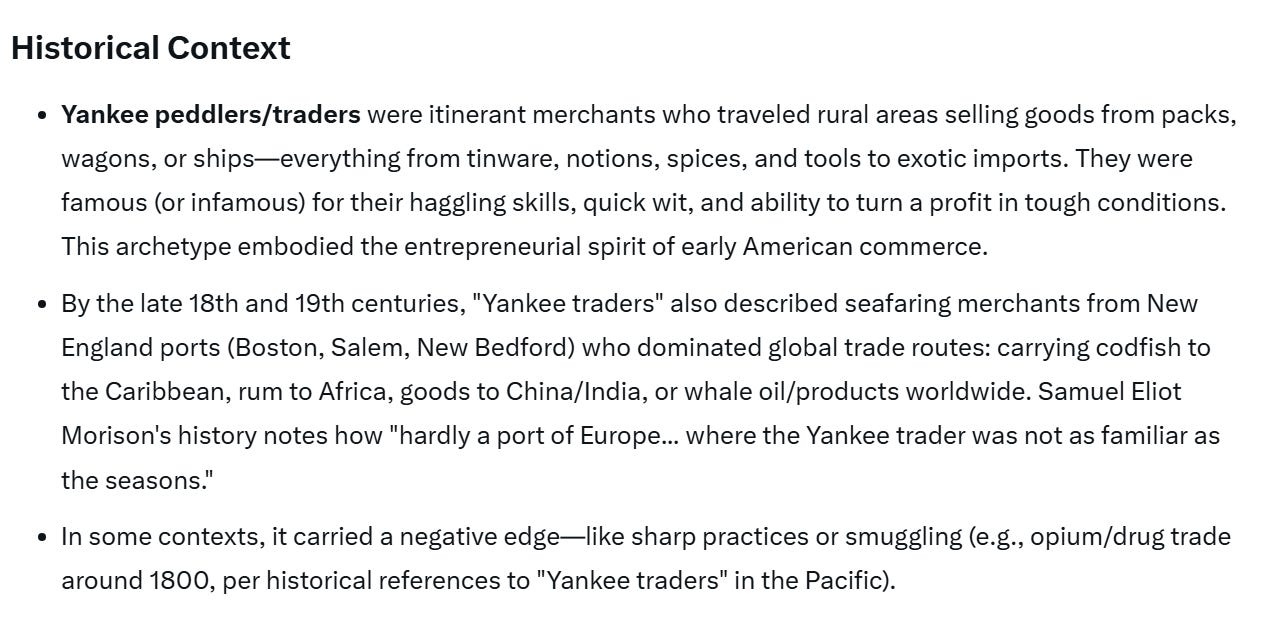
Here is what Grok has to say about the archetype, Yankee Trader:
_________________________________________
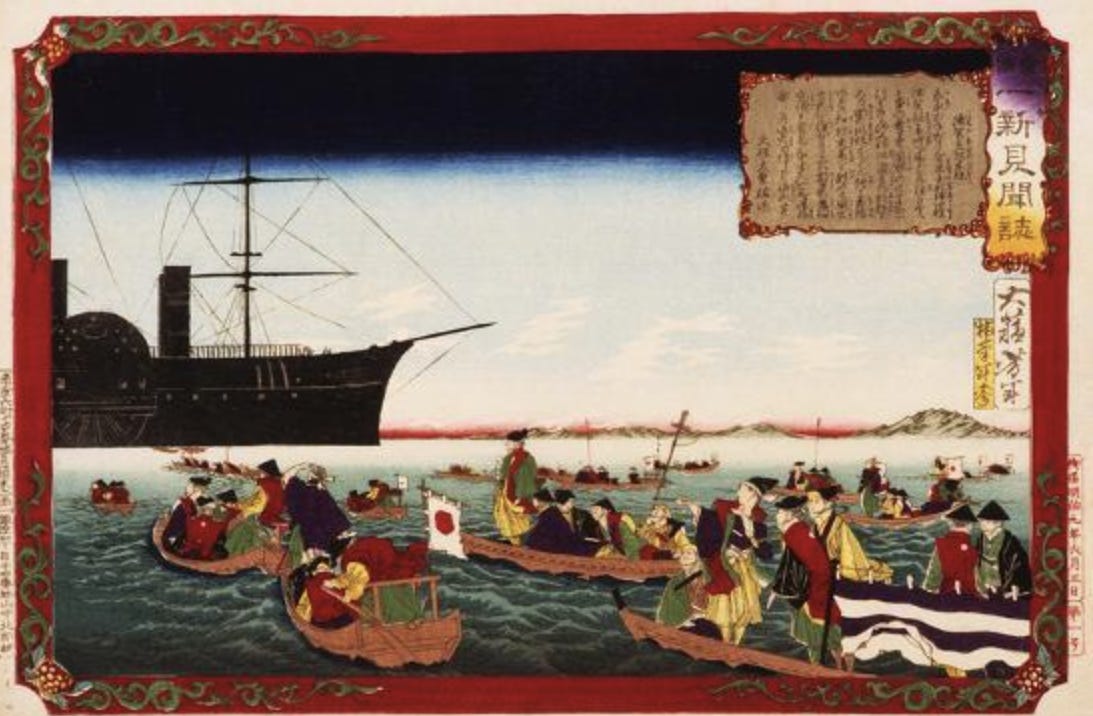
Commadore Perry’s trip to Japan highlights America’s military interests were more supportive of trade than conquest. In the 20th century the Communists liked to hold America’s commercial interests against us. Fifty, Sixty years ago, when I was a kid in school, we were made to understand how the developing nations needed trade protection so they could develop their own industries. Free trade would freeze poor countries in time and lock them into dependency, inequality, and poverty. Free trade was treated like a capitalist conspiracy - to grind down the poor by selling the capitalists’ surplus production. Land reform was what developing countries needed - it meant land distribution. Landlords were a capitalist plague. Self-sufficiency was the antidote to the capitalist oppressor. You were trading with the enemy, when you were trading with the US of A. We the students weren’t being indoctrinated, but we were sure hearing the other side of the story. I grew up thinking it was patriotic to be in favor of free trade. All our enemies were against it.
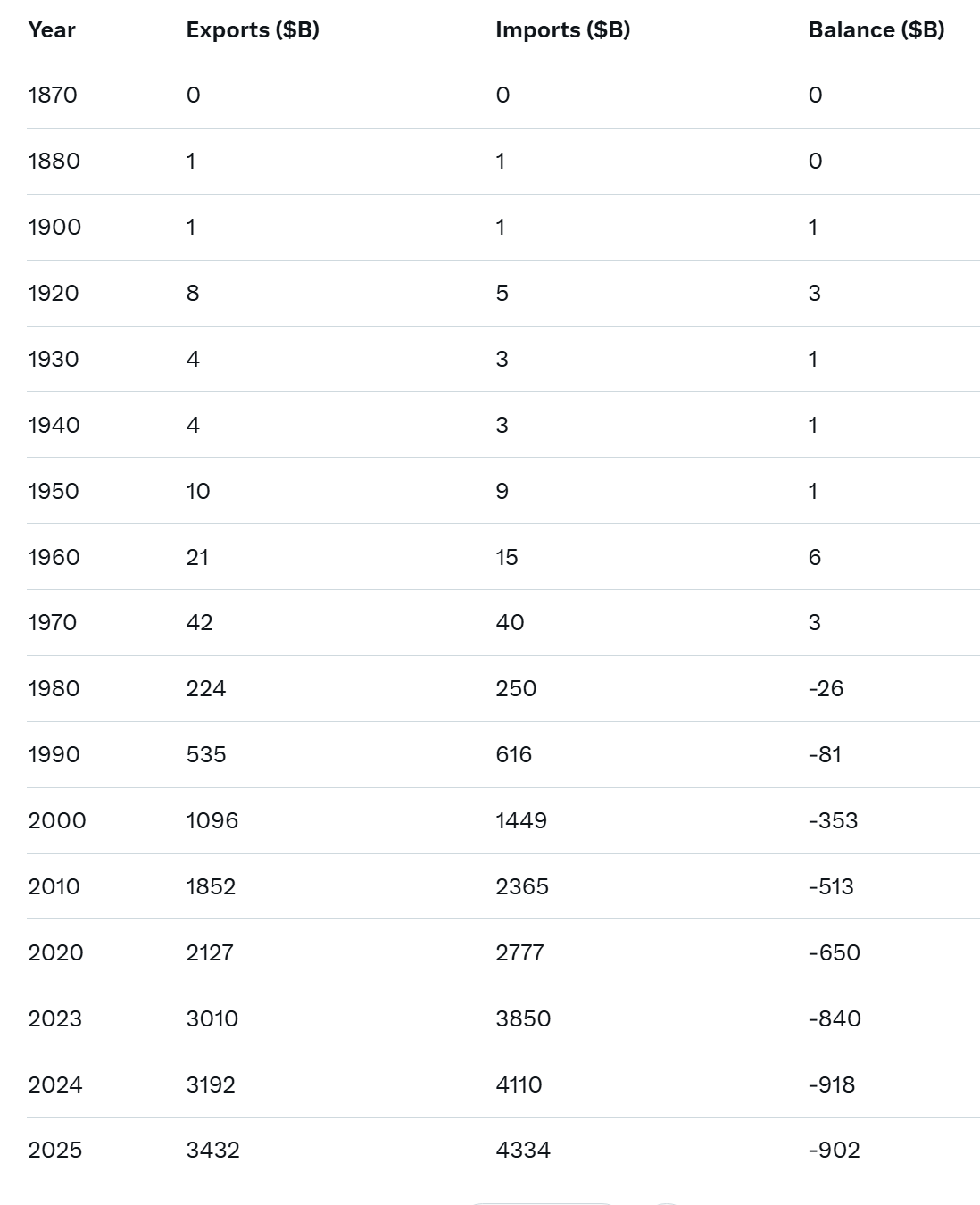
This article’s main purpose is to show in historical context, international trade’s explosive growth, especially in the last twenty-five years. Below is a table showing US trade in unadjusted dollars.
So, what about trade as a percentage of GDP? This is where our current circumstances get interesting. Below is an AI table for the US by decade:
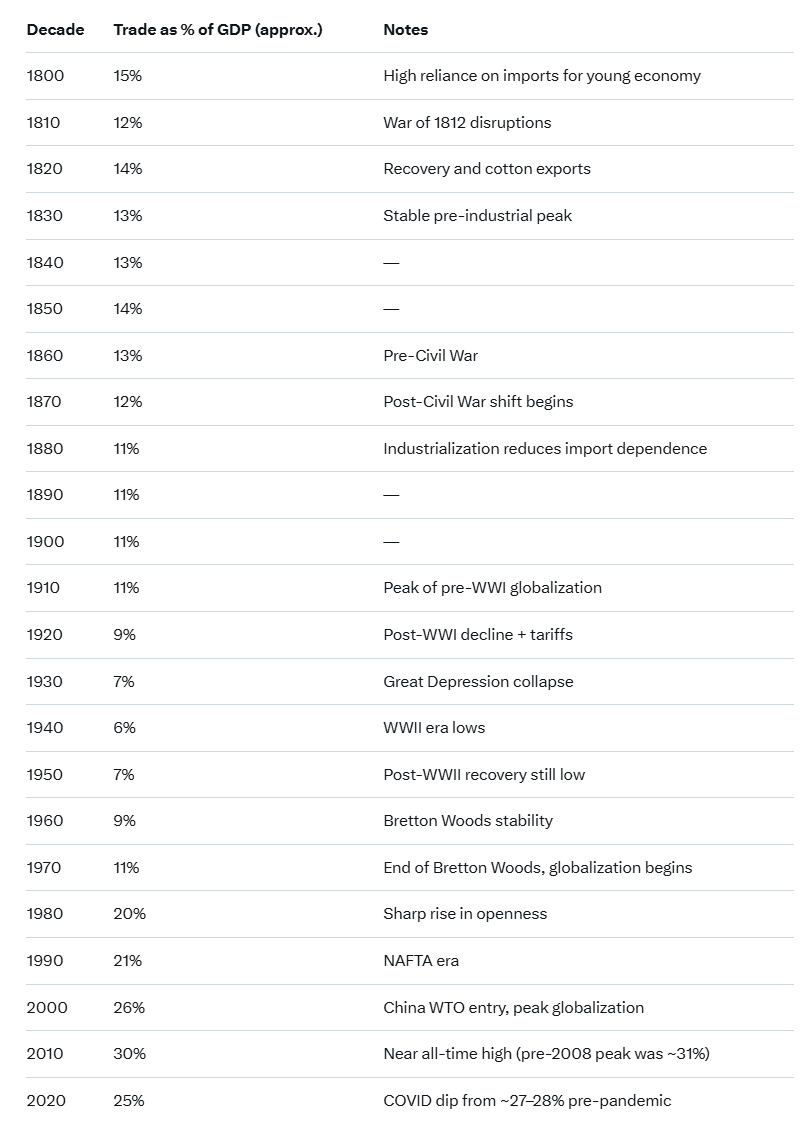
But the most interesting part of the picture is the other countries. Look at how trade dominates other nations’ GDP. Below is a chart of the G20: Trade as a percent of GDP.
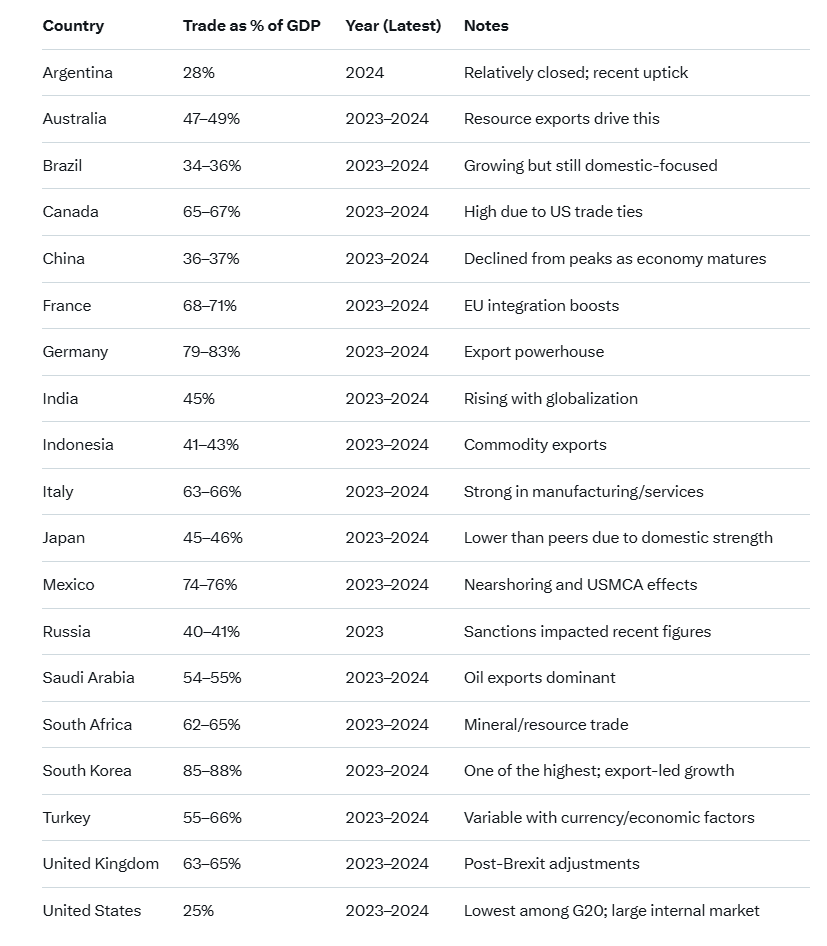
A few of the G20 nations simply wouldn’t have a GDP if it wasn’t for international trade. The United States would be at least 25% ‘poorer,’ without trade and it has the lowest percentage among the G20. The numbers above demonstrate you can’t understand the national economy apart from the new global economy. It isn’t true to say all trade is global trade. But no part of commerce now can be untangled from the integrated economy of global trade.
Trump isn’t an economist or a diplomat, he is a reactionary. He wants the US to dominate the world economically, but not necessarily politically. He doesn’t want to rule over the world, but he could. Like Mohammad Ali, another American original, he is the greatest. Roughly, Trump thinks after World War II, the US was a beautiful place. Trump’s spirit animal is the ‘Yankee Trader.’ He lives by his wits making deals. His conception is all trade is between losers and winners. I can’t remember exactly how my dad said it, something along the lines of, ‘trade flourishes when both men think they are getting a bargain.’ That is not the mind of Trump. Trump is all about winning, never about both men agreeing they are getting a bargain.
Trump created a lot of uncertainty back in April 2025 with his wild and unpredictable imposition of tariffs. Uncertainty is certain to unsettle markets. Maybe the most surprising result from Trump’s tariff mad caps is how little disruption there has been to world trade. Trump’s instincts tell him he can’t blow it all up. He knows everybody has to trade with us.
Trump loves tariffs, because he loves comparative advantage. The world regime of open economies and America’s huge internal market puts us in the catbird’s seat for a new world order of tariffs as a tax base. He loves the idea of indirect taxes as a source of federal revenue. The sheer volume of imports makes them a potent revenue stream for taxation purposes. Marginal tax rates are possible on income because wages constitute 55% of the US GDP. Payrolls are easy to tax. They are the largest revenue stream in the country. The income tax used to be unconstitutional and it didn't matter because property was easier to tax at that earlier, simpler time. Property was almost entirely tangible in the 19th century. Property was easier to see than income.
In the US, as more property became intangible, that is, became bonds, bank accounts and equity shares, it became harder to tax. Income tax on wages was a transactional tax, like a sales tax or a VAT. The virtue is transactions are relatively easy to track and tax. It's like robbing banks, it's where the money is.
Trump is determined to try tariffs. There is such a volume of imports as a share of the economy, tariffs are a bit like a value-added tax, a VAT tax. Trump is broadening the tax base and encouraging domestic manufacture all at the same time with tariffs. He keeps blasting away with his executive powers assuming some of it will stick. Some of it will. Higher tariffs on imports are the new paradigm.
Trump, when it comes to trade, doesn't believe in friendship. He believes in winning. I have been surprised at Trump's unwillingness to invest in international friendships. He as no allies, he only wants to make a good deal for the US. Qatar plays Trump like a fiddle, with gifts and promises, even as Doha consistently works against us by supporting and financing Hamas, etc. Doha finances Islamic terror. Not that Qatar has bought Trump's friendship. If they are winning something, it's an intangible, and they would be well advised not to take anything for granted. Trump has proved himself a real politician. He has found out a way to tax indirectly without offending his voters. Even if he is likely to offend everyone else.
What jumps out at me is the size and volume of global trade. It's an interesting correlation that since 1980 global trade and global GDP have roughly quadrupled in size in tandem. The US lags in one category: Our economy (GDP) has more than tripled in the last forty-five years, while our trade volumes have increased five times.
The cost and barriers to effective international trade communication has plummeted. Communication precedes trade. Understanding a market precedes selling into it or sourcing from it. The marginal cost of email is essentially $0.00. The Pilgrims and the Merchant Adventurers had no idea how much they were risking. George Washington and the founders were taking an outsized risk in their rebellion. Modern finance and communication have made the risk and uncertainty of international trade a marginal risk. My guess is you will see more globalization in the future, not less. Tariffs are here to stay. That won't be a problem as long as they remain marginal taxes. My advice is we put on our big boy pants and remember Yankees used to trade with everybody - and we did it to our advantage. We can do it again.
No posts
Comments
Nothing yet. Say the first thing.
Sign in to join the conversation.