
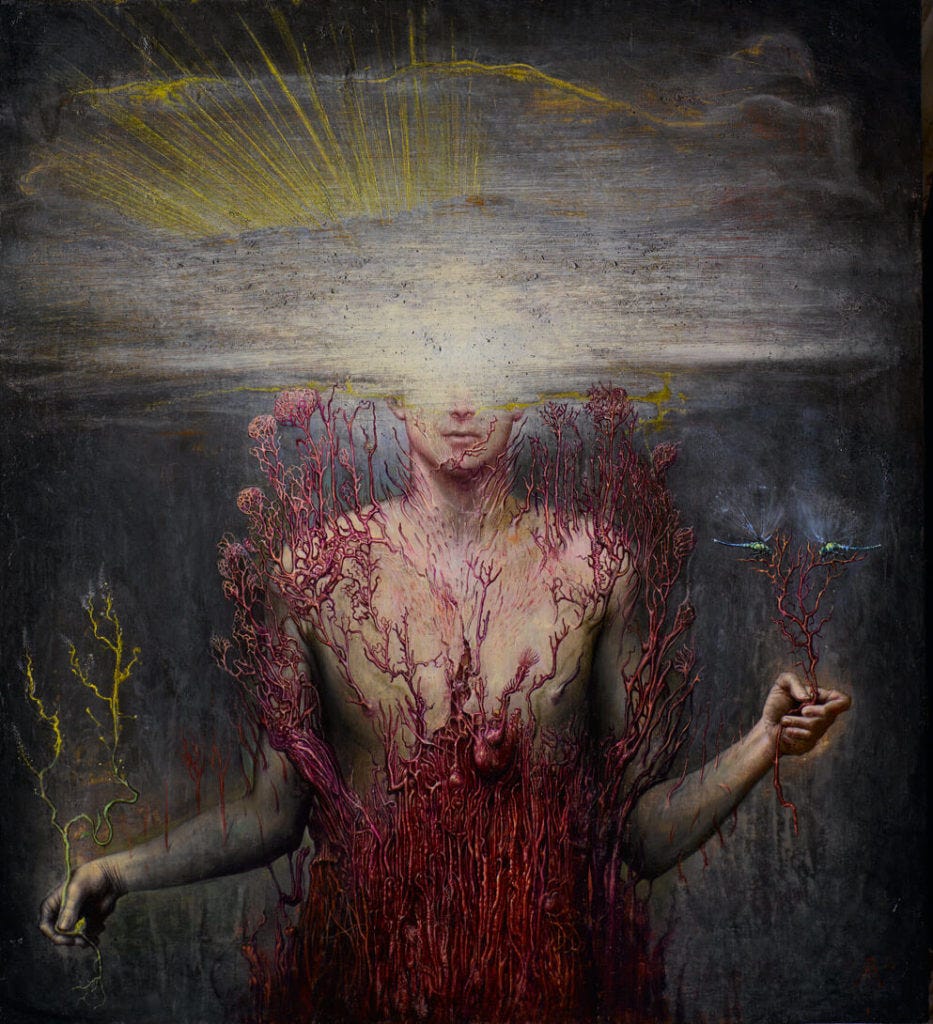
My last post explored the Corpus Hermeticum and the impact this set of ancient texts had on Western culture. That transformative impact is almost complete and we can easily recognize ourselves as living in the world it inspired. It is now widely agreed that the sun is the center of the solar system, that there are multiple galaxies, and our entire universe is held together by an underlying set of energies and forces—like gravity or space/time. Humanity is, in this world, our center of attention. Filled with inner authority and unlimited potential. Humanity is an intrinsic and rare part of the universe that is able to invent, create and self-determine our way to almost any future that we can imagine.
Thanks to the inspiration of the Corpus Hermeticum and the inner authority that these texts identified (the divine spark), our modern, western economies are essentially humanistic— Humans have all the power even if not everyone enjoys equal rights or personal freedoms.
But there is another set of texts that were buried and lost for 1578 years. These are the Nag Hammadi texts. They are similar to the Corpus Hermeticum in some ways because they connect us to a time before religious dogma and the manipulation of beliefs for institutional power and authority. However, unlike the Corpus Hermeticum the Nag Hammadi texts have only just been translated and their impact hasn’t really been felt yet. So what can we expect? Where might the Nag Hammadi texts take our culture. What guidance might we need that these texts might deliver on?
The Nag Hammadi texts are much more diverse and more extensive that the Hermetic Corpus. They contain 52 texts that were translated into Coptic and date from the 3rd–4th centuries CE. The reason they were buried is not known, but it is very likely that they belonged to a nearby Pachomian monastery and someone decided these texts were so important that they needed to be buried in a jar, rather than being destroyed. This was almost certainly a response to the Festal Letter of 367 CE, written by the Bishop of Alexandria, Athanasius, that condemned the use of non-canonical scriptures.
These texts build on the same foundations as the Corpus Hermeticum— and the core idea that when the Self is known at sufficient depth, what is found there is a connection to a universal (divine) principle that underlies all existence. “The one who knows oneself knows the All”. This is what the texts called gnosis (knowing)— not knowing facts, scripture or information about God, but recognizing an experience of the divine that lives at the core of our own being and does not require a priest as the intermediary.
In fact, three of the texts found in Nag Hammadi, were also part of the Hermetic Corpus:
The Discourse on the Eighth and Ninth (Codex VI) — a Hermetic initiation text in which a master guides a student through the ascending spheres of cosmic consciousness.
The Prayer of Thanksgiving (Codex VI) — a Hermetic liturgical prayer describing the gratitude of those who have achieved gnosis.
Asclepius (Codex VI) — a dialogue between Hermes and Asclepius, partially known already through a Latin translation; the Nag Hammadi version restored the original context
In some ways, the Nag Hammadi texts are even more radical than the Corpus. While the Corpus Hermeticum reveals the divine spark (and in doing so, exposes the corruption of the institutional Church) the Nag Hammadi texts goes into more detail about exactly what we need to do in order to connect with this. Much like Carl Jung’s account of human psychology, the texts explore the obstacles and ‘hostile forces’ or archons that must be overcome in order to connect with, and experience, our true nature. The themes within these texts include, psychological deception, gender roles (the suppressed feminine dimension), social hierarchy and conformity, material/spiritual balance, corruption and misinformation, the primacy of first-hand experience over received wisdoms etc.
The Corpus Hermeticum arrived in a moment of cultural readiness. The city of Florence was already filled with a restless humanist energy and the translation of these texts ignited an era of individual inquiry, scientific method, and the assumption that human beings don’t need priests to uncover the underlying truths of the universe.
It feels to me like the Nag Hammadi texts are also landing at an equally significant moment of readiness. We already have a humanist outlook, an anthropocentric perspective, but I don’t believe we are clear eyed about the malevolent forces and bad actors who stand in the way of us achieving our true potential:
—Consciousness— Nous (mind)—for all our biological and scientific discoveries, our understanding of consciousness remains limited. How does our biological body create first-hand experiences, our emotions, our ideas, our rational and intuitive thoughts and knowledge? Not just what is the full extent of our mind’s potential but also what are the limitations of our consciousness? (Science to date has focused only on objective observations but to fully understand consciousness we have no choice but to consider what it is like to have an experience, which means we have to put more value on subjective, internal realities).
—Intermediaries to our reality —the Archons —in the Nag Hammadi texts there is reference to a set of forces and malevolent actors who trick us with deceptions and illusions. If we imagine ourselves in the context of first century Christians, it’s easy to recognize the psychology of the Archons. They refer to thought patterns, habits and social hierarchies that keep us small, distracted and compliant. They are essentially metaphysical prison guards who keep our attention focussed on unimportant material distractions so that we remain under their power and influence. The archons deceive and misinform humanity at scale, keeping us working for them rather than achieving our full potential. The archons are not a single adversary. They are a system of seven or twelve distinct powers, each governing a specific form of limitation and forgetfulness. In Jungian terms this might be thought of as patterns of thought or complexes that surround a trauma and cause a person to act from their subconscious. Fear-complex, authority-complex, shame-complex, inferiority-complex — each is a kind of archon/ruler that claims temporary control over the psyche and must be consciously acknowledged before it can be seen through.
So, if the Corpus Hermeticum taught us to believe in the potential of humanity, the Nag Hammadi texts are here to help us achieve that potential without getting distracted or tricked into settling for something less. If I had to guess the impact that the Nag Hammadi texts are likely to have on society and culture in the next 400 years, I would anticipate the growth of discernment—a fine tuning of inner authority, the unlearning of biases and a responsibility to uncovering truth— as a practice:
Discernment is not a natural capacity, it is a developed skill — a trained capacity that spans different human dimensions: body, mind, social relationships and external reality — four of the six suits (Anthropos, Nous, Ecclesia and Aletheia) of Aeonology. Train only one of these and the others stay exploitable, which is why discernment has to achieve alignment and cohesion across all four at once, not just the one that feels most urgent.
But cohesion across all four doesn’t happen all at once, it builds in stages. It starts with an awareness and recognition of these dimensions — acquainting yourself with them directly, before you can trust anything they are telling you. Once acquaintance is in place, a second stage of assessing the honesty of your interior response is possible. This cannot be purely objective or reasonable (as Aristotle might argue), instead this assessment must, by definition, be subjective.
Human beings have always lived by a mixture of first-hand knowledge (direct experience with an external reality through perception, experience, and inner attention) and second-hand knowledge (testimony, description, inherited belief).
Bertrand Russell famously divided human understanding into two distinct categories—“knowledge by acquaintance” and “knowledge by description.” This is a distinction that I keep coming back to, especially in reference to the idea of knowing and Gnosis. It’s unlikely that gnosis was ever about knowledge by description because back in the 1st century, second-hand knowledge was sparse, slow, and if available, was directly traceable to a specific, trusted source. First-hand experience and knowledge by direct acquaintance, on the other hand, was the dominant material of daily life.
Today, this ratio has inverted. Second-hand experiences vastly outweigh direct experience of external reality for most people. Our kids especially, experience the world through their parents, teachers, societal protectors as well as mass media and platform technologies (AI, Games, Social media,smartphones, apps, software, porn etc.). Our modern lifestyles (and the biggest, most profitable businesses humans have ever created) profit from optimizing our exposure to (paid for) ‘descriptions’ via feeds, algorithms, analysis, content generation etc. These ‘attention-capturing’ systems profit not from depth of exposure to reality, but instead from velocity of exposure to second-hand descriptions—to use Russell’s distinction. Just think about all the experiences that you come across on your digital feeds. Experiences that feel like they are derived from the real world—the angry airline passenger, the traffic stops, the talking dog, the angry neighbor, the political news report, the kilted invasion of Boston— but the reality is that these are mostly manipulated by algorithm, manufactured to elicit an emotion and over emphasized with a false frequency that gives the impression that these are more common that they actually are. Not to mention the AI-generated accounts, the malevolent bots, the false reviews and fake comments…our digital channels are a long way from the real world and the identity of the people ‘describing’ these experiences is unknowable, unverifiable and unlegislated against.
Back in Russell’s day, it was possible to validate a second-hand source by tracing the information back to a specific person’s real world experience. Today, it’s almost impossible to know the relationship of online content to any genuine, true experience. Worse still, the ease of access and availability of these pre-digested and optimized experiences means we stop seeking genuine, direct encounters with a person, place, or your own interior state. Off-line ‘acquaintances’ start to feel like hard work, slow, and rife with a high risk of disappointment and negative experiences—so why bother? So much better to stick with the sweet tasting comfort of delusion.
The first step in the practice of discernment is to learn to trust your ‘felt sense’ of truth. Your interoceptive accuracy and your trust of your own inner authority. This is not something we are ever taught and, given what I’ve just described about our media environment, it’s very likely that our ‘instrument’ for assessing truth might have been hacked or compromised such that we can no longer discern the difference between our own authentic responses and manufactured ones.
Developing the trust of your own sense of truth is a practice that takes time. The goal here is to fine tune the accuracy of your own internal signals, rather than simply jumping to an ego informed, or a performed sense of confidence—you know, the sort of confidence that life coaches try to teach you. Accuracy comes firstly from an awareness of the variety of different signals and secondly, from developing a subjective confidence in these perceptions. This is what differentiates bad discernment (misreading your own inner state) from good discernment (having confidence in your assessment of how you feel).
I hate to promote the Aeon cards again, but this is exactly what the Aeonology cards were designed to achieve. To give your mind, body and spirit awareness of these different dimensions of your inner being— exposure and reflection on the full deck of cards not only gives you greater awareness of these dimensions but frequent usage and experience of them also helps you build trust and confidence in the accuracy of your introspection.
How does it feel to feel something true? Can you tell the difference between knowing something true and knowing outrage, arousal, deception or illusion? There is nothing easy about being able to tell the difference between contact with something ‘true’ versus contact with a falsehood designed to make us feel a particular way.
The number one teaching of the Nag Hammadi texts is the tension between the Mind and Truth —the first syzygy of Aeonology — that exposes us to the reality that we are not who we think we are. We are not who we pretend to be. What we think is true, is most commonly a deception or a distraction (perpetrated by the Archons). What we blindly accept as received wisdoms must only be believed if they can be verified by our own experience and that we are familiar enough with the practice of understanding our experiences, that we have confidence in the authenticity of that experience.
So, if the ease and convenience of pre-digested experiences is what is driving us to consume more of them than is healthy, then we might need to develop a taste for the things that initially seem complex and difficult. If passive consumption of what is easy and accessible is the problem, then leaning into the difficult, the complex and the uncomfortable might just be the antidote.
Discernment is more than just developing a sensitivity to externally sourced misinformation. It’s deeper than simply making good choices about the sources you choose to believe. The Nag Hammadi texts clearly identify the Nous/Mind as a primary source for misinformation—The Archons don’t lie to you from the outside, they speak in your own voice, through your own desires and as if you’ve discovered something yourself. The principal deceivers in the Apocryphon of John are described as:
“Ephememphi: the demon of pleasure; Yoko: the demon of desire; Nenentophni: the demon of grief; Blaomen: the demon of fear and the mother of them all Esthesis-ouch-epi-Ptoe ” The Apocryphon of John, Nag Hammadi text.
The Mother’s name in this text, literally translates as a cold sensory input from the world without real acquaintance—an outside experience without inner response: “Esthesis” means the raw faculty of external perception; “Ouch” means not or no; “Epi” means above or over; “Ptoe” means to excite with passion.
The consequence of these same demons are described as a lack of understanding and a loss of discernment.
“Thus the first ruler (Demiurge) said through the prophet, ‘I shall make their minds sluggish, that they may neither understand nor discern.” The Apocryphon of John, Nag Hammadi text.
Honestly, they could not be describing the experience of an over abundance of Russell’s knowledge by description and a deficiency of knowledge by acquaintance any more accurately.
The Nag Hammadi texts clearly advocate for a two pronged approach to discernment, knowing your own inner biases, prejudices, the parts of yourself that you hide, the parts of yourself that you cannot see because of trauma, ego, unconscious suppression and/or societal expectation.
It equally advocates for a deep evaluation of the hidden motives of the source and whether the description is grounded in actual, human experience or is it a fabrication or a deception. Is the source honest and true or is it mediated, modified or manipulated in some way?
An important practice, taken from Jung’s shadow integration work, is the act of turning to face what has been denied, and naming it. The act of recognizing and naming it has the effect of withdrawing its unconscious power over your behavior. For me, this means taking a moment to reflect whenever I am feeling emotionally activated or excited —whether angry, desiring, judging or fearing (remember the name of the mother of the demons, this is the activation that was missing). These trigger moments get extra attention from me because they are likely a symptom of some unrecognized part of my shadow being projected onto others. This is when I might turn to the Aeonology cards and do a reading to put a name to this moment, and to help me categorize it and align it with other parts of my understanding of myself. The cards not only have language to help alignment but also symbols and associated meanings drawn from Valentinus’ aeonology. Jung’s recommendation for integration of these shadows of the self include establishing dialogues with these suppressed parts of yourself through what he called ‘active imagination’. Picture a shadow figure (like a character from a dream or a person who triggers you) and engage with it, asking questions to uncover its feelings and underlying needs. Again, the cards help in establishing this diagnostic dialogue.
Alternatively, Jung advocated for integration through action. Finding a limited and controlled way to manifest this inner truth into your daily life. For example, if your shadow has repressed anger, then it may be possible to channel that energy into assertiveness or boundary-setting behaviors rather than unhinged, subconsciously driven outbursts. Again, the spreads used for readings always include this important step. Reflection on how to integrate this shadow into your mindset (“What you should look to yourself for”) and an activation of this understanding into action (“How you should proceed”).
Most importantly, Jung asked us to suspend judgment and recognize that everyone has hidden parts. Recognizing that even though they are suppressed and hidden, our hidden natures are not necessarily bad and should be acknowledged without shame or guilt. For every dark shadow there is a corresponding lightness that could reveal an untapped potential for creativity, strength, and/or passion. The flip sides of despair, fear and emptiness are faith, hope and love—at least if Valentinus is to be believed.
As we enter an era of unlimited algorithmic and synthetically generated content, it is highly likely that humanity will find itself with an acquaintance deficit— needing to offset the overabundance of ‘descriptive experiences’ with an intentional cultivation of direct acquaintance with reality, including the reality of our own inner states.
Human discernment will need to be reconceived to be more than just an evaluation of different sources of information. It will need to evolve into a first-hand, embodied practice of self acquaintance. One that places greater value on unmediated real-world experiences over aggregated or analyzed descriptions of it. Such a future might look more like the past than the future the tech billionaires are imagining for us—we might evolve to prefer to walking on actual ground rather than reading about a place or observing it virtually; sitting with a grieving friend instead of texting them wishes or writing a substack about grief; reading a source document before we read anyone else’s analysis of it. First-hand experiences become rare and valuable while other content, although useful, lacks meaning or value. A consequence of such a shift would be that we prioritize our own unmediated impression before being influenced by an inherited one— a recalibration (or restoration) of memory that deletes all the garbage in our heads that has been put there by someone else and instead values and remembers what unmediated experiences with reality actually feels like.
While we are doing all this inner work and experiential work, there is another dimension that the Nag Hammadi texts describe that is important to incorporate. This is the important dimension of Ecclesia (Gathering), the fact that humans exist not just as mind, body and soul but also as a community.
The way we assess and validate our individual discernment and the honesty of our understanding of reality is by sharing these first-hand perspectives with others. Solitary conviction, no matter how well-trained, is still only half of a relation.
(I suspect there's some alignment here with quantum physics because of the interaction between the observer and the observed, but that's another ‘rabbit hole’ all of its own, so I'm going to leave it there for another post.)
At the end of the day, one of the best validations of our first-hand experiences is sharing them, or at least discussing with a close circle of trusted peers with similar values and priorities. This is not the crowd sourcing/broadcasting model of Clay Shirky’s “Here comes everyone” but a small trusted group of close relationships working towards a collective sense of shared truth. I’ve seen this model work best in creative communities where artists start internally, with ideas, but ideas aren’t really valuable until they are enacted on, made real, and the public response to them can be assessed. There’s something magical about this combination of people doing their own thing, overlapping and ultimately collectively contributing to a shared sense of understanding. The Quakers too have this in their spiritual practices. There’s a lot of silent, personal prayer and reflection as well as deep listening towards a goal of shared understanding. This sharing of personal experiences and knowledge allows a deeper truth to emerge that everyone recognizes. I hope we get to see much more of this sort of ‘reality-testing’ and alignment with smaller, high-trust groups. Pre-existing relationships allow peers to constructively comment on a person’s shared truth from the outside. If you haven’t had an Aeonology reading, then I highly recommend it. We often do them in a group setting where everyone present brings their interpretations to the table.
Comments
Nothing yet. Say the first thing.
Sign in to join the conversation.