
Sorry about the delay. I am finally getting back to my writing routine after a little break.
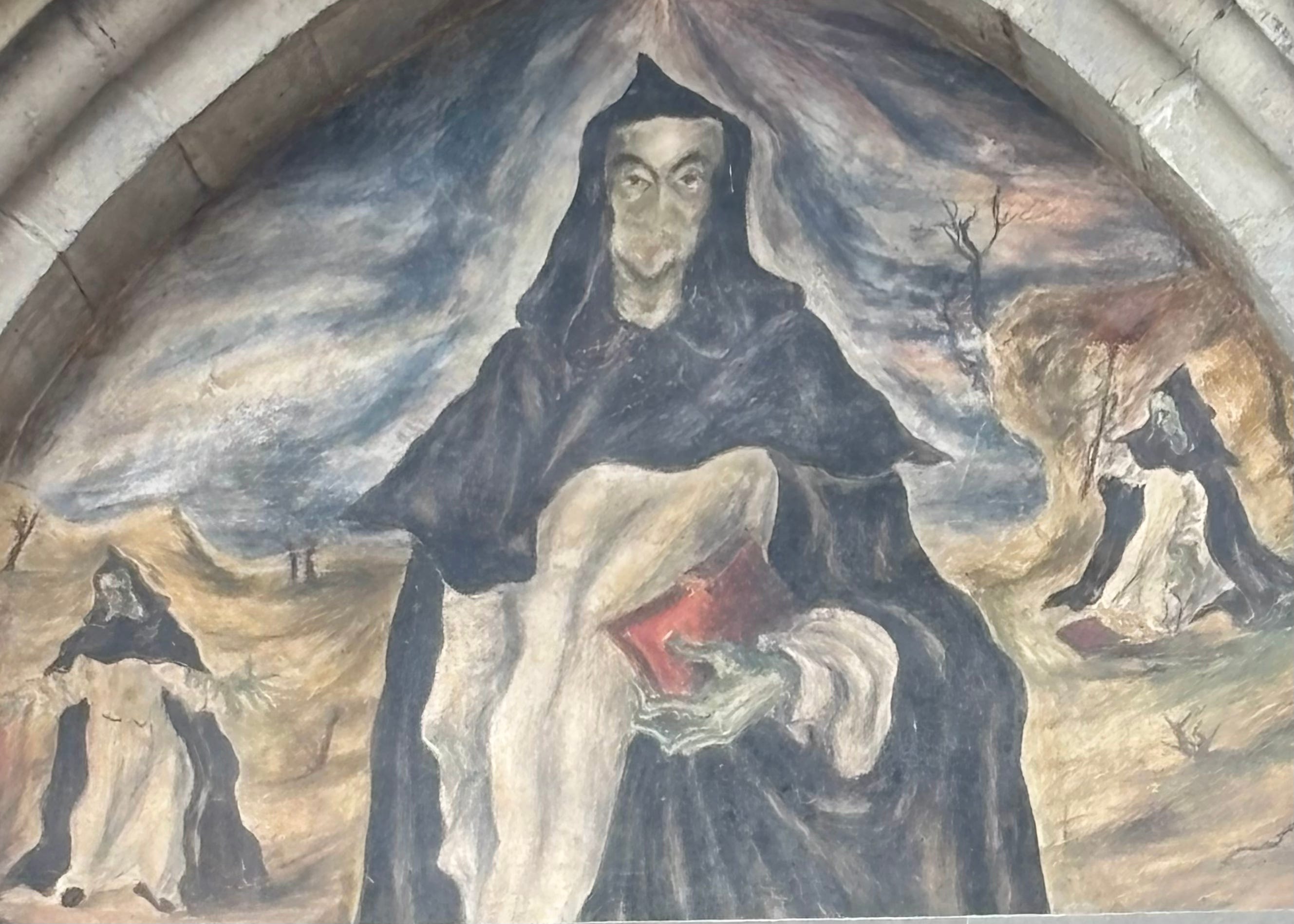
I was travelling in Italy for nearly three weeks — a much needed escape with beautiful family and friends, good food, good wine, good weather and a little time for some extra research.
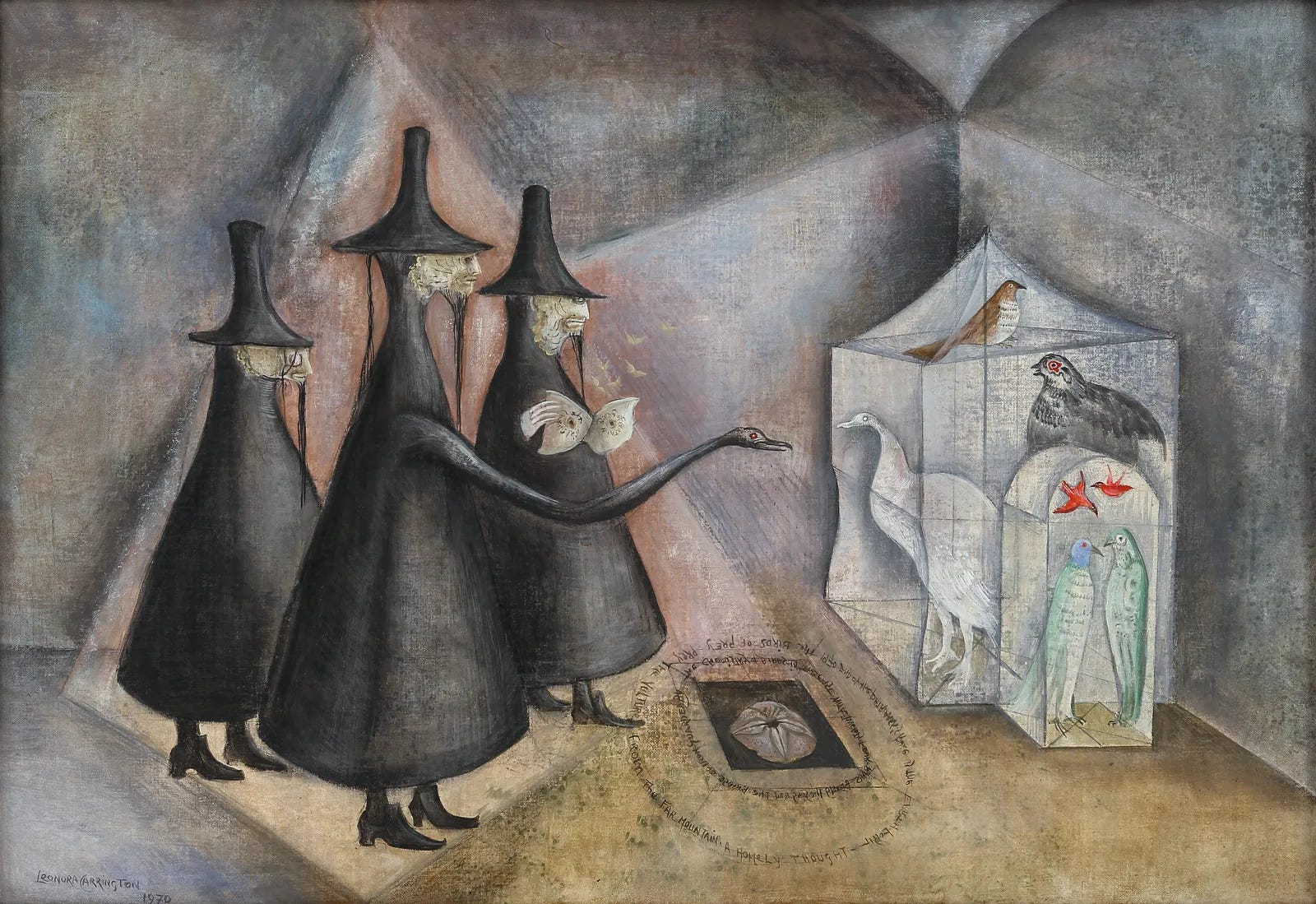
After spending a week with my immediate family, I had the chance to visit Florence, which I had never been to before. We were shown around by my dear friend Claudio Pedretti who is working on a book called “Dear Edgar: A Renewed Humanism” which he has kindly asked me to contribute to. The title refers to Edgar Morin, a French philosopher and sociologist who very sadly died last month at the age of 104, on May 29th 2026 — the very same day that Claudio and I met in Florence to discuss my contribution.
Walking around Florence, it was impossible not to be influenced by the humanistic principles that had engulfed the City since the renaissance. For me, it was also an opportunity to dive deeply into the Medici Family library of ancient texts, including the Nag Hammadi Gospels that had informed and inspired this journey of Aeonology.
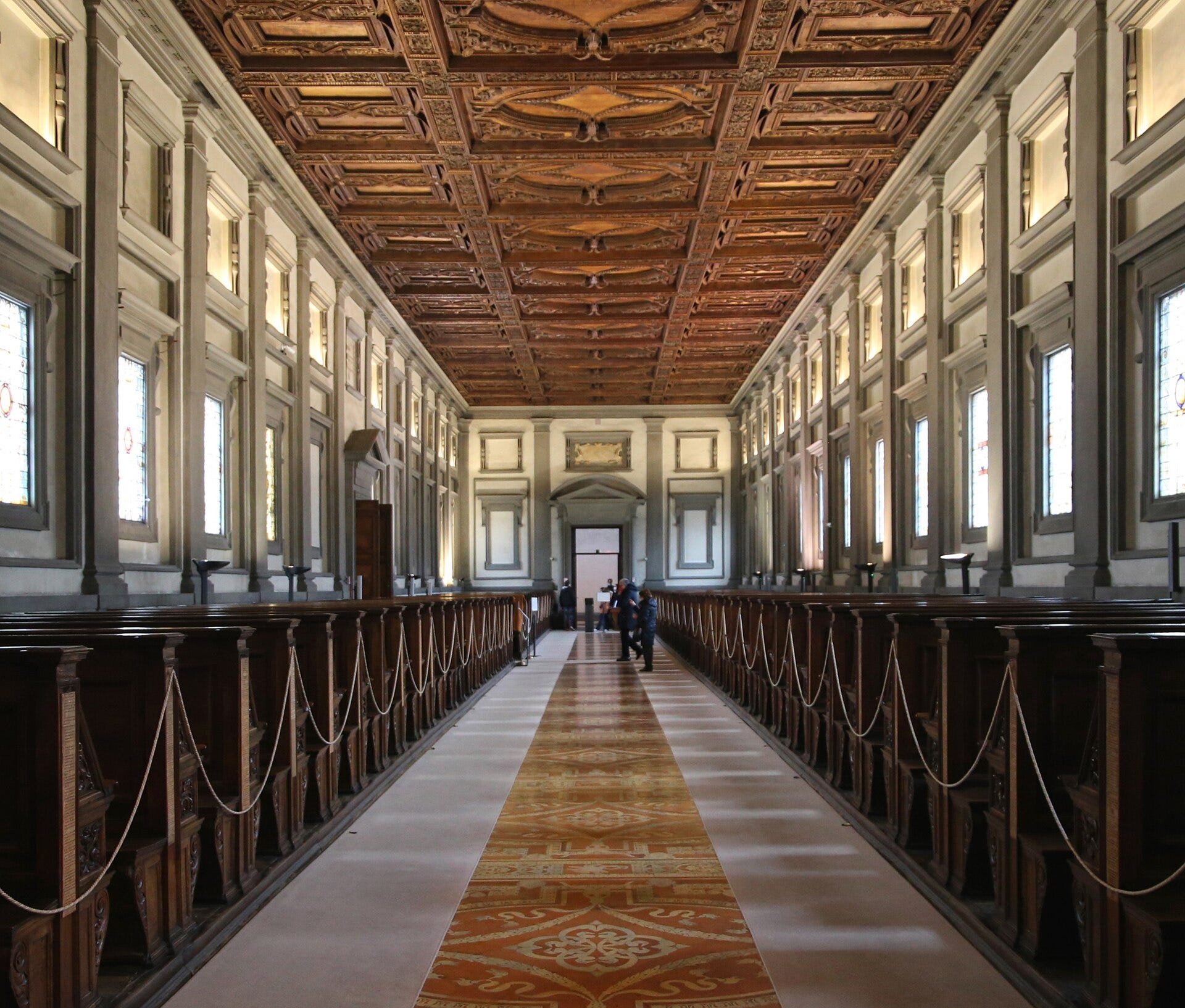
Florence was the home of the Medici Family and in many ways they were the guiding force behind the renaissance. Not only did this wealthy family directly patronize artists such as Donatello, Botticelli, Michelangelo and Leonardo da Vinci but they also shaped modern, western thought by building the first public library in Florence and filling it with humanist texts.
Back then (1460’s ), Western Europe was shrouded in a dark cloud of religious beliefs that seemed to have a contempt for humanity and nature. Catholic powers found it profitable to promote the idea that human beings were inherently sinful—considering them fallen, corrupted creatures, headed for damnation. The only salvation for these poor creatures was to pay (with either time, goods, services or money) the leaders of the Church so that they would put in a good word with their distant, vengeful and judging God. Not unlike the situation we are seeing with our political leaders in America right now. Tariffs are like God’s retribution for sin. The only way to avoid tariffs is to pay the piper to get them lifted. Those who show loyalty to the ‘Church’ benefit handsomely — This is what corruption looks like.
What was amazing about the Medici library was that it emphasized an entirely different and more optimistic perspective on humanity. Cosimo Medici, an obsessive collector of ancient manuscripts, purchased and commissioned translations of lost texts that presented humanity, not as damned, but as dignified beings (Anthropos), who were a microcosm of the divine universe, and capable of creation (Epinoia), self-determination (Autophyes) and the pursuit of Happiness (Hedone) —Yeah, the founding fathers of America took this very ancient notion (probably because of Freemasonry’s popularity) and baked it into the constitution.
Most significant to the library was a collection of philosophical and theological dialogues, found in a Byzantine monastery, and (allegedly) written by Hermes Trismegistus. These texts were believed to contain prophetic secrets and magic from Ancient Egypt and became known as the Corpus Hermeticum.
The significance of the corpus hermeticum cannot be overstated. It transformed the cultural mindset from one of darkness to one of light. Shifting the very notion of humanity from broken to beautiful—capable of infinite potential and their own spiritual ascent. This collection of ancient texts, which had remained buried and untranslated in a Byzantine library for a millennium, did more than simply inspire the Renaissance and modern western thought, it positively fueled it.
The Corpus Hermeticum put humanity back in the center of our attention.
At its simplest, it put the Sun—not the earth— at the center of our solar system as a ‘visible God’ —an idea that went on to inspire Copernicus.
The texts also described the God of the Hebrew bible as a lesser, flawed Demiurge, who somehow fooled humanity into believing they had power and authority over us— creating rules and threatening us with damnation. In many ways, this narrative directly exposed the corruption of the Catholic Church, questioning external authority and replacing it with the notion of an inner authority (the divine spark), that directly connected us to higher states of being.
Rather than considering humanity as separate from nature, these ancient texts described us as an integral, if somewhat insignificant, part of a deeper, mathematical and harmonious structure that connects everything in the universe. Although this was expressed in spiritual terms, the very idea of a universal structure to the universe became a foundational concept of modern science, physics and arguably mathematics.
Spiritually, the Corpus Hermeticum posed an inconvenient question of the Church. If a pre-Christian Egyptian sage could have received exactly the same revelations as the Apostles, how could the institutional Church claim to be uniquely authoritative? If these earlier Christian texts describe humanity as having an inner divinity with direct access to a moral and spiritual guide, how can the Church claim unique, spiritual authority? Was it possible that the institutional Church had suppressed a purer, more ancient form of spirituality that exists outside the Church’s control?
How could a few old manuscripts make such a difference?
Sure, the initial impact was on a relatively small number of intellectuals, artists and philosophers who were writing about topics as diverse as Theology, Metaphysics, Alchemy, Astrology and Medicine. By 1486 Giovanni Pico della Mirandola had taken these ideas and written Oration on the Dignity of Man. By 1543 Copernicus’ heliocentric model of the universe changed how we viewed our place in the universe with his book De revolutionibus orbium coelestium that directly references Hermes Trismegistus. Giordano Bruno (1548–1600) took this to its logical extreme, imagining an infinite universe with countless worlds, of sun-centred galaxies, and a universal divine principle animating all things. This novel perspective was so toxic to the institutional Church that Bruno was burned at the stake in 1600 for heresy. From here, these ideas could not be suppressed. Copernicus, informed Kepler, who in turn informed Galileo and Newton. Newton himself was a devoted student of Hermetic and alchemical texts, and his second edition of the Principia (1713) brought the hermetic notion of a universal order and underlying cosmic harmony to much wider audiences across Europe.
While the Hermetic texts may not have been read by a critical mass of everyday people, the underlying ideas made their way into the aether. The writings didn’t just shape doctrine, cosmology and theology, it gradually filtered down through culture to shape the texture of millions of parent-child relationships.
Picture two children raised a few centuries apart, shaped by the two competing theologies of human nature—pre-Hermetic Corpus and post-Hermetic-Corpus.
Pre-corpus, a child is born into an environment where original sin is the starting assumption: she is already corrupted, her impulses suspect and her will is something that needs to be broken before it can be trusted. Her parents, in this scenario, understand that their role is to catch the child being bad and discipline the inherent badness out before it takes hold. Because of this, the parents’ attention is focused on a combination of constant surveillance and unending judgment—making affection and love something that is only expressed on the condition of compliance. This child learns that she has to prove, again and again, that she is willing to be controlled and that rewards come only when she conforms to other people’s desires and expectations— an external locus of control. The developmental impact of such an upbringing is a daughter who is highly compliant but inwardly anxious and has great difficulty trusting their own judgment.
Now imagine a second child raised a few hundred years later, inside the Hermetic-humanist tradition. The starting point here is that this child is fundamentally good and he carries innate potential. He is self-determining. He has dignity. He is fundamentally capable. In this scenario, the parent’s role shifts from corrector to nurturer — someone helping to create an environment where their intrinsic nature can be drawn out and oriented toward growth, rather than suppressing a nature oriented toward corruption. His mistakes are treated as opportunities to learn, rather than evidence of corrupted character. Discipline becomes guidance toward better expression of his already-good self rather than punishment for being bad. Rather than developing an external locus of control, the post-hermetic child evolves towards the idea that their own perceptions, ideas and impulses are basically reliable and worth developing —an internal locus of control that tends to produce adults more able to learn from failure without collapsing into self-loathing.
(Please note: The gendering of these two examples is intentional. The patriarchal nature of our society (and our institutions) mean that female inner authority gets left in the dark ages. While the Renaissance did wonders for inner authority generally, something the Aeon cards are designed to train too, I think it’s important to give a nod that even today, female inner authority continues to be doubted, supervised, and more often than not, assigned to a man).
These developmental differences do not stop at the individual or family level. Changes in our most deeply held beliefs inform our behavior, our interactions with others and ultimately our society transforms. Populations trained since birth to look outwardly for validation and approval, find themselves pre-conditioned for authoritarian structures —because a strong and judgemental external authority, with strict rules and brutal punishments, provides exactly the corrective feedback that the anxious self requires. There is an easiness and simplicity to life for these populations as they are relieved from the burden of trusting their own perceptions —which is probably why some parts of America are unphased by the blatant lies of the administration.
Alternatively, when a population is brought up with a strong internal locus of control it is more disposed toward participation and consent-based institutions—democracy. When a population is told their ideas matter, their potential is unlimited and that they can have a meaningful impact on the world, then they want their say. They want to have input and steer society in ways that match their values and vision. As a result it is considerably more difficult, and more complex operationally, to unify everyone behind a single agreed narrative.
And this is exactly what happened. The renaissance is our clearest historical instance of such a collision: an entire continent of people newly granted inner authority discovered that they don’t necessarily agree. Politically, we saw a shift from absolute monarchies and religious orthodoxy to conflicts of individual agency and personal ambition— as witnessed by an era of intense fighting and religious upheaval. However, it was also the period when a genuine alternative to authoritarianism was established. The ultimate political and economic outcome was a growth in democratic principles and egalitarian social organization; a trend towards investing in human potential (mutual trust and resources for education, security, rights etc.) rather than rationing human risk (with restrictions, surveillance and punishments).
If anything, the renaissance and the Corpus Hermeticum established an alternative to authoritarianism. Although authoritarianism exists on both sides of the political spectrum, it tends to be grounded in a failure to accept ambiguity. This Hermetic antidote asked us to build a capacity (both individually and societally) to hold tensions, rather than try to outsource judgement to someone else. It asked us to examine our own reactions to uncertainty and chaos before freaking out. It helped us learn to be ok with the idea of not-yet-knowing.
Personally, I see this theme in so many things. The psychology of Jung who tells us we are not who we think we are and that our consciousness is only part of the story. I was at a great gig by the band “Hurray for the Riff Raff” this week and they sang the song “One of us” by Joan Osborne. You might remember the song from the 90’s that describes God as “a stranger on the bus, trying to make his way home.” For some strange reason this took me down a rabbit hole of Process Theory and the writings of Alfred North Whitehead. Whitehead describes God as “a fellow sufferer who understands”. The more I think about it, the more I find this Hermetic mindset of being ok with not-yet knowing helpful. It might be the only intelligent response to a universe that is relational and layered rather than absolute (to come back to my quantum-informed observations.)
If this has been the impact of the 18 or so ancient texts of the Corpus Hermeticum, then the next, most obvious question for me is what will the impact be of the 52 Nag Hammadi texts. The Nag Hammadi texts were only translated in 1970’s and cover a wider and in many ways deeper set of humanitarian issues—not just that there is an inner authority but what stands between you and achieving it. It might be fun to imagine what impact these texts might have in the next 400 years.
That’s going to be the subject of my next post. Sign up.
Comments
Nothing yet. Say the first thing.
Sign in to join the conversation.