
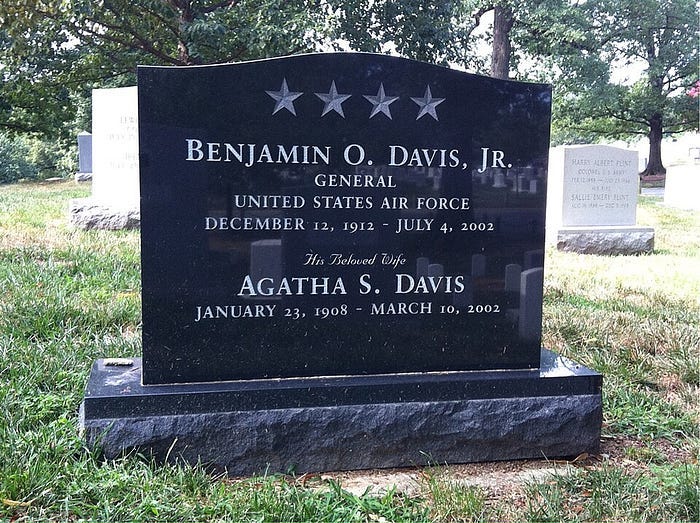
Benjamin O. Davis Jr. graduated from West Point in June 1936 with a face that betrayed nothing of the four years he had just survived. The Corps of Cadets had spent his entire Academy career pretending he did not exist, a silence so complete that it became the longest sustained Coventry in West Point’s history. Yet Davis walked across the Plain with his shoulders square, his uniform immaculate, and his class standing firmly in the top tier: 35th out of 276. He would have finished much higher, but for failing three classes: boxing, ballroom dancing, and CPR. He failed those classes because they required a partner.
Other cadets, staff, and faculty had been ordered to treat Davis as if he were invisible. He wasn’t to be spoken to directly, touched, or called on in class; he couldn’t have study partners or be in study groups. He hadn’t done anything to deserve what they called Coventry except be Black at West Point. He had done everything the Army asked of him, and more. He had endured what no other cadet had ever been asked to endure.
And once Davis graduated, they wanted him gone. Quietly, a voluntary exit, a clean erasure, a return to the forty‑two‑year racial silence that had preceded his arrival. The offer came quickly.
It did not arrive on official letterhead. It did not come from the War Department. It came through intermediaries, men who understood how the Army preferred to handle problems like Davis. They approached him with the tone of people delivering good news, as though they were offering him a gift rather than an escape hatch.
The pitch was simple: Leave the Army. Become a lawyer. We’ll set you up in Chicago.
They told him he could attend law school with financial backing. They told him he would have a stable career waiting for him. They told him he would be respected, welcomed, and supported in ways the Army could not, nor ever would provide. They told him that a legal career would be safer, more predictable, more dignified than the slow suffocation that awaited him in uniform. They did not have to say the rest out loud.
Everyone understood what the Army was preparing to do with him. The institution had no place for a Black officer who excelled. It had no plan for a lieutenant who had survived four years of engineered isolation and still emerged near the top of his class. It had no desire to confront the contradiction of a segregated Army producing a leader whose competence made segregation look absurd.
If Davis accepted, the Army could avoid the uncomfortable reality of a Black officer whose advancement would challenge the architecture of segregation. They could avoid the spectacle of a brilliant young lieutenant assigned to meaningless posts, denied promotions, and quietly sidelined. They could avoid the moral question of what it meant to break a man who had already proven unbreakable. They could avoid his undeniable Blackness.
The intermediaries framed the offer as a chance to start fresh. They spoke of Chicago as though it were a promised land — a city where a young Black man with discipline, intelligence, and a West Point pedigree could build a life untouched by the Army’s racial constraints. They spoke of law school as though it were a natural next step, a path that would allow Davis to use his mind rather than endure the Army’s hostility.
They did not mention that the Army had already decided his future. They did not mention that he would be assigned to the 24th Infantry Regiment — a segregated unit with limited opportunities for advancement. They did not mention that his career would stall for years, not because of his performance, but because of his race. They did not mention that he would be denied command positions routinely given to white officers with half his talent. They did not mention that the Army feared him.
Davis listened politely. He had been raised in the military. He understood the language of quiet pressure. He understood the difference between an offer and an ultimatum disguised as generosity. He understood that the Army was trying to solve a problem it had created — a problem named Benjamin O. Davis Jr. He declined.
He told his father, Benjamin O. Davis Sr., about the offer. Davis Sr. had been the Army’s lone Black senior officer for decades — the only Black man to rise through the ranks in a system designed to prevent exactly that. He understood the Army better than anyone alive. He understood what the offer meant, and what the refusal would cost.
He did not tell his son what to do. He did not push him toward the Army or away from it. He simply told him the truth: If you stay, they will make your life difficult. Davis Jr. stayed anyway.
He stayed because he believed in the uniform. He stayed because he believed in service. He stayed because he believed that the Army could be better than it was. He stayed because he refused to let the institution that had tried to break him decide the rest of his life. He stayed because he was stubborn in the way only people who have survived four years of silence can be.
The Army responded exactly as Davis Sr. predicted. They assigned him to the 24th Infantry Regiment, a unit where Black officers were confined, monitored, and denied meaningful command. They stalled his promotions. They gave him administrative tasks instead of leadership roles. They treated him as an anomaly, a problem, a complication. They waited for him to quit. Just like he didn’t quit at West Point, he didn’t quit the Army.
Davis studied. He trained. He worked. He built a reputation for discipline so flawless that even officers who disliked him respected his performance. He became the kind of officer whose competence forced the Army to confront its own contradictions.
Then, in 1941, the War Department faced a new problem: creating the first Black aviation program. They needed a commander who was disciplined, brilliant, and unbreakable. They needed someone who could withstand pressure, hostility, and scrutiny. They needed someone who could lead men who would be judged not only as pilots, but as representatives of an entire race. They needed someone the Army had tried to push out five years earlier. They needed Benjamin O. Davis Jr.
The offer in 1936 had been meant to end his career. Instead, his refusal became the foundation of the Tuskegee Airmen — the unit that would break the Army’s assumptions about Black leadership, Black intelligence, and Black capability. The Army had tried to erase him, but Davis persevered.
Davis Jr. would go on to lead the 99th Fighter Squadron, then the 332nd Fighter Group. He would command pilots who flew more than 15,000 combat sorties. He would oversee missions that protected bombers so effectively that white crews began requesting “the Red Tails” by name. He would become the first Black general in the U.S. Air Force. He would reshape American military history.
And all of it — every mission, every promotion, every victory — existed because he refused the offer meant to end his career before it began. The Army had wanted him gone quietly. Instead, he became impossible to ignore.
The silence that had defined his cadet years became the opposite of his legacy. The man the Corps of Cadets refused to speak to became the officer whose leadership spoke for itself — loudly, decisively, and permanently. The offer in Chicago was supposed to be an ending. Davis Jr. turned it into a beginning.
Comments
Nothing yet. Say the first thing.
Sign in to join the conversation.