
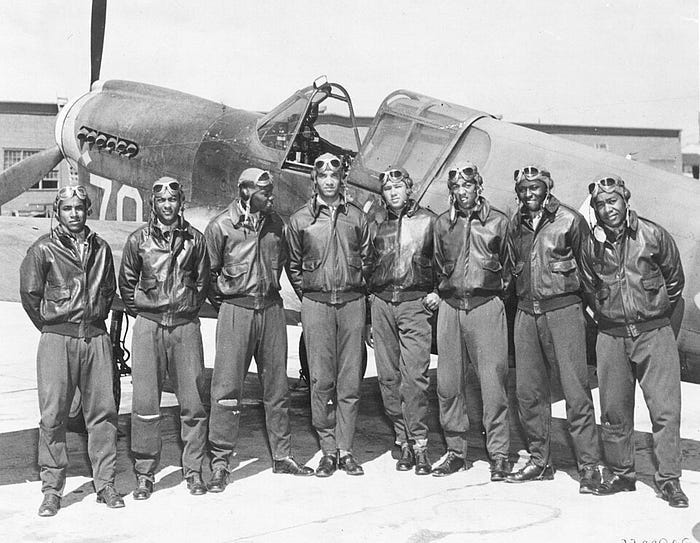
I started this story about the Tuskegee Airmen almost a week ago, but I found I couldn’t tell it without telling three other stories first. You couldn’t appreciate the Tuskegee Airmen without understanding the background of Benjamin O. Davis Sr.
His son:
And knowing how badly the U.S. Army ( the Air Force hadn’t been formed yet) didn’t want Black officers and pilots.
Even after getting an appreciation for the hard work and perseverance of Black Army officers. The Tuskegee Airmen were born out of Franklin D. Roosevelt’s desire to win reelection and a recognition that he needed the Black vote to do so.
And 1940 is the inflection point where Black voters began shifting from the Republican Party (the party of Lincoln) toward the Democratic Party in decisive numbers.
By 1940, Black voters in northern cities — Chicago, Detroit, Cleveland, Philadelphia, New York — had become a meaningful and increasingly organized voting bloc. Roosevelt’s New Deal programs (especially WPA, CCC, and relief hiring) had begun to erode the GOP’s century‑long hold on Black voters.
In 1936, Roosevelt won roughly 70% of the northern Black vote (varies by city). By 1940, that support held or increased, especially in cities where New Deal jobs were concentrated.
Roosevelt didn’t win because of the Black vote alone — but the Black vote reinforced his coalition in states he needed to hold.
Black voters were concentrated in states with large industrial cities:
Illinois (Chicago)
Michigan (Detroit)
Ohio (Cleveland, Cincinnati)
Pennsylvania (Philadelphia, Pittsburgh)
New York (NYC, Buffalo)
These states were part of Roosevelt’s “Northern urban firewall.” He won all of them — and the Black vote was part of the margin.
The Chicago Defender endorsed Roosevelt. Black precincts on the South Side voted overwhelmingly Democratic — a reversal from the 1920s.
Black autoworkers, many employed through New Deal recovery programs, voted heavily for Roosevelt. These votes didn’t flip states on their own, but they strengthened Roosevelt’s urban majorities, which were essential to his reelection.
Black Americans disproportionately benefited from WPA, CCC, and NYA jobs — even within segregated structures.
Her public support for civil rights (including her relationship with Walter White and Marian Anderson) signaled a moral shift inside the White House.
The GOP had not delivered meaningful civil‑rights progress since the 1920s. Many Black voters felt abandoned.
Roosevelt’s administration opened limited opportunities for Black workers in defense industries — a major issue in northern cities.
Though Black newspapers ultimately endorsed Roosevelt, that didn’t mean they weren’t giving him hell daily. Black newspapers were Roosevelt’s most persistent and unignorable critics on military segregation. They didn’t just ask him to do more — they cornered him. By 1940, the Pittsburgh Courier, Chicago Defender, Baltimore Afro‑American, and Norfolk Journal and Guide had built a coordinated, relentless campaign that made the White House’s silence untenable.
Black newspapers ran front‑page stories pointing out the contradiction Roosevelt could not escape: America was preparing to fight fascism abroad while maintaining racial caste at home. They printed editorials with headlines like “Democracy? Not for Negro Soldiers” and “Jim Crow in Uniform.” The message was simple and devastating: How can you defend democracy when you refuse to practice it?
The Courier and Defender published investigative pieces documenting how Black college graduates — engineers, mechanics, pilots — were rejected from aviation training solely because of race. They printed names, qualifications, and rejection letters. They forced the War Department to answer questions it had avoided for decades.
Black newspapers covered Davis’s progress at West Point like a presidential campaign. Every humiliation he endured — silence, isolation, the four‑year “no‑talking” rule — became evidence of the Army’s hostility toward Black excellence. By 1940, Davis was a living indictment of military segregation, and the papers made sure Roosevelt knew it.
This is the part Roosevelt could not ignore. Editorials openly questioned why Black Americans should support a president who allowed the Army to treat them as second‑class citizens. Northern Black voters were becoming a decisive bloc in Chicago, Detroit, Cleveland, Philadelphia, and New York — cities Roosevelt needed. The newspapers made it clear: military segregation had political consequences.
The Courier’s campaign for Black pilots — later formalized as the “Double V” movement — argued that if Roosevelt could not integrate the skies, he could not claim moral leadership on the world stage. Aviation became the symbolic battleground: If Black men could fly, they could no longer be dismissed as inferior. If the Army blocked them, it proved segregation was ideological, not practical.
By 1941, the pressure was so intense that the White House began quietly negotiating with civil‑rights leaders. Roosevelt didn’t suddenly become a racial progressive — he became a president who could no longer afford the optics of doing nothing.
Official title: Assistant to the Inspector General, responsible for the inspection, discipline, training, and administration of all Black units in the U.S. Army.
It was a national oversight position that put Davis Sr. in charge of evaluating every segregated unit—infantry, artillery, engineers, service battalions—across the Army.
Roosevelt needed:
a high‑ranking Black officer the Army could not dismiss,
someone who understood the institution from the inside,
and someone who could report on segregation without igniting a political firestorm.
Davis Sr. was the only person who fit all three.
It made Davis Sr.:
the highest‑ranking Black officer in U.S. military history at that moment,
the Army’s internal auditor of its own racial system,
the man responsible for documenting abuses the Army preferred to hide,
and the officer whose reports shaped Roosevelt’s understanding of military segregation.
This position put Davis Sr. at the center of the debates that eventually forced the creation of the Tuskegee Airmen—even though he himself was not an aviator.
Davis laid out the problem plainly:
The Army’s racial policies were indefensible.
Segregated units were under‑resourced, under‑trained, and intentionally mismanaged.
Black soldiers were being denied advancement, technical training, and leadership roles.
And most importantly: the Army’s refusal to train Black pilots was a political, moral, and strategic liability.
Davis told Roosevelt that the United States could not claim to fight fascism abroad while maintaining racial caste at home — a point Black newspapers had been hammering for months. He made clear that aviation was the test case. If Black men could fly, the entire logic of segregation collapsed.
Roosevelt understood the stakes. Allowing Black pilots meant creating a Black officer corps in a field the Army considered elite. So he asked Davis the question that mattered most:
“If we authorize Black aviators, who will lead them?”
This wasn’t a polite inquiry. It was Roosevelt probing whether the Army had any Black officer capable of commanding a flying unit — and whether Davis believed such leadership existed.
Davis didn’t hesitate.
“My son.”
Benjamin O. Davis Jr., then a young officer who had survived four years of total isolation at West Point, was the only Black man in the Army whose discipline, record, and temperament could withstand the scrutiny the War Department would impose on a Black flying unit. Davis Sr. wasn’t making a sentimental appeal. He was making a strategic one:
Davis Jr. had the training.
He had the character.
He had already proven he could endure institutional hostility without breaking.
And he was the one officer the Army could not easily sabotage or dismiss.
If Davis Jr. commanded the unit, the experiment could not be quietly undermined. If Davis Jr. succeeded, the Army’s racial assumptions would be disproven in front of the world. If Davis Jr. failed, the Army would blame him — and Black America — for decades.
Roosevelt approved the program anyway. Not because he was a racial progressive, but because Davis Sr. had given him a solution he could not politically refuse.
The Tuskegee Aviation Program was authorized.
The 99th Pursuit Squadron was formed.
Benjamin O. Davis Jr. became its commander.
And the Tuskegee Airmen went on to become one of the most successful fighter groups of World War II.
The Army had tried to prevent Black pilots for decades. Davis Sr. forced the door open. Davis Jr. walked through it — and brought hundreds of Black airmen with him.
A little-appreciated fact is how important HBCUs were in supplying the pilots and support staff of the Tuskegee Airmen. As the only Black general officer in the U.S. Army, Benjamin O. Davis Sr. carried a responsibility no white officer could have performed: explaining the military’s needs to Black institutions while also explaining Black institutions to a military that refused to understand them. It was a role the Army could give him that wasn’t commanding troops in the field.
Met with presidents, deans, and ROTC commanders at Howard, Tuskegee, Hampton, Fisk, Wilberforce, Morgan, and others.
Assessed their ROTC programs, engineering departments, and pre‑military training capacity.
Encouraged them to expand math, science, and mechanical curricula so Black students would be ready for technical roles the Army claimed they “could not” perform.
Prepared faculty for the reality that Black graduates would face segregated assignments, limited advancement, and institutional hostility — but that preparation was still essential.
“The opportunities will come late, and they will come grudgingly — but you must be ready when they do.”
Davis Sr. understood that the Army would only open doors under pressure, and when it did, it would look for any excuse to declare Black soldiers unprepared. His visits were designed to eliminate those excuses.
While Davis Sr. shaped institutional readiness, Benjamin O. Davis Jr. shaped personal readiness—and served as living proof of what Black excellence looked like inside an institution designed to break him.
Spoke to ROTC cadets about discipline, endurance, and the realities of military life.
Demonstrated that a Black officer could meet — and exceed — West Point standards even under conditions of engineered isolation.
Encouraged students to pursue aviation, engineering, and mathematics despite the Army’s whites‑only aviation policy.
Explained how to navigate an institution that would test their resolve before it tested their skill.
“You must be twice as prepared for opportunities that will come half as often.”
Students listened because Davis Jr. embodied the future the Army insisted could not exist.
These trips were not symbolic. They were foundational.
They created the academic and ROTC pipeline that fed the Tuskegee Airmen.
They prepared Black colleges to demand — not request — access to technical military roles.
They built the intellectual infrastructure that made the Army’s segregationist claims impossible to defend.
They ensured that when Roosevelt finally authorized Black aviators, there were Black men ready to fly.
Some hoped the Tuskegee Airmen experiment would fail before it even got off the ground. Roosevelt felt the program would need 5,000 recruits to get off the ground. Davis Sr. and Davis Jr. tapped their HBCU network, and 35,000 recruits showed up; 15,000 were hired to become 1,000 pilots, and 14,000 for support staff positions.
When Franklin D. Roosevelt entered office, the U.S. Army Air Corps was fully segregated by law, doctrine, and culture. It was not simply an Air Force that included segregation — it was an Air Force built around segregation. Every policy, training pipeline, and command structure was designed to keep Black Americans out of aviation or confined to racially restricted units.
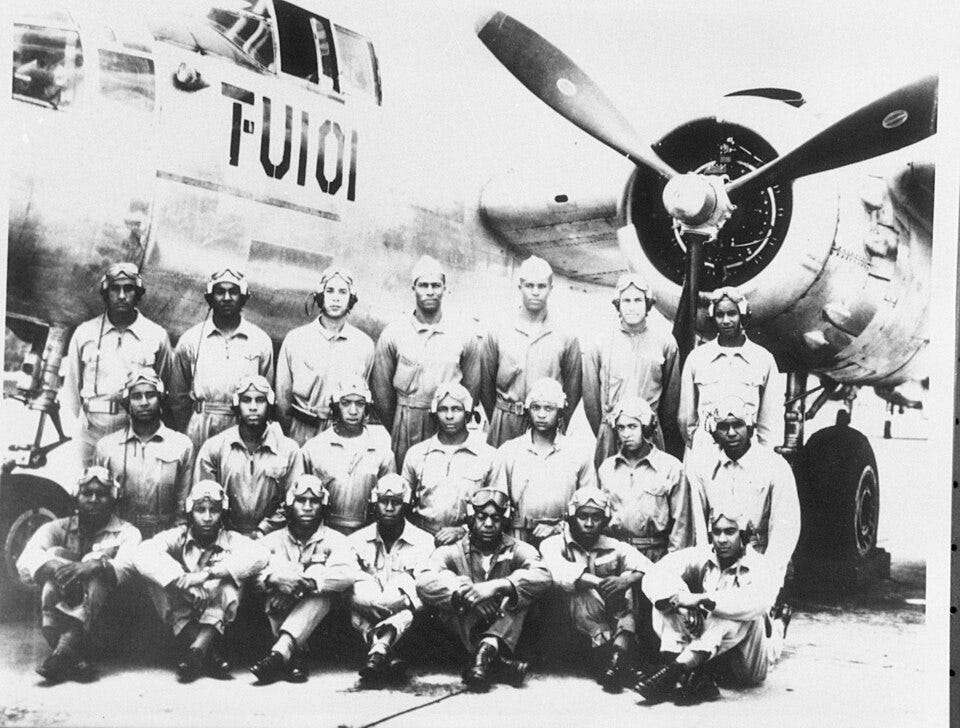
Before 1941, the Air Corps maintained an explicit racial doctrine: Black men were unfit for aviation, leadership, or technical roles.
This doctrine was not informal prejudice — it was written into:
War Department training manuals
Air Corps personnel policies
Officer selection criteria
Psychological evaluation standards designed to exclude Black applicants
The Air Corps was the most segregated branch of the U.S. military.
When Roosevelt finally authorized Black aviators, the Air Corps did not integrate. It created segregated units, including:
99th Pursuit Squadron (later Fighter Squadron)
332nd Fighter Group
477th Bombardment Group
Every one of these units was:
commanded by white officers at first
isolated from white units
trained separately
evaluated separately
supplied separately
and judged by standards designed to prove failure
Segregation was not a side effect — it was the organizing principle.
Training for Black aviators was deliberately separated from the main Air Corps pipeline:
Primary flight training at Tuskegee Institute
Advanced training at Tuskegee Army Air Field
Technical schools restricted to Black trainees
Maintenance and ground crew schools segregated by race
White trainees went through Maxwell Field, Randolph Field, Kelly Field, and other major bases. Black trainees were confined to Tuskegee — a single, racially designated site.
At every Air Corps installation, segregation governed:
barracks
mess halls
recreation facilities
classrooms
officer clubs
medical facilities
Even blood plasma was segregated by race — a policy the Red Cross adopted under Army pressure.
Black units were placed under:
white commanders
white operations officers
white flight surgeons
white evaluators
white disciplinary officers
The Army believed Black officers could not command white personnel, so even when Davis Jr. became commander of the 99th and later the 332nd, his authority was restricted to Black airmen.
Black aviators were:
deployed separately
assigned missions separately
evaluated separately
denied access to mixed combat wings
The 332nd Fighter Group flew escort missions because the Air Corps refused to integrate them into bomber groups or mixed fighter wings.
Black aviators faced:
slower promotions
restricted leadership opportunities
segregated award boards
segregated disciplinary systems
Even their combat record — one of the strongest escort records of the war — was dismissed or minimized by white commanders who opposed their existence.
Roosevelt’s Air Force was segregated because Roosevelt chose expansion without integration — a political compromise designed to appease Black voters and civil‑rights leaders without confronting the Army’s racial hierarchy.
In the end, the story of Roosevelt’s segregated Air Force — and the men who forced it to change — is not a tale of sudden enlightenment from Washington. It is a record of Black Americans preparing themselves long before the nation was willing to recognize their worth. Benjamin O. Davis Sr. and Benjamin O. Davis Jr. did the quiet, necessary work: visiting HBCUs, building pipelines, shaping discipline, and insisting that opportunity would come, even if it arrived late and wrapped in resistance.
When Roosevelt finally authorized Black aviators, he did so because the pressure was undeniable and the preparation was already done. The Tuskegee Airmen were not the product of a presidential vision; they were the result of a community that refused to wait for permission. Their success exposed the contradictions of a segregated Air Force and made it impossible for the country to pretend that exclusion was ever about ability.
Comments
Nothing yet. Say the first thing.
Sign in to join the conversation.