
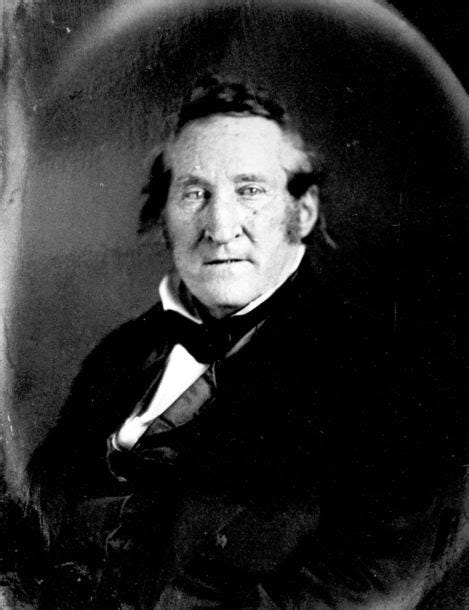
In 1850 the U.S. Congress was beset with tension and anger. The nation was on the verge of being torn apart. The two largest political parties, Democrats and Whigs, were both divided into factions, partly because of different positions on slavery. Brilliant senator John C. Calhoun of South Carolina led one group—Democrats who were determined to preserve society as it existed in the South. To maintain political power against the free states, they favored the extension of slavery into newly-acquired American territories in the West. Some of them threatened secession unless guarantees were enacted that would protect the system of slavery. A new political party was also in the picture, the Free Soilers, who were adamantly opposed to any extension of slavery. Some Whigs and Democrats held views similar to the Free Soilers. Thomas Hart Benton of Missouri was one such Democratic senator, and he wrote on January 17 that, “for all practical purposes of legislation, we are already nearly in a state of disunion.”[i] America had moved towards breaking up in the 1830’s, but compromise had kept the states together. Now the divisions seemed especially bitter and entrenched, with Northern abolitionists fanning the flames as much as the Southern radicals were. President Zachary Taylor urged restraint, and threatened to use military force to hold the country together.
On April 17, the short, abrasive Henry S. Foote of Mississippi rose to speak in the Senate. He had insulted Benton publicly on previous days, and Benton, a big, physically impressive man, tried to bear the offenses without reciprocating. Now, Foote went on the attack again. He accused Benton and other senators of being “calumniators,” or slanderers, for describing the concerns of Southern senators as “agitation” and “crying wolf.” As Foote proceeded to taunt Benton specifically,
“Senator Foote suddenly broke off. Benton had stood up at his desk, pushed his chair violently from him, and started walking down the passage behind the bar toward Foote’s seat. Now Foote backed down the aisle toward the Vice-President’s dais, drawing and cocking as he did so a five-chambered loaded revolver. At first Benton, checked by his old friend Senator Dodge of Wisconsin, had started back toward his seat but when he saw the pistol he turned and followed the retreating pistol-wielder down the aisle. Pandemonium… Senators leaping from their seats… calls for the Sergeant-at-Arms…cries for order… Dodge tried forcibly to detain Benton, and a number of other Senators surrounded Foote. But Benton would not be restrained and continued his advance toward Foote, who crouched by the Vice-President’s desk, pistol still pointed at Benton. As he strode forward, Benton called out in what one observer remembered as a ‘loud and defiant’ voice:
‘Let him fire! Stand out of the way! I have no pistols! I disdain to carry arms! Stand out of the way, and let the assassin fire!’ But while Foote still held his gun, he was nearer fleeing than firing.
Finally, Senator Dickinson of New York confiscated the revolver and locked it in his desk, and both Benton and Foote were persuaded to return to their seats. Blandly, [Henry] Clay intoned, ‘I hope that order will be preserved.’”[ii]
Congress sometimes got a bit exciting in the 19th Century.
After things cooled down on April 17th, the Senators got back to business. The great Henry Clay of Kentucky, who had crafted vital compromises in previous years, was able to help steer some votes through Congress which kept the peace for a time. But the specter of division and war continued to haunt American leaders.
Before 1850, America enjoyed a time of growth, blossoming, and change. Many Americans felt optimistic about their nation’s future. The population increased dramatically. Territory in the west was acquired by purchase, negotiation, and war, and it was being explored and settled. An intellectual flowering occurred. Great authors such as Hawthorne, Longfellow, and Poe were widely read. Cities and industry grew, reform movements flourished, and experimental, utopian communities were planted. Historians characterize the period as a time of both “expectations” and “growing pains,” with America as “a nation going places” and “a boisterous teenager.”[iii]
Some of the boisterousness went too far. In the 1830’s especially, America saw an increase in rioting and other violent disorders. “American society was subject to various tensions, uncertainties, and fears which sometimes found violent expression.”[iv] Conflicts related to slavery, abolitionism, immigration, social class, religion, and political partisanship were behind much of the violence. And after the Compromise of 1850, political divisions continued to grow. With hindsight we know that America’s terrible Civil War erupted in 1861. That war would cause the deaths of over 600,000 men, along with awful destruction. In the 1860’s, 600,000 was a much higher proportion of the American population than it is today. From the 1840’s onwards, Thomas Hart Benton, the man without a pistol on the Senate floor, was warning Americans of the dangers that he feared were looming. Clearly Benton didn’t always hide his temper, but he nonetheless accomplished a significant amount of peacemaking in these tumultuous times.
Benton’s biographer William N. Chambers wrote,
“Benton epitomizes his age. In both his private life and in his long public career, he represents many of the salient qualities of his time. Beyond this, his story offers a triple interest for our own day—first, because he was a unique, robustious, always interesting, controversial person; again, because his career in context makes a revealing case study not only in the politics of his era, but in American democratic politics in general; and finally, because what he stood for is a part of the democratic heritage on which we may draw as we face the problems of today.”[v]
Chambers wrote this in 1956, and Benton’s ideas and example can be interesting and instructive today as well.
Thomas Hart Benton was born in North Carolina in 1782. His parents were kind and conscientious, and gave Thomas a good start in life. His father Jesse was a scholarly lawyer who owned a renowned collection of books. Jesse died of tuberculosis when Thomas was 7 years old, and the boy took on heavy responsibility to help support his mother and siblings. Along with chores, Thomas took time to read from his father’s library under the guidance of his pious mother. He was especially interested in history and geography, and his favorite books included histories of England. As William Chambers noted, “young Thomas early absorbed from his reading an old-whig intellectual passion for liberty and hatred of tyranny.”[vi] Sir Walter Raleigh was one of his heroes. After some schooling, he attended the University of North Carolina. Although he had been a dutiful, studious boy, he was expelled from the university for stealing from fellow students. One biographer believes that Benton was tempted to steal because of his shortage of funds compared with wealthier classmates.[vii] Whatever the motive, the shame from this incident lingered with Benton for many years, and haunted him during his political career.
After his expulsion, 19-year-old Thomas and his mother led the family and some inherited slaves to settle on land which his father had purchased in Tennessee. There, Thomas experienced frontier life and the challenges of running a farm. Among boisterous frontiersmen, he continued to follow his mother’s advice to refrain from hard liquor, tobacco, and gambling. He also became a skillful shooter.
One crop grown on Thomas’s farm was cotton, which was sold in Nashville for export from the port of New Orleans. When the Spanish governor of New Orleans closed the port, ending purchases of cotton from Tennessee, Thomas learned a painful lesson about how various regions of North America were tied together economically. As Thomas recalled,
“We raised cotton then… and three or four hundred pounds to the acre, and so many acres to the hand, had filled us all with golden hopes. I came into Nashville, to sell the summer’s crop. I offered it to the merchant, a worthy man, with whom we dealt. His answer, and the reason, came together, and gave the first intelligence of my own loss and the calamity of the country. Not a cent could he give for the cotton…”[viii]
Persevering with his studies at home, Thomas taught school for a time, and was admitted to the bar as a lawyer in 1806. He developed a sympathy for poorer farmers who had trouble navigating the Tennessee legal system, and he began to write newspaper articles advocating legal reforms. He also witnessed the success of some small farmers whose hard work paid off. “Over the years, his observations and his reading made the moral clear to Benton: Give the people land and opportunity, and they could build in the great Western expanse an Arcadia of happy, self-respecting, republican freeholders.”[ix] Benton was a great admirer of Thomas Jefferson, whom he called “that statesman who could conceive measures useful to all mankind,”[x] and he shared Jefferson’s emphasis on the virtues of independent, yeoman farmers.
In 1809, Benton ran for state senate, and was elected. He worked successfully to get judicial reforms passed, and also argued for the rights of slaves in court. Benton continued to own slaves, but he eventually opposed slavery at great political cost. Along with many Americans, he believed that the immediate abolition of slavery would result in too much disorder and racial conflict. Yet he was open to ideas for gradual emancipation. As a U.S. senator he spoke favorably of some abolitionists such as the Quakers, whom he characterized as “good people, aiming at benevolent objects, and endeavoring to ameliorate the condition of one part of the human race, without inflicting calamities on another part.”[xi] He also said, after many debates about slavery, that the solution to the problem “seems to be above human wisdom. But there is a wisdom above human! And to that we must look. In the meantime, not extend the evil.”[xii]
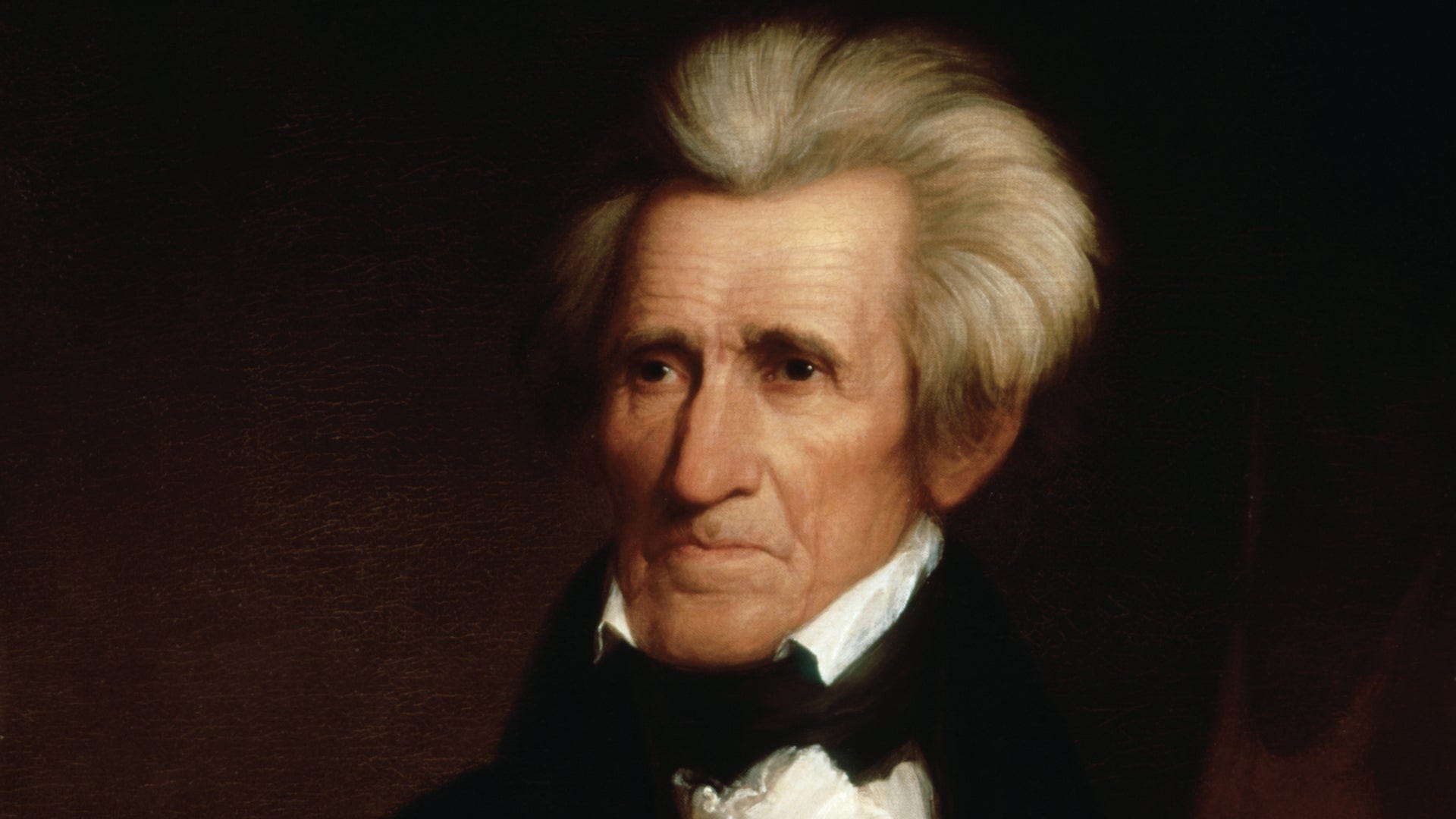
Benton served as an officer in the Tennessee Militia and regular Army during the War of 1812. Although he did not see combat, he did experience some of the burdens of command, while leading men on an expedition that was cancelled before the enemy was engaged. Andrew Jackson, general of the Tennessee Militia, was impressed by Benton’s leadership skills. The assertive Benton, though, soon became embroiled in conflicts with fellow officers. Like George Washington, Benton struggled mightily throughout his life to control his temper. Many young men of the time, especially in the American South, were very sensitive about defending their honor. During the first half of the 19th Century, many fought duels, and Benton was no exception.
Another man who wasn’t afraid to duel or get into a brawl was Andrew Jackson. Jackson was aptly described by historian Elbert B. Smith as a man “who could be gentle as well as fierce.”[xiii] In 1813, Benton experienced the fierce side. Benton’s brother Jesse got into a dispute with a Jackson associate, and after they did a lot of wrangling over matters of honor, Thomas Benton and Jackson got involved. Feathers were ruffled further on both sides. In a Nashville hotel, the Benton brothers encountered Jackson with some of the latter’s friends, and they all got into a massive brawl. Jackson was shot in the arm and, after a chaotic struggle involving several men wielding weapons, Thomas Benton fell down a staircase and the brawl then ended. No one was killed, Jackson recovered, tempers eventually cooled, and Jackson’s relationship with Benton entered a very different phase later on.
In 1815, Benton moved west to St. Louis, Missouri, which was then a small town, not far from the western frontier. Benton soon felt at home, and wrote, “It has been my happiness everywhere to meet with good people.”[xiv] Benton resumed his law practice, and specialized in land claims and titles. Unfortunately he and another lawyer rubbed each other the wrong way, and they eventually fought two duels. Benton killed the younger man in the second one. It was another event which haunted him the rest of his life, and it turned him against violence.
Benton still was widely respected in St. Louis, and in 1818 he took a job as a newspaper editor. This allowed him to publicly express his opinions on a variety of political subjects. He continued to push for practical measures to aid small farmers, such as a law to facilitate cheap salt, which was vital for livestock and food preservation. He also urged statehood for the Missouri territory, and improvement of roads, many of which were in very poor condition.
Benton had already seen how the American West offered opportunities for people in humble positions back East, and he was an early advocate for settlement in the Oregon territory and Texas. For many years, he urged that public lands in the West be made more easily available to small farmers. He was determined to find out what the far western lands were like, and frequently invited explorers, Indian chiefs and White frontiersmen such as Kit Carson to his home. His son-in-law John C. Fremont was a western explorer and mapper, who ran as the first presidential candidate for the Republican Party in 1856.
In 1820, Benton was elected to the U.S. Senate, and Missouri achieved statehood the following year. Benton was open to learning from his colleagues, who remarked on his studious nature. When he spoke, though, he still showed his passionate, aggressive side. Rufus King, a friendly, older senator from New York, advised him to speak more calmly, in order to be more effective.
In 1821, Benton married Elizabeth McDowell, and they would have several children together. Marriage and family life suited Benton very well, and seemed to settle him down to a degree. For the rest of his life, he was deeply devoted to his wife and children. He also became a regular Presbyterian churchgoer. After Elizabeth became an invalid, many visitors were impressed by how gentle and caring the big, sometimes blustery Benton was with his wife.[xv]
Throughout his political life, Benton was an advocate for small businessmen, entrepreneurs, and wage earners, as well as for small, independent farmers. Although he often argued on behalf of western regional interests early in his political career, he was very attached to the Union of American states. He considered the Union to be a protector of individual legal rights, an enabler of a strong economy that benefitted all states, and a deterrent against aggression and meddling by other countries. Today, he would be called a champion of “the little guy,” a populist, and a nationalist. Benton visited his hero Thomas Jefferson in 1824, and the former president inspired Benton with ideas for building a road across the North American continent. In the Senate, Benton continued to advocate western expansion. In addition to pressing for easier access to public lands by poor farmers, he promoted trade with Mexico, peaceful relations with western Indians, and protection for western settlers.
Benton opposed financial speculation, which was rampant in the 1820’s and 30’s. He became an advocate of gold and silver currency—“the best currency for a republic; it suits the men of middle property and the working people best.”[xvi] During the 1837 economic depression, Missouri remained relatively prosperous, at least partly due to following Benton’s economic principles.
When Andrew Jackson came to Washington as a senator in 1823, Benton and Jackson made amends. During Jackson’s presidency, Benton became one of “Old Hickory’s” strongest supporters in acting against powerful financial interests, and the Bank of the United States. During the tempestuous political struggle against the latter, Benton spoke out against the danger of a powerful national financial institution, governed by “a directory of seven… and none of these elected by the people, or responsible to them.”[xvii] The Bank of the United States went extinct in 1836 when Jackson ensured that its charter was not renewed.
By this time, Benton had grown increasingly worried about what he called the “agitation” of pro-slavery and abolitionist partisans, which he feared would destroy the Union. He opposed an attempt by Calhoun to stop Congress from accepting abolitionist petitions. And while he criticized radical abolitionists for being “incendiary,” Benton also became more outspoken against slavery. He befriended the strongly antislavery senator William H. Seward, who later played a major role in Republican politics.
In 1844, Benton was among a group of civilians on the naval ship U.S.S. Princeton, observing a demonstration of a new gun. The gun accidentally exploded, killing some nearby, but Benton was spared. Some associates believed that Benton became more forgiving of others after this close call. He remained bitterly opposed to the Southern sectionalist John C. Calhoun, though. Calhoun considered Benton a traitor to the South, and Benton believed that Calhoun betrayed the nation.
In the 1840’s, America became embroiled in territorial disputes with Britain and Mexico. In the Oregon territory, the U.S. and Britain argued about where the American/Canadian border should be located, with some Americans insisting on 54 degrees north latitude. Based on a careful examination of the language of previous treaties and historical claims by Britain and the U.S., Benton was convinced that the border should be further south, at 49 degrees, and he supported patient negotiation with Britain. The dispute was resolved peacefully, and Benton deserved much of the credit.
For many years, Benton had looked forward to Texas becoming a part of the United States. He strongly opposed antagonizing Mexico over the issue, though. Texas won its independence from Mexico in 1836, and it was annexed by the U.S. in 1845. As tensions increased between the U.S. and Mexico, Benton urged negotiation rather than war. When war with Mexico did break out in 1846, Benton believed that the war should be concluded as quickly, boldly, and humanely as possible. He continued to advise President Polk, and helped develop the winning military strategy. Victory resulted in America gaining a vast amount of territory in the West.
In 1848, another dramatic event happened in Congress. Former president and now U.S. representative John Quincy Adams rose to speak on the floor of the House. Suddenly he suffered a stroke and collapsed. Congressmen rushed to his aid, and tearfully watched over him as a doctor assisted. Adams died a couple of days later. He had been a champion of eastern financial interests, and had clashed with Benton, yet both were patriots, and they developed a mutual respect. In a eulogy, Benton said that Adams provided “the example of a life, public and private, which should be the study and the model of the generations of his countrymen."[xviii]
Not everyone in Congress was a great orator. During some speeches, senators at their desks wrote letters or pulled out books to read. “When the giants spoke, however, all was excitement both in the galleries and on the floor”[xix] Those giants were Henry Clay, John C. Calhoun, Daniel Webster, and Thomas Hart Benton. Many of their eloquent speeches were printed and widely distributed soon afterwards. Benton was not considered quite as inspiring as the other three, but he impressed listeners and readers with his logic, use of facts, thorough arguments, references to history, and humor. He was not guilty of false modesty, and could sometimes be accused of pomposity, but contemporaries considered him to be an effective champion for certain causes, and appreciated that he was often gentlemanly, despite his occasional blusteriness. Speeches by Benton and others sometimes lasted 2 or 3 hours or more, yet Americans of the time eagerly attended or read them.
During the Senate debates over the Oregon boundary question, Benton demonstrated a bit of his humor. A stickler for using the right word, he described a historical incident that “took place.” He mentioned in a quick aside that the word “transpired” was sometimes misused for “took place,” and said to the transcriber of the debates: “Do not write me down ‘transpired,’ or I shall certainly expire.”[xx] On another occasion, when a bill was introduced to provide more ventilation in the Senate chamber, Benton expressed with mock horror, “No sir, no more ventilation! We have quite wind enough, sir! Yes sir, quite wind enough!”[xxi] During the turmoil of 1850, the Senate had grueling debates about an “omnibus bill” that included several different proposals. After the bill was defeated and each proposal was considered separately, Benton described how “cats and dogs that had been tied together, scratching and biting, being loose again, every one of them ran off to his own hole and was quiet.”[xxii]
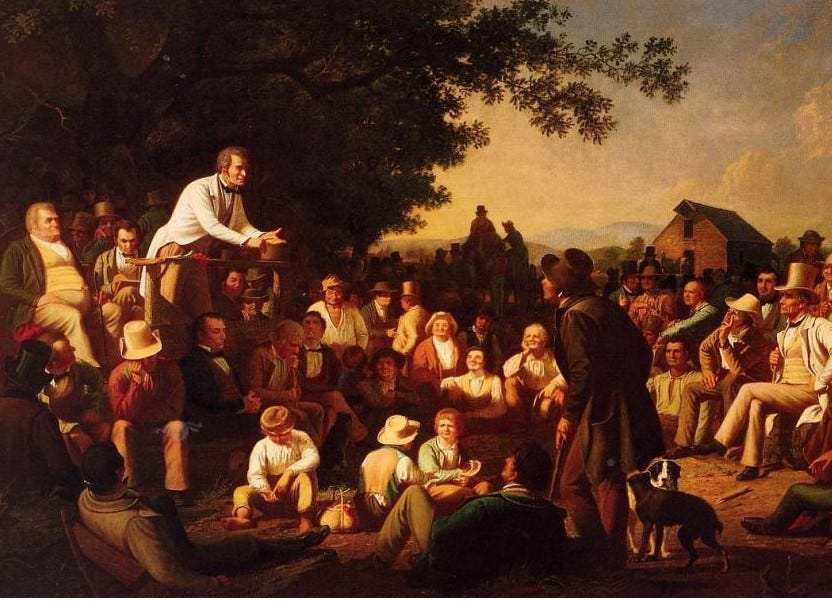
In 1849, Benton went on a lecture tour of Missouri to speak against the Jackson Resolutions, which were pro-slavery resolutions passed by the state legislature, and influenced by Calhoun. Benton’s life was threatened as he traveled into counties where pro-slavery sentiment predominated, yet he persevered. His outspokenness against the expansion of slavery and the institution itself resulted in his losing the 1851 senatorial election. He won a term as a U.S. representative in 1853, but lost a race for governor in 1856. As the great historian Samuel Eliot Morison wrote, “his sturdy nationalism had grown too old-fashioned for Missouri.”[xxiii]
After leaving politics, Benton visited family and friends, lectured, and kept busy writing. In 1856-7 he toured the North, speaking about the threats to the Union. He produced a history of the American government from 1820-1850, a commentary on the Dred Scott Supreme Court decision, and a useful abridgement of Congressional debates from 1789 to 1850. In 1857 he wrote to friend and former president Martin Van Buren, “If Mr. Buchanan continues the policy of the present administration, the Union will approach its last days, and to save it in 1860 will require all its friends, forgetting everything else, to stand together.”[xxiv] A few months later, his health declined severely. He worked on his abridgement until almost the end, and died on April 10, 1858. Theodore Roosevelt wrote, “Benton always showed at his best when the honor or integrity of the nation was menaced, whether by foes from without or by foes from within.”[xxv]
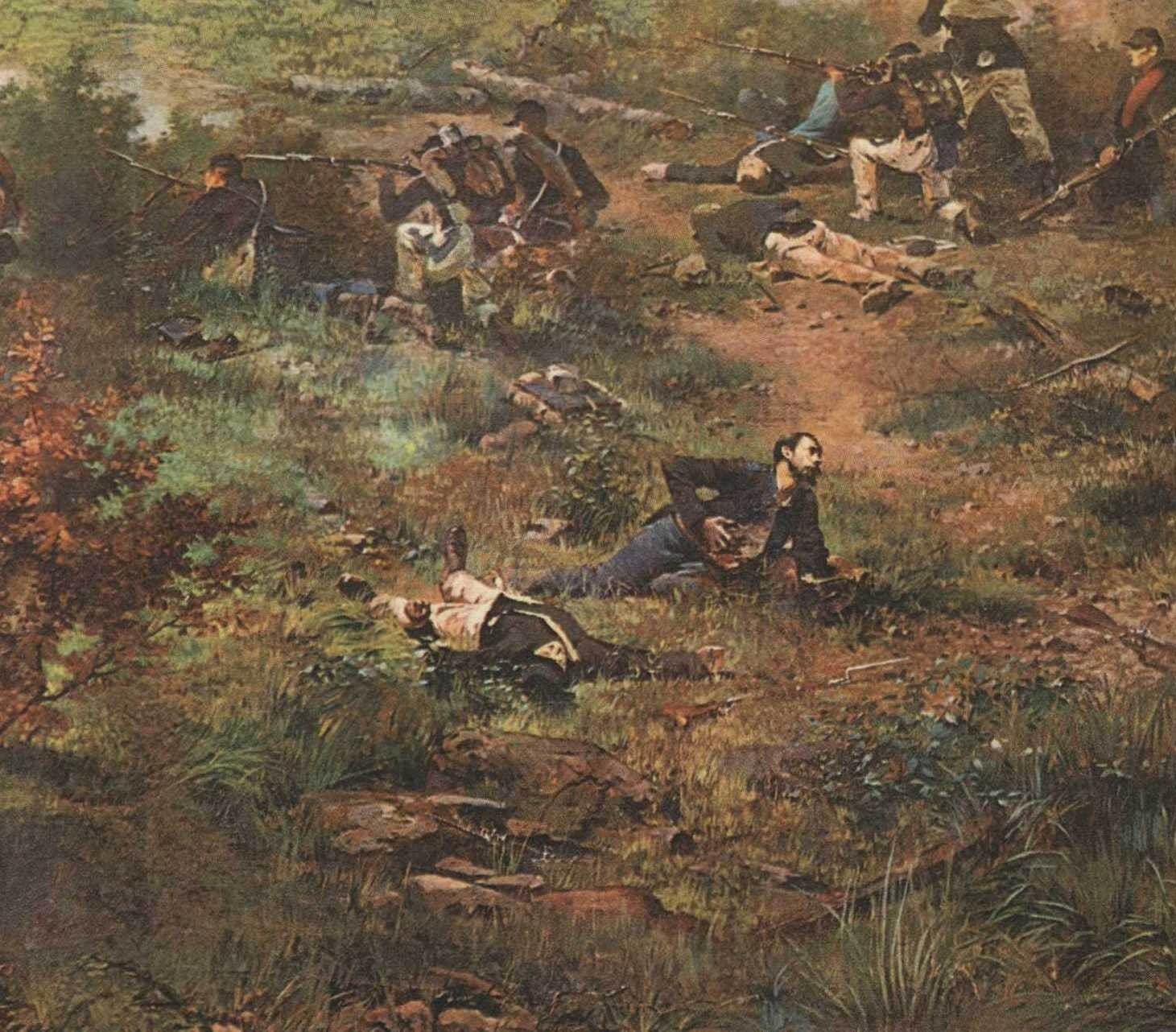
Some commentators on the Civil War seem to suggest that the bloodshed was necessary for the country to progress. Some of the more than 600,000 dead of that awful time might disagree. Men such as Benton tried to sound the alarm beforehand, and to steer the country safely through the perilous politics of the time. The voices of these peacemakers were eventually drowned out by harsher voices, North and South.
__________________________
[i] Chambers, William N., Old Bullion Benton: Senator from the New West, Boston: Little, Brown & Co., 1956, p. 355.
[ii] The Congressional Globe , April 17, 1850, p. 762, https://www.congress.gov/congressional-globe/page-headings/31st-congress/n-a/23500; Chambers, p. 361.
[iii] Allen Nevins, William N. Chambers, Margaret Coit, Roger Butterfield.
[iv] Dawson, Nelson L., Democracy Betrayed: A History of the Democratic Party from Cotton Plantation to Urban Plantation, New York: Algora Publishing, 2020.
[v] Chambers, pp. xi-xii.
[vi] Ibid., p. 12.
[vii] Smith, Elbert B., Magnificent Missourian: The Life of Thomas Hart Benton, Philadelphia: J.B. Lippincott Co., 1958, p. 20.
[viii] Register of Debates in Congress, 1st Session of the 21st Congress, 1830, p. 103, https://digital.library.unt.edu/ark:/67531/metadc30742/m1/107/?q=benton%20new%20orleans, University of North Texas Libraries, UNT Digital Library.
[ix] Chambers, p. 31.
[x] Benton, Thomas Hart, Thirty Years View; Or, a History of the Working of the American Government for Thirty Years, from 1820 to 1850, Vol. 1, New York: D. Appleton & Co., 1883 ed. (1854 original), p. 14.
[xi] Register of Debates in Congress, 1st Session of the 24th Congress, 1836, p. 85, https://digital.library.unt.edu/ark:/67531/metadc30748/m1/47/?q=%22inflicting%20calamities%22; Benton, Thirty Years View, Vol. 1, p. 577.
[xii] Benton, Thomas Hart, Thirty Years View; Or, a History of the Working of the American Government for Thirty Years, from 1820 to 1850, Vol. 2, New York: D. Appleton & Co., 1883 ed. (1856 original), p. 759. https://www.gutenberg.org/cache/epub/44837/pg44837-images.html#FNanchor_10_10
[xiii] Smith, p. 34.
[xiv] Chambers, p. 62.
[xv] Ibid., pp. 303-306, 413, etc.
[xvi] Register of Debates in Congress, 2nd Session of the 21st Congress, 1831, p. 74, https://digital.library.unt.edu/ark:/67531/metadc30763/m1/41/?q=%22middle%20property%22
[xvii] Register of Debates in Congress, 2nd Session of the 21st Congress, 1831, p. 51, https://digital.library.unt.edu/ark:/67531/metadc30763/m1/30/?q=%22or%20responsible%20to%20them%22
[xviii] Benton, Thirty Years View, Vol. 2, p. 709, https://www.gutenberg.org/cache/epub/44837/pg44837-images.html#FNanchor_10_10
[xix] Ibid, p. 276.
[xx] The Congressional Globe, April 1, 1846, p. 583, https://www.congress.gov/congressional-globe/page-headings/29th-congress/n-a/15802
[xxi] Chambers, p. 332.
[xxii] Smith, p. 279.
[xxiii] Morison, Samuel Eliot, The Oxford History of the American People, New York: Oxford University Press, 1965, p. 574.
[xxiv] Smith, p. 317.
[xxv] Roosevelt, Theodore, Thomas Hart Benton. New York: Houghton, Mifflin & Co., 1890, p. 306, https://www.gutenberg.org/cache/epub/37656/pg37656-images.html
Comments
Nothing yet. Say the first thing.
Sign in to join the conversation.