
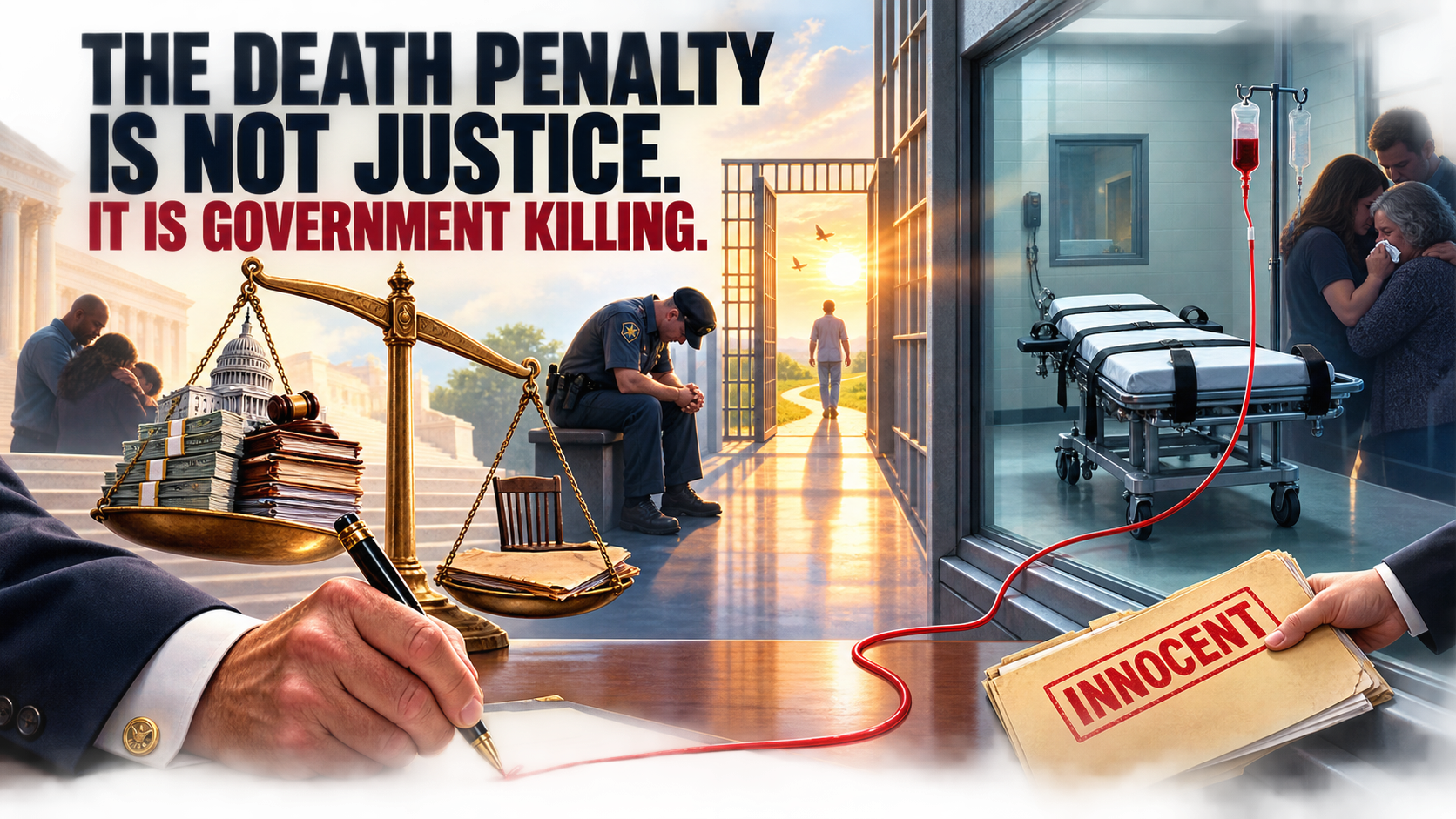
The death penalty keeps me awake at night. I mean that literally.
There was a time when I drank so heavily that after I posted or wrote about the death penalty, I would question myself: Was I too harsh? Too technical? Too tangled up in legal gobbledygook? Did I even make sense?
I spent 47 years inside Angola. I worked as an Inmate Counsel on death row and took care of the guys in the hospital. Everybody I worked with was waiting to die. The guys I had for clients in the hospital were waiting to die. The death penalty was never a classroom debate to me. It was never a political talking point. It had names. It had faces. It had families. It had men waiting in cells while the state decided the day and hour they would die and there was nothing they could do about it..
Once you have lived close to or worked in that kind of machinery, you cannot pretend it is clean. You cannot pretend it is just another sentence.
It is death, only it comes with a lot of paperwork.
On August 18, Florida executed William Frances Silvia by lethal injection. He was the thirteenth person Florida has executed this year. Thirteen human beings killed by one state in less than eight months. Florida alone has carried out more than half of America’s executions in 2026. (Associated Press) In 2025, Florida executed 19 people under DeSantis, setting a state record.
Silvia’s spiritual adviser, the Rev. Dr. Jeff Hood, had a simple message for Gov. Ron DeSantis:
“If you’re going to sign it, watch it.”
Exactly.
If a governor is willing to order a human being killed, he should have to look through the glass. He should have to watch the straps pulled tight. He should have to watch the needles go in. He should have to wait for the announcement that another life has been taken in our name.
Do not sign the paper and walk away.
Do not call it justice and hide from what it really is.
Since the modern death penalty began, American states and the federal government have executed 1,677 people. As of January 2026, about 2,004 people were living under active death sentences. (Death Penalty Information Center, Death Row Population)
Those numbers are not proof that the system works.
They are proof that the system kills.
Who receives a death sentence can depend on the county where the crime happened, the prosecutor handling the case, the race of the victim, the money available for a defense, and the quality of the lawyer appointed to represent the accused.
Two people can take part in the same crime and receive completely different sentences. One may die. The other may eventually walk out of prison.
That is not “equal justice.”
That is a lottery with a death chamber at the end.
Almost everyone facing a death sentence is poor enough to need an appointed lawyer. You won’t find any Perry Masons in capital trials. The quality of that representation varies wildly from one state and one county to another. (Death Penalty Information Center) I’ve had clients who had real estate lawyers. I’ve had clients whose lawyers were addicted to cocaine, arrested for cocaine and disbarred for cocaine.
Think about what that means.
The government brings whole teams: prosecutors, investigators, police departments, laboratories, experts, and tax money. A poor defendant may receive an overworked lawyer – a real estate lawyer! - with too little time, too little money, and too little help.
Then we pretend both sides entered that courtroom as equals.
They did not.
When the punishment is death, “good enough” lawyering is not good enough. A warm, breathing body in a chair at the defense table is not good enough. A missed witness, an untested piece of evidence, or a childhood history never presented to the jury can become the difference between life and death.
If wealth can change a person’s chance of surviving the legal system, then we are not executing the “worst of the worst.”
We are too often executing the poorest of the poor.
We cannot have an honest discussion about the death penalty without talking about race.
Black people make up roughly 40% of the people on death row, while making up about 12% of the United States population. And among death sentences imposed from 1972 through 2025, 72% involved at least one white victim. (Death Penalty Information Center)
That tells us something ugly and something most people don’t want to hear or won’t admit.
The system does not treat every victim’s death as equally valuable. Cases involving white victims have been far more likely to produce death sentences than cases involving Black victims.
Every murder victim matters.
Every grieving family matters.
Their race should not decide how hard a prosecutor pushes for death.
The victim’s wealth or political influence should not decide a person’s life.
But in America, and especially in the South, it still does.
The death penalty did not grow in clean soil. It grew out of slavery, lynching, racial terror, and a legal system built for wealthy white men. We changed the language. We moved the killing behind prison walls. We dressed it in court orders and legal phrases. In other words, we dressed it in camouflage.
But the old bias did not disappear.
Since 1976, 203 people who were wrongly convicted and sentenced to death have been exonerated.
Two hundred and three.
For roughly every eight people executed in the modern era, one person has been freed from death row after a wrongful conviction. A major study estimated that at least 4.1% of people sentenced to death may be innocent. (Death Penalty Information Center)
Read that again and think about it.
We built a punishment that cannot be corrected, then handed it to a system that repeatedly gets the answer wrong.
Wrongful convictions are not freak accidents. They grow from familiar failures: mistaken eyewitnesses, false confessions, lying witnesses who are secretly rewarded, junk science, poor defense work, hidden evidence, and prosecutorial misconduct. In Louisiana, prosecutorial misconduct has helped send innocent people to death row and has played a major role in multiple exonerations.
People with intellectual disabilities are especially vulnerable. They may try to please authority figures. They may not understand the danger they are in. They may confess to something they did not do. They may be unable to help their own lawyers. (ACLU) We had cases just like that in Louisiana. There are cases exactly like that in Florida.
The Supreme Court has said they cannot legally be executed. Yet states still fight over who qualifies, while human beings remain trapped between something called “clinical definitions” and an execution date.
Supporters of the death penalty often ask me, “What about the worst cases?”
I ask a different question.
What error rate are you willing to accept when the punishment is death?
One innocent person?
Ten?
Two hundred and three nearly killed before the truth came out?
There is no acceptable number.
We are told the death penalty prevents murder.
The evidence does not support that promise. Research has found no meaningful proof that executions deter murder any better than other severe punishments. Even the National Institute of Justice says the certainty of being caught matters far more than the harshness of the punishment. (National Academies, National Institute of Justice)
That makes sense.
Most murders are not committed after a calm review of sentencing laws. No one who commits a murder sits around at night studying statutes. They happen in the midst of rage, fear, desperation, intoxication, mental illness, or chaos.
An execution years or decades later does not stop that moment.
If we truly want fewer victims, we should put our money into solving crimes, preventing violence, treating addiction and mental illness, protecting families, and making communities safer.
Killing a prisoner strapped to a gurney does none of that.
Death penalty cases cost far more than cases that end in life imprisonment - often two and a half to five times more. (Death Penalty Information Center)
That money does not go to victims’ families. It does not pay for counseling, housing, food, funeral bills, or years of lost income. It goes into a long legal machine built around one goal: getting a human being into the death chamber.
Then states spend even more money finding execution drugs through secret suppliers because drug companies do not want their medicines used to kill people. Florida and Louisiana have passed laws shielding the identities of execution participants and drug suppliers from public disclosure.
We are told there is never enough money for schools, mental health care, public defenders, violence prevention, or help for victims. There is never money for school lunches or counselors.
But somehow there is always money for wars and always money to kill.
That should outrage every taxpayer in America.
I will never minimize murder. I committed a murder. I will never tell a grieving family how it should feel. Losing someone to violence tears a hole through a family that may never fully close.
Victims deserve to be remembered. Their families deserve truth, help, respect, and care. But an execution cannot bring anyone home or seat them at the supper table.
What it often brings is another family into the same circle of grief. It forces victims’ families through years or decades of hearings, appeals, reversals, warrants, and delays. The state holds out the word “closure” as if death can heal what death destroyed. DeSantis says his goal is to bring justice to victims’ families. But when Curtis Windom faced execution, members of all three victims’ families asked that his life be spared. If this is truly about victims, their voices must matter even when they ask for mercy.
DeSantis has publicly described executions as “justice for victims’ families,” while all three victims’ families in Windom’s case specifically said they wanted his life spared. (Associated Press, Death Penalty Information Center)
Executions also wound the prison workers ordered to carry them out. Former execution-team members and prison officials have described nightmares, panic attacks, substance abuse, guilt, and symptoms of post-traumatic stress. (Death Penalty Information Center)
Ronald McAndrew led Florida’s execution team from 1996 to 1998 and supervised three electric-chair executions: James Earl Bush, John Mills, and Pedro Medina. Medina’s 1997 execution went terribly wrong - smoke and flames came from beneath the headpiece while McAndrew stood only a few feet away. Altogether, he was involved in eight executions: three in Florida and five in Texas. (American Bar Association)
McAndrew, a self-described law-and-order conservative, now strongly opposes capital punishment. He calls executions “premeditated, ceremonial political killings” and says the memories still haunt him. In 2026, he publicly urged Florida corrections workers to refuse participation in further executions because of the lifelong trauma they can cause. (Death Penalty Focus)
The condemned person’s family suffers too. Mothers, fathers, children, brothers, sisters, and grandchildren live under a sentence they did not receive for a crime they did not commit.
The death penalty does not contain trauma.
It spreads it and sets it loose to cause more trauma.
I am not a deeply religious man. But Sister Helen Prejean is one of my heroes. Her book Dead Man Walking, together with my own experience, helped change the way I understood state killing.
She taught millions of people something simple: no human being is only the worst thing he or she has ever done.
That does not erase the victim.
It does not excuse the crime.
It means we refuse to surrender our own humanity while judging another person’s actions.
Every time the government kills a restrained and defenseless human being, something happens to us too. We train ourselves to look away. We let officials use soft words like “procedure,” “protocol,” and “sentence carried out.”
But a human being is alive.
Then a Governor signs a piece of paper.
Then government workers act.
Then that human being is dead.
We can bury it under all the legal language we want. It is still killing.
And every time we accept it without protest, a small piece of our collective soul dies with it.
I do not trust any government with the power to make an irreversible mistake and then hide the killing behind prison walls.
This is the same government that loses evidence, hides evidence, lies and manipulates, tolerates misconduct, underfunds defense lawyers, uses junk science, and convicts innocent people.
Yet we are expected to believe it becomes perfect at the exact moment it decides who must die.
I do not believe that.
I cannot believe that.
The death penalty is arbitrary. It is racist. It is classist. It is expensive. It does not make us safer. It wounds victims’ families, prisoners’ families, and prison workers. And because the system makes mistakes, it always carries the risk of killing an innocent person.
That is not justice.
That is government killing, paid for with our money and carried out in our name.
We do not have to accept it.
We can speak. We can write. We can call governors and demand clemency. We can support defense teams and abolition groups. We can vote for prosecutors and lawmakers who refuse to feed the death machine. We can share the names and stories of the people the state would rather reduce to numbers.
Most of all, we can refuse to be silent.
The government may claim the authority to kill.
But it does not have the right to call our silence consent.
End the death penalty.
End it now.
OR, Buy Me A Cup Of Coffee To Help Keep Me Writing!
Click The Image Below!
OR, HELP US TO END THE DEATH PENALTY BY CLICKING EITHER IMAGE!
Comments
Nothing yet. Say the first thing.
Sign in to join the conversation.