
GDoc: https://tinyurl.com/ndaccess | http://tiny.cc/nd_access (PDF 460Kb)
An important caveat, dear reader: this is my own experience and perspective–and as a human being, every autistic person is unique. Thus, my experiences are not “one size fits all” for anyone else who is autistic or neurodivergent. My own experiences are not “one size fits all” for anyone else who is autistic or neurodivergent. More simply, “I don’t ‘get this’ or ‘got this’” about autism, ADHD, or being auDHD, as every human being and neurodivergent person is unique.
Unfortunately, some advocates speak and write about autism, ADHD, and neurodivergence who create false expectations and stereotypes, suggesting that a neurodivergent person is a certain way. I DO NOT want to repeat that mistake in this essay. I’m an autistic, ADHD person, or auDHD, and NOT a mental health professional. What works for me is uniquely my own and is not a one-size-fits-all approach regarding being autistic, ADHD, or neurodivergent.
My hope and intention is to share information and let others know the things that help me to cope, function, and live as a neurodivergent person, dear reader...for what it is worth.
I am neurodivergent; I am both autistic (diagnosed late in life) and ADHD (attention deficit hyperactivity disorder) (diagnosed in college), so autistic + ADHD = auDHD. I also have undiagnosed OCD (obsessive-compulsive disorder) and complex PTSD (post-traumatic stress disorder) ; hence, I am very neurodivergent.
Yet, while I have worked in the space of accessibility (developing an open-source tool that tests web content for accessibility [Gilrea 2026]), I originally did not know of accessibility as a concept, its definition, or how to implement it . The realization of accessibility came later in my career.
When I was still undiagnosed as neurodivergent, well before accessibility was formally defined and recognized, I often perceived a problem, a challenge, a difficulty when using a computer. I see accessibility as a concept that emerged with the mainstreaming of home computers in the late 1970s and early 1980s. Content on computers led to the information access that formalized the need for and requirement of accessibility.
I write about my experience, from the initial perception and realization of something “wrong” or “off” about content on a computer to landing in the accessibility space. The significant aspect is that, being neurodivergent, long before I was diagnosed in college and later in life, I perceived the challenge and difficulty that accessibility entails.
Thus, I am writing about my journey, the learning process, and now realizing how significant accessibility is for everyone. Everyone - but especially for neurodivergent persons accessing computer content.
I was diagnosed as neurodivergent, but “not all at once” as auDHD. I always knew I was different, often “out of phase” with the world, the social fabric, and the constructed reality that others seemed to know. I have a disability, but it is an invisible one , one I carry inside.
One big difference from others was , and is, that I was sensitive or had a susceptibility to perceive or even feel things from colors, fonts, shapes, and how they were combined . As a young avid reader and bookhound, some book covers and magazine covers were horrible, while others were quite relaxing and soothing. I did not understand why I received very odd looks when a word in a color would evoke a “taste” or “odor” in my mind.
For the curious and intrigued reader, to satisfy your inquisitive nature about the published content I am alluding to, check out the Compute! magazine covers [Commo 2026] on the Commodore computer history site and then the book covers of texts [DLH 2026] on the Commodore archive Bombjack site.
I had an ADD (attention deficit disorder) diagnosis in college in my twenties as a “college kid” from the university counseling center. Late in life, in my late forties, I was diagnosed as an “aspie” (for Asperger’s Syndrome, now classified as high-functioning autism) by happenstance in the hospital. Thus, I received two outmoded, archaic diagnoses that explained what I was-a neurodivergent individual.
This odd perception and difference from others characterized being a neurodivergent person and being “wired differently” with hyper-acute, hyper-sensitive perception senses.
I can still remember the thrill and elation I had in 1983 when I got a Commodore 64 home computer, moving up from a Vic 20. The Commodore 64 was an impressive computer for the time (and in some ways , still is today as I write this in June 2026).
I had set up my Commodore 64 connected to a television set (hey, it was the 1980s...) at the end of my bed on a small table. I loved waking up and either watching Saturday cartoons or turning on my Commodore to program or play games. Usually, I was typing in a program for a game, utility, or other app from Compute! magazine.
As I typed the games in or loaded them from a floppy disk or tape cassette, I still remember rubbing my eyes, blinking, and then stopping whatever I was doing for a while. Some color schemes for apps, games, and programs felt like a razor blade across my eyeballs.
I wore glasses later, but I still remember, after reading some of the Commodore books I acquired either at the bookstore or from TAB Books, how to change the foreground and background colors. I changed the screen to a background of dark blue and the foreground font color to light grey–at least when I used my Commodore 64 computer to write and program.
This would be accessibility for the color schemes; I could not change the font on the Commodore 64 (you can find the font as a font type online...). Later , when I upgraded to a PC and started experimenting with fonts , I encountered some font schemes and colors that were so...awful that I avoided them.
In college, when I took “oral communications” or speech, we had to do a presentation on a topic. The instructor showed some previous examples (we had to use actual cardboard with letters, numbers, and graphics - so not some computer presentation ; it was the early 1990s), both good and bad.
I still remember one presentation that featured a horrible style of almost wavy lines around a worse font that was black-and-white on cardboard. Again, I did not know about accessibility or that I was neurodivergent; I just knew it made me uncomfortable to read and view.
On the other side of the coin, just out of college, a few years into my career as a junior software engineer, I worked at a Fortune 25 company. The team I was on interacted with a work colleague who was completely visually impaired-he was blind.
Yet, when his screen-to-voice application malfunctioned (he interfaced through hearing...which was a new thing for me to grasp...but fascinated me), he would (as our cubicles were in proximity) ask one of us to describe his screen. Others disliked this, as the coworker would be very blunt (perhaps even rude) and ask specifically about what was on the screen.
He once said he liked how I gave a literal description of what I saw. He commented to me that others seemed to use language that still involved seeing the screen, which, of course, he could not. That made me more aware of how what was described impacted my understanding of what the content was on the computer screen.
In both example cases for me, something was off visually, and both created an uncomfortable irritation (sometimes to the point of nausea) with the content in color, fonts, and other features. I knew something was “off” for me, but not specifically what it was. I knew when I experienced it, just not what the experience meant. In the case of my blind coworker, the description without the visual experience of the screen was an alternate way of perceiving the content of the computer. This invisible “thing” to me that I perceived yet could not fathom, nor put my finger upon as a concept. Hmmm...
In a previous job role with VMware, I learned more fully about accessibility. I knew there existed formal guides, specifications, and standards about content, especially content on the Internet and World Wide Web. But with so much content on a web page, from Bugzilla to see the current bugs, to wikis explaining libraries, and then even content in a PDF for a user manual...it was more impactful for me both as a user of the content, and then also later as a creator and writer of content.
The thing was firstly my neurodiversity, and with a sensitivity to light (photophobia), and also how my mind processed the symbols and glyphs of content on the screen, accessibility made sense immediately.
Then, when I transitioned to another team that did accessibility exclusively (and I was a senior ML engineer developing and maintaining an accessibility testing tool...), having a description of content then made sense as well...a colleague was blind, and just hearing how they worked with terrible content that was inaccessible, I suddenly recalled my former blind coworker needing me to describe literally the computer screen.
There was one big “Aha! Eureka!” moment of comprehension and realization; it was a gradual realization of different moments. And reflecting and cogitating upon past experiences, reconsidering “old knowledge,” I realized that my neurodiversity had helped me to perceive and detect inaccessible content that was horrible to view and see.
Thus, even undiagnosed, I was sensing and perceiving the awful content and experiencing it as an uncomfortable feeling and emotion, from my eyes getting tired to just nausea looking at some awful content. This experience was accessible, and the realization was due to my neurodiversity. Yet, even in 1983 as a young teenager, I perceived, knowing it, but not what “it” was that I perceived.
My experience understanding accessibility and its importance, along with how my neurodiversity involved perceiving, sensing, and experiencing content both accessible and inaccessible, has been like the statement from the Colossal Cave adventure [Adams 2026] of: “YOU ARE IN A MAZE OF TWISTY LITTLE PASSAGES, ALL ALIKE.”
The same experience in a maze of content, with similar perceptions and experiences, the twisty little passages that were all alike in the same. Accessibility and computer content in the early home computer era of computers, to now (June 2026 at the time of this writing...), the need and necessity of accessibility remains constant.
The concept of accessibility, at first, to me was a formal list of colors, fonts, sizes, positions, and so forth for computer content-mostly for web pages. Now I understand and comprehend accessibility as access to information to admit that information into my brain without any challenge or difficulty.
When content is inaccessible, the content cannot get admission in the mind as it cannot cross through the senses into the human brain. So simple, yet such an abstract and nebulous concept that is vital, as more information is on a computer, and that information needs to be admitted into a user’s mind.
As a neurodivergent, I sensed and perceived inaccessible content long before I knew of accessibility, and that I was neurodiverse. The different “wiring of the mind” created a hypersensitive perception and sense of content and information. But this perception, then, and then realization later, imprinted and underscored for me the need and necessity of accessibility.
Thus, that personal experience, combined with my neurodivergence, provided me with insight , which motivates and drives my advocacy for accessibility. I have great empathy for those who struggle with reading or using content that is not accessible.
One aspect of accessibility is that, by following the guidelines for accessibility (such as from WCAG) [WCAG 2025], there is “equal access” to content for both neurodivergent and neurotypical individuals. I experienced difficulty and challenges in reading, comprehending, and understanding inaccessible content.
During the Victorian Era in Great Britain, there was a movement, the “Ragged School “movement [Goodm 2026], a drive to ensure that those in Great Britain could read. This was a push to increase the literacy rates of the public so that any person could have access to information that was printed in books and newspapers.
Literacy, the ability to read and write, allows any person to admit information into their mind and then share their information, experience, and ideas in written form for others to read. Thus, literacy was the “accessibility” of the Victorian Era, and now accessibility is the same access to computer content and information in a consistent form and structure.
In Great Britain during the Victorian Era, knowledge and education were the keys to social mobility, the path to a better life. However, knowledge existed in written form, making literacy the master key to that key. The Victorians experienced an increase from a 50% literacy rate in 1837 to 100% by 1901-everyone was literate and could read and write. Thus, in sixty-four years, the entire population of Great Britain became literate, and all information became accessible.
Similarly, today, with a vast majority of content and information available online and accessible via a computer, phone, tablet, laptop, desktop, or even a digital display in an airport, accessibility is crucial for acquiring knowledge to use in day-to-day living and functioning. Without accessibility, there is an unequal segregation of content, preventing some individuals from accessing it and creating an inequality in an era of widespread information.
In the Victorian Era, content and information existed in books, newspapers, and documents-the connection was literacy, reading, and writing in the English language. The connection among the content was language, and then accessibility was determined by literacy, the ability to read and write that content. That content and information stemmed from the early 20th century.
Today, in the 21st century, information and content have shifted. All individuals must be literate in the content and information to read and access it. However, content has shifted to being stored on computers and online. There is also another aspect of online content via a computer : the interconnection of that content.
“Consider a future device ... in which an individual stores all his books, records, and communications, and which is mechanized so that it may be consulted with exceeding speed and flexibility. It is an enlarged intimate supplement to his memory.”
This is the idea of Vannevar Bush, who wrote a seminal article [Bush 1945] “As We May Think, “ describing the concept of a “memex,” a memory plus index device. The memex allowed information to be interconnected and led to hyperlinks [Davie 2011] and hypertext in the modern World Wide Web.
The content and information on a computer that is online is hyper-connected. From a webpage, the connections extending outward to other sites, content, and information are known. However , there is currently no way to determine, just from the webpage (or any other source of content and information online) , about the connections coming into a webpage.
This hyper-connectivity of content and information makes accessibility even more vital, as one inaccessible webpage or site becomes the “weak link” in the chain of information. Without a way to know who is connecting to the content and information, an inaccessible webpage (or other form) can unknowingly be the weak link in the chain that admits information into the user’s mind, accessibility.
Information and content are now hyper-connected, including images, text, documents, and other content in various formats, all accessed simply via a web browser. Thus, although information and content are more readily available, not all content and information is accessible. It may be “out there” but not admissible into the brain or mind of users due to inaccessible content.
Accessibility is intangible and an invisible idea, and only when content is inaccessible is the concept and idea of accessibility revealed as important. Accessibility is “equal access” to any information or content without any barrier or invisible limitation.
The written description or visually acceptable and functional form of content and information that is accessible provides equal access that makes content universal and ubiquitous. These needs and necessities are not new in history or in the information society of humankind.
Individuals who cannot access content and information on a computer are excluded, segregated, and discriminated against because of the invisible concept of accessibility and by inaccessible content.
History has shown that with desire and social movements , all content and information can be made accessible for all. This universal accessibility will create a level playing field where everyone, everywhere, can access content and information anywhere.
[Adams 2026] Adams, Rick. “The Colossal Cave adventure,” 2026, https://rickadams.org/adventure, Accessed June 21, 2026.
[Bush 1945] Bush, Vannevar. “As We May Think,” The Atlantic Monthly, Volume 176, Issue 1, pp. 101–108, July 1945.
[Commo 2026] Commodore Computers: History, Prototypes, and More. “COMPUTE! Magazines – Issue 1 Through 43,” https://www.commodore.ca/commodore-gallery/commodore-comput-magazines-issue-1-through-43, Accessed June 21, 2026.
[Davie 2011] Davies, Stephen. “Still Building The Memex,”“ Communications of the ACM. Volume 54 Issue 2, pp. 80–88, February 2011.
[DLH 2026] DLH’s Archive, Generic Books Main Page, https://commodore.bombjack.org/generic/generic-books.htm, Accessed June 21, 2026.
[Gilre 2026] Gilreath, William Fletcher. “Project Crest: Automated Accessibility Testing Tool,” https://github.com/wgilreath/crest, 2026, Accessed June 21, 2026.
[Goodm 2026] Goodman, Ruth. “Inside a Victorian school | Historian Ruth Goodman on lessons and discipline,” Accessed June 21, 2026.
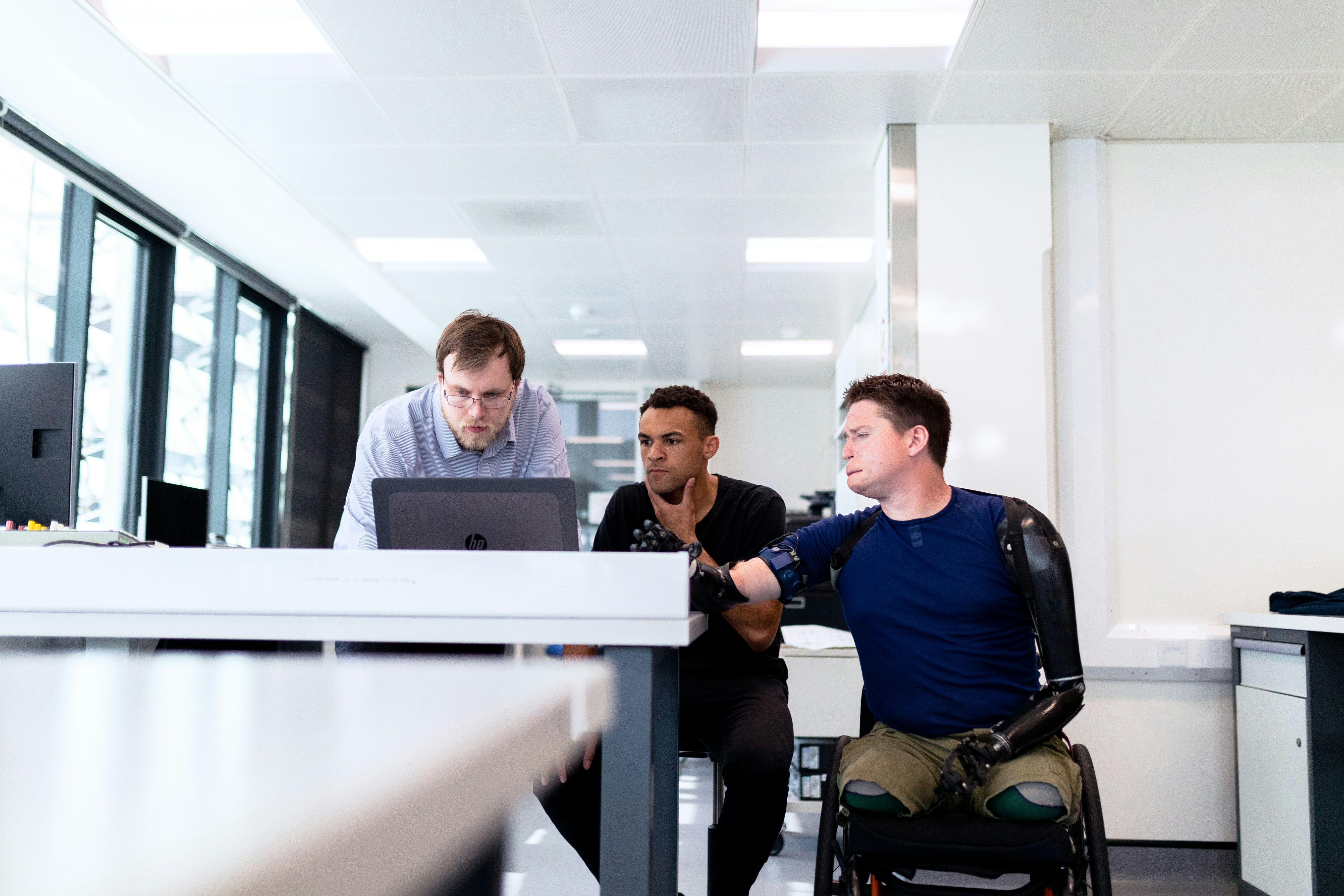
[ThisI 2020] ThisIsEngineering, “Engineers look at computer screen with prosthetic limb user,” https://unsplash.com/photos/man-in-blue-dress-shirt-sitting-on-black-office-rolling-chair-6DSItOWspGY, February 7, 2020, Accessed June 21, 2026.
[WCAG 2025] World Wide Web Consortium. “Web Content Accessibility Guidelines (WCAG) 2.1,” https://www.w3.org/TR/WCAG21, 2025. Accessed June 21, 2026.
This essay is licensed under the Creative Commons 4.0 Attribution-NoDerivatives 4.0 International license.
You are free to:
Share — copy and redistribute the material in any medium or format for any purpose, even commercially.
The licensor cannot revoke these freedoms as long as you follow the license terms.
Under the following terms:
Attribution — You must give appropriate credit, provide a link to the license, and indicate if changes were made. You may do so in any reasonable manner, but not in any way that suggests the licensor endorses you or your use.
NoDerivatives — If you remix, transform, or build upon the material, you may not distribute the modified material.
No additional restrictions — You may not apply legal terms or technological measures that legally restrict others from doing anything the license permits.
No posts
Comments
Nothing yet. Say the first thing.
Sign in to join the conversation.