
https://tinyurl.com/audhdtnbotm | http://tiny.cc/audhd (PDF 700Kb)
An important caveat, dear reader: this is my own experience and perspective--and as a human being, every autistic person is unique. Thus, my experiences are not “one size fits all” for anyone else who is autistic or neurodivergent. My own experiences are not “one size fits all” for anyone else who is autistic or neurodivergent. More simply, “I don’t ‘get this’ or ‘got this’” about autism, ADHD, or being auDHD, as every human being and neurodivergent person is unique.
Unfortunately, some advocates speak and write about autism, ADHD, and neurodivergence who create false expectations and stereotypes, suggesting that a neurodivergent person is a certain way. I DO NOT want to repeat that mistake in this essay. I’m an autistic, ADHD person, or auDHD, and NOT a mental health professional. What works for me is uniquely my own and is not a one-size-fits-all approach regarding being autistic, ADHD, or neurodivergent.
My hope and intention is to share information and let others know the things that help me to cope, function, and live as a neurodivergent person, dear reader...for what it is worth.
I now realize and identify my neurodivergence as auDHD, or autism plus attention deficit hyperactivity disorder (ADHD). Yet, this context of my neurodiversity has been slow, challenging, and difficult for me to understand and perceive. The timeline and path of my life, I summarize and review to provide the context of one diagnosis to another, and then to auDHD as two separate diagnoses twenty years apart. Hence, in my path in life, it took two decades to finally reach the point of my neurodivergent knowing, understanding, and diagnosis.
In college in the 1990s, I went to the university health center and then to the counseling center. I can still remember waiting in the examination room, the large simulated leather couch-bed with the plastic, and then the gauze paper. I sat in a chair in one corner, next to a small table. The doctor came in and asked me some questions that seemed less about my body and more about my mind.
But then he made his pronouncement, “You’re wired.” (basically hyper-active with energy...) as I was sitting with one leg up and across the other, and my foot was twitching, but the other leg was bouncing like a jackhammer. Thus, I passed the medical test and qualified as “wired.” Then he stated I had to talk to a counselor at the university counseling center and get an evaluation. So, another step forward in the diagnostic method of medical science. (Note the sarcasm and sardonic tone...)
By this convoluted process, I received a “attention deficit disorder” (ADD) as ADHD was then called. I was then put on several different prescription medications--one was Ritalin. Ritalin, in retrospect, was the “hip” and “popular” prescription drug to be prescribed. I recall it gave me cold sweats and intense tension inside, but it did not help with the symptoms of ADHD. I was on other prescription medications, like Zoloft (which I stopped after some extreme reactions...), but I remained fully ADHD, and “all over the place” emotionally and mentally.
Yet, while ADD or ADHD, something did not seem right. I felt different, at times like a defective human being; something was missing. I knew and perceived that something was missing, but what? What I read on ADD and ADHD was similar but not exact. I often felt like I only noticed the “wrong of not seeming right” in things when I experienced them, and the information about ADHD did not explain, or touch upon this...so I had this feeling and perception of being incomplete, defective, and something was off with me.
I had a late-in-life diagnosis by happenstance in 2015\. I was in an automobile accident, and I hit my head hard on the steering wheel when I collided with another automobile. I pulled over, and then was “punch drunk” as loopy, disoriented, but trying to get out and walk to the other vehicle.
Because of some erratic and strange behavior, I was kept for observation. During that time period, the psychiatrist told me I had Asperger’s Syndrome--or now high-functioning (I loathe that categorization as it implies lesser functioning...or that high-functioning is the exception...) and not some of the other personality disorder diagnoses I had previously.
At the time, I was skeptical, in disbelief, my perception was how mental health professionals are always castigating, and invalidating other diagnoses...a constant “prove them wrong” approach. So I was skeptical and did not accept it fully. That changed over time, and that’s a very long story beyond this essay (perhaps yet-another essay if there is interest...let me know, dear reader, your feedback is often my motivation, impetus, and reward...)
Later, I ran across some information that talked about being autistic and ADHD, or “auDHD”...and having both diagnoses, realized I was both, yet also neither, as the two had cross-intersectionality. This was for me, a “recontextualization” (say that three times fast...) or a new context of life experience, of two separate neurodivergent diagnoses. So the auDHD diagnosis is the result of two diagnoses, and realizing it was, in itself, a unique neurodivergent form.
Jade Farrington [Farri 2025] explains about auDHD as a diagnosis:
“It wasn’t until 2013 that the Diagnostic and Statistical Manual (DSM) allowed people to be diagnosed as both Autistic and ADHD (known colloquially as AuDHD). As soon as you were diagnosed with one, that stopped you being diagnosed with the other.
This is just one of the many things wrong with the medical model as studies now estimate that around 70% of Autistic people are also ADHD, and up to 50% of ADHDers are also Autistic. Other common co-occurring neurodivergences include dyspraxia, dyslexia, learning disabilities, and more.
If you’re Autistic and ADHD, then it can be harder to identify this because characteristics will camouflage one another. For example, you may be well organised so think you can’t possibly be ADHD, or enjoy trying new things and think that means you can’t be Autistic.”
I often read about autism, Asperger’s Syndrome, and ADHD, and found some, but not all, things relatable. Yet the auDHD diagnosis, as the total of the two previous ones, made better sense and resonated with me. Understanding being an auDHD neurodivergent has taken me most of my life, and I am still learning more about auDHD and then my own self as a neurodivergent, so I perceive myself as a “work in progress” still learning, growing, understanding, and sharing with others along my path in life.
One “recontextualization” was some old knowledge I had in my mind. This was from my early years at a community college as a student. In one class, I remember the textbook about the mind began with Sperry’s model of the brain. For explanation, I will summarize Sperry’s model of the human brain, and then how knowing this, it helped me to understand and comprehend being auDHD.
Roger Sperry’s brain model (often referred to as split-brain theory) posits that the two cerebral hemispheres (left and right) have distinct, specialized functions and can operate with independent streams of consciousness when the corpus callosum that connects the two hemispheres is severed.
“The Split-Brain Experiment conducted by Roger Sperry [Sperr 1961] remains a cornerstone in the study of cognitive processes. The research highlights the importance of brain lateralization and the need for supportive environments that foster cognitive integration and development. It emphasizes the significance of thoughtful approaches to understanding and addressing the complexities of brain function.” [Sincl 2026] Sperry discovered that the two hemispheres of the human brain had distinct yet parallel cognitive functions:
Left Hemisphere: Dominant for language, speech, writing, logical thought, and analytical processing. If an object was shown to a patient’s right visual field (controlled by the left hemisphere), they could verbally name it.
Right Hemisphere: Dominant for spatial awareness, facial recognition, visual-motor tasks, and holistic/artistic processing. If an object was shown to the left visual field (right hemisphere), the patient could not name it, but could identify it by touch or draw it with their left hand.
You, dear reader, are probably at this point in reading and asking yourself, “Self, this is fascinating, or boring self to tears, what is the point of Sperry’s model of the brain to auDHD?”
Sperry’s model of the human brain focused on cognitive processes and specialization. But consider each hemisphere of the brain as a neurodivergent cognitive process of:
left hemisphere - logical, analytical processing, the autistic side.
right hemisphere - creative and artistic processing, the ADHD side.
The left hemisphere is the realm of autism, the logical, analytic, where ordering, pattern seeking occurs; and the right hemisphere is the realm of ADHD, the creative and artistic, where the creative fire, imagination, and intuition occur. Sperry focused on cognition and where it is specialized, but the neurodivergent “different mind” fits within Sperry’s model of the human brain.
The two hemispheres of the human brain, or the two neurodivergent cognitive processes, are opposite ends of the continuum, yet in the same mind of the neurodivergent person. The dual neurodivergent nature creates a challenge as the autistic and the ADHD sides of the mind process cognitive competition within the same mind for cognition and control.
I will elaborate and expatiate upon several challenges I have experienced, what they are like, the nuances of the challenge, and then how I can be effective in the midst of an ADHD tug-of-war with autism in my mind, behavior, and actions. While simple to write, explain, and discuss, keep in context that it is \__very difficult_\_ for me, and I daresay for other auDHD neurodivergent individuals. Easy reading in this essay is from hard experiences in life.
I have found that I alternate between my focus shifting among different things and being hyper-focused on a task, a project, or something I am exclusively focused on. Sometimes my mind set, behavior, and actions are either-or, I am hyper focused, “head down to the grindstone,” or I am mentally jumping and bouncing around on different topics, things, external stimuli, then creating internal thoughts that are a mental kaleidoscope of ideas, concepts--all to ponder but all around my consciousness.
When I was writing my computer architecture book on one-instruction-set computer architecture [Gilre 2003], I was given a fixed deadline by the publisher. The challenge was it seems everyone has touched or tinkered with one-instruction set computers, and the history of computers, computer architecture has many examples, and footnotes. Combining all that scattered, diverse information and knowledge into a coherent book was a challenge.
The problem and challenge was too much information out there on the Internet, books, web sites. I found myself jumping and shifting among the information, leading to new ideas, concepts, and then I would jump around inside those ideas and concepts. And the deadline from the publisher was looming, approaching. Yet the deadline helped to remind and force me to “get it done” and stop information gathering and seeking knowledge.
The first step was to say “enough!” about the knowledge and information I had collected. The second step was to then do a pseudo mind map, where I put the different kinds of information into a cluster of information--around the chapters for the book. And of course, I finally decided to stop changing the table of contents; my thinking was I could re-edit and revise once I had a working prototype of the book. Those conscious limits and boundaries helped me to focus, and the mind mapping approach of information around a chapter with a topic and then the sub-topics helped me to organize my work, thinking, and efforts.
At that point, it was taking the “patches” of information and weaving them together. I had to cut some things I had hoped to include, or write in support (such as a one-instruction assembler and emulator), but the deadline was like the Greek mythical [Cicer 1877] “Sword of Damocles” above my writing head.
At times, I would get lost in technical details, but then would force myself to return to the topic at hand. But this work-style, chaotic and disorganized, worked, as I did get the book [Gilre 2003] written, published, and out there.
When I am “in the zone” or hyper focused, I can be active on a project, task, or some activity, and I look at the time, but then look again, and many hours have gone by in time. I will forget meals, check voicemails, read e-mails, and ignore pets (although cats are very good at getting attention and being insistent...) while I am intently focused.
This can happen when I’m writing source code, programming, coding, or weaving software...I am focused on the code, and whatever particular nuance, such as a bug to debug, some feature I am adding, testing some aspect, and so forth. I have a burst of “hyper productivity” and can go from just starting to a working prototype in several hours...or all night sometimes, or several days if I really am focused. The ADHD creative fire is creating code, and then my autistic side causes hyper focus with the finding and creating patterns of thought in the code.
Yet I like to be punctual and on time. Once in a job interview for a position with a state government, I got to the building, found my way in, and then had to go through a security system. The receptionist told me to sit, and then complained that I was “5 minutes too early”...with a tone of inappropriateness like I made a vulgar joke or comment.
But I would rather wait than be late for a job interview. I have always had that desire to be punctual, so much so that I will plan out some appointments rather than just wait and go to the appointment. Then the unexpected occurs, and I am late. There is this feeling and emotion of panic and dread at being late or having a missed appointment.
Once, when traveling by air, because of weather and a mechanical malfunction, I found myself in an airport hub, and the plane had departed. I remember (I was a college graduate, doing the job search, flying out to be interviewed...) the ticketing agent could see the panic and confusion in my eyes. It was not just the unexpected (which was overwhelming) it was that “missed the appointment” to get on the airplane, and fly back home.
The one thing I do is not mix things I know will get my hyper focus, and have an appointment in the same time frame. I find some minor distraction, like a book I am reading, or playing a game on my tablet computer...but doing something that I know will “pull me in” to a bubble, a cocoon of concentration and then hyper focus.
One challenge for me at times is to get started with a project. Often, I will be “all over the place” planning how I will do a project, but then it becomes the movie “Office Space” style “planning to plan” thinking. I want to have the project outlined in a step-by-step, detailed plan, and then I will refine and revise the plan. So while thinking about what to do and how it will be done, I do not actually do it. My ADHD side is being creative and also pondering the possibilities.
When I have written novels (and yes, I have published novels, one is under a pen name, others are just not marketed or advertised...) sometimes I know the general idea of the novel, the main and primary characters in the story.
But then what to write, and how, is difficult, so I sit and stare at a blank screen with nothing written. Instead of an old-fashioned Underwood typewriter with a sheet of paper, it’s a laptop with a blank white screen with the distraction-free editor I used (which at least allows me to focus on the screen and not the controls...). But an ocean of white, writer’s block at its fullest extent.
One thing that has helped is not to start at the beginning and then write until the end. I do not “begin at the beginning” but, to use a technical writing professor’s concept in college, use “lateral entry.” I will write a scene, a situation, or even a chapter just to have one facet of the story written.
I can then “jump around” in my mind with the story, and then put those written “chunks” of the story into order. Instead of following a linear chain of the story unfolding, I work on forging the links and then connecting them. Thus, breaking the mental or creative chain of thought, to actually create a chain of scenes, scenarios, and situations to have the story as a novel.
Executive dysfunction is how the ADHD brain is impaired in some cognitive processes, such as planning and focus. Yet there is a similar executive dysfunction in autism in that finding the pattern, structuring, and ordering impair other cognitive processes such as carrying out a task, or avoiding perfectionism. Both executive dysfunctions lead to a greater executive dysfunction.
The executive dysfunction is amplified by autism, as the counter-balance to ADHD executive dysfunction tries to override and counter-balance with another cognitive process, which adds another aspect to the ADHD cognitive process, and vice versa.
Consider both neurodivergent natures of cognitive processing:
Autism is about finding the pattern, the nuance, connecting the dots in the data from information--order, structure in the left brain hemisphere.
ADHD is about the need to create, explore all the variations of the dots in the data--create, combine in the right brain hemisphere.
Two programs of neurodiverse nature, ADHD and autism, are trying to control and direct the cognitive process in the human brain.
auDHD in the brain is about finding the pattern, the need to create a pattern, explore variations in the pattern, connecting and recombining the dots in the data from information, creating a new order, but then finding that pattern, and then exploring the patterns...in an endless cycle, a tug-of-war of cognitive processing and thinking...which can lead to impairment without any cognitive coping ability or skill for the task to perform, or the goal to obtain.
A person with autism + ADHD = auDHD does not wear a badge or label that states “I’m auDHD.” So, realize you do not know what is going on, the cognitive processing, tug-of-war, the battle for control inside a person’s mind. There is a maxim I learned when I moved to Oregon that seems popular: “Don’t let “blank” rent space in your head,” which is appropriate. Why? If you are an outsider to an auDHD person, you will see a very unique, very different person.
Yet do not let their difference “rent space in your head” as you interact with that person. Conversely, an auDHD person is not just renting space in their head; they are renting computing time in their brain to the two extreme neurodivergent cognitive processes. An auDHD person has no choice except to rent the space and computing time to their autistic and ADHD processes.
For an auDHD person, if you see some “eccentric” or “strange” behavior--that can be a way to cope. You do not know what is going on in that person’s mind, and how the coping actions help. Thus, accept it as-is, idiosyncratic, but if it helps the person, brings some calm, focus, do not question, or try to be a belligerent do-gooder trying to “help” by questioning or invalidating them.
In my own personal experience, I tend to have a messy desk, yet I know where every object of relevance to me is...I can find my smartphone, a particular pen, scissors, and so forth. What really upsets me, and this has happened, is either the “help” of “arranging my desk” or to a person’s own idiosyncratic standards of order.
Or worse, someone who knows I am auDHD, and this coping skill (controlled clutter I call it...), and then, as a “joke” will move one object around. I can often immediately detect “something’s out of place,” but not what--and it really annoys and irks me. That kind of invalidation as a “joke” is often a relationship ender for me. If a person cannot accept me as-is, without me having to explain, or I have to justify myself, then that other person is nothing but a problem--and I put them out of my life.
At work, the same applies: how a person works, their work style can seem strange, bizarre, even puzzling--but if the person can do their job with eccentric actions and baffling coping skills, leave them alone. They have found some means to work and keep from fighting the competing neurodivergent cognitive processes of autism and ADHD in their mind.
In her final entry of her diary, Anne Frank [Frank 1995] wrote of how others perceive her, describing herself as “a bundle of contradictions.”
She wrote:
“As I’ve told you many times, I’m split in two. One side contains my exuberant cheerfulness, my flippancy, my joy in life, and, above all, my ability to appreciate the lighter side of things. By that I mean not finding anything wrong with flirtations, a kiss, an embrace, an off-color joke. This side of me is usually lying in wait to ambush the other one, which is much purer, deeper and finer.”
This is the perfect, best way of describing in a non-jargon way about an auDHD. A person with auDHD has the struggle against their own mind, and then the struggle to cope, function, and live in an unwelcoming world. You may not understand or comprehend, but you can accept that person as-is and realize they are a person, a human being.
[Cicer 1877] Cicero, Marcus Tullius. Tusculan Disputations et. al. Translated by Yonge, C. D., Harper Brothers, New York, New York, United States of America, 1877.
[Farri 2025] Farrington, Jade. “Do You Think You May Be Autistic or ADHD? A Neuroaffirming Guide To Exploring Your Neurotype,” https://jadefarrington.substack.com/p/free-ebook-do-you-think-you-may-be, May 23, 2025, Accessed May 23, 2026.
[Frank 1995] Frank, Annelies Marie. The Diary of Anne Frank: The Revised Critical Edition. Bantam Doubleday Publishing Group, New York, New York, United States of America, 1995.
[Gilre 2003] Gilreath, William F. Computer Architecture: A Minimalist Perspective, Kluwer Academic Publishers, New York, New York, 2003. https://www.caamp.info
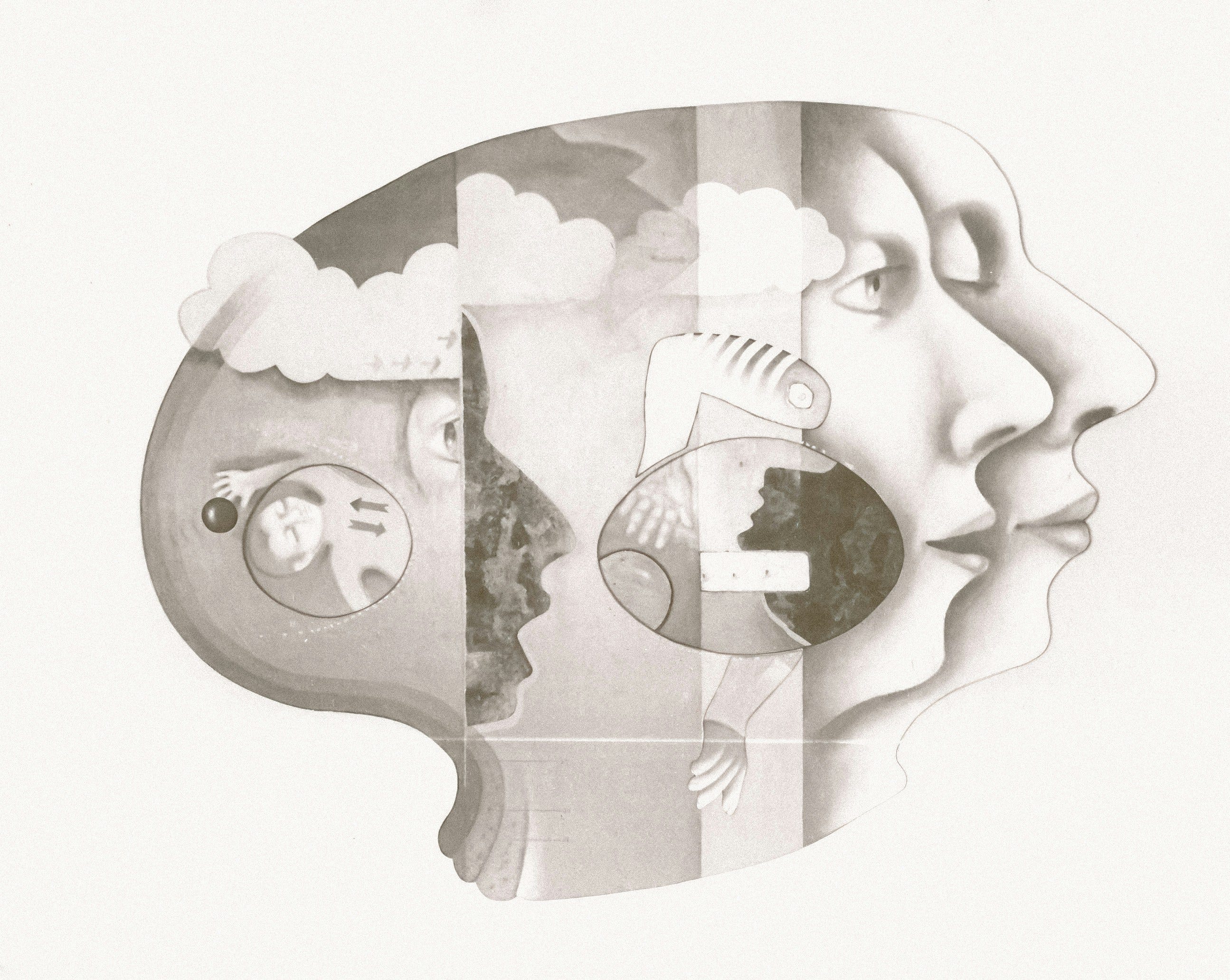
[Sinal 2024] Sinaloa, Wiki. “Surreal profile of faces and abstract elements,” https://unsplash.com/photos/surreal-profile-of-faces-and-abstract-elements-raJrSL-LfVg, November 28, 2024. Accessed May 23, 2026.
[Sincl 2026] Sinclair, Amelia. “Divided Minds: An Exploration of the Split-Brain Experiment by Roger Sperry,” Achology Transactions Ltd., 2026. https://achology.com/general-interest/exploration-of-the-split-brain-experiment-by-roger-sperry, Accessed May 19, 2026.
[Sperr 1961] Sperry, R.W. “Cerebral Organization and Behavior: The split brain behaves in many respects like two separate brains, providing new research possibilities,” Science, Volume 133, Issue 3466, pp. 1749-1757, June 2, 1961.
This essay is licensed under the Creative Commons 4.0 Attribution-NoDerivatives 4.0 International license.
You are free to:
Share — copy and redistribute the material in any medium or format for any purpose, even commercially.
The licensor cannot revoke these freedoms as long as you follow the license terms.
Under the following terms:
Attribution — You must give appropriate credit, provide a link to the license, and indicate if changes were made. You may do so in any reasonable manner, but not in any way that suggests the licensor endorses you or your use.
NoDerivatives — If you remix, transform, or build upon the material, you may not distribute the modified material.
No additional restrictions — You may not apply legal terms or technological measures that legally restrict others from doing anything the license permits.
No posts
Comments
Nothing yet. Say the first thing.
Sign in to join the conversation.