
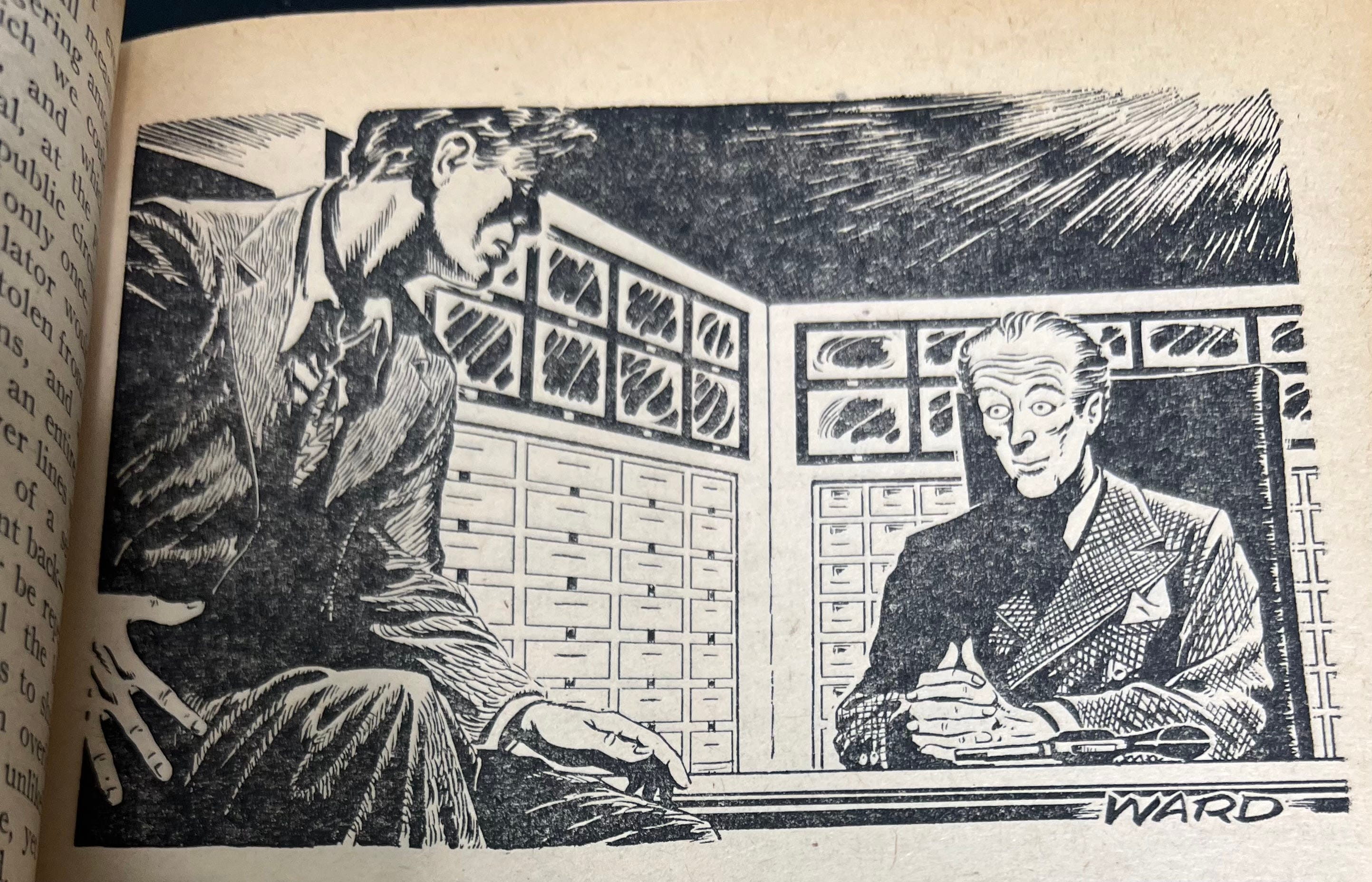
Some years ago it became popular in certain quarters to identify John W. Campbell as a fascist. For people who aren’t freaks deep in science fiction lore, Campbell was the essential editor of the essential mid-century American science magazine Astounding Science Fiction. Known for his two-page editorials on diverse topics, it is a matter of record that he at times espoused right-wing, contradictory, and out there points of view. But was he a fascist?
I’ve been reviewing issues of Astounding from 1949 for a couple years now. It’s been a slow clip—and there’s a lot of Astounding I haven’t read—but I haven’t encountered anything politically offensive in that time. This post continues in that line, picking up where we left off1 with the January 1950 issue.
This issue is the first time I’ve encountered a Campbell editorial where he addresses a concrete political situation, and it’s a heavy one. At the time of publication in late 1949, some months previous the world had become aware that the Soviet Union had nuclear weapons.
How would an American fascist respond to this development? One would think he would excoriate the Soviets, suggest perhaps that disloyal Jewish Communists stole the plans for the weapons, and beat a nationalistic drum. Instead he writes, “Nature’s not nationalistic; she’ll answer any intelligently phrased question asked by any intelligent being anywhere in the universe.”3 He goes on to say that the real problem isn’t that the Soviets have nukes. To identify the real problem, he quotes Rodgers and Hammerstein:
Text within this block will maintain its original spacing when published
You’ve got to be taught
Before it’s too late,
Before you are six, or seven, or eight,
To hate all the people your relatives hate;
You’ve got to be carefully taught.
So the problem according to Campbell is not the danger implied by horrific weapons, instead it is that people are taught to hate each other. And to explain his position he turns to musical theater.4 Fellas, is this fascism?
Campbell hits on the idea of “pushbutton warfare.” I take it this phrase generally describes civilization’s ability to destroy itself by the acts of a few men sitting in rooms pushing buttons. Campbell posits this isn’t the real pushbutton warfare. He goes on to draw out a metaphor explaining that pushbuttons are invisibly wired into people’s minds. These pushbuttons, when activated, cause people to hate and kill.
On the hawkish side, he does bemoan that the Soviets, with their planned economy, are better at producing these sorts of pushbuttons than the United States’ free market is. He writes, “The only well-organized pushbutton producers in this country are frittering away their time with such unimportant things as teaching people to laugh en masse.” And yet he brings himself back from the brink, “The world does not need a defense against atomic bombs. We need a science that will turn off and rip out those pushbuttons.”5 His views here are idiosyncratic, of course, but overall seem humane.
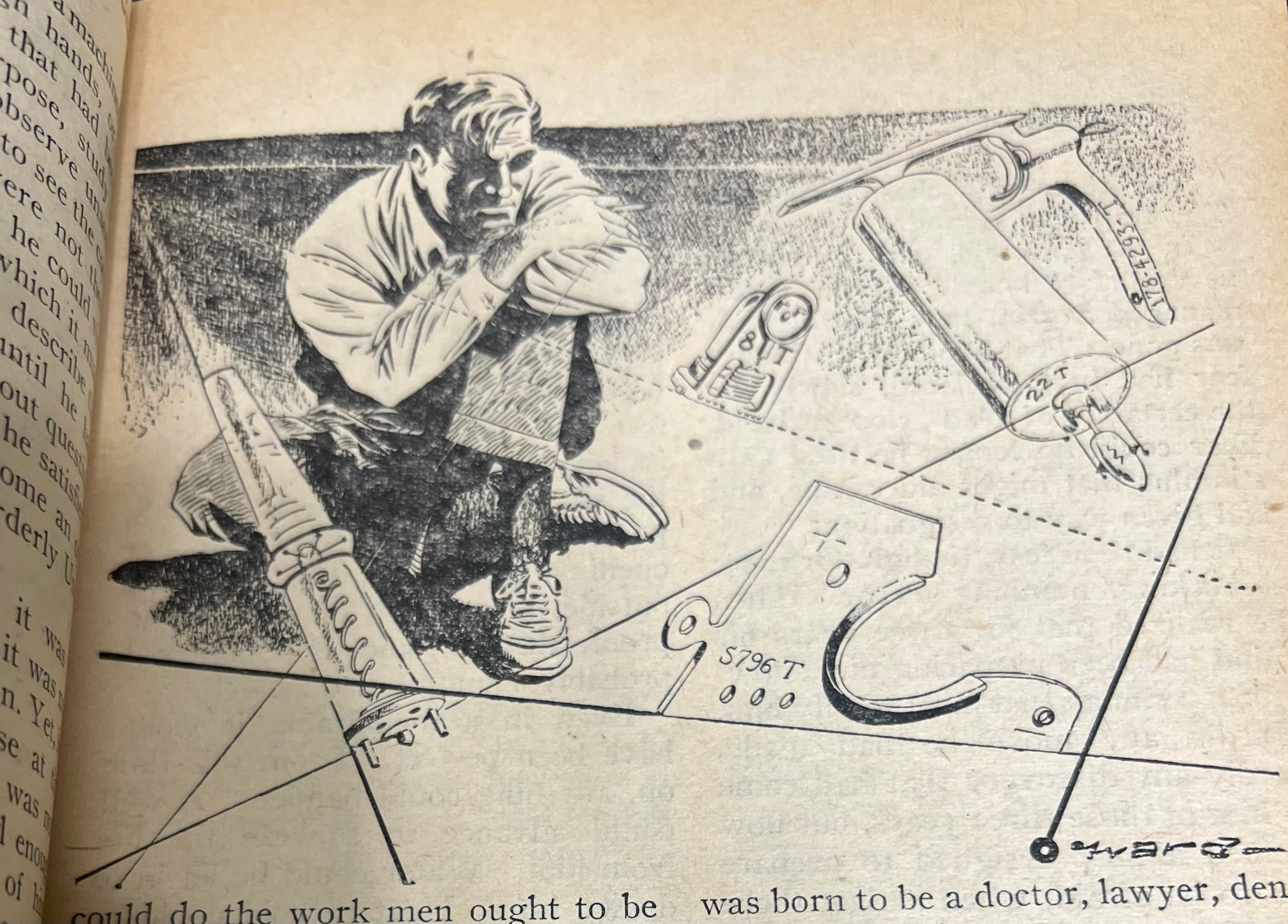
In this issue of Astounding, the specter of war doesn’t just cast its shadow over the editorial. In one story, seemingly unrelated to war, a telescope is suddenly and jarringly likened to “an antiaircraft gun” for what feels like no reason.7 In another “Not To Be Opened—” by Roger Flint Young, war and preparations for war play a central role.
This one lays the foundation for a wild ride by starting off with an almost mimetic description of the childhoods of the the protagonist Jim Tredel and of his father Tom Tredel. I say almost mimetic because while the events of the story’s early pages are plausible enough, if science-tinged, in real life people don’t talk in long right-brained philosophical monologues.
The elder Tredel grew up working in a machine shops from the age of 10 where he was largely self-educated.
On his own he learned a philosophy that was his own. It began to form in the first few weeks he worked, grew with the years.
“There is no such thing as a part,” he would explain, over and over. . . .
“There is no such thing as a piece. There is no such thing as something that doesn’t belong to something else. There is nothing, except as it fits into something else, as it’s part of the whole.
“The arm of a chair now, for instance. That arm is meant to fit the back of a chair, and the seat of a chair. It is also meant to fit the forearm of the man who sits in it. A person who’s never seen one before, but is trained to know relationships, should be able to reason out what that chair arm is, and what a chair looks like.
“The arm goes with other parts to make a chair. But that chair isn’t complete in itself. It’s designed to hold a man who sits. It’s no good unless it does that. The four legs of the chair are made to come to the same plane, so it will rest evenly on the floor. And the floor is another component, meeting the walls of the house, which are built to reach the foundations.
“The foundations lead to the street, and that street connects with other streets, so that one house is connected to all the other houses in the world. And if there’s an ocean in between, they’re still connected.”8
This philosophy and the desire to work in the then-new field of electronics is drilled into the younger Tredel seemingly from infancy. This conditioning takes and by the time Tredel is an adult, he is an electronics man who has fully internalized his father’s philosophy. This is of great consequence to the story.
The story then skips ahead to a scene of Tredel trapped in a room with no way out. He has found himself there because of his own actions and investigations, all enabled and driven by his complete internalization of the elder Tredel’s philosophy. From there, the story rewinds to three years before this critical moment to a time when Tredel has just returned from World War II to marry his sweetheart and to see that the manufacturing enterprise that he helped start is in good order.
From here it becomes clear that Tredel has been made super-normal mentally by his father’s philosophy. In inspecting his plant, he encounters a pressed piece they are manufacturing that fills him with a sense of menace because from it he can intuit some sinister apparatus it goes into. The piece is ostensibly for a toy, but through a little investigation and more intuition, he figures out that only about half of them are going into toys and, what’s more, the toy would work better if it were redesigned without the piece’s inclusion.
From the pressed piece, he intuits the existence of a handful of other pieces that through long investigation he is able to track down. Meanwhile his new marriage is falling apart because of his single-minded obsession with his investigations. He isn’t putting in time at the plant and he is spending a small fortune.
This part of the story and much of what comes after it read as disturbing and paranoid to me. It wasn’t Astounding’s house style to have a madman for a protagonist but it was three in the morning when I was reading this and I was bringing my own fears about recurring Bipolar mania to bear on the story. I thought, did this guy get messed up in the war somehow? In so doing, I was making the story more relatable and interesting than it actually is.
A flaw is that I never quite understood why Tredel felt a sense of menace from the pressed piece or why he feared a sinister conspiracy. Even after he uses his super-intuition to acquire all the pieces of the device, and the device turns out to be a powerful disintegration ray, I thought to myself maybe this is just a wing of the military-industrial complex behind this. Tredel is, in part, a defense contractor. Why is he upset by a weapon? But Tredel rules out any government involvement without explaining why.
Anyway, after he constructs the disintegration ray, there are more leads and intuitive leaps that have him discovering the production of a kind of EMP device. And eventually he follows its trail to a futuristic warehouse beneath a normal-looking warehouse by the docks. He comes full circle to the scene where he is trapped.
The reveal at the end of the story is that a man from the future is telepathically controlling a body in the present and using it to layaway great stores of weapons that will still be intact in 1,000 years for use by a revolutionary Underground. Their purpose is to take up arms against a world dictator. Del, the man from the future, explains the middle of the 20th century was the last time the surveillance state was weak enough that the Underground could have gotten away with producing the weapons.
Once Tredel learns that Del won’t kill him because he is going to be an important inventor one day and his premature death might cause a paradox, he attacks Del. He credits Del’s story that he is from a future Underground but believes they are really a sinister minority trying to set up a dictatorship. He reasons that if they have the power of telepathic mind control, they would simply be able to use it on the existing world dictator to stop him if the set up were actually as Del described.
Tredel accidentally kills Del, and with Del’s dying breath, the future man explains the dictator is not human. He succumbs before he is able to explain what is needed to stop the dictator. The task of using his super-intuition to figure out how best to help the revolutionaries of 1,000 years hence is left to Tredel. The story closes with him pondering what kind of being the dictator may be.
The components of this story are all interesting but my own super-intuition is telling me that something was left out. I don’t know how readable this story is without the reader doing extra work that the author didn’t do.
There’s more to say on this issue of Astounding. I may break up reviewing it with something else just to keep things lively.
“The Real Pushbutton Warfare” by John W. Campbell, Astounding Science Fiction, Vol. XLIV, No. 5, January 1950, p. 4.
The song is “You’ve Got To Be Carefully Taught” from South Pacific, 1949, quoted Id.
“The Xi Effect” by Philip Latham, Id. at p. 13.
“Not To Be Opened—” by Roger Young Flint, Id. at pp. 33-34.
No posts
Comments
Nothing yet. Say the first thing.
Sign in to join the conversation.