
“You belong to this people, Chief,” she said, “but are not of them. . . .”
“In every company one walks quicker than the rest,” answered Wi.
“Then he finds himself alone,” said Laleela.
“Not so, because he must return to guide the others.”
“Then, before the hilltop is gained, night will overtake them all,” said Laleela.
“If a man gain that hilltop, what can he do by himself?”
“Look at the plains below and die. At least it is something to have been the first to see new things, and some day those who follow in his footsteps will find his bones.”
—Allan and the Ice-Gods by H. Rider Haggard, Chapter 12.
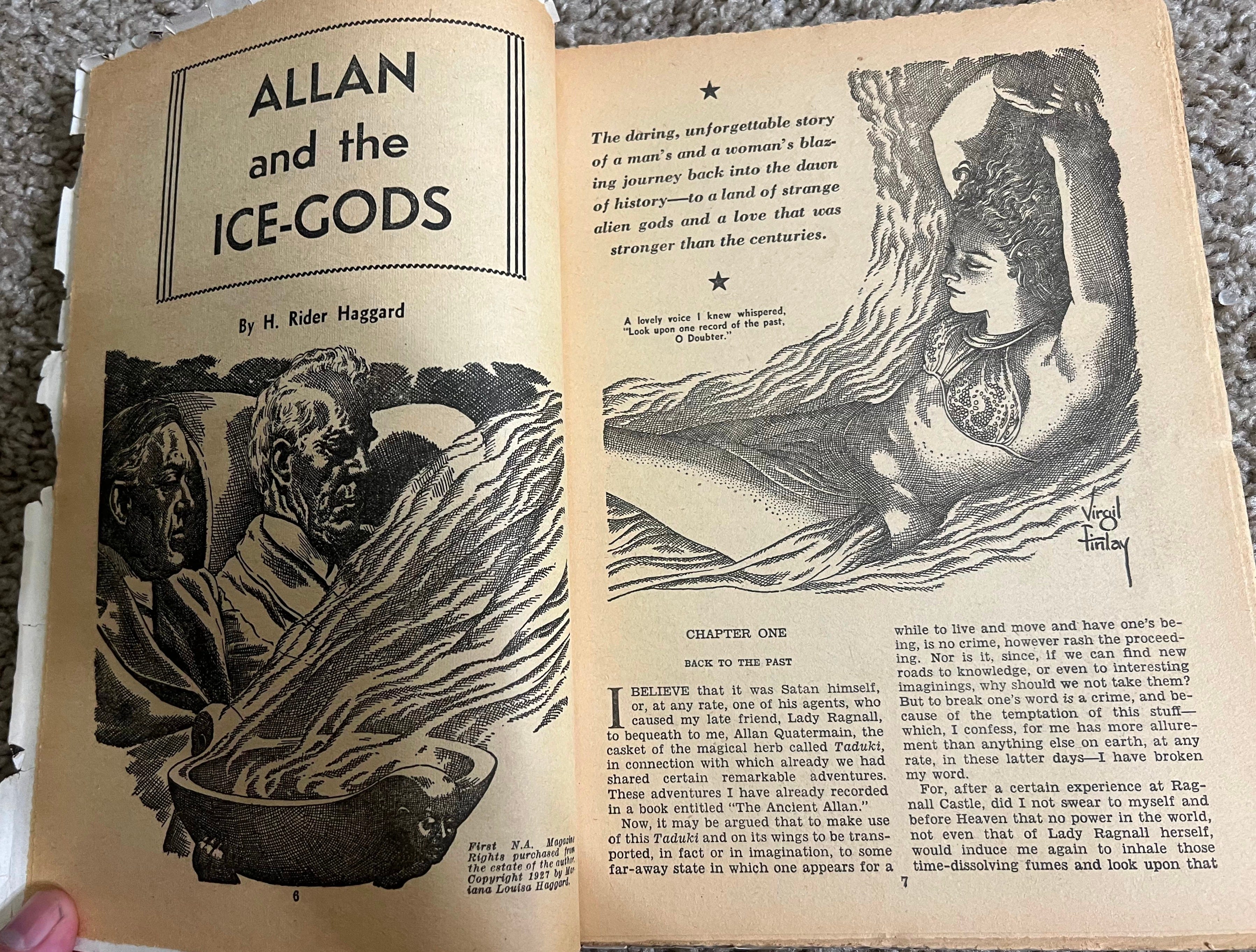
In Allan and the Ice-Gods (1927), H. Rider Haggard delivers a romantic and exciting fantasy adventure about Paleolithic hunter-gathers struggling with both a changing climate and a changing society. In actual fact, the novel reads more like social science fiction than it does fantasy, because it speculates about what the political and economic contours of Paleolithic life were and about how individuals and groups in that context might respond to revolutionary social change.
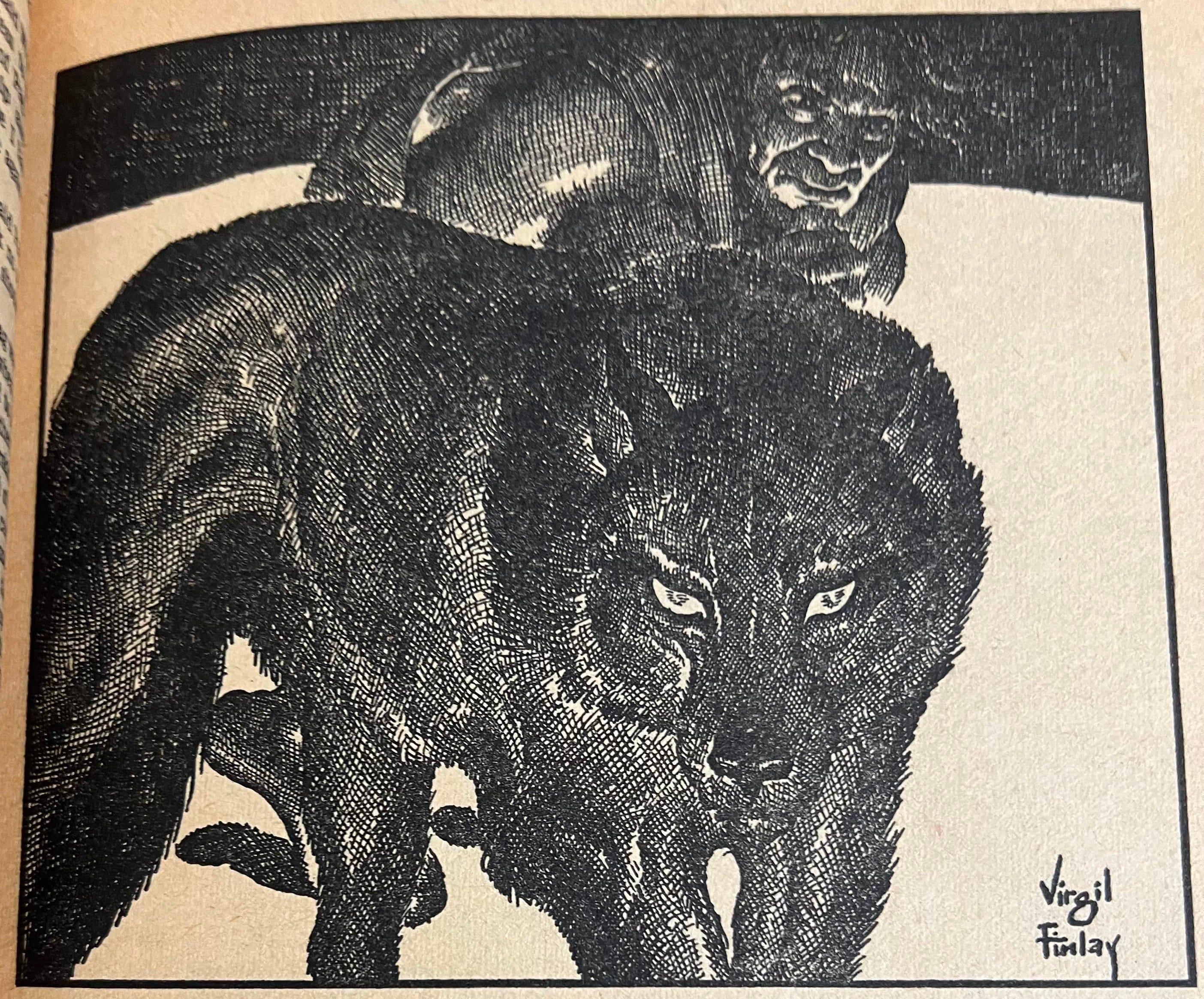
This is not to say the novel isn’t fantasy. Haggard adroitly uses fantasy elements with a light touch throughout the narrative to imbue it with gravitas and mystery it wouldn’t have otherwise. Signs from divinities are never quite given full credence or fully explained away. There is a clairvoyant dream. A baby is suckled by a wolf with great consequences for the plot later on. The novel’s final cataclysm is caused by either divine intervention or the auspiciously-timed natural shifting of glaciers. In a time of overwrought and over-explained magic systems, we could use more fantasists with a sense of ambiguity like Haggard’s.
Indeed, the frame of the story is an ambiguous drug-induced past life regression undertaken by Haggard’s recurring character the big game hunter Allan Quatermain, the hero of King Solomon’s Mines and many such fine novels. Quatermain undertakes an inward journey after reading what is best understood as the suicide note of a nobleman’s widow named Lady Ragnell, whom Quartermain loved but was doomed by pride and circumstance and perhaps Fate not to be with.1 The reader is tempted to accept at face value that Quatermain is narrating his past life as Wi the Hunter, a primitive but forward-looking man of the Pleistocene epoch. But Quatermain himself is never quite convinced of this. He offers two rational explanations. Perhaps the drug unlocked the germ of a memory encoded in him by the experience of one of his Pleistocene ancestors. Perhaps it was all just a fanciful dream.
Another element of gravitas comes from Quatermain’s style of perspective-jumping close third person narration delivered through Haggard’s expansive prose. Haggard writes in long, multi-clause sentences and longer paragraphs that fill up half a page or more. In these long sentences, Quatermain repeats elements of the story for emphasis. For example, he rarely refers to Wi’s axe simply as Wi’s axe or the axe. He is more likely to call it something like Wi’s axe, that was made for him by Pag the wolf-man, that he used to slay the old Chief Henga. The reader, of course, already knows all this about Wi’s axe, but the effect is to convey just how legendary Wi’s axe is among his tribe. It’s not for nothing that elsewhere in Haggard’s Quatermain opus that Quatermain cops to his favorite book being the Old Testament.
Despite all this gravitas and mystery, I still say this reads more like social science fiction than straight fantasy. That is because the novel is about reform and revolution, some of the more speculative sociological phenomena I can think of.
It’s worth laying out the structure of Wi’s society as we dive in. The people are ruled by a Chief who, by dint of uncodified ancestral laws understood to be divine in origin and by dint of being physically the strongest man, has despotic power over the persons and property of the tribe. There are rich and poor characterized by unequal access to things like food and fishhooks. The institution of slavery exists and comes about when a man saves another man’s life. Marriage is patriarchal and polygamist and the women are little better than slaves won through violence. There is an uneven balance of men and women in the tribe because of female infanticide. For marriage purposes, this is exacerbated by the rich and powerful men being prolific polygamists.2 The people worship mysterious Ice-gods that live in the glaciers surrounding the beach they live on and about whom little is known other than that they are hungry for blood and that they are ill-tempered. The one and only check on the Chief’s power is that another man may kill him in one-on-one combat and become the new Chief. In short, Wi’s society is ripe for reform and revolution.
The backdrop of Wi’s story is that the tyrannical Chief Henga has murdered Wi’s little daughter Fo-a because he hates Wi and because he wants to goad Wi into challenging him so he can kill him. Under the people’s system of government, Henga was within his rights to do this. Henga is very unpopular for his tyranny, laziness, high taxes, and taking of all the choice women but all the people fear him. Wi does not care to be killed in a fight with Henga, for a sense of fatalism encircles him, but he fears for the lives of his wife Aaka and his surviving son Foh. Ultimately Wi is goaded by Aaka and an ambiguous oracle from the Ice-gods to challenge Henga.
As it would in a science fiction novel, Wi’s victory hinges on superior technology. Enter Wi’s axe, “the Axe of Victory,” that was made for him by Pag the wolf-man, that he used to slay the old Chief Henga. Pag is Wi’s beloved slave, a one-eyed misogynist and little person. Pag discovered a piece of meteorite iron which, having independently hit upon the art of blacksmithing, he forged into an axe head the likes of which the people had not seen before. Pag also thinks to grease Wi with blubber to make him hard to grapple and to shear off Wi’s long hair so Henga cannot use it as a handhold. For much of the novel, Pag and Wi are like if two souls were one but Pag is the brains at least with regard to all technical matters.
So Wi, goaded by Aaka and the Ice-gods, assisted by Pag, accomplishes a political revolution. But he doesn’t stop there. Quatermain, with some admiration and some admonishment, calls Wi a reformer. To my mind, what he actually pushes forward is a social revolution. He enacts by decree a total upheaval in the community’s system of property. On his first day as Chief, he declares an end to polygamy and declares further that henceforth women have free choice in selecting their husbands. He also establishes something like divorce. In a society where heretofore the main form of productive property was property in the form of wives held in servitude by threat of violence this comes across as something like abolition combined with land reform without compensation. And it creates chaos! There’s fighting in the proverbial streets at first as bachelors and newly single women try to figure each other out. People get killed in a way that Wi does not foresee.
He and Pag also do a bevy of things that don’t tamper with the underlying structure of the society which we may comfortably call reforms. They institute new healthier cooking practices, cull the local wolf population, exhort the people to store more food for winter, establish the death penalty for infanticide, and create a creche for abandoned babies. All well and good, yes?
Not so much. It’s lonely at the top for Wi. While Aaka was glad to see Henga die, she is a supporter of the ancien régime. Ideologically she supports polygamy, does not think women want to be free, and opposes some of Wi and Pag’s reforms. Moreover, she is jealous that Wi takes counsel from Pag when in the days of their youth she was his confidante. Through Quatermain’s shifting close third person perspective, the reader also gains insight into that she has become permanently embittered by the murder of Fo-a. Things being what they are, ought not Wi and Aaka divorce as the new law allows?
Well, the problem with Wi is that he is so very noble. Upon instituting his new law he pledges not only that he himself will not practice polygamy but that he will stay married to Aaka, the wife of his youth. He seals this pledge by saying should he violate it, the Ice-gods will bring down a curse on his head and on all the tribe. So Wi is very much stuck in his marriage to Aaka for political and religious reasons.
What’s worse than Wi’s marital troubles is that the winters are growing longer and the wild animals and plants upon which his people rely are dying or leaving the area and not returning. Hardship abounds. Like many revolutionary politicians who come after him, Wi has to preside over scarcity and privation. Even though the people love Wi for his integrity and fear him for his axe, there is a lot of grumbling that the Ice-gods are displeased with his new way of doing things.
All these problems are exacerbated by the arrival halfway through the book of Laleela, a blond woman in a canoe from a relatively advanced civilization in the south. Though he is smitten at first sight, even Wi believes she is a spectral Witch-from-the-Sea at first. Though Pag admires Laleela for her wisdom and kindness, he resents her because she comes between him and Wi. Laleela and Wi fall in love though this is unconsummated because of Wi’s vow and because this is an H. Rider Haggard novel. For various reasons, the reader easily infers that Laleela is or might be Lady Ragnell in a past life.
Laleela brings to the morose and somewhat suicidal Wi a new and somewhat secretive lunar religion that promises eternal life. This new faith makes him happy. But as climactic conditions continue to worsen, invaders come from the north, and Wi’s allies are all divided among themselves, the backwards people of the tribe now have another reason to believe that Wi has brought the Ice-gods’ disfavor upon them in the form of his new blasphemy. What’s more they believe he has violated his pledge and taken Laleela to wife in secret.
In the end, Wi can’t hold it all together and the backwards people of the tribe are all killed dramatically by a deus ex machina. In the closing frame of the story, Quatermain reflects that Wi met the fate of all reformers.
I would question Haggard as to whether the reformer’s fate is so different from that of the big game hunter or the writer of fantasies. In the end, we all face hardship and we all die. In the meantime, we may know a good friend or comrade or find a meaningful spiritual practice. Laleela talked to Wi about the satisfaction of seeing the plain from the hilltop. Sometimes it may be enough to see just the hill.
Allan and the Ice-Gods is a direct sequel to another novel, The Ancient Allan, which provides much of the frame story’s backstory. I haven’t read it yet. There are a lot of Allan Quatermain novels. They involve any number of women who are doomed by their association with Quatermain.
In my sentimentality, I do not believe slavery, class distinction, private property, or patriarchal marriage existed among our Paleolithic ancestors. A more archeologically-minded science fiction reviewer might go through all of the elements of Wi’s society line by line seeking to show how Haggard got it wrong from a scientific perspective. I think this approach would miss what is going on in the novel.
No posts
Comments
Nothing yet. Say the first thing.
Sign in to join the conversation.