
Winchester, Va., is not a place that changes easily. Founded in 1744, it sits at the northern tip of the Shenandoah Valley—George Washington surveyed land here as a teenager, and one of his offices stands two blocks from City Hall. Some families have lived here for generations. History isn’t just background in Winchester. It’s identity.

So when Christian “Kit” Redmer arrived as communications director in the summer of 2023, he didn’t walk in with a rebrand. He walked in with a question: who in this city feels like they have a stake in their government, and who doesn’t?
What Redmer built in Winchester over two years is a near-perfect illustration of how my Five Elements of High-Performance Communications work as a system—each one reinforcing the next. The story starts with organizational leadership.
Note: Redmer has been a GGF reader since August 2023. Winchester’s story is not a consulting engagement—it’s what happens when intentional work compounds over time.
Redmer came to local government by an unusual path—years in the U.S. Foreign Service had given him a clear-eyed appreciation for what healthy democratic culture requires.
He didn’t arrive alone. Sarah Frey joined the communications team at roughly the same time, and together they replaced the previous team. The city was doing digital communications—social media posts, routine updates—but little genuine community presence. The outreach muscle hadn’t been built.
Then-City Manager Dan Hoffman hired Redmer specifically to change the city's relationship with its residents—and that mandate changed everything about how the team could operate. The push for deeper community engagement wasn’t something Redmer had to argue for from below. He’d been commissioned to do it. That authorization matters more than almost anything else in this story.
And we should note current City Manager John Piper continues to support Redmer and Frey in this work.
Redmer and Frey started with presence. Not campaigns. Not initiatives. Just showing up, consistently, wherever Winchester residents already were.
They went to English language learner classes offered by the local university. They attended GED programs and Goodwill’s professional development courses. They built relationships with church pastors and, when a minister was willing, held informal town halls with parishioners after Sunday services. They went to fairs, festivals, and neighborhood gatherings.
To pull other departments into the work, Redmer developed a monthly outreach calendar shared at Winchester’s senior staff meeting, which draws about 30 managers from across city government. Every department sees it. Every department is implicitly invited to show up.
“To really be effective in this role,” Redmer said, “you really do have to be able to get out there and build those relationships—partly to leverage them, but partly also just to get to know what’s going on in the city.”
The results were measurable. Winchester conducts community surveys, and between 2023 and 2025—same survey, same methodology—the percentage of residents who felt they had an opportunity to be involved in their government rose nine points. Redmer is clear-eyed about what that number means.
“It’s still at 39%,” he said, “so it’s not as high as I’d like. We still have a long way to go.”
Nine points in two years is a signal something real had shifted.
That shift created the conditions for something else entirely.
Within their first six months, Redmer and Frey developed a secondary brand identity for the city: “It’s Our City,” rendered as a shield bearing Winchester’s lion. The traditional city logo stayed. This wasn’t a replacement—it was an extension, and that distinction mattered in a city where tradition runs deep.
The new mark was designed for reach. Not to win design awards, but to say something to residents who had never thought of Winchester’s government as theirs: you belong here. The banners now hang on both sides of council chambers. When residents walk in—whether they’ve attended every meeting for twenty years or never set foot in the building—they see the same message.
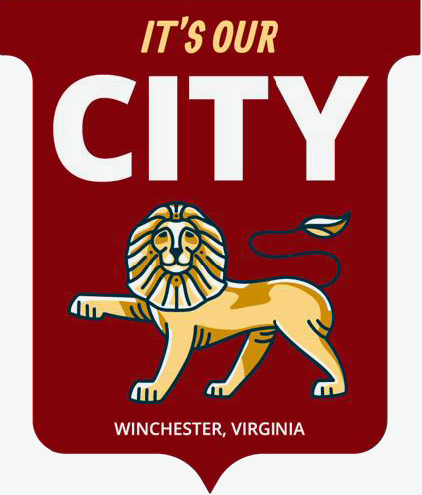
The banners communicate a promise before anyone says a word.
By late 2025, the city was preparing to update its strategic plan for the 2026-2031 period. Redmer pushed for community connection to be more than a line item under communications. He wanted it recognized as a central organizing principle.
The argument he made wasn’t philosophical. It was structural. “Connecting our community,” he told leadership, “is the glue that helps all of the other functions.” Public safety, quality of life, fiscal sustainability—none of it lands with residents who don’t trust the government delivering it.
The argument worked in part because leadership had already seen the evidence. A ribbon cutting for a local development project—a dilapidated factory converted into hundreds of apartments, including affordable units—drew a packed room. Every member of city council was there.
“You could feel the community coming together,” Redmer said. “I could feel a shift after that event.”
When elected leaders feel a room, they believe differently than when they read a report. That’s the lesson Redmer takes from the experience, and it’s the most transferable thing in this story: don’t try to win the argument in a work session. Win it by putting your leaders somewhere the community can speak for itself.
In February 2026, Winchester’s Common Council formally adopted the 2026-2031 Strategic Plan. The first of its five focus areas: Connecting Our Community.
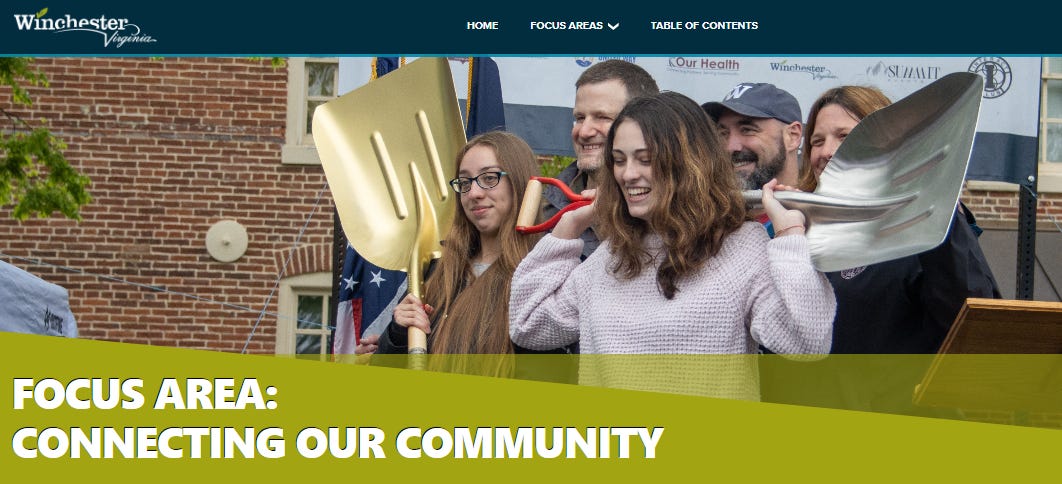
“It was very rewarding,” Redmer said, “to feel the council come along with that. And now it’s enshrined for the next five years.”

A strategic plan is only as useful as what it authorizes. Redmer already knows what he’s doing with it.
Winchester’s communications team runs a recurring social series called “Did You Know”—short, accessible posts designed to inform residents and, when necessary, counter disinformation without being combative about it.
Coming next is a year-long campaign working through the plan’s specific action items—how they’re funded, how they’re staffed, what they’ll look like when they’re done. The goal is to make the plan real for people.
“Not just something sitting on a shelf,” Redmer said.
The Five Elements aren’t a checklist Winchester worked through in order. They’re a system that took shape over two years of intentional work—and a strategic plan that formalized what was already true on the ground.
Redmer’s advice to a communications director trying to do something similar is direct: frame the work around trust, not tactics. Show your leadership what it looks like before you ask them to commit to it. Build community champions so elected officials hear the case from residents, not just from staff. And don’t expect it to happen fast.
“It takes time,” he said. “It’s not overnight, that’s for sure.”
Winchester started building in 2023. The flywheel is turning.
If your organization wants to build this kind of communications culture, I consult cities on the Five Elements framework through my own practice. I also offer workshops for staff and elected officials through SGR.
Onward and Upward.
No posts
Comments
Nothing yet. Say the first thing.
Sign in to join the conversation.