
On the Monday morning before the 2026 Transforming Local Government Conference1 opened in Dallas, a few dozen local government professionals did something their calendars almost never allow. They sat down for four hours and thought—deliberately, and without interruption—about a problem with no clean answer and a ten-year horizon.
It was a mixed room: city managers, assistant city managers, supervisors, a public information officer or two. The pre-conference workshop, Anticipatory Leadership: Shaping the Future with Strategic Foresight, was led by AFI Strategy Director Hauson Le and Steven Kenney, founder of Foresight Vector and a consulting futurist for AFI. Their premise was simple and a little unsettling: the world is changing faster than local governments can adapt, and the usual tools—data, experience, last year’s budget—are necessary but no longer sufficient.
Le has a way of making that concrete. A modern car has gone from roughly 3,000 parts to 30,000. Pandemics have reshaped how people work, weather disasters have reshaped what services cities must provide, and polarization has reshaped community cohesion itself. Leaders, he argued, are operating in a VUCA world—volatile, uncertain, complex, ambiguous—to which he added a fifth letter, P, for the pressure of doing more with less.
Strategic foresight, the morning’s throughline, is not fortune-telling. It is the disciplined exploration of multiple plausible futures so leaders can act today with those futures in view. Preparation, not prediction.
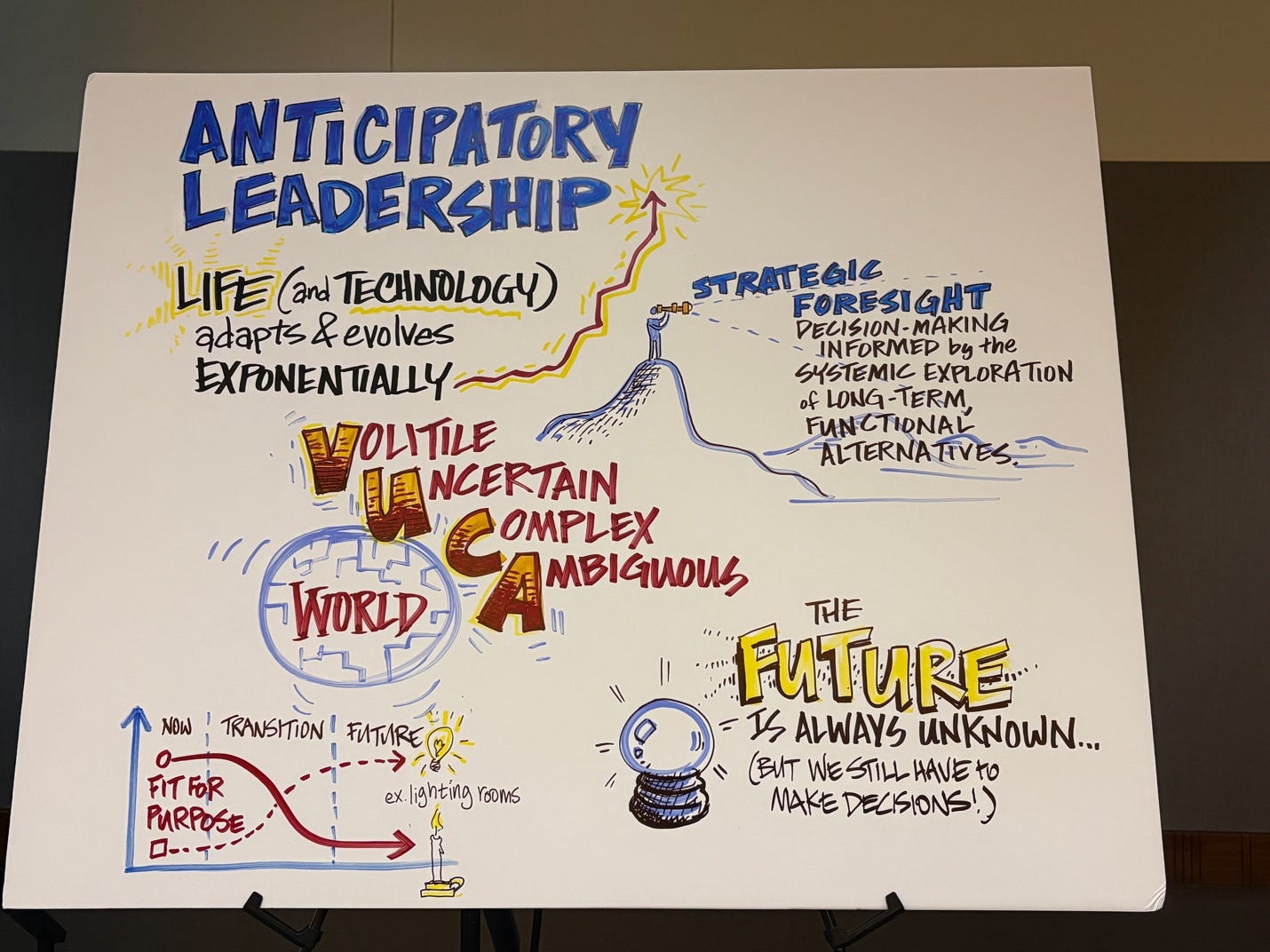
What made the morning land, though, wasn’t the theory. It was watching the theory get put to work on a real problem.
My table took up the future of the local government workforce and narrowed it to organizational structure. Around it sat people I’ve known and respected for years: Brenda Eivens, city manager of Cedar Park, Texas, who came up through human resources; Kat Caffrey, city manager of Des Moines, Washington, who once worked alongside Brenda in Cedar Park; and Heidi Behrends Cerniwey, city manager of Ellensburg, Washington. These are extraordinarily busy people. What struck me over the next several hours was how fully they gave themselves to an exercise with no deliverable, no constituents in the room, and no immediate payoff—except a better way to think.
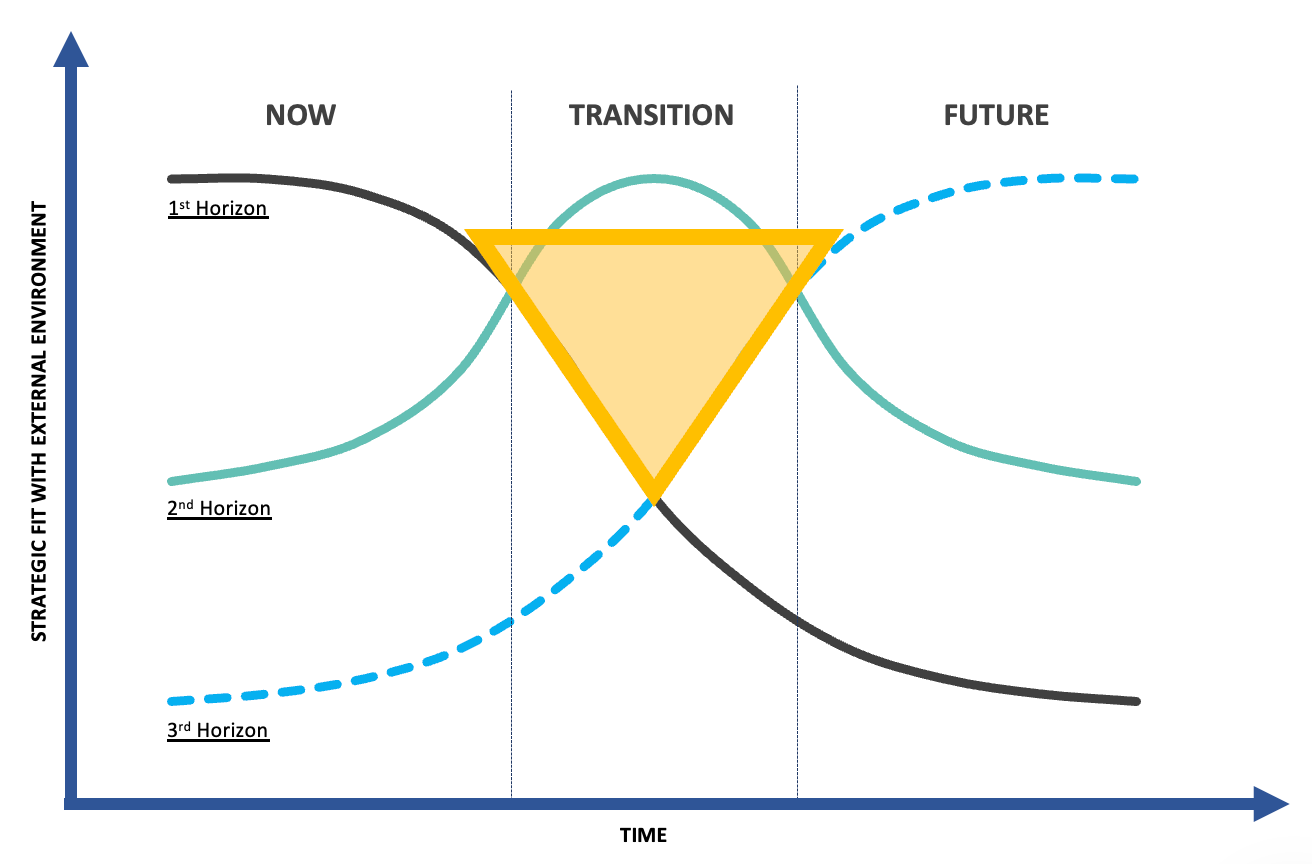
The first tool was the Three Horizons framework, developed by foresight pioneer Bill Sharpe. It maps three versions of a system across time: Horizon 1, today’s prevailing way of doing things; Horizon 3, the emerging future that eventually becomes the new normal; and Horizon 2, the contested, unstable transition between them. Le illustrated it with the history of lighting—the candlemaker as the H1 manager, Thomas Edison as the H2 entrepreneur, and the chemist Humphry Davy, whose early electric-light experiments were the H3 vision. The point isn’t that one of them wins. It’s that an organization needs all three perspectives at once.
Our Horizon 1 came easily, because everyone recognized it: structures that are hierarchical and traditional, where doing something new usually means adding another full-time position, and where holding onto the status quo feels like the safe, responsible choice. Our Horizon 3 was harder and more hopeful—an agile organization, right-sized, with the appropriate mix of people, mindset, and technology, and accountability built in. Then came the weak signals that the future is already arriving: automated traffic enforcement, more pilot programs, departments of innovation, cross-functional generalists. Sharpe calls the space in between H1 and H3 as the “triangle of choice,” (see below) and observes that the area of greatest uncertainty is also the area of greatest freedom.
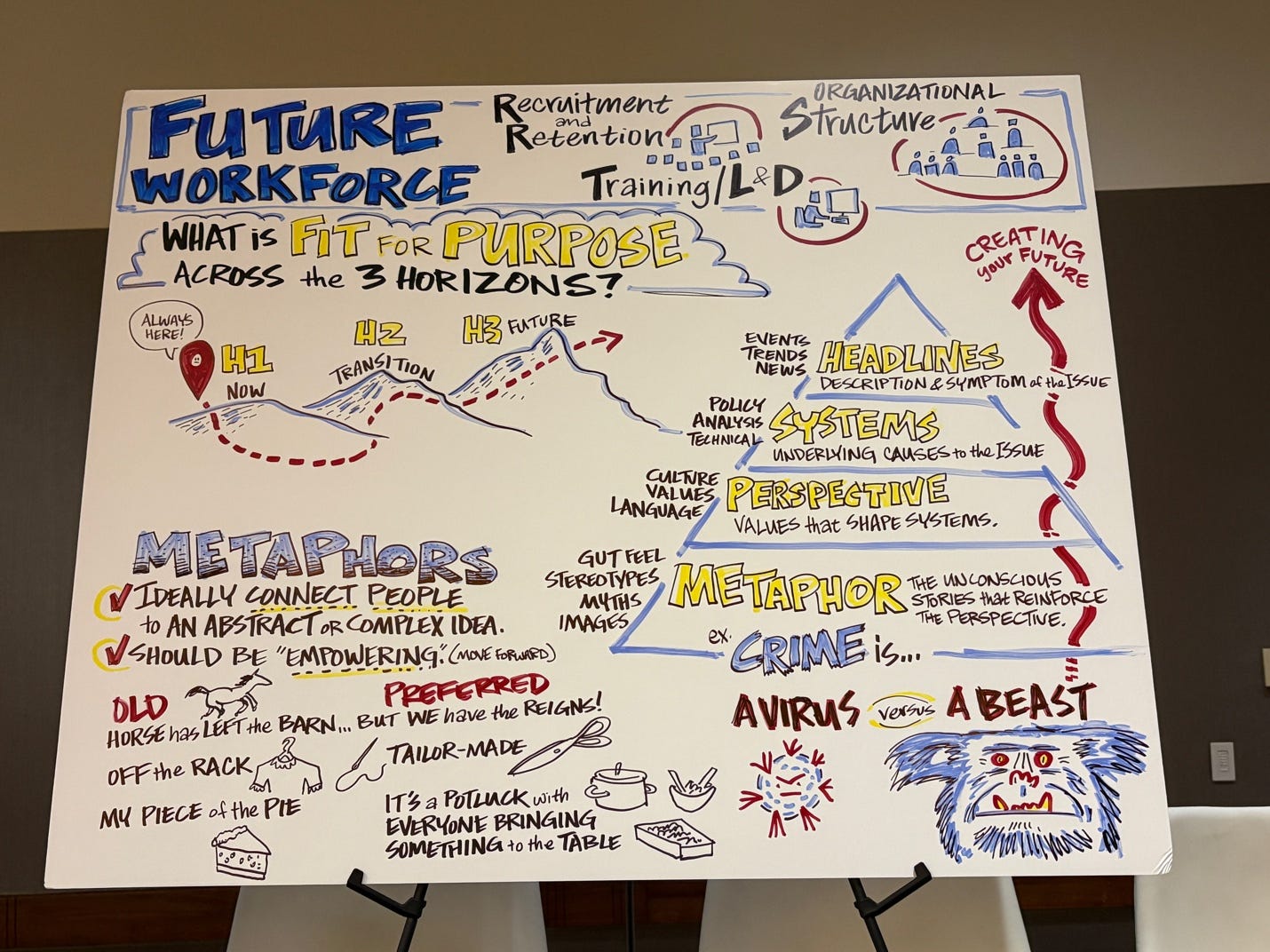
The second foresight tool dug deeper. Causal Layered Analysis asks you to peel a problem apart in four layers:
the headlines everyone can see
the systems beneath them
the perspectives that hold those systems in place, and, at the very bottom,
the metaphors and stories we don’t even realize we’re telling.
Deconstructing our topic was sobering. The headline: Tradition trumps change. The systems: culture, fear, civil service rules, union structures. The perspectives: a deep conviction that certainty is safe and that incremental change is the only responsible path. And the metaphors doing the quiet heavy lifting—If it ain’t broke, don’t fix it, and I’m getting my piece of the pie.
Then we turned it around. Kenney and Le pointed to research showing that describing crime as “a beast” pushes people toward enforcement, while describing it as “a virus” pushes them toward prevention—same facts, different story, different solutions. We can choose our metaphor, in other words, instead of letting it choose us. Our table’s new story became a potluck: everybody brings something to the table, and what each person brings matters. From “evolve or die” and “from caterpillar to butterfly” flowed new perspectives—servant leadership, the greater good, everyone valued—new systems like sandboxes safe enough to fail in and a redefined employment relationship, and at last a new headline: A city reimagines its workforce to deliver better public service.
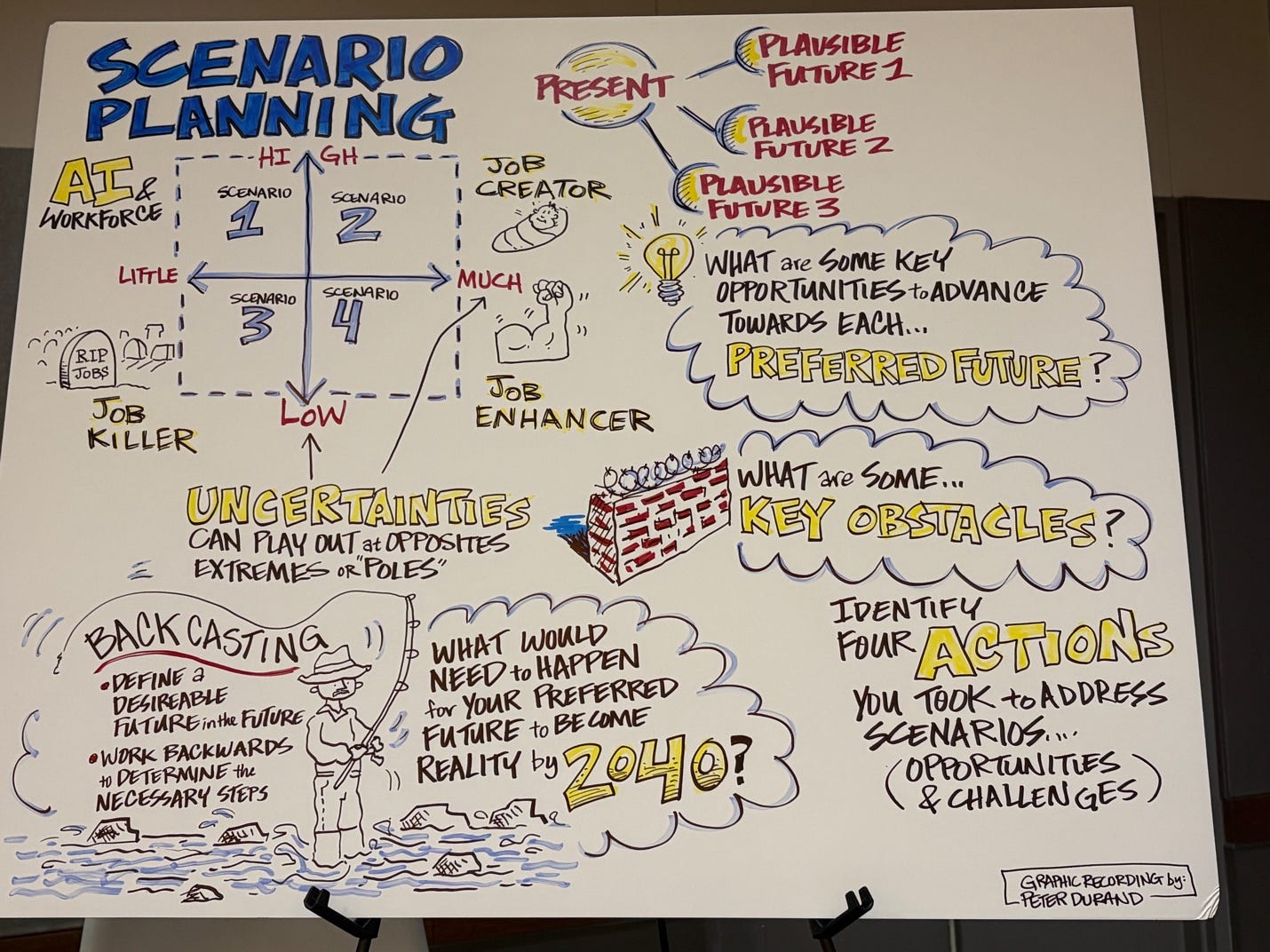
The session’s final tools pressure-tested that vision. Using a 2x2 scenario matrix, the group mapped how two uncertainties—shrinking versus new resources, technology as job-killer versus job-enhancer—could produce very different transitions. Then, through backcasting, participants stood in a preferred 2040 and worked backward, naming the moves they’d need to make in 2035, in 2030, and as early as this year to get there.
“We cannot achieve what we cannot imagine,” reads the Elise Boulding line the facilitators used to frame it.
“This is not linear work,” one participant said during the debrief. “It’s relational.”
That caught something true about the morning. The frameworks matter, but the real value was the rare permission to step out of the daily work of putting out fires and think hard, together, about a problem with no clean answer.
It helped that the problem was real. Give a room of city managers a hypothetical and you’ll get polite participation. Give them the thing that keeps them up at night and they lean in.
Brenda and Kat leaned in. They tested each other’s assumptions, backed up when a word wasn’t right, and stayed locked on it for four hours, which is longer than either of them gets to think about anything on a normal Tuesday.
That’s the part of public service nobody sees. It happens in a hotel meeting room with no cameras, no council, no constituents, and it looks like people refusing to settle for the easy answer.
Later that afternoon, I caught Brenda on the elevator and asked, plainly, how helpful the pre-con had really been. “It was amazingly helpful,” she said.
Kat sharpened that for me afterward. What moved something for her was the attention the session paid to the transition itself—Horizon 2, the unstable stretch after an organization leaves the old way and before the new one holds. That stretch is where change usually breaks down, and almost nobody plans for it on purpose. Leaders name the destination, then trust the middle to sort itself out.
She also credited the room. Four hours with peers who carry no agenda and no stake in your outcome is rare. No staff watching, no politics in the chairs, nobody who has to walk out and implement whatever you just said. Honesty comes easier when the room isn’t managing consequences.
The workforce question, in her read, was a warmup. The problem she’d aim these tools at is financial sustainability—revenue caps written decades ago for a scope of service nobody imagined then, and cities now being asked to do far more inside those limits. That’s the uncertainty worth building scenarios around. That’s where backcasting would earn its keep.
What participants took home was a method they could run again on any question worth four hours.
We cannot achieve what we cannot imagine. The imagining is the work.
Onward and Upward.
Disclosure: The Alliance for Innovation covered my expenses to attend TLG 2026 in exchange for conference coverage. AFI had no review of or input into this piece for GGF. The nonprofit has worked with local governments on innovation capacity since 1979, and its regular Member Meetups continue this kind of work between conferences.
No posts
Comments
Nothing yet. Say the first thing.
Sign in to join the conversation.