
Music by David Raksin
Lyric by Johnny Mercer
Introduced instrumentally as the theme from the 1944 Otto Preminger film Laura
Introduced vocally by …. See below!
Special thanks to Nick Rossi for helping with this column and also for suggesting it to begin with. Nick is writing what promises to be an even more comprehensive story about the song “Laura” for the journal Noir City, and I am really looking forward to reading that. More thanks to Elizabeth Zimmer for proofing & editing, Michael Lavine for the music, and Rob Waldman & Dan Weinstein for general kibbitzing.
Bob Kimball mentions this story, but here’s a longer version of it from no less an authority than Sinatra himself, who recalls a poignant conversation that he once enjoyed with the great Cole Porter in 1956. (This is from Mr. Sinatra’s famous 1986 “Yale Interview” with Sidney Zion. Click here for video excerpt.)
It was during the same period that we were doing High Society, Mr. Porter and I were sitting, people were chatting, and I said to him, “Cole, I’m curious about one thing. If you had not written a particular song, but you found you loved it and wished you had written it, what would it be?” And he said, “Laura.” And it fractured me, because I was crazy about the song “Laura,” it’s such a beautifully written song, the lyrics and music are so beautifully intertwined. I asked him why, and he said, “I don’t know why, but Johnny Mercer and Raksin...” - the boy’s name was David Raksin who wrote it for the film, Laura. By the way, I found out later they threw him a bone, because they wanted to get him out of his contract at Fox, and they said, “Just write us a little song for the picture.” A little song for the picture! It made him a very famous man. But that to me was quite interesting that Cole Porter, who had such an enormous catalogue, chose a song by practically a beginner, Raksin was really a beginner.
At this point, Sid responds: “And then about three million Jewish girls got named Laura! I knew two million of ‘em.”
Raksin himself confirmed the Cole Porter story, telling Phil Furia (in Skylark) that Porter sent Mercer a telegram “saying ‘Laura’ was his ‘favorite song—among those he didn’t write.’” (And yes, I think it’s cute that Sinatra refers to Raksin as a “boy”; Raksin was actually three years older than Sinatra.)
In his account, David Raksin says that Johnny Mercer had not seen the movie when he wrote the lyrics to “Laura.” I personally like to think that he eventually did watch it.
At the end of the film, no spoiler alert here, Clifton Webb (as “Waldo Lydecker,” great name, that) recites part of “Vitae Summa Brevis,” a classic poem from 1896 by the great British poet Ernest Dowson.
They are not long, the weeping and the laughter,
Love and desire and hate;
I think they have no portion in us after
We pass the gate.
They are not long, the days of wine and roses:
Out of a misty dream
Our path emerges for a while, then closes
Within a dream.
Here’s the edited audio from the Laura soundtrack:
In 1962, Johnny Mercer and Henry Mancini were commissioned by director Blake Edwards to write a title song for the film The Days of Wine and Roses. The movie was based on a 1958 teleplay by J. P. Miller which had taken its title from Dowson’s poem. It’s said that as soon as Mercer heard the title, he immediately recognized it as a line from Dowson. I do not doubt that Mercer was well-read enough to know Dowson’s work even before 1944, but he also would have remembered the poem from its inclusion in the film Laura—that is, assuming that once his song “Laura” was such a big hit that he actually went and watched the movie itself!
At the time that Robbins Music decided to commission a lyric from Johnny Mercer and publish the Laura theme as a popular song, Raksin obliged to add a verse. The verse is included in the original 1944 sheet music, but of all the thousands of recordings of “Laura,” the verse has only been performed a handful of times, including on two different albums by Michael Feinstein. Here are some versions that do utilize the verse, starting with the two by Michael. The first, a sublime performance done with just guitar accompaniment—although considering it’s the seven-string instrument of Bucky Pizzarelli, that means it’s more like a guitar and a half—and hear how he references the famous introduction by George Van Eps to Sinatra’s 1945 version of “I Don’t Know Why.” This is from a CD released in time for the Mercer centennial in 2009, in conjunction with the documentary by Clint Eastwood and the late Bruce Ricker, and the second is with the Israeli Philharmonic.
There are also two renditions by outstanding, veteran female vocalists, Chris Connor, sounding not much older than she had 30 years earlier on her 1987 release, Classic, and Joyce Breach, who uses “The Bad and the Beautiful” as introduction before she sings the verse, on her 1999 Reel Time.
Chris Connor, from the album Classic (1987)
Joyce Breach, in a medley with “The Bad and the Beautiful” from Reel Songs (1999)
And two more that do not seem to be on youtube:
Betty Buckley from Much More
Richard Rodney Bennett: Way Ahead of the Game: The Lyrics of Johnny Mercer
VERSE
You know the feeling
Of something half-remembered,
Of something that never happened,
Yet you recall it well.
You know the feeling
Of recognizing someone
That you’ve never met,
As far as you could tell.
Well—
REFRAIN
Laura
Is the face in the misty light, Footsteps
That you hear down the hall,
The laugh
That floats on a summer night
That you can never quite Recall.
And you see Laura
On the train that is passing through,”
Those eyes,
How familiar they seem! She gave
Your very first kiss to you.
That was Laura,
But she’s only a dream.
A concert dance starring that excellent musician / historian / raconteur, the sadly late Ian Whitcomb. Shared by Daniel Weinstein, who informs us: “ Ian Whitcomb & his Dance Band~Part 6 of 13 @ The Los Angeles Variety Arts Garden ~ 1988. Therein you will see/hear David Raksin singing Laura to Ian's band playing the stock arrangement, written by Mark Winstein (no relation!) and including myself in trombone (I get to play the melody. Thank you, Bill Harris!)”
A google search for the complete lyrics (including the verse) yielded this “alternate” verse, but after doing one of my customary deep dives, I can’t find anything else about it, or even where it came from. Can this be one of those AI “hallucinations” that we keep hearing about? Somehow it seems appropriate for a song about a half-remembered woman that may not even actually exist.
You can give your heart to a melody,
Or a poem that you happen to know.
You can look back on a memory,
That was yours in the long ago.
You can think of a face you used to see,
In the guttering candlelight,
But there’s never a face in a melody,
That can haunt you night after night, like...
(Chorus: “Laura is the face in the misty light...”)
Sinatra first started singing it on the air in April 1945, but didn’t make a recording of the song until October 1947. A few months earlier, he had already recorded “Stella by Starlight,” the film theme by Victor Young, with lyrics by the brilliant and perennially underappreciated Ned Washington, another tale of an ethereal woman who may not actually exist. Both of these classic 1947 Columbia Recordings had amazing orchestrations by Axel Stordahl. Here’s what I had to say about them in Sinatra! The Song is You.
“Was it a vision,” Keats asks in “Ode to a Nightingale,” “or a waking dream?” Stordahl decorates “Laura,” a noir song about a dream girl, vividly imagined but, in the lyric at least, ultimately unreal, with surreal, dreamlike motifs. Pizzicato violins suggest “footsteps that you hear down the hall,” and the muffled French horns together with a flute distant enough to be several blocks away enhance the quality of the scenario. For a closer, Sinatra seems to dissolve into the ether, like a movie flashback where everybody’s faces get all mushy and wavy. “Stella by Starlight” (from the Ray Milland ghost story The Uninvited) showcases Stordahl’s ability to create the moody presence of otherworldly enti- ties via spooky one-finger piano passages and bass lines that go bump in the night. “Laura” and “Stella” are perfect embodiments of the Sinatra-Stordahl ideal; they’re depicted so vividly that you could almost swear that they were real, and not just characters in a song—characters who aren’t even really there to begin with since “Stella” is a ghost and “Laura” exists only in a dream.
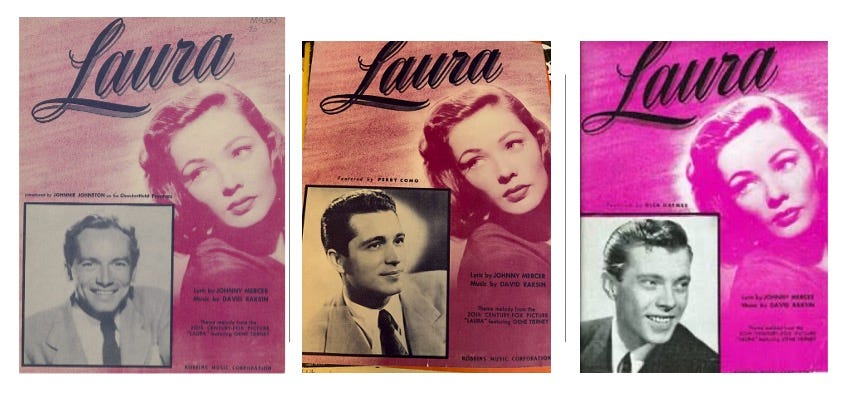
Johnny Johnston #1, Perry Como, Dick Haymes
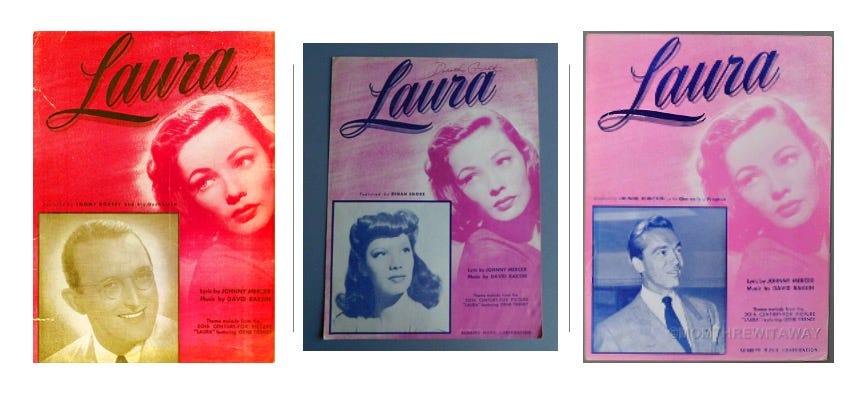
Tommy Dorsey, Dinah Shore, Johnny Johnston #2
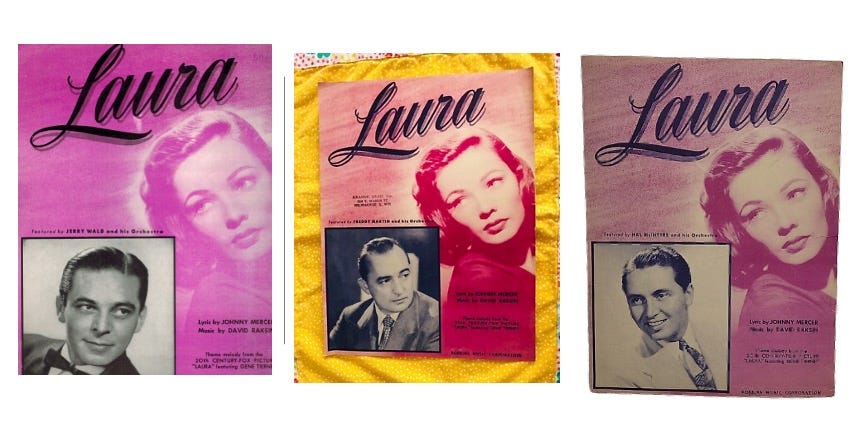
Jerry Wald, Freddy Martin, Hal McIntyre
Woody Herman #1, Woody Herman #2
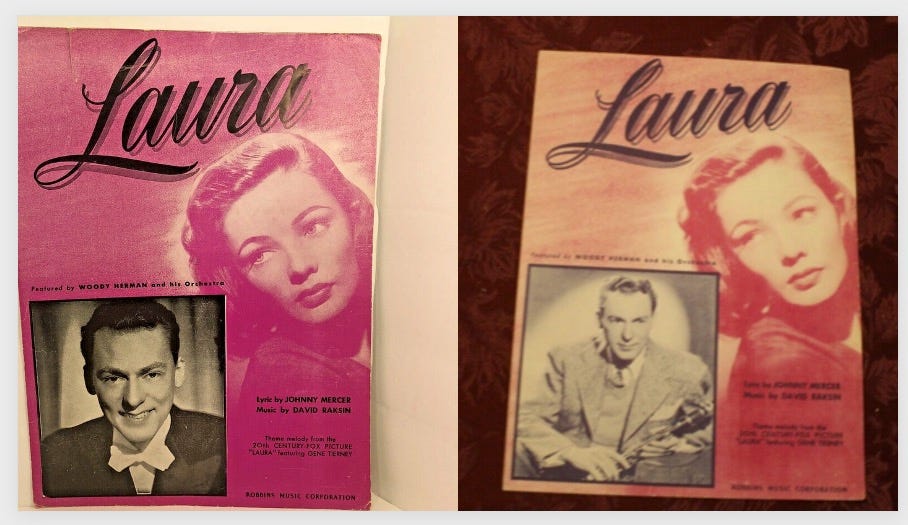
Very special thanks to Elizabeth Zimmer, Rob Lester, & Dan Fortune for their expert proofing, hey!) Special Thanks again to Daniel Weinstein, Jordan Taylor, & Rob Waldman.)
Slouching Towards Birdland (Will Friedwald’s Substack) is a reader-supported publication. To receive new posts and support my work, consider becoming a free or paid subscriber.
Sing! Sing! Sing! : My tagline is, “Celebrating the great jazz—and jazz-adjacent—singers, as well as the composers, lyricists, arrangers, soloists, and sidemen who help to make them great.”
A production of KSDS heard Saturdays at 10:00 AM Pacific; 1:00 PM Eastern.
To listen to KSDS via the internet (current and recent shows are available for streaming) click here. Here is the running list of recent shows.
The whole series is also listenable on Podbean.com; click here.
Mack Gordon & Harry Revel Pt 1 (1931-1934) (SSS #212 2026-08-29)
Listen: + Playlist:
Hello Bluebird! (SSS #211 2026-08-22)
Listen: + Playlist:
Buddy Greco @ 100 with Courtney Newman (SSS #210 2026-08-15)
Listen: + Playlist:
Jimmy Van Heusen: “On the Road with Bing & Bob”
(SSS #209 2026-08-08)
Listen: + Playlist:
Tony Bennett @ 100: “Ultimate Mr. Broadway” (SSS #208 2026-08-01)
Listen: + Playlist:
Louis Armstrong: The Great African-American Songbook
(SSS #207 2026-07-25)
Listen: + Playlist:
Bastille Day! Jacques Brel (SSS #206 2026-07-18)
Listen: + Playlist:
Jazz Goes Broadway! West Side Story
(SSS #205 2026-07-11)
Listen: + Playlist:
Judy Garland sings Harold Arlen (SSS #203 2026-06-27)
Listen: + Playlist:
July 4th Special—Great American Cities in Song (SSS #204 2026-07-04)
Listen: + Playlist:
Miles Davis @ 100: Sketches of Broadway (2026-06-24)
Listen: + Playlist:
200th Episode Special! Friedwald’s Favorites & Wilsci’s Winners
(SSS #200 2026-06-06)
Listen: + Playlist:
Miles Davis @ 100 | “Miles Ahead”
(SSS #202 2026-05-30 )
Listen: + Playlist:
Bobby Darin @ 90 | “By Request”
(SSS #201 2026-05-23)
Listen: + Playlist:
SLOUCHING TOWARDS BIRDLAND is a Substack newsletter by Will Friedwald. The best way to support my work is with a paid subscription, for which I am asking either $5 a month or $50 per year. Thank you for considering. (Thanks as always to Arlen Schumer for special graphics.) Word up, peace out, go forth and sin no more! (And always remember: “A man is born, but he’s no good no how, without a song.”)
Note to friends: a lot of you respond to my Substack posts here directly to me via email. It’s actually a lot more beneficial to me if you go to the Substack web page and put your responses down as a “comment.” This helps me “drive traffic” and all that other social media stuff. If you look a tiny bit down from this text, you will see three buttons, one of which is “comment.” Just hit that one, hey. Thanks!
Slouching Towards Birdland (Will Friedwald’s Substack) is a reader-supported publication. To receive new posts and support my work, consider becoming a free or paid subscriber.
No posts
Comments
Nothing yet. Say the first thing.
Sign in to join the conversation.