
Music by David Raksin
Lyric by Johnny Mercer
Introduced instrumentally as the theme from the 1944 Otto Preminger film Laura
Introduced vocally by …. See below!
Special thanks to Nick Rossi for helping with this column and also for suggesting it to begin with. Nick is writing what promises to be an even more comprehensive story about the song “Laura” for the journal Noir City, and I am really looking forward to reading that. More thanks to Elizabeth Zimmer for proofing & editing, Michael Lavine for the music, and Rob Waldman & Dan Weinstein for general kibbitzing.
Is “Laura” the most significant song from a major motion picture to never even be nominated for an Academy Award (™)?
1944 was a great year for music and also for movies: 12 songs were nominated, many of which were notable for being especially tailored for the WW2 era that birthed them, especially the year’s big winner, “Swingin’ on a Star.” Jimmy Van Heusen and Johnny Burke wrote this for Bing Crosby, by far the most popular singing star of Hollywood’s studio era, in what would be his most successful movie role to date, Going My Way. There were other 1944 movie songs that also became all-time standards, including “Long Ago and Far Away” from Cover Girl and “The Trolley Song” from Meet Me in St. Louis. Some of the nominated songs are beloved by music buffs like me, like “I Couldn’t Sleep a Wink Last Night” from Higher and Higher and “I’ll Walk Alone” from Follow the Boys. And there’s at least one 1944 Academy Award-nominated song that is best remembered by future generations because of Bugs Bunny: “Sweet Dreams, Sweetheart” from Hollywood Canteen.
But then there are some that are, frankly, head-scratchers even for those of us rather extreme song buffs, among them “Remember Me to Carolina” from Minstrel Man and “Silver Shadows and Golden Dreams” from Lady, Let’s Dance. I can only assume that the Academy members nominated these because of their fondness for minstrel shows and ice dancing. And there’s another puzzler: the all-time jazz and pop standard “Brazil” by the great Carioca composer Ary Barroso, which was officially introduced in the 1944 Republic Pictures Brazil aka Stars and Guitars, even though it’s barely heard in that B-musical.
But “Laura?” Not even nominated! Furthermore, Steve Lawrence and Billy May did not even include it on their great 1964 album Academy Award Losers.
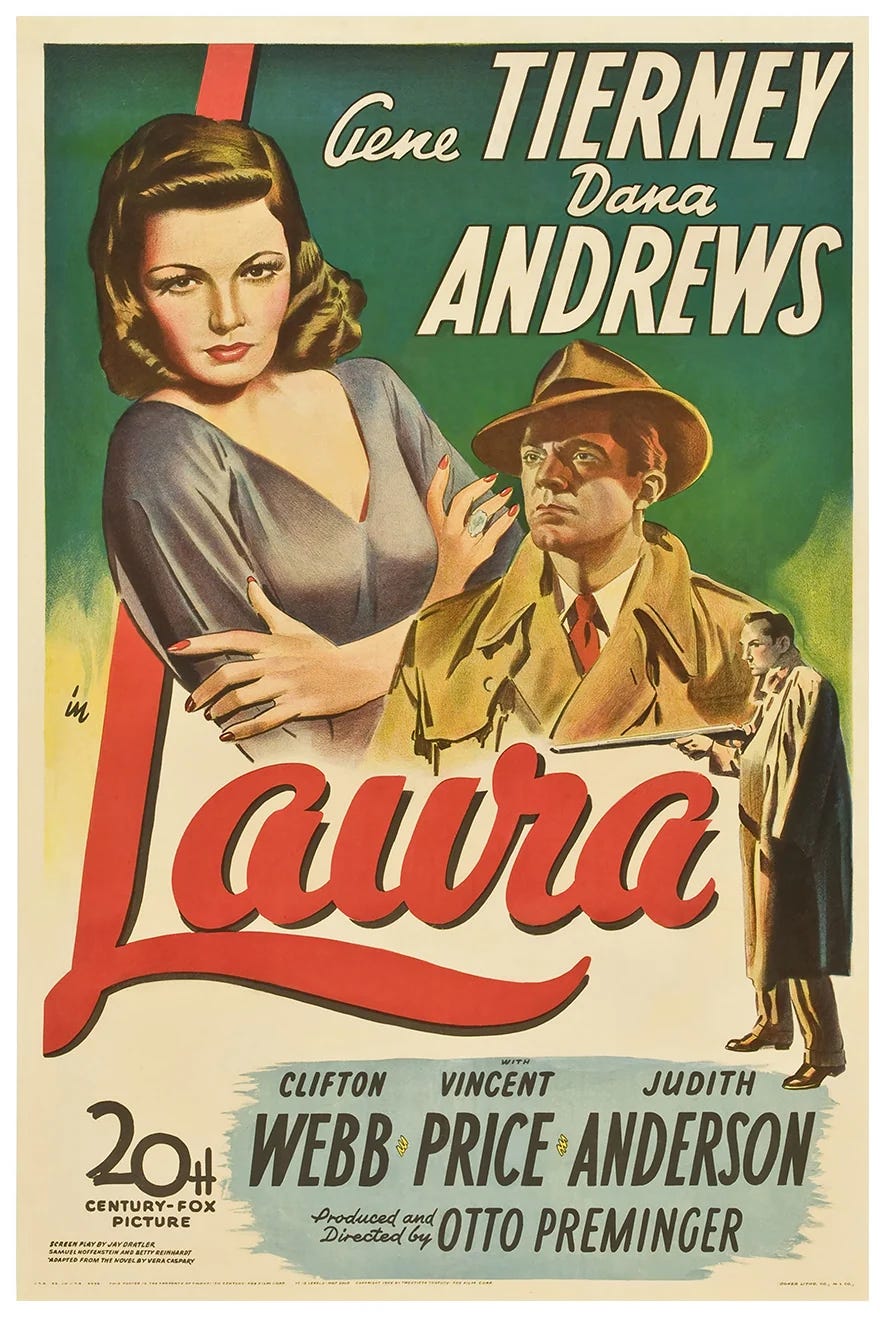
I think it’s safe to say that “Laura” has become, over the decades, by far the most widely loved, recorded, and performed movie song of the 1944 season, and quite possibly of the entire decade. And as my colleague, guitarist and historian Nick Rossi, points out, “Laura” might be the most successful song introduced in a film noir. There are a few challengers, starting with Matt Dennis and Earl Brent’s masterpiece “Angel Eyes” from Jennifer (1953) and “Stella by Starlight” from The Uninvited (1944), although the latter is perhaps more of a supernatural / horror film than a crime-oriented / noir film. Perhaps the Academy was only considering songs that were introduced in movie musicals, which would explain why none of the three songs referenced here, “Laura,” “Stella by Starlight,” and “Angel Eyes,” songs that have all been massively popular standards over the last 70-80 years, were nominated by the Academy.
Fortunately, David Raksin, composer of “Laura,” did receive a nomination for one of his 1944 assignments, Forever Amber, which was nom’d for “Best Music Score of a Dramatic or Comedy Picture”; perhaps ironically, that movie (based on a novel by one of Artie Shaw’s many wives) and its music are not remembered nearly as well as “Laura.” “Laura” is also one of only a few songs by the immensely talented Raksin to become something of a standard: “Smile” did not give him the proper credit (his contribution is still not acknowledged by the publisher) and “The Bad and the Beautiful” is mainly known only by jazz buffs through the superlative recording by Bill Evans.
“Laura” might not have been considered by the Academy (™) because it didn’t become a proper song with lyrics until several months after the fact. Both Laura and To Have and to Have Not, which sports another all-time classic song in “How Little We Know?” were released on October 11, followed by Meet Me In St. Louis about ten days later on the 22nd. (Like I say, a great year for movies and music.) The “Laura” theme is only heard instrumentally in the movie. and the lyric wasn’t unveiled until around February 1945, which was too late for the 1944 Academy Awards ceremony, held on March 15, 1945.
At the time, 20th Century Fox did not own their own music publishing firm, but they partnered with Robbins Music, based in the Brill Building in New York. Robbins executive Abe Olman was the firm’s chief liason with Fox, and it was Olman’s idea to turn the Laura theme into a popular song. According to our great friend, the late Bob Kimball, Johnny Mercer was actually their third choice: first they went to Oscar Hammerstein II (who was currently engaged in writing State Fair with his new partner Richard Rodgers for Fox) and then Irving Caesar, an old-timer whose hits were mostly long behind him. As Raksin told Michael Feinstein, Caesar actually wrote a lyric, and titled his version of the song “Two Dreams,” but Raksin wisely rejected it.
As Raksin told the late Phil Furia for his biography of Mercer (Skylark: The Life and Times of Johnny Mercer) :
“It was an abominable lyric.” Abe Olman thought Caesar’s lyric was serviceable and turned to Raksin asking, “Who are you to turn this down?”
“The composer, that’s who.”
A songwriter himself, Olman could sympathize with the young composer. “Well, who would you like?”
“Well, there’s a guy I don’t know, but he’s such a wonderful lyricist I would adore to have him.”
“Who’s that?”
“Johnny Mercer.”
“Oh, I know him.”
At this point, Olman dispatched a telegram to Mercer:
“DEAR JOHNNY HAVE PHONED DAVE RAKSIN TO CONTACT YOU IN REGARD TO THE LYRIC FOR THE MELODY FROM LAURA TREMENDOUS CALLS FOR THIS TUNE FROM ALL OVER THE COUNTRY AND POSITIVE IT CAN BE A NUMBER ONE HIT STUDIO ADVISES THEY HAVE RECEIVED SEVERAL THOUSAND LETTERS CONCERNING SONG HOPE YOU CAN HOP ON IT RIGHT AWAY”
In 1944, Mercer was writing mostly for Paramount Pictures (Here Come the Waves, Out of this World) and was soon to win his first of four Oscars for the classic MGM musical The Harvey Girls, released in January 1946.
As Bob Kimball reports:
Mercer wanted to use the title “Footsteps in the Dark.” He hadn’t even seen the movie—”I simply absorbed the tune and let it create an atmosphere for me.” Raksin said, “I thought Johnny’s achievement was amazing, that he should get that feeling into a lyric. And I know he worked hard, sweated blood sometimes, but you would never have known it. He would show up without a hair out of place—with this thing he had written on the tip of his little finger.”
Bob also quotes Mercer himself:
“If a fellow plays me a melody that sounds like something, well, I try and fit the words to the sound of the melody. It has a mood and if I can capture that mood, that’s the way we go about it. Laura was that kind of picture. It was predesigned, because Laura was a mystery. So I had to write “Laura” with kind of a misterioso theme.
That’s hard, because there are so few notes. And because the intervals are tough, the key changes are strange. And at the time it came out, it was most strange. But since it has become so popular, it’s easier now. But that kind of song is always difficult, because you have to write a lyric that’s going to be a hit, and you don’t have many notes to work with.”
(Above, the King Cole Trio’s MacGregor transcription of “Laura” with Nat singing, probably recorded in Spring 1945. Below, Nat’s piano instrumental version of the song from the 1952 album Penthouse Serenades.)
As Raksin told Gene Lees (for his biography, Portrait of Johnny):
So Johnny came to see me. He said, ‘Oh boy, what a great tune.’ I gave him a copy of the tune and an acetate. He came back in a few days with the lyric. Somebody later said to me that I had changed the lyric. I said, ‘I can just see myself changing Mercer’s lyric!’ It turned out that Johnny had two places where he had different words and couldn’t choose and asked my opinion. I told him, ‘I prefer this one,’ ‘I prefer that one.’ And he accepted that.
The vocal versions of “Laura” start appearing around February 1945. Nat King Cole may have been the first; after all, Johnny Mercer was a friend, and as a cofounder of Capitol Records, for a time he served as Nat’s hands-on producer. Nat and the King Cole Trio, with bassist Johnny Miller and guitar legend Oscar Moore, recorded “Laura” not for Capitol, unfortunately, but for a MacGregor transcription. The date is sometimes given as May 1944, but this is almost certainly wrong; February or March 1945 is much more likely. (Nat never sang “Laura” on a commercial Capitol Recording, but he recorded a lovely piano instrumental version in 1952 for his album Penthouse Serenades.)
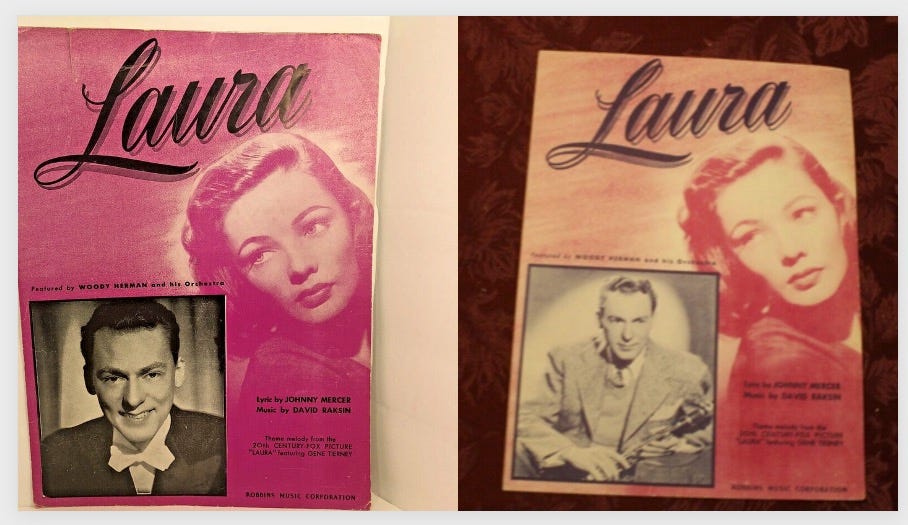
Then in February, there were two versions by big-name big bands, both made for Columbia Records: Harry James and his Orchestra with a vocal by Buddy DeVito on the 14th, and then Woody Herman on the 19th. This proved to be a major break for Herman, who had just switched recording affiliations, from Decca Records to Columbia. As Woody told Stuart Troup, the co-author of his posthumous memoir The Woodchopper’s Ball (1990):
It was still wartime, and companies could press only a limited number of records for an artist before moving on to another artist. So I made a deal.
“Don’t worry about the guarantees,” I told Columbia. [I presume that Woody means label head Mannie Sachs.] “Just give me as much publicity as your top two artists.” The top two Columbia artists then were Frank Sinatra and Dinah Shore. Every time Columbia put an ad in a trade paper, I got one. That drove the other bandleaders crazy—Les Brown, Harry James. They couldn’t figure it out. Sinatra would be on one page, Dinah Shore on the other, and I would be on the next: “Columbia Records presents …” We became Number One in the country because of that as much as anything. It pushed us to the very peak of popularity.
It also helped Woody attain the upper brackets of mass market popularity that he happened to record “Laura.” As he tells the tale:
“Laura” was the first side we recorded on our first Columbia date, and it was also our first release. I had seen the movie, heard the theme and liked it. Harry James was Columbia’s big band then, and he thought he had it sewed up. He recorded it a few days after {sic} us, but Columbia scrapped his and released ours.
“I had arranged with Johnny Mercer to sing his lyric. We were performing at the Meadowbrook in New Jersey when we went into the studio in New York on February 19, 1945, to make the cut. It became a smash hit. Columbia had a gold record made as a special gift to me, even though the record hadn’t really sold a million copies. It couldn’t, because the companies weren’t allowed to press that many. But Columbia gave me the gold record as a token. Over a period of years, it finally did sell a million.”
Woody was more specific when he related the story to his longtime superfan, the late George Hall (a close friend of mine). As Woody told George, the band was set to record “Laura” as an instrumental. The Herd was then playing at the Meadowbrook in the evenings and set to record at 799 Seventh Avenue that same day. Woody was staying at a hotel in Manhattan and he was on his way over to the studio to do his first date for Columbia, when, unexpectedly, he spotted the gap-toothed, huckleberry face of Johnny Mercer, waiting for him in the lobby. The two took a cab over to the studio, and, on the way, Mercer showed Herman his newly-penned, handwritten lyrics to “Laura.” Herman quickly made an executive decision to make a vocal version of the theme, with himself singing.
(There are, not surprisingly, holes in all these stories: it seems unlikely that Ralph Burns could have rewritten the entire arrangement to fit a vocal chorus that quickly, and, contrary to Woody’s recollection decades later, the James version had been waxed five days before—not after—the one by Woody and the Herd. It’s also quite telling that Mercer knew that Woody was the one to sing it, and even though he was a partner in Capitol Records, he gifted it to Woody rather than a Capitol artist or band. Of course, I have no doubt that Nat Cole immediately wished that he had officially sung it for an Capitol Records release.)
In 1945, the Herman Herd had an outstanding vocalist in Frances Wayne, who was soon to marry trumpeter and arranger Neal Hefti, but it was decided that the lyric of “Laura” better suited a male singer. The only boy vocalist with the Herd was the leader himself, although he mainly shouted the blues and novelty numbers. “Laura” was Woody’s first great ballad vocal, and, as many have noted, showed what a great singer of love songs he could be, leading the way to such efforts as his album with Erroll Garner, Songs for Tired Lovers, which, although the title is an obvious gag, is a lovely album of ballads. (Daniel Weinstein reminds me that the 1941 “T’is Autumn” is also another early example of Woody crooning a more “serious” song.)
Played today, the James record is relatively generic: Buddy DeVito has a beautiful voice but little individuality; he seems like a road company Sinatra, although this is notable at a moment when most big band baritones still were imitating Bing Crosby. The James arrangement, which features a big string section, sounds rather like an anonymous Hollywood studio orchestra. In fact, the James “Laura” sounds like the opening half of the famous Spike Jones RCA record, in which the “other orchestra” plays it completely straight before the City Slickers come in and tear it to pieces. Spike Jones actually plays about eight bars of the Raksin theme as kind of a Hollywood rhumba a la Desi Arnaz.
(Rob Waldman and I were speculating as to whether the first half of the Spike version might have been arranged by Richard Jones, Spike’s younger brother. Dick Jones who went on to a consequential career as an arranger-conductor-producer of easy listening albums for Capitol Records, and worked frequently with Sinatra in the mid-1950s. One of these albums, the 1957 Stringtime, in fact, contains a very fiddle-heavy arrangement of “Laura.”)
The Ralph Burns / Woody Herman version, however, is modish, stylish, and highly noir-ish, and Woody’s Johnny Hodges-inspired alto saxophone solo is as much of a selling point as his singing. You can hear why Columbia issued Herman over Harry. The Herman / Burns version also boasts short but effective solos by vibraphonist Marjorie Hyams and trombonist Bill Harris.
George Hall, being almost as much of a nerd as I am, mentioned to Woody that the James record was eventually issued almost 25 years later on a Harmony LP, which was actually titled Laura. Woody responded, “Well, if it wasn’t for Ralph’s great chart, then Columbia would have issued Harry’s version and put mine on a Harmony LP 25 years later.”
VERSE (About which there will be more information in part two)
You know the feeling
Of something half-remembered,
Of something that never happened,
Yet you recall it well.
You know the feeling
Of recognizing someone
That you’ve never met,
As far as you could tell.
Well—
REFRAIN
Laura
Is the face in the misty light, Footsteps
That you hear down the hall,
The laugh
That floats on a summer night
That you can never quite Recall.
And you see Laura
On the train that is passing through,”
Those eyes,
How familiar they seem! She gave
Your very first kiss to you.
That was Laura,
But she’s only a dream.
Part Two will include:
Everything you wanted to know about the rare verse to “Laura”
The Story about Sinatra, Cole Porter, and “Laura”
And the connection between Laura and The Days of Wine and Roses!
Very special thanks to Elizabeth Zimmer, Rob Lester, & Dan Fortune for their expert proofing, hey!) Special Thanks again to Daniel Weinstein, Jordan Taylor, & Rob Waldman.)
Slouching Towards Birdland (Will Friedwald’s Substack) is a reader-supported publication. To receive new posts and support my work, consider becoming a free or paid subscriber.
Sing! Sing! Sing! : My tagline is, “Celebrating the great jazz—and jazz-adjacent—singers, as well as the composers, lyricists, arrangers, soloists, and sidemen who help to make them great.”
A production of KSDS heard Saturdays at 10:00 AM Pacific; 1:00 PM Eastern.
To listen to KSDS via the internet (current and recent shows are available for streaming) click here. Here is the running list of recent shows.
The whole series is also listenable on Podbean.com; click here.
Hello Bluebird! (SSS #211 2026-08-22)
Listen: + Playlist:
Buddy Greco @ 100 with Courtney Newman (SSS #210 2026-08-15)
Listen: + Playlist:
Jimmy Van Heusen: “On the Road with Bing & Bob”
(SSS #209 2026-08-08)
Listen: + Playlist:
Tony Bennett @ 100: “Ultimate Mr. Broadway” (SSS #208 2026-08-01)
Listen: + Playlist:
Louis Armstrong: The Great African-American Songbook
(SSS #207 2026-07-25)
Listen: + Playlist:
Bastille Day! Jacques Brel (SSS #206 2026-07-18)
Listen: + Playlist:
Jazz Goes Broadway! West Side Story
(SSS #205 2026-07-11)
Listen: + Playlist:
Judy Garland sings Harold Arlen (SSS #203 2026-06-27)
Listen: + Playlist:
July 4th Special—Great American Cities in Song (SSS #204 2026-07-04)
Listen: + Playlist:
Miles Davis @ 100: Sketches of Broadway (2026-06-24)
Listen: + Playlist:
200th Episode Special! Friedwald’s Favorites & Wilsci’s Winners
(SSS #200 2026-06-06)
Listen: + Playlist:
Miles Davis @ 100 | “Miles Ahead”
(SSS #202 2026-05-30 )
Listen: + Playlist:
Bobby Darin @ 90 | “By Request”
(SSS #201 2026-05-23)
Listen: + Playlist:
Jazz at Lincoln Center Swing University:
A Special video Session: Sinatra in the Sixties (click to view)
With Seton Hawkins & Will Friedwald (Thursday April 2, 2026)
Bing Crosby Birthday Special—Ultimate Broadway Songbook
(SSS #199 2026-05-16)
Listen: + Playlist:
The Sacred Music of Duke Ellington—Then and Now
(SSS #198 2026-05-09)
Listen: + Playlist:
TONY BENNETT REMEMBERED ON NY1
a video interview with Stephanie Simon and Will Friedwald 2023-07-23
Click Here
Cinco de Mayo:
The Ernesto Lecuona (and Margarita Lecuona) Songbook
(SSS #197 2026-05-02)
Listen: + Playlist:
Ella Fitzgerald Sings the Jimmy Van Heusen, Sammy Cahn, Johnny Burke, & Jule Styne Songbook(s) (SSS #196 2026-04-25)
Listen: + Playlist:
SLOUCHING TOWARDS BIRDLAND is a Substack newsletter by Will Friedwald. The best way to support my work is with a paid subscription, for which I am asking either $5 a month or $50 per year. Thank you for considering. (Thanks as always to Arlen Schumer for special graphics.) Word up, peace out, go forth and sin no more! (And always remember: “A man is born, but he’s no good no how, without a song.”)
Note to friends: a lot of you respond to my Substack posts here directly to me via email. It’s actually a lot more beneficial to me if you go to the Substack web page and put your responses down as a “comment.” This helps me “drive traffic” and all that other social media stuff. If you look a tiny bit down from this text, you will see three buttons, one of which is “comment.” Just hit that one, hey. Thanks!
Slouching Towards Birdland (Will Friedwald’s Substack) is a reader-supported publication. To receive new posts and support my work, consider becoming a free or paid subscriber.
No posts
Comments
Nothing yet. Say the first thing.
Sign in to join the conversation.