
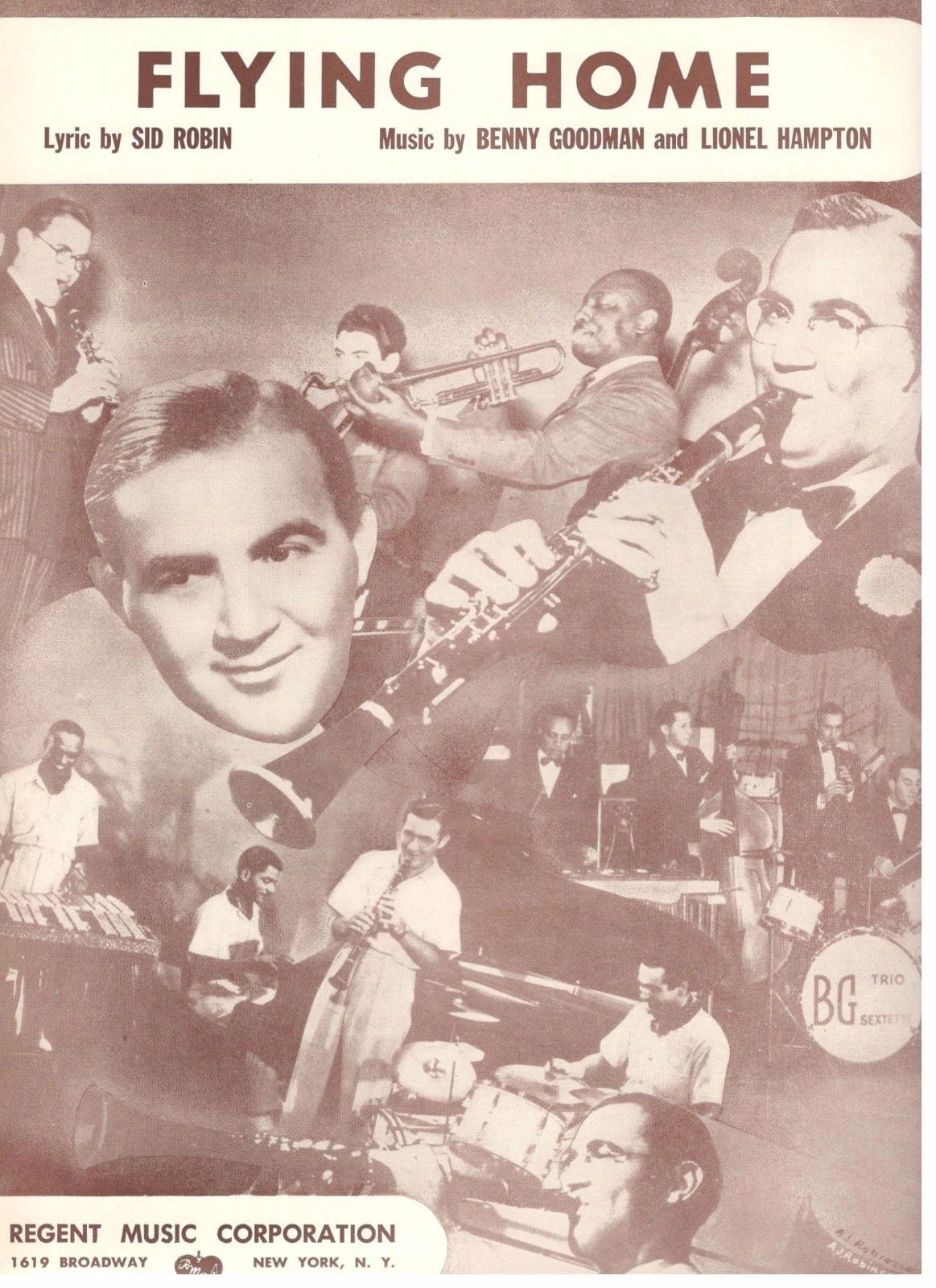
This time special thanks to the very great Mark Cantor, as well as to Michael Lavine for finding the “Flying Home” (Sid Robin edition) sheet music, and as usual to Elizabeth Zimmer, Daniel Weinstein & Nick Rossi. Yes!
Okay, the title of this post is deliberately provocative and admittedly an exaggeration: Mike Stoller and the late Jerry Leiber, as producers perhaps even more than as songwriters, are among the major auteurs in all of American music, but they didn’t invent what jazz fans call vocalese. (As Lewis Porter explains, the usage of this term was coined by Leonard Feather.) However, Jerry & Mike do deserve at least a little credit for being among its earliest practitioners. Their vocalese lyric to the big band classic “Flying Home” was recorded on January 30, 1952, three weeks or so before King Pleasure’s breakthrough “I’m in the Mood for Love (Moody’s Mood for Love)” on February 19, 1952, and nine months before Annie Ross’s landmark “Twisted” on October 9, 1952. (Yes, they deserve “Props” for a song about “Flying.” Ha!)
Our buddy, Professor Lewis Porter, has given us a comprehensive survey of the early pre-history of vocalese, before Lambert, Hendricks, and Ross, and his first (of four) installments is to be found here.
By 1952, “Flying Home” was already one of the most iconic numbers in jazz or American pop, and Jerry and Mike, being major jazz fans as well as scholars and practitioners of the blues, both grew up with the classic Lionel Hampton recording, with its much-memorized tenor saxophone solo by Illinois Jacquet.
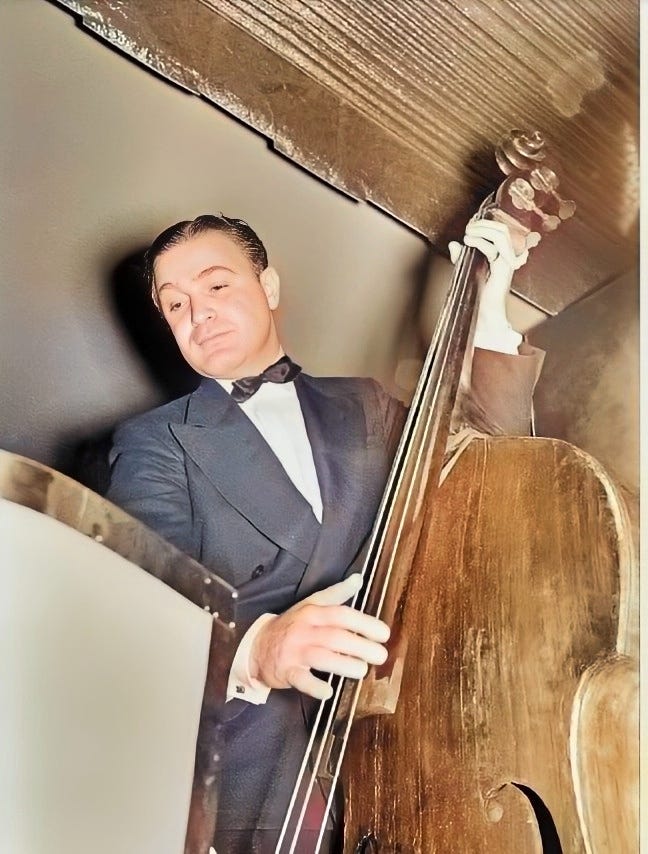
The team briefly mentions some of the backstory behind this very unusual lyric in their collective memoir, Hound Dog, written with the resourceful David Ritz. Around 1951—they were both 17 or 18 at the time—they were doing some work for Harry Goodman. Goodman (1906-1997) is best known to jazz history as Benny’s older brother and a highly competent professional bass player, who played a key role in the rhythm section of some of Benny’s most celebrated bands. However, in the larger picture, Harry Goodman was much more active as a music publisher. Based in the Brill Building, he started his publishing company, Regent Music, initially as Benny’s business partner, and their younger brother, Gene, previously Benny’s band boy, also part of the firm. Their first copyrights were mostly Benny’s big band instrumentals. By the 1950s, Regent Music was leaning heavily into rhythm & blues, as it was starting to be called, which was clearly going to be the next big trend in music.
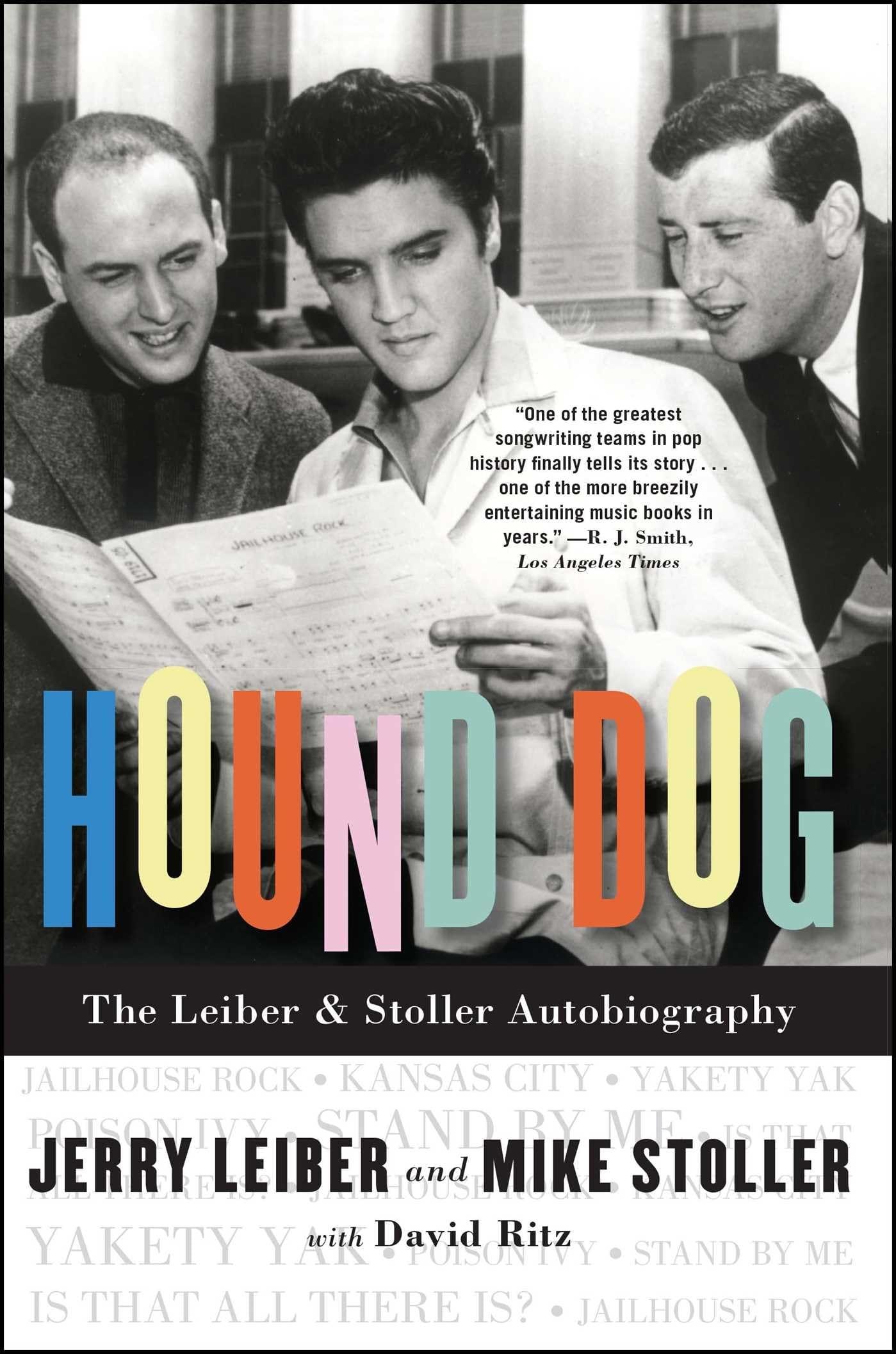
“The fact that we were selling songs didn’t excite our ambition; it was hearing those songs sung by master singers that had us running back to Mike’s little upright piano. At the same time, we inevitably ran into the characters—some shady, some legit—who hung around the edges of the business.
Harry Goodman ran his brother Benny’s publishing firm. Harry was the guy who got us to put words to “Flying Home,” a Benny Goodman—Lionel Hampton composition. Not only did he work Benny’s tunes, but he had a publishing deal with Chess Records. That meant he needed blues songs, and we assured him that the blues was our specialty.
“You got hits?” Harry asked.
“We got hits,” I answered.
And that’s all they have to say about it. I used to be in touch with Mike (who, by the way, recently, at the age of 90-something, composed the excellent score to the 2025 Broadway musical version of Beaches), his wife Corky Hale, and Mike’s son, Peter Stoller, but I haven’t been in contact with them for a while. I would love to find out more, specifically how it occurred to them to write a full-on, Jon Hendricks-style vocalese lyric to this arrangement when that was a very new concept.
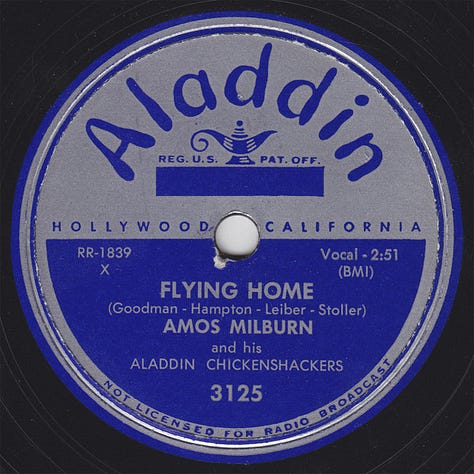

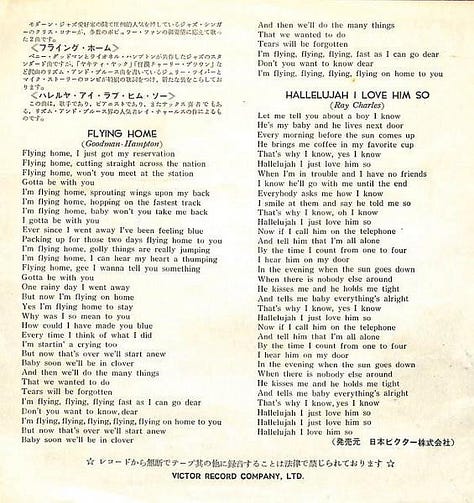
As far as I can tell, the Leiber & Stoller “Flying Home” has been recorded three times. First, as I mentioned above, on February 19, 1952 by Amos Milburn for Chess Records. Then again, by Chris Connor, on July 31, 1958, in a session produced by L&S, around the time that the highly influential original LHR debut album Sing a Song of Basie was about to be released.
Unlike most of Jon Hendricks’s vocalese adaptations of classic jazz instrumentals, Leiber & Stoller’s text to “Flying Home” only covers about half of the famous record, cutting off just a few choruses into the tenor sax solo and not including any of the tutti shout chorus at the end.
Amos Milburn and His Aladdin Chickenshackers: Amos Milburn (piano and vocals), Maxwell Davis – Tenor Saxophone (musical director and tenor saxophone), Billie Smith (tenor saxophone), Jewell Grant & Leroy Robinson (alto & baritone Saxophone), Johnny Moore (guitar), Lloyd Trotman (bass),Jesse Sailes (drums), Los Angeles, January 19, 1952 (On this recording, Maxwell Davis plays an actual tenor solo in homage to Illinois Jacquet.)
Chris Connor with unknown orchestra and chorus, New York, July 31, 1958. No one else is credited, i.e., no conductor or arranger, but there is a credit: “Special Lyrics by Leiber & Stoller.”
And, more recently, there’s a third recording of the L & S lyric, by the contemporary, Chicago-based jazz singer Rose Colella in 2014. According to Tom Lord, the personnel is: Chris Madsen (saxophone), Dan Murphy (piano), Dan Effland (guitar), Joe Policastro (bass), Mikel Avery (drums).
And it turns out that when Regent Music Corp. (1619 Broadway) first published the song in 1941, there was a lyric included, by Sid Robin. Sydney Robin (1912-1986) was a lifelong New Yorker and apparently not related to the very successful lyricist Leo Robin (from Pittsburgh). He spent most of his songwriting career collaborating with more famous African-American musicians and composers, and ultimately contributed the words to roughly three jazz standards that most everybody reading this will know: “I Miss You So” (associated with the Cats and the Fiddle, also recorded by The King Cole Trio and Chris Connor, among others), “Harlem Nocturne” (the Earle Hagen theme, an instrumental hit for Earl Bostic, but sung wonderfully by Mel Tormé and others), and “Monday Every Day” (for which Robin apparently wrote both words and music, and which was sung definitively by the great Al Hibbler, and also sung wonderfully by Jo Stafford). He also worked on a number of songs with Louis Jordan, including “Look Out, Sister.”
While I think all of the songs listed above are excellent, I have to admit that Robin’s lyrics to “Flying Home” are far from his best, and they probably derived from the usual situation in the big band era when a publisher has what he thinks will be a hit but he feels that it has to have a lyric, even a perfunctory one. (Oh I could write a lot about those! A few examples: “Stompin’ at the Savoy,” words by Andy Razaf, “A String of Pearls,” words by Eddie DeLange, and many, many tunes by Raymond Scott and Maxwell Anderson, although some of those worked out very well, especially “Sleigh Ride.”)
It seems like Harry Goodman realized that the Robin text wasn’t very good—after ten years nobody wanted to sing it—so perhaps that’s why he commissioned a new lyric from Jerry and Mike. Between the two different sets of words for “Flying Home,” the curious point is that the 1941 Sid Robin lyric was officially published but, as far as I can tell, never sung or recorded by anybody. Contrastingly, the 1951 lyric by Jerry Leiber and Mike Stoller was recorded at least three times (1952, 1958, 2014) but never actually published as sheet music.
Thanks to George Connolly for pulling my coat-tails to this third completely different lyric. The British entertainer, Georgie Fame (born Clive Powell in 1943), who has been active in jazz, pop, and blues circles since the mid-1960s, also wrote his own set of words as part of a rather unusual Benny Goodman songbook / tribute album in 1983 with the somewhat ungainly title In Goodmansland. This was a set of duets with the Swedish pop and jazz artist Sylvia Vrethammar (I know what you’re thinking, but no, apparently she wasn’t one of the Abbas). It’s actually not a bad album, in a British jazz / R&B guy-meets-Swedish pop star kind of way, and kudos to them for doing a Benny Goodman project. The mix on the recording is kind of mushy, and a lot of the words are unclear, but below, my buddy Tom Buckley helped me to transcribe this set of words as well, although I can’t blame him for obvious errors.
Nick Rossi reminds us that the actual riff that inspired the song is is by Charlie Christian, who doesn’t get credit, although Benny Goodman (who also published it) and Lionel Hampton (who made it into a big band classic) do.
From Daniel Weinstein: First, a clarification of the structure of the 1942 Lionel Hampton big band version (the previous versions, by the Benny Goodman Sextet with Charlie Christian in 1939 and by a Lionel Hampton pick-up group on Victor in 1940, do not follow this structure.)
The 1942 record starts with a 4 bar intro featuring Hamp’s vibes;
1st chorus in Ab Major - ensemble 16 bars followed by 16 bars of Hamp’s vibes improvising over the bridge and the last 8, with a different riff by the sax section;
2nd and 3rd choruses in Ab Major - Illinois Jacquet’s iconic solo; 2 bar modulation by Hamp’s vibes;
1st shout chorus in Db Major (including screaming trumpet responses to Hamp on the bridge by Ernie Royal);
2nd shout (1/2 chorus only,) beginning on the bridge (with further call and response between Hamp and Royal) and concluding with the last 8 bars.
The Leiber and Stoller lyrics are fitted to both the melody and to the first chorus only of Jacquet’s solo. The Amos Milburn record has Milburn singing the melody and solo lyrics in F Major, after which the key changes abruptly to Ab for Maxwell Davis’ take on Jacquet’s solo. I am guessing that the second chorus of Jacquet’s solo, consisting in the first 16 bars of one note repeated in a syncopated fashion, did not strike L&S as fodder for further clever lyrics (anything further, Fodder?)
Final note: The iconic Jacquet solo starts with a few notes from “Ah, so pure” (”M’apparì tutt’amor” or “Ach so fromm”) from Friedrich von Flotow’s opera Martha (1847). In 1942, this was one of the most recognizable pieces of music in the world, 85 years later, “Martha” is mainly remembered for its jazz interpretations (Fats Waller, Adrian Rollini, Connie Boswell and The Bobcats) and as a quotation source in the Jacquet solo. It’s interesting how the different lyric writers come up with different words for those notes.
(Full ensemble)
Flying home, I just got my reservation
Flying home, cuttin’ straight across the nation
Flying home, won’t you meet me at the station
Gotta be with you.
I’m flying home, sproutin’ wings upon my back,
I’m flying home, hoppin’ on the fastest track,
I’m flying home, baby, won’t you take me back
I got to be with you.
(Hampton’s brief vibraphone solo)
Ever since I went away, I’ve been feelin’ blue
Packing up my clothes today, flying home to you.
(Hampton + full ensemble)
Flying home, caught a plane that’s really jumpin’
Flying home, I can hear my heart a-thumpin’
Flying home, gee, I want to tell you something
Gotta be with you.
(Illinois Jacquet tenor saxophone solo)
One rainy day I went away
But now I’m flyin’ on home
Yes, I’m flyin’ home to stay.
Why was I so mean to you?
How could I have made you blue?
Every time I think of what I did,
I start to a-cryin’ too.
But now that’s over,
We’ll start anew.
Baby, soon we’ll be in clover
And then we’ll do the many things
That we wanted to do
Tears will be forgotten
I’m flyin’, flyin’, flyin’
Fast as I can go, dear
Don’t you want to know, dear
I’m flyin’, flyin’, flyin’
Flyin’ on home to you
On the Amos Milburn disc, there’s a tenor saxophone solo by Maxwell Davis at this point, which quotes and references the iconic Jacquet solo.
Flying home, to a place that’s always sunny.
Flying home, with my pockets full of money.
Flying home, to my little hometown honey.
Waitin’ for me there.
C’mon let’s go, don’t you mind this sudden flurry,
Don’t you know, that I’m in an awful hurry,
Ain’t it so, that my baby’s gonna worry
If I don’t get there.
My heart is burnin’
Ever since I’ve been learnin’ how I missed her (him)
Now I can stand it,
Won’t you please understand
I’ve been lonesome,
Living by my ownsome
Flying home, from now on there’s no more grievin’,
I won’t roam, once I’m there I’m never leavin’,
Flying home to that love I’ll be receivin’,
We’ll be so happy
That’s why I’m flying home.
Checking out, got my reservation,
And there ain’t no doubt about the situation.
Now I’m heading south to the destination;
People, soon I’ll be flying.
Hold the phone, let it keep ringing.
I’m flying home—listen to me singing.
And the more I go, now I’m really winging,
And you know I’m not lying.
We gotta go, and don’t you know
It’s really fun up in the sun.
Kick off your shoes, forget your blues;
Fasten your belts, all aboard—
(Moving all the way.)
Taking off, leaving all the paperwork.
I’ve had enough; you can do the dirty work.
Life is tough if you’re in the middle of it—
That’s why I’m flying.
(start of tenor saxophone solo section)
Ooh-wee, don’t you agree?
I’ll be with you above the clouds.
It’s really amazing scenery
The sky has a rosy hue;
I know that you’ll dig it too.
[Several lines unclear beneath the music]
Nobody around to slow us Down,
We promise fun for everyone
Soaring and feeling free,
Every now and then [I’ll be with you? I’ll look at you?].
Oh, what a party—you and me,
Heavenly.
[Several lines unclear - this is best I can figure out]
We’ll have a rapture sort of time
And man, everything will turn out fine.
See there’s no other way
So we’ll take “the right stuff” every time
Ooh, we better be
Fast! Slow! Let’s Go!
(clarinet solo)
[Instrumental section]
He’s one happy fellow
[In his head, out of the valley].
See his girl—now tell us,
She’s a real winner, like a humdinger
[No one thinks of service, never one for fun].
Go ahead, raise the character curtain,
On the biggest aeronautic show in all the world.
Flying home!
Very special thanks to Elizabeth Zimmer, Rob Lester, & Dan Fortune for their expert proofing, hey!) Special Thanks again to Daniel Weinstein, Jordan Taylor, & Rob Waldman.)
Slouching Towards Birdland (Will Friedwald’s Substack) is a reader-supported publication. To receive new posts and support my work, consider becoming a free or paid subscriber.
Sing! Sing! Sing! : My tagline is, “Celebrating the great jazz—and jazz-adjacent—singers, as well as the composers, lyricists, arrangers, soloists, and sidemen who help to make them great.”
A production of KSDS heard Saturdays at 10:00 AM Pacific; 1:00 PM Eastern.
To listen to KSDS via the internet (current and recent shows are available for streaming) click here. Here is the running list of recent shows.
The whole series is also listenable on Podbean.com; click here.
Buddy Greco @ 100 with Courtney Newman (SSS #210 2026-08-15)
Listen: + Playlist:
Jimmy Van Heusen: “On the Road with Bing & Bob”
(SSS #209 2026-08-08)
Listen: + Playlist:
Tony Bennett @ 100: “Ultimate Mr. Broadway” (SSS #208 2026-08-01)
Listen: + Playlist:
Louis Armstrong: The Great African-American Songbook
(SSS #207 2026-07-25)
Listen: + Playlist:
Bastille Day! Jacques Brel (SSS #206 2026-07-18)
Listen: + Playlist:
Jazz Goes Broadway! West Side Story
(SSS #205 2026-07-11)
Listen: + Playlist:
Judy Garland sings Harold Arlen (SSS #203 2026-06-27)
Listen: + Playlist:
July 4th Special—Great American Cities in Song (SSS #204 2026-07-04)
Listen: + Playlist:
Miles Davis @ 100: Sketches of Broadway (2026-06-24)
Listen: + Playlist:
200th Episode Special! Friedwald’s Favorites & Wilsci’s Winners
(SSS #200 2026-06-06)
Listen: + Playlist:
Miles Davis @ 100 | “Miles Ahead”
(SSS #202 2026-05-30 )
Listen: + Playlist:
Bobby Darin @ 90 | “By Request”
(SSS #201 2026-05-23)
Listen: + Playlist:
Jazz at Lincoln Center Swing University:
A Special video Session: Sinatra in the Sixties (click to view)
With Seton Hawkins & Will Friedwald (Thursday April 2, 2026)
Bing Crosby Birthday Special—Ultimate Broadway Songbook
(SSS #199 2026-05-16)
Listen: + Playlist:
The Sacred Music of Duke Ellington—Then and Now
(SSS #198 2026-05-09)
Listen: + Playlist:
TONY BENNETT REMEMBERED ON NY1
a video interview with Stephanie Simon and Will Friedwald 2023-07-23
Click Here
Cinco de Mayo:
The Ernesto Lecuona (and Margarita Lecuona) Songbook
(SSS #197 2026-05-02)
Listen: + Playlist:
Ella Fitzgerald Sings the Jimmy Van Heusen, Sammy Cahn, Johnny Burke, & Jule Styne Songbook(s) (SSS #196 2026-04-25)
Listen: + Playlist:
SLOUCHING TOWARDS BIRDLAND is a Substack newsletter by Will Friedwald. The best way to support my work is with a paid subscription, for which I am asking either $5 a month or $50 per year. Thank you for considering. (Thanks as always to Arlen Schumer for special graphics.) Word up, peace out, go forth and sin no more! (And always remember: “A man is born, but he’s no good no how, without a song.”)
Note to friends: a lot of you respond to my Substack posts here directly to me via email. It’s actually a lot more beneficial to me if you go to the Substack web page and put your responses down as a “comment.” This helps me “drive traffic” and all that other social media stuff. If you look a tiny bit down from this text, you will see three buttons, one of which is “comment.” Just hit that one, hey. Thanks!
Slouching Towards Birdland (Will Friedwald’s Substack) is a reader-supported publication. To receive new posts and support my work, consider becoming a free or paid subscriber.
No posts
Comments
Nothing yet. Say the first thing.
Sign in to join the conversation.