
Very special thanks this week (in particular) to the indefatigable Rob “On the Job” Lester for his very special help, not only in proofing but in researching this week’s entry. Way to go, Rob! Thanks also, as always, to Elizabeth Zimmer. Yes!
“The Banjo (That Man Joe Plays)”
By Cole Porter
Introduced by William Stephens in the London revue Wake Up and Dream! (1929)
Recorded by Jack Hylton and his Orchestra, March 26, 1929 (HMV B-5622)
“The Banjo (That Man Joe Plays)” is, to put it mildly, a unique entry in the Cole Porter canon. It taps into two traditions, both of which Porter rarely addressed again in any other song.
First, in the late ‘20s, there was a succession of pop songs celebrating the instruments of the orchestra and certain fictitious musicians who had what these songs describe as a superhuman ability to play them.
The central thesis in this particular continuum was “Piccolo Pete,” by the Texas-born composer and bandleader Phil Baxter, a major hit for Ted Weems and his Orchestra. There would be dozens, going into the 1940s, including a whole subgenre of organ grinder songs and another series about drummers. (I will list a representative few of these below with Youtube links. (And at some point I am going to compile a whole program of these: Sing Sing Sing Celebrates the Orchestra!)
Recorded by Smelser with an all-star orchestra:
“Sam” was first recorded by The Williams Sisters at the end of 1926 but more famously recorded by Ruth Etting in 1927 and then recreated by Doris Day in the Etting biopic Love Me or Leave Me (1955).
The quirky composer Herman Hupfeld, who is best known to history for “As Time Goes By,” actually wrote two notable novelty songs about instruments and instrumentalists of almost mythic prowess:
This 1932 song seems to have only been recorded in England, but it was also the basis for a very early Merrie Melodies cartoon.
Is it a coincidence that two of Hupfeld’s early songs were used in Warner Bros. cartoons? This is ten years before his most famous song would play a key role in the most celebrated WB movie ever, Casablanca. “When Yuba plays the Rumba on the Tuba” was a major hit for Hupfeld, and, unbelievably, at the time of its release, was much more popular than “As Time Goes By.” The song was extensively featured in the 1938 Merrie Melodies short You’re an Education, directed by Frank Tashlin. (Side note: In 1931, “Yuba” was one of the very first North American songs written in what was then the Cuban rhythm known as “the rhumba,” which had recently been introduced to North American listeners via the breakout hit, “The Peanut Vendor.” And yes, Hupfeld’s lyrics to “Yuba” include a side swipe at “The Peanut Vendor.”)
The Revellers:
and in the 1938 Merrie Melodies short, You’re an Education:
This is the first of several songs about a big band drummer of mythic ability, who, judging by the British-Hebraic accent employed by drummer / vocalist Max Bacon, was Jewish. (I wonder if Buddy Rich ever heard this.) It was written by a major American songwriting team, then writing for Paramount Pictures in Hollywood, but somehow first recorded in the UK in 1933, and then in 1934 and ‘35 is played by American bands, principally Joe Haymes and The California Ramblers. Mack Gordon’s lyrics reference other songs about mythical musicians, including “Goopy Gear.”
It only makes sense that the most celebrated drummer of his day (practically any day) should have a song revelling in his instrumental prowess.
Another song about a super drummer (and there are more: Mel Tormé did one called “Drummer Boy”), this one by Tony Pastor, singing with his own Orchestra in 1940, a song written by and featuring Pastor’s own drummer Johnny Morris.
We will end with “The Ghost of Piccolo Pete” again by Phil Baxter & Ted Weems, a sequel song from 12 years later, in 1939.
(This is hardly an exhaustive list! There are many more of these “Mythical Musician” type tunes—Tin Pan Alley’s symbolic children of Orpheus—and yes, as I say above, at some point I intend to gather as many as I can for a radio show.)
“The Banjo” also taps into the much broader and older tradition of nostalgic songs about the South, what were called “Plantation Songs” in the 19th Century but, after Jolson, were referred to by Tin Pan Alley-ites as “Mammy Songs,” even though they were more about geography than family or maternity. “The Banjo (That Man Joe Plays)” is almost the only Cole Porter song that can be so described, and even this might be a stretch since all the geographical references in the text are to the West (“Frisco”) rather than to the South. However, terms and images like the “lazy moon,” women named Amanda on “that old-fashioned veranda” are the kind of things we find in Mammy songs, as is “Miss Mandy / Strumming that tune for her favorite dandy.” It’s admittedly somewhat subversive of Porter to include a distinctly 1920s phrase, “propaganda,” popularized in the Soviet Union, here.
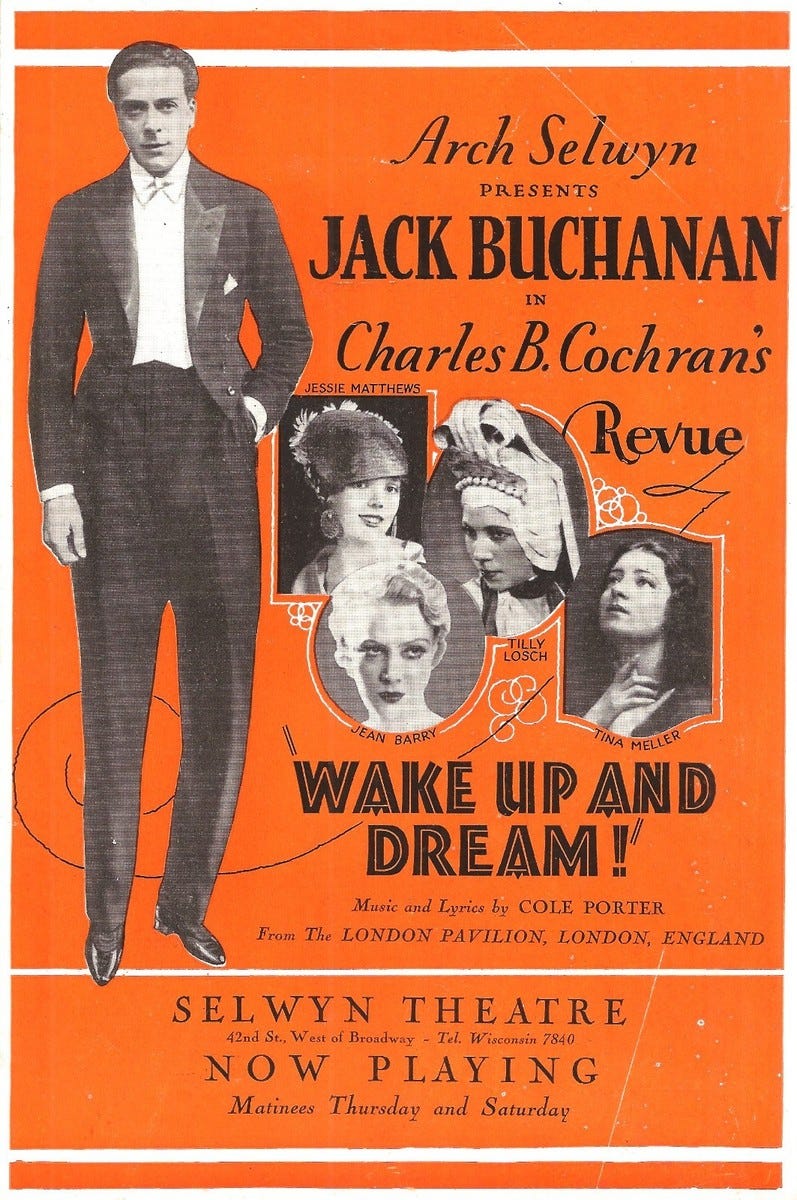
Porter wrote “The Banjo” for his 1929 London revue, Wake Up and Dream!, which opened at the Pavilion Theatre on March 27. Then, on December 30 at the Selwyn in New York, Wake Up and Dream! became virtually the last show to open on Broadway in the 1920s. As far as I can tell, the London production consisted entirely of songs by Porter, including “Looking at You,” “I’m a Gigolo,” and the soon-to-be mega-standard “What Is This Thing Called Love?” However, the New York edition dropped a number of the Porter songs and added others by various authors both British and American. But “The Banjo” was included in both editions, sung in both by William Stephens. (Dan Weinstein informs us that “The repeated use of syncopation in the rhythm of the melody is reminiscent of ‘I Know That You Know.’”)
And yet, even though the song appeared in this successful revue in two major cities, somehow it only seems to have been recorded once, by Jack Hylton and his Orchestra (for HMV on March 26, 1929), a group that seems to have recorded absolutely every single interesting song composed in the 1920s and ‘30s. It was on the flip side of “Let’s Do It (Let’s Fall in Love),” a song from Porter’s 1928 Broadway show Paris which he re-used in the London production of Wake Up and Dream!. The Hylton track features a prominent banjo ringing away throughout, which already was an archaic sound on a 1929 dance band arrangement, and the vocal trio also seems like a throwback to old-time plantation and minstrel show days.
(Side note: the song is also included in two British dance band medleys of Wake Up and Dream! “Selections,” by Bert Firman on Zonophone and The New Mayfair Dance Orchestra, also on HMV.)
William Stephens, who performed “The Banjo” in both London and New York, had a rather unusual career: there’s one earlier Broadway credit, for a 1903 show listed as an “opera” titled A Princess of Kensington (41 performances). There’s also one other show, a 1930 production at the Vanderbilt Theatre titled The Vanderbilt Revue, with songs by Dorothy Fields and Jimmy McHugh as well as our man Cole. According to the New York Times, he seems to have reprised the Porter song “I’m a Gigolo”:
An inferentially pretty risque gigolo skit and the appearance of the palpitant-voiced William Stephens, a leftover from the superior “Wake Up and Dream!,” in a subsequent song called “Ex-Gigolo” {sic} continue the merriment, which sinks toward the finale of the first act and through the first number of the second part- something in the way of a legend about the jackdaw of Rheims-only to rise again sharply thereafter.
(I’ll let you guys look up “the jackdaw of Rheims.”) Here’s Variety on this same revue:
Unquestioned hits of the evening were the Griffiths Brothers inside a prop horse and William Stephens baritoning “I’m a Gigolo” next ‘to Closing … The Times Square bunch will be dropping in, to catch the act regularly. Stéphens caught a bright lyric and an. ear-tickling. tune: as his share, and must haye known.that he could deliver it, because of the position allotted. Certainly he took full advantagé of the opportunity, and, after the lull, the spot was perfect.
Postscript: Rob “On the Job” Lester reminds me that there’s at least one more Cole Porter song about the South, although it’s not exactly a plantation song or a mammy song. “Mississippi Belle” was commissioned from Porter by Warner Bros. for an unproduced film, and so far as I can find, it has only been performed and recorded by the resourceful and vivacious Miss Daryl Sherman, for an excellent album of Porter songs with a New Orleans flair, titled Mississippi Belle: Cole Porter in the Quarter (2011).
Verse 1
Joe plays the banjo and plays every night
Under a lazy moon
I know what Joe’s gonna play all right
He only knows one tune
It may be a limited repertory
Still every note of it tells a story
Refrain:
When that man Joe makes that banjo
Play that old tune I adore
San Francisco, dear old ‘Frisco,
Calls me ‘cross the prairies once more
Something lingers in his fingers
That reminds me of early days
And I’m back with my Amanda
On that old-fashioned veranda
That’s why I make propaganda
For the banjo that man Joe plays
Verse 2:
Whenever Joe starts that old song of mine
Somehow my memory strays
Back to the Gold Coast in forty-nine
Back to those good old days
A banjo is playing and there’s Miss Mandy
Strumming that tune for her favorite dandy
https://www.sheetmusicsinger.com/the-banjo/
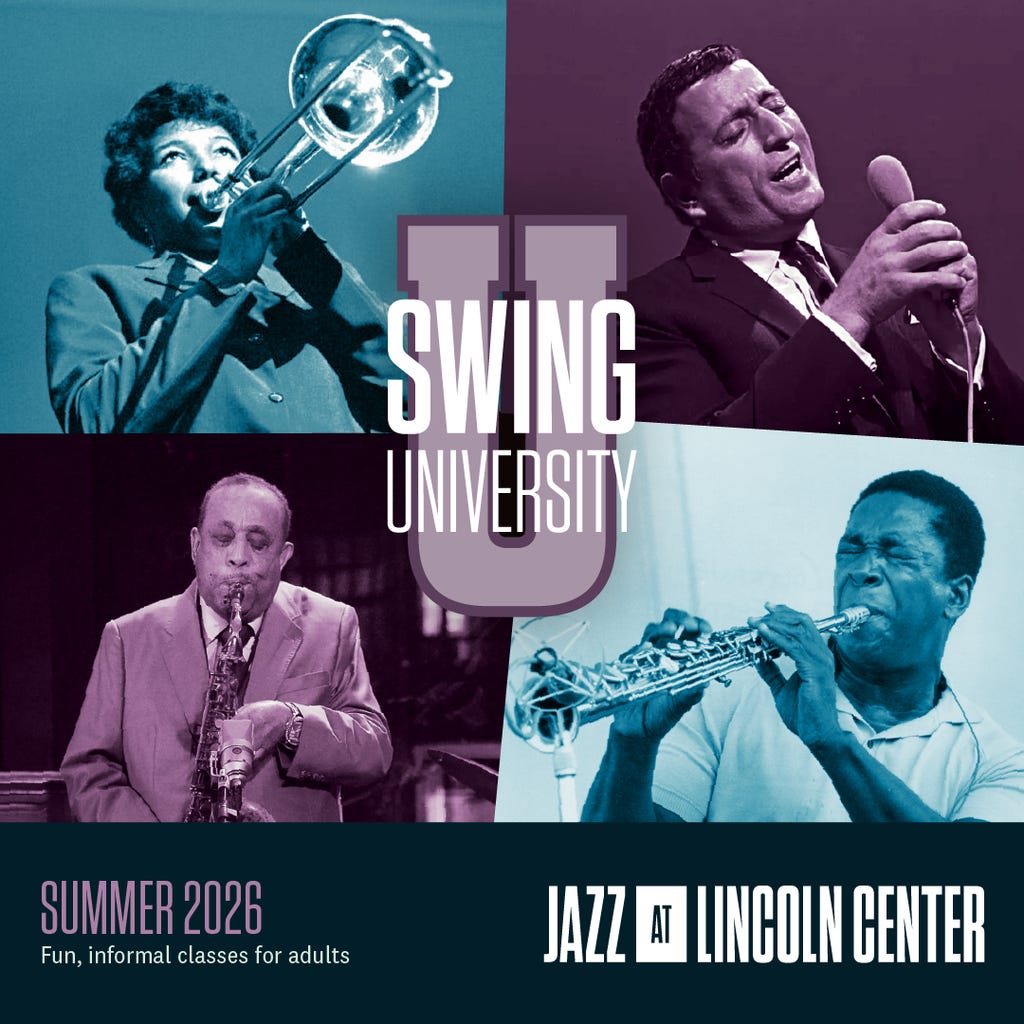
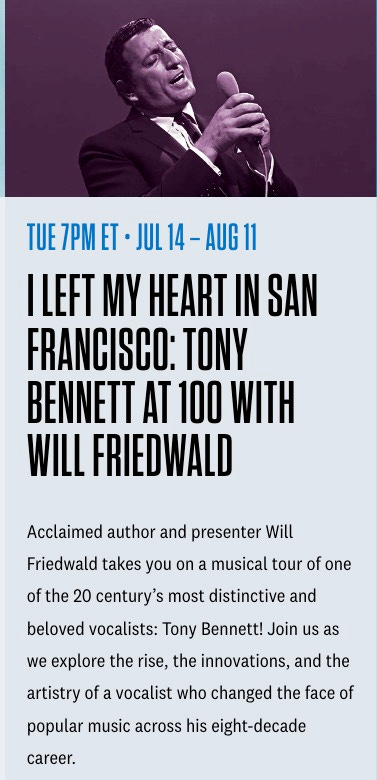
Over the next five Tuesdays, I am doing a comprehensive zoom series on the life and music of our favorite centennial celebrant, the legendary TONY BENNETT! To register (and it’s very reasonable) click Here:
Coming Next: Summer Time is Comedy Time
Jackie (Mason) and Me: In Honor of The Jackie Mason Musical, written by his longtime partner, Ginger Reiter, and starring his daughter, Sheba Mason, in a limited run in New York. At the Actor’s Temple Theater July 25-26. For Tickets and more info, click here.
Very special thanks to Elizabeth Zimmer, Rob Lester, & Dan Fortune for their expert proofing, hey!) Special Thanks again to Daniel Weinstein, Jordan Taylor, & Rob Waldman.)
Slouching Towards Birdland (Will Friedwald’s Substack) is a reader-supported publication. To receive new posts and support my work, consider becoming a free or paid subscriber.
Sing! Sing! Sing! : My tagline is, “Celebrating the great jazz—and jazz-adjacent—singers, as well as the composers, lyricists, arrangers, soloists, and sidemen who help to make them great.”
A production of KSDS heard Saturdays at 10:00 AM Pacific; 1:00 PM Eastern.
To listen to KSDS via the internet (current and recent shows are available for streaming) click here. Here is the running list of recent shows.
The whole series is also listenable on Podbean.com; click here.
Tony Bennett @ 100: “Ultimate Mr. Broadway” (SSS #208 2026-08-01)
Listen: + Playlist:
Louis Armstrong: The Great African-American Songbook
(SSS #207 2026-07-25)
Listen: + Playlist:
Bastille Day! Jacques Brel (SSS #206 2026-07-18)
Listen: + Playlist:
Jazz Goes Broadway! West Side Story
(SSS #205 2026-07-11)
Listen: + Playlist:
Judy Garland sings Harold Arlen (SSS #203 2026-06-27)
Listen: + Playlist:
July 4th Special—Great American Cities in Song (SSS #204 2026-07-04)
Listen: + Playlist:
Miles Davis @ 100: Sketches of Broadway (2026-06-24)
Listen: + Playlist:
200th Episode Special! Friedwald’s Favorites & Wilsci’s Winners
(SSS #200 2026-06-06)
Listen: + Playlist:
Miles Davis @ 100 | “Miles Ahead”
(SSS #202 2026-05-30 )
Listen: + Playlist:
Bobby Darin @ 90 | “By Request”
(SSS #201 2026-05-23)
Listen: + Playlist:
Jazz at Lincoln Center Swing University:
A Special video Session: Sinatra in the Sixties (click to view)
With Seton Hawkins & Will Friedwald (Thursday April 2, 2026)
Bing Crosby Birthday Special—Ultimate Broadway Songbook
(SSS #199 2026-05-16)
Listen: + Playlist:
The Sacred Music of Duke Ellington—Then and Now
(SSS #198 2026-05-09)
Listen: + Playlist:
TONY BENNETT REMEMBERED ON NY1
a video interview with Stephanie Simon and Will Friedwald 2023-07-23
Click Here
Cinco de Mayo:
The Ernesto Lecuona (and Margarita Lecuona) Songbook
(SSS #197 2026-05-02)
Listen: + Playlist:
Ella Fitzgerald Sings the Jimmy Van Heusen, Sammy Cahn, Johnny Burke, & Jule Styne Songbook(s) (SSS #196 2026-04-25)
Listen: + Playlist:
SLOUCHING TOWARDS BIRDLAND is a Substack newsletter by Will Friedwald. The best way to support my work is with a paid subscription, for which I am asking either $5 a month or $50 per year. Thank you for considering. (Thanks as always to Arlen Schumer for special graphics.) Word up, peace out, go forth and sin no more! (And always remember: “A man is born, but he’s no good no how, without a song.”)
Note to friends: a lot of you respond to my Substack posts here directly to me via email. It’s actually a lot more beneficial to me if you go to the Substack web page and put your responses down as a “comment.” This helps me “drive traffic” and all that other social media stuff. If you look a tiny bit down from this text, you will see three buttons, one of which is “comment.” Just hit that one, hey. Thanks!
Slouching Towards Birdland (Will Friedwald’s Substack) is a reader-supported publication. To receive new posts and support my work, consider becoming a free or paid subscriber.
No posts
Comments
Nothing yet. Say the first thing.
Sign in to join the conversation.