
On the first full day of summer, my family and I packed bottled water and herbal bug spray and drove an hour east of our home, making turns onto progressively smaller roads until we reached the steamrolled-flat land of the Mississippi floodplain. On one side of us, the steel towers of a power line marched away like Don Quixote’s giants behind a cornfield listless in the summer swelter. But on the other side was our destination—the mounds.
In an unrolling expanse of growing-green meadow fringed by trees, the mounds stood up—and out. Like stepping stones for giants, they rose square and sturdy to forty feet, the last surviving traces of a Native American people who came to this land long before the cornfields and power lines and saw something different—something sacred.
With the sun burning low in the sky, we set off on a tour through the mounds, following our guide—a young woman with straight black hair and a can of bug spray in the pocket of her uniform. Our gaggle of visitors shuffled after her with the awkwardness of trespassers through the sacred space. After a time, I found myself concentrating less on the words being said and more on the place I was walking through, the people whose footsteps had crossed this plain a thousand years before mine.
But those footsteps, in fact, appear to have been left lightly upon the trails of time. The people of this place were apparently like the grass that grew shaggy on the mounds—springing up vibrant for a season, then fading invisibly back into the dust from which they came. They lived on the land, our tour guide related, for three hundred years. But their reasons for coming, their way of life, and even their tribal name have all been buried beneath the sweep of time. All that remain are a few artifacts—broken pottery husks, tools shaped from bone and stone, a shallow burial area.
And of course, the mounds.
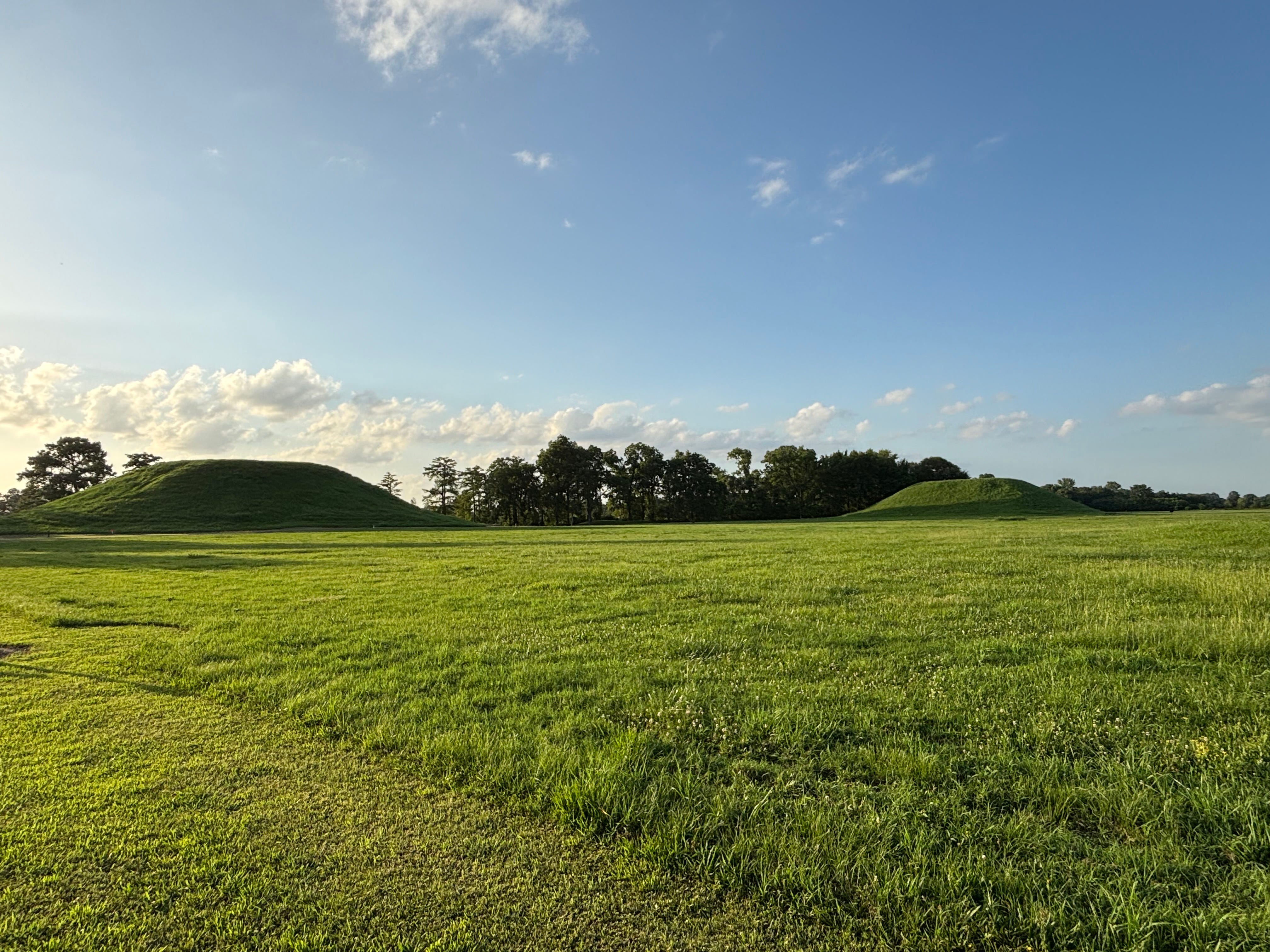
A few were gently conical. Two were trapezoidal, with steeply slanted sides and a squared-off top. Some were no longer mounds at all—having been plowed over by practical-minded pioneer farmers, only their outlines remain marked on the ground. But all held a certain austere secrecy, as if they watched us with tolerance, but not welcome. A thousand years ago, the land was sacred. They still remembered that.
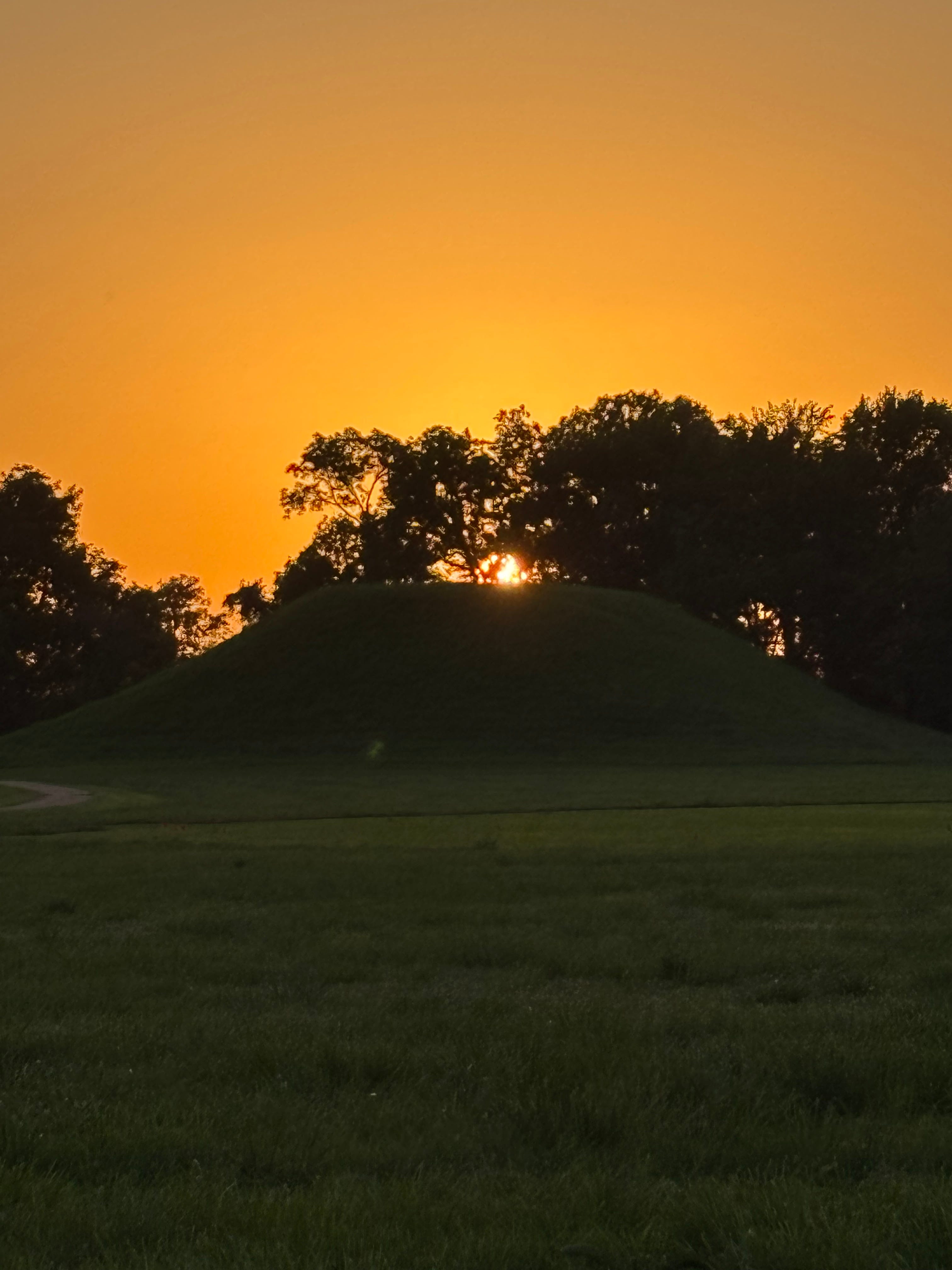
And the mounds remembered something else—their tryst with time. Having been built in a pattern of mathematical precision, the mounds are arranged in the beautiful dance of a solar calendar. Sunsets on both the solstices and equinoxes line up with different mounds, meaning that four times a year, this place has a date with the sun. And it was this we had come to witness.
As the sun hovered just above the trees, we quietly slipped away from the chattering group and waited at the edge of the meadow. The minutes ticked by as barn swallows zipped in the air above me and mosquitoes sang a siren song near my face. And then, at the very moment of sunset, the great burning disk of sun slipped neatly behind the center of the mound like a gold coin—another summer’s deposit into the treasury of the years. In the sudden stillness that followed, I looked at the mounds, their patient shadows puddling around them beneath the clouds that tinged with the faint purple of evening. And I thought about time, and the way we live in it.
We’re shortsighted creatures, after all, especially these days. Our measure of time’s reality is comprehended totally within the limits of our own lives—or maybe, if we have an especially keen gaze, the lives of our children. Yet in the past, I believe, people were more able—or maybe just more willing—to accept their own brevity as compared to the great tapestry of time, to allow their care to reach back to their forefathers and extend to the generations following.
After all, the unknown people who built these mounds spent three centuries on the project. I imagine the labor, the backbreaking drudgery of it—digging dirt from an offsite area with an antler trowel, slinging it in a rough basket over the shoulders, marching across the plain, and dumping the insignificance of the contents on the discouragingly slow progress of the mound site. Then doing it all over again—a grand labor begun, possibly, by forgotten grandparents, and only to be completed by equally unknown grandchildren. I look at our microwave society, our culture clamoring for efficiency and productivity and instantaneity, and I can’t imagine a people who cultivated such timelessness, who taught themselves to view their efforts with the patient persistence of eternity itself.
Yet whether we realize it or not, we today still find ourselves in the middle of a vast labor that began with the first breath in Eden and won’t end until the scroll of our sky is rolled. We live downstream of labors we did not begin, inheriting the choices of a staggeringly long chain of ancestors. And we, in turn, will float our own days down the river of time to our children and a thousand generations after them. We are all, in some way, dumping baskets of dirt on a vast building project—one whose beginning is murky in the past, and one whose ending remains to be achieved. And this leads us to wonder: what are we building?
I can’t answer that question for you. I’m not even sure I know the answer for myself. But as I stood in the shadow of the mounds, my own modern metrics for success and achievement looked like the cheap plastic toys they are. What I hope to build for my children, I realize, must be much larger than the small, selfish goals of our culture: financial affluence or circumstantial happiness or a sleek car in the driveway.
Instead, I hope to build something greater. Something deeper. I hope to build with patience and persistence—accepting that my place is not to start, or to finish, but to be faithful with my moment in the story God is telling. I want to build in a way that removes myself from the center, that brings my work to bow before the sky, the stars, the light that is higher and holier than me. I want to see with the eyes of eternity, not efficiency, so that I sow time like the seeds of summer and measure my harvest with God’s bushel. And most of all, I want that harvest to be slow-growing and long-lasting, so that a thousand years from now the love and hope and peace and joy I built with the dirt of my ordinary days are still standing, still sanctified, still testifying to the turning of time and still reminding my descendants to look to the sky.
So today, I’m praying that I think less about my to-do list, my own petty aims and achievements, my myopic concentration on my own brief life. I’m dumping a basket of dirt with this day, and I want it to be rich soil from which much good grass can grow. These people of the mounds, whoever they might have been, are long removed from me in time and thought. Yet I hope that I build the way I learned from their silent witness—that my legacy is as patient as the seasons, as enduring as the sun, as full of grace as the link between Heaven and Earth.
No posts
Comments
Nothing yet. Say the first thing.
Sign in to join the conversation.