
For several days, while Asian stock markets process the events in the Levant, the public discourse remains centered around its usual taxonomy: Israel attacked Beirut, Iran retaliated with missiles, and Trump intervened to contain Netanyahu. This sequence—suspicious given the amour fou between the allies—serves to track the day-to-day developments, but it is ultimately useless because it merely describes the movements without touching the underlying mechanics that produce them.
While the framework of the Israel-US conflict against Iran remains useful for tactical escalation, it takes a backseat when questioning what is truly at stake. Iran closed the Strait of Hormuz on March 27, leaving thousands of sailors and hundreds of vessels stranded in the Persian Gulf. Yemen, meanwhile, has not closed Bab al-Mandab: it threatens it, keeping it as a secondary leverage point available if Washington does not yield on Hormuz. This distinction matters more than it appears. A closed strait is a fait accompli; a threatened strait is an option that retains its value precisely because it has not been exercised. The Houthi rebels of Ansar Allah know this, which is why they keep it in reserve rather than expending it.
If the object at stake were territory or nuclear deterrence, military logic would suffice to read both movements. However, the closure of Hormuz pushed Brent crude oil above one hundred dollars, and the mere threat to Bab al-Mandab, without the need to execute it, was already enough to rattle markets that have spent months calculating the cost of instability before it even occurs. This rules out the possibility that the sequence is solely related to a military stance. Instead, it concerns the cost of access to the financial and geoeconomic system. Iran and its allies are flexing their muscles to force their return to the international circuit and, in doing so, are placing Shanghai at the center of the board instead of London and Wall Street.
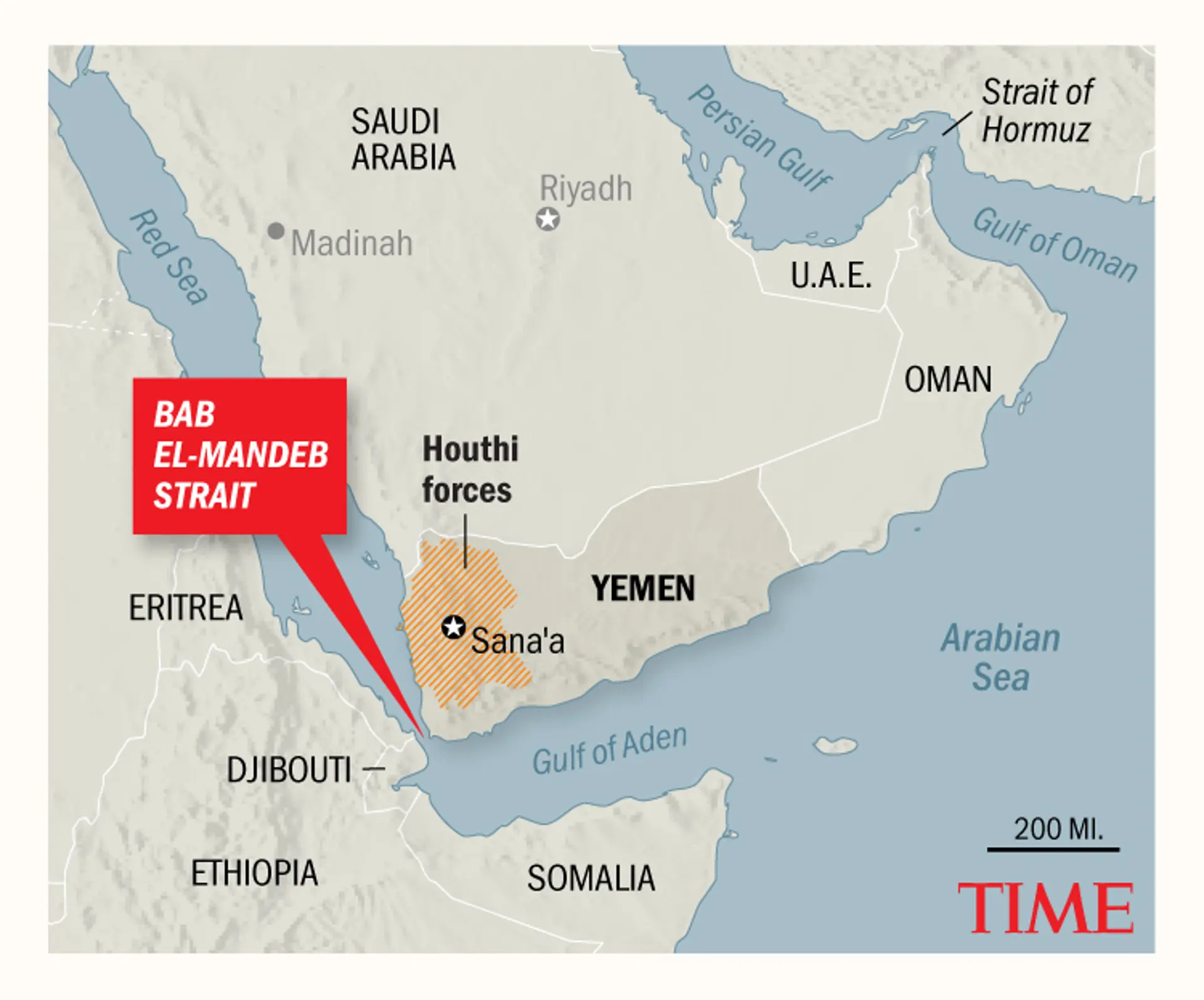
The diversion around the Cape of Good Hope adds between ten and twenty days to each voyage. J.P. Morgan estimates that this equates to a reduction of approximately 9% to 10% in global effective container shipping capacity. Traffic through Bab al-Mandab had already fallen between 40% and 60% since late 2023, prior to the most recent threat, and Asia-Europe freight rates remain 25% to 40% above pre-crisis levels. These figures do not describe a temporary disruption; they describe the moment infrastructure ceases to be reversible. The supply chain has already redesigned itself around the possibility of its absence, meaning that the normalization of the corridor, should it occur, will no longer restore the previous order. There will be different beneficiaries.
Iran understood this before anyone else in the West. Long before the pandemic, its strategy was not to win the inevitable conflict with Israel, but to make losing too expensive for the alleged winner. Each missile does not aim to destroy Tel Aviv, but rather to force Israel to calculate how much the next round is worth before authorizing it. The Israeli response was forceful and well-rehearsed, yet politically costly—especially for a Trump administration that ended up requesting an additional $200 billion for the Pentagon while Netanyahu acted on his own accord. For Israeli analyst Ori Goldberg, Trump’s irritation does not stem from what is happening in Lebanon, but from the fact that Netanyahu behaves as if he has the last word. Israel decides, Washington foots the political and financial bill, and Israel’s northern border is secured through intelligence, while the geoeconomic cost of sustaining the war falls upon an oil empire that is already sinking in domestic support.
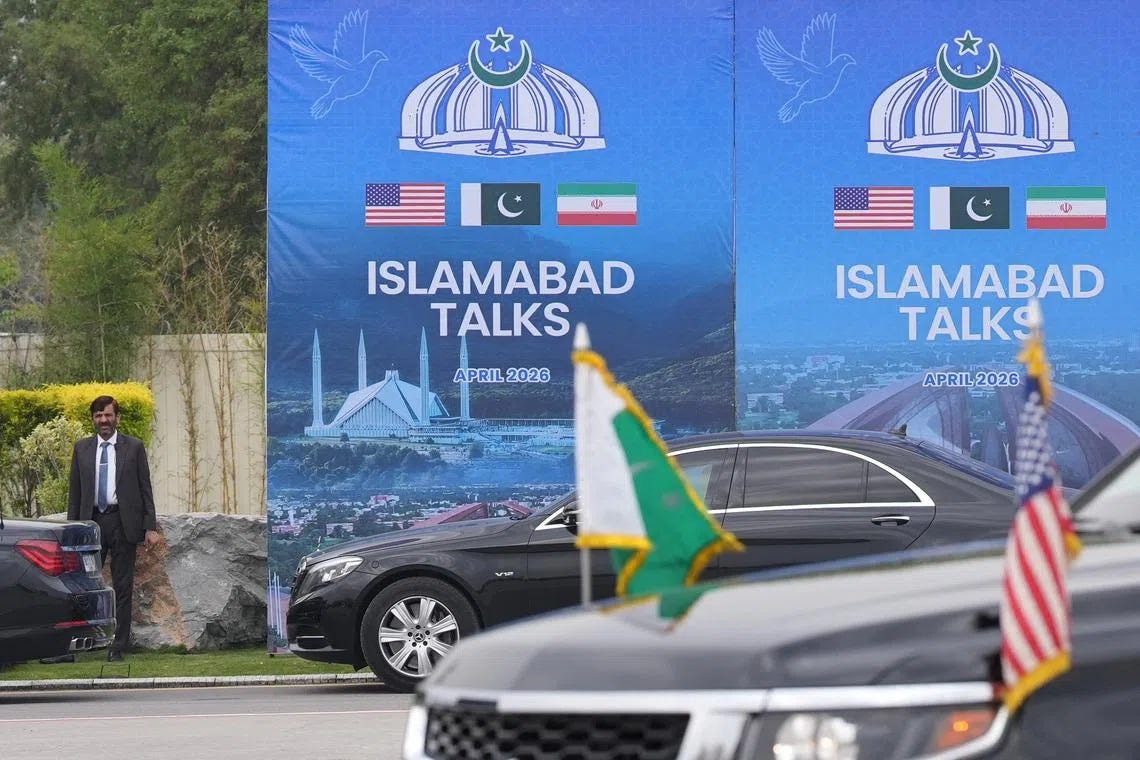
Meanwhile, Pakistan has quietly facilitated what Washington could not negotiate openly, because while the math adds up, the long-term business is in jeopardy. The memorandum of understanding between the United States and Iran is a sacrifice that neither side can sign without losing its domestic audience, though only one of them risks its reputation as a military superpower. The mediator possesses 170 nuclear warheads and has no incentive for the conflict to expand eastward. Israel, on the other hand, shows every indication that it will continue to expand its borders as much as possible, even when Washington no longer has an interest in such a costly enterprise. This combination turned Pakistan into the player most invested in making the agreement work, and simultaneously the most ignored by media outlets that covered the conflict as if the negotiations were strictly bilateral.
Trump called for a ceasefire weeks ago, which was immediately understood as a containment of an Israeli escalation that could spin out of control. What was less understood is that Trump was also seeking to contain markets that had been pricing in the risk for months. The financial phase of the conflict was never a side effect of the military phase: it is a parallel dimension with its own dynamic, and Teheran is the one who loses the least in it. The Bank for International Settlements estimates that global financial derivatives are equivalent to eight times global GDP—an invisible ledger whose stability depends on the Gulf’s energy corridors not faltering under uncertainty. Proof of this dependence came when the mere announcement of the agreement caused Asian stock markets to rally by more than 5% and crashed Brent crude by 4.67%, down to 83 dollars. The markets did not wait for the memorandum to be signed.
If the conflict were simply Israel against Iran, the scenario would be bilateral and the decisive variable would be the capacity for mutual destruction. However, the double closure of Bab al-Mandab and the already consummated closure of Hormuz turns the conflict asymmetric in a highly specific way. The actors who depend most on the corridor—namely European shipping companies, Lloyd's insurers, and supply chains that are already circumnavigating Africa because the Red Sea ceased to be safe eighteen months ago—have no vote in the negotiations. They paid the costs of a dispute in which they are not a party, meaning that the entity truly affected is the very mechanism that makes the US wealthy.

If Yemen does not close the route, it is because the global logistical order can sustain itself while the political order deteriorates. For decades, the West managed this tension through naval superiority and power projection capabilities. Neither has disappeared, but both are insufficient to guarantee the global financial and economic framework. The cost of keeping Bab al-Mandab open under sustained pressure exceeds what any coalition is willing to commit indefinitely—even the US.
Netanyahu knows this, which is why he attacks Beirut even after Washington seals the deal with Tehran. It is the only leverage he has left to unilaterally dictate the terms of a peace he does not control. The problem is that this logic produces the exact opposite of what it promises. Every bombing that defies the memorandum does not weaken Iran before the world; it reinforces the notion that Washington is the one paying the bill. And every day that Israel maintains troops in southern Lebanon against the letter of the agreement makes it more urgent—for actors who are neither Israel nor Iran—that the next negotiation comes with compliance guarantees, not just a signature.
The era of Western logistics ends in an accumulation of weeks like this one, where the cost of keeping it open has surpassed the cost of redesigning it. This Friday, in Islamabad, the United States and Iran will formally sign what the markets had already discounted since Monday. Washington is negotiating against the clock to preserve its dominance over the oil-rich Middle East, while Netanyahu, in the meantime, continues to act as though that signature binds him to nothing.
[References in the comments]
No posts
Comments
Nothing yet. Say the first thing.
Sign in to join the conversation.