
Bolivia demonstrated that punishment mandates are useless for governing and that imported political technology collapses the moment it touches land tenure. Argentina, Peru, and Ecuador confirm that what happened there was not an Andean exception but the first visible case of an operational pattern. The new Latin American right has no charm to lose because it never had any. What varies from country to country is how long it takes for the adjustment to become unsustainable. The coalitions that reached power through penalty transfers against progressivism inherited countdowns instead of agendas and now face the friction of trying to govern with tools designed exclusively to destroy.
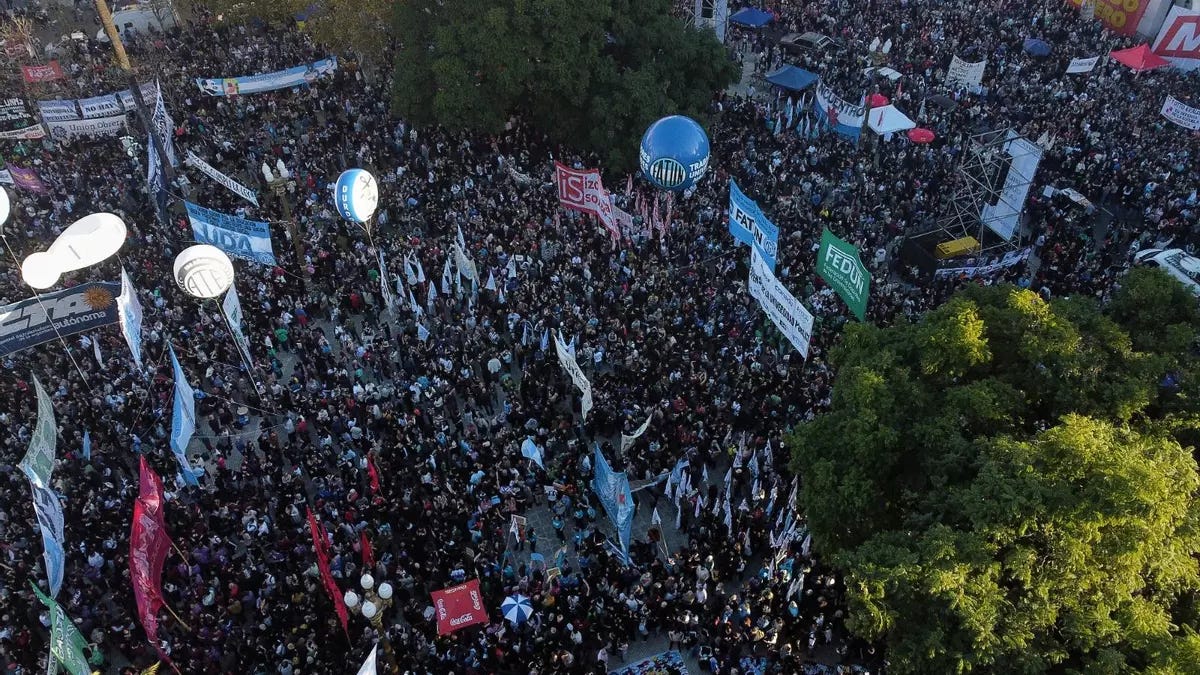
Argentina illustrates the technocratic absorption variant, where the project proves separable from the person embodying it. Buenos Aires’ ruling establishment is quietly engineering a better-mannered neoliberalism that preserves financial openness without Javier Milei’s disruptive performance. That operation confirms that the spectacle is removable but the normalization is not. While the cabinet fractures between factions whose cohesion depended on electoral momentum, the government surrenders maritime sovereignty to the US Southern Command and declares Argentine waters a global common good. The geopolitical handover advances independently of domestic erosion and appears to respond to strategic commitments made before taking office, running deeper than the electoral moment that brought Milei to the presidency. The sectors that have marched for public universities and reproductive health are resisting the immediate material consequences of the arrangement rather than contesting its deeper layer. The system absorbs protest through technocratic replacements and institutional delay while long-range strategic decisions advance with little public attention.
Peru represents the case of persistent structural demand that no recent government has managed to process. Roberto Sánchez reached the presidential runoff because he expresses the Andean and rural world historically excluded from Lima, the same world that had voted for Pedro Castillo in 2021. That electorate held its position and waited for a channel of representation to reappear after the institutional closure of the Castillo period. The harder sectors of the Peruvian right pushed fraud narratives and widened the margins of public tolerance toward positions historically associated with Fujimorism, but the persistence of the Andean political subject proves that exclusion outlasts every containment operation. Winning would be only the beginning of a larger problem, because reaching the Government Palace is radically different from carrying out transformations in a country where the ruling class retains every lever of real power.
Ecuador functions as the laboratory of stabilized authoritarianism, where repression produces adaptive fatigue rather than insurrection. Daniel Noboa lost his referendum four to zero and faces mass mobilizations against labor precarity and hospital shortages, yet the system absorbed the rejection without collapsing. The difference with Bolivia is that state violence produces accumulated exhaustion in Ecuador rather than open rebellion. Community organizations document systematic aggressions against marginalized populations under military curfews, and civil liberties are restricted through emergency decrees justified in the name of security, in a context that politically benefits conservative and business sectors. Resistance exists in both streets and assemblies but still lacks the critical mass to break the institutional tolerance threshold. The clock runs slower because the cost of adaptation remains lower than the cost of rupture.

Latin America operates today as a map of political capital running out at speeds dictated by the friction between negative mandates and the positive reality of administering scarce resources. The three signals of the Bolivian collapse function as an exportable metric for measuring that friction elsewhere: the official press substitutes language to conceal state responsibility for deaths, the sectors that originally voted for the candidate converge in marches that transcend sectoral grievances, and the president disappears from public view while the criminalized opposition gives interviews. In Bolivia those signals appeared simultaneously within six months. In Argentina they manifest sequentially, mediated by technocratic replacements. In Peru they emerge as underground electoral pressure that neither disputes over electoral legitimacy nor successive institutional containment operations have managed to neutralize. In Ecuador they register as chronic discontent still searching for its unifying catalyst.
The old refuses to die and the new cannot yet be born in a liminal time where no government lasts long enough to consolidate what it came to destroy. In some cases we already know the outcome because the countdown reached zero. In others the clock keeps running and no one has designed the mechanism to stop it or correctly measured how far it still has to go.
[References in the comments]
No posts
Comments
Nothing yet. Say the first thing.
Sign in to join the conversation.