
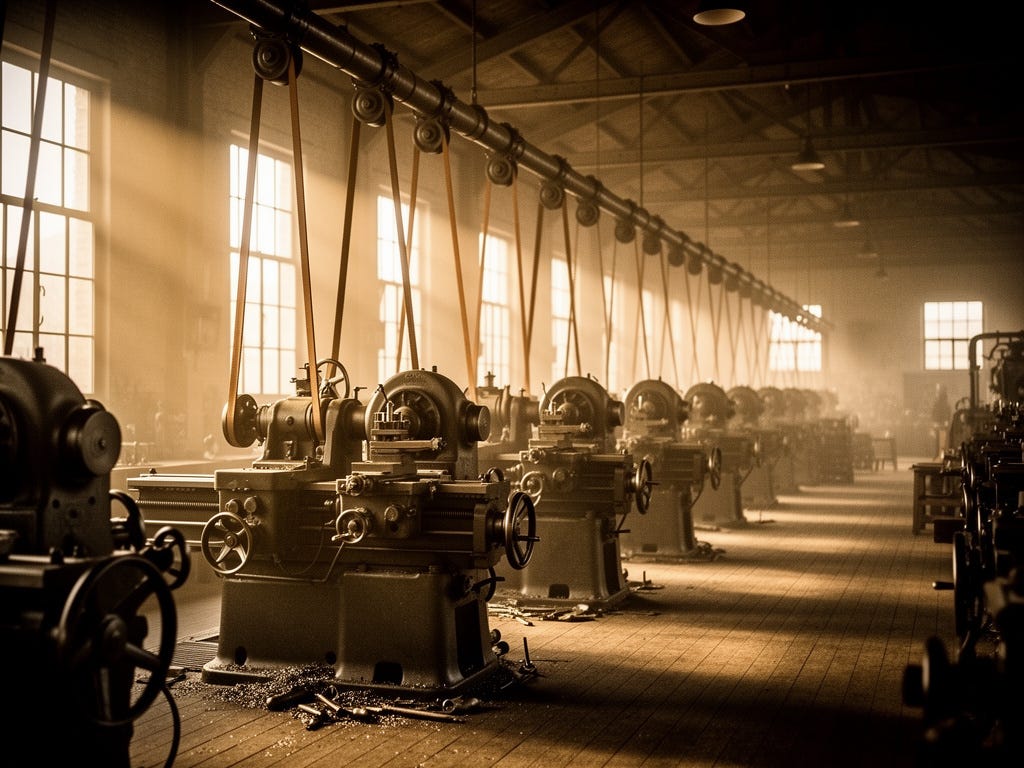
Walk into an American machine shop in 1900 and look up. Running the length of the ceiling is a steel shaft, spinning all day, driven by one massive steam engine in the basement. Every machine on the floor hangs off that shaft by a leather belt. The lathe, the drill press, the grinder. None of them sit where the work flows best. They sit where they can reach the belt. The whole building is arranged around the geography of a single power source, and nobody on the floor questions it, because nobody can remember building a factory any other way.
That driveshaft is the most important object in the room. It’s also invisible, in the way that load-bearing assumptions always are. You stop seeing the thing everything is built around.
Then electricity arrives, and here’s the part that should worry every founder rolling out AI this quarter.
Factories started electrifying in the 1890s. The productivity payoff didn’t show up until around 1920. Thirty years of a better technology sitting inside companies and barely moving the numbers.
The economist Paul David wrote the definitive account of this in 1990, in a paper called “The Dynamo and the Computer.” He was trying to explain why the computers of the 1980s weren’t showing up in productivity statistics, and he reached back to electricity to do it. Robert Solow had just made the joke that you could see the computer age everywhere except in the productivity data. David’s answer was that this is simply what general-purpose technologies do. They arrive, and then nothing happens for a long time, and the nothing is the most important part.
Because the technology was never the holdup. Electric motors worked. Power was cheaper and cleaner than steam. The holdup was that for thirty years, owners installed electric motors into factories still designed around the driveshaft.
The obvious first move, when electricity showed up, was to pull out the steam engine and bolt in one big electric motor to spin the same shaft. Cleaner. Cheaper. Safer. And almost no gain, because the factory was still laid out around a shaft that no longer needed to exist. Warren Devine, whose 1983 history “From Shafts to Wires” is where a lot of this detail comes from, tracked the slow part: electric motors ran less than 5% of America’s factory horsepower in 1899. Twenty years later it was more than half. The motors were available the entire time. The redesign took a generation.
The breakthrough wasn’t a better motor. It was a different question. Around 1913, factories like Ford’s Highland Park stopped asking “how do we power the old layout more efficiently?” and started asking “if every machine has its own motor, why are we arranging anything around a shaft at all?” Put a small motor on each machine and you can lay the floor out around the work itself. The sequence. The flow. The thing moving through. That’s the assembly line. That’s when the numbers finally moved, and through the 1920s American manufacturing productivity grew at a clip it hadn’t touched before.
The motor was 1890. The insight was 1913. Most companies spent the gap optimizing a driveshaft.
Here’s the uncomfortable translation. Your org chart is a driveshaft.
Every process in your company was built around a constraint that felt permanent: that a human being was the only thing that could read the document, make the judgment, write the first draft, route the request to the right desk. Your headcount, your approval chains, your handoffs, your org chart itself, all of it is the leather belt running from the work to the one power source that could actually do the thinking. A person.
AI removes that constraint the way the small motor removed the shaft. Not entirely, not everywhere, but in enough places that the old geometry no longer makes sense. And what is almost everyone doing about it? Bolting a motor onto the driveshaft. Buying licenses, dropping agents into the existing process, watching the recruiting pipeline go from weeks to hours or support handle more tickets per head. It feels like progress. It shows up as cost savings. So leaders call it the win and stop.
That’s the electric motor spinning the old shaft. You’ve made the existing layout cheaper to run. You have not redesigned the factory.
I want to be precise here, because I wrote a piece a few weeks back arguing that low AI adoption is a leadership failure. This is a different claim. This isn’t about whether your team uses the tools. They probably do. It’s about whether your company is still shaped like the problem AI just dissolved. You can have 100% adoption and a driveshaft running straight down the middle of the building.
I met a founder this spring named Christian Bitzas. Engineering background, the kind of résumé that includes NASA and Raytheon. He built a supply chain automation platform in about two months, mostly with AI, and walked into our conversation with eight companies already in his pilot pipeline.
Sit with the two months. Not because he’s a genius with a keyboard, though he’s sharp. Because he had no driveshaft to protect. No legacy org, no team whose roles assumed a human in every loop, no decade-old process that “mostly works.” He got to ask the Highland Park question by default, because there was no old factory to renovate. He laid the floor out around the work and put a motor on every machine, because that was the only floor he’d ever drawn.
That’s the real advantage the incumbents keep misreading. They think the threat from companies like Christian’s is speed, or cheapness, or that they’re AI-native in some branding sense. The actual threat is that they were never arranged around the old constraint. They’re not faster at running your process. They’re running a different process, the one you’d design today if you were honest enough to start over.
So why doesn’t everyone just redraw the floor? This is the part I lived, and it has nothing to do with the technology.
At Concur, we spent years with a bundled platform — expense, HR, procurement — that worked, sort of. Revenue was fine. And it was quietly strangling us, because we were spread across three buyers and not the best in the world at any of the three. What finally broke us out wasn’t building more. It was layoffs, sunsetting the products that diluted us, and rebuilding around the one thing we could own completely. SAP bought us for $8.3 billion. Not because we’d built the most, but because we’d had the nerve to tear down a structure that was still standing.
That nerve is the actual bottleneck of this whole era, and almost nobody prices it in. Redesigning around AI means deleting roles people are good at and proud of. It means admitting the org chart you spent a decade building is now the shaft. And the redesign doesn’t pay off on day one. Performance dips first, because the new process has bugs and the old muscle memory is now wrong. There’s a trough before the climb, and the trough is real and immediate while the payoff is delayed and, while you’re standing in it, entirely theoretical.
So leaders flinch. They harvest the cost savings, tell themselves they “did AI,” and retreat to fine. Fine is the enemy. Fine is exactly what bolting a motor onto the old layout hands you, and it feels safe enough that most teams never walk into the dip on purpose.
The tech is not your constraint. You are standing in 1900 with a working motor and a steam-era floor plan, and the only question that has ever unlocked the next thirty years is the one Highland Park asked: if I were building this function from scratch this year, knowing what these tools can do, what would I even build? Not “what can I automate in my current process.” That one keeps you optimizing the shaft forever.
The motors have been available the whole time. The companies that win this decade won’t be the ones who bought them first. They’ll be the ones willing to move the machines.
Your factory is already wired. The only question left is whether you’ll redraw the floor, or keep polishing a driveshaft that doesn’t need to be there.
No posts
Comments
Nothing yet. Say the first thing.
Sign in to join the conversation.