
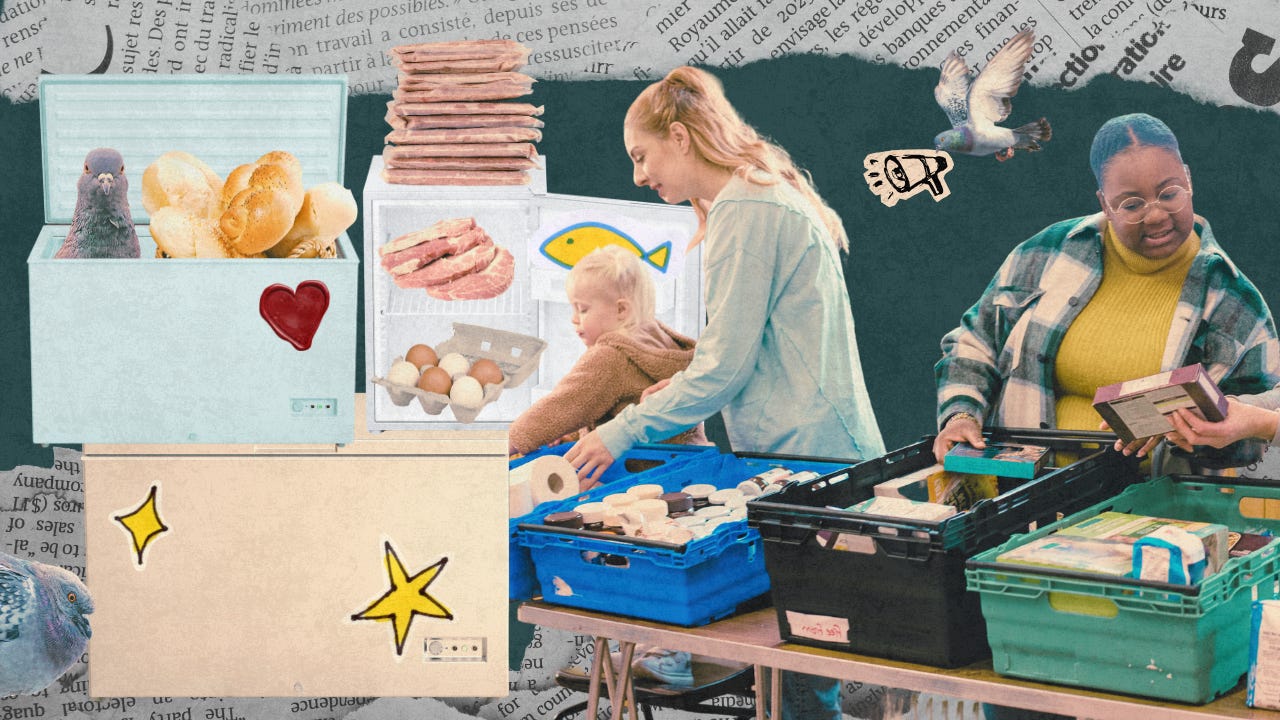
My church needs a new freezer.
A big one.
And it’s not that we don’t already have freezers.
We have many freezers.
It’s not even that one of our freezers has broken.
We need a new freezer because we need to store more food.
We need to store more food because there are more people coming to us who need food.
And not just a few more.
Nourish East End is a food justice ministry of East End United. In addition to community meals and opportunities for social connection, our core program is a weekly market-style food bank. We are a Daily Bread Food Bank member agency. Every week a whole bunch of people walk through our doors because they need groceries and we have groceries.
Our numbers just keep growing.
In July 2025, we had 2866 visits from neighbours looking for food assistance.
This July, we had 3454.
In case you’re wondering exactly what those numbers math out to, let me save you reaching for your calculator. It is a 17% increase.
Which means 17% more food.
And, apparently, another freezer.
I can honestly say that when I was in seminary, I never suspected I’d be thinking about freezers so much.
But also…
This is exactly what we are supposed to be doing.
Our neighbour is hungry.
So we give them food.
It ain’t complicated.
We don’t need a committee to determine whether feeding hungry people is a good idea.
(Although, we do have a committee to decide how best to do it. We’re still a church after all.)
The theological framework has been ingrained in us for years.
(Even among our volunteers for whom church isn’t their thing.)
Staff source food. Our volunteers pick up donations. Volunteers haul boxes and sort cans and stock shelves and clean refrigerators. Volunteers make spreadsheets. Together folks find ways to turn one case of something into many smaller boxes of something that can stretch further.
And when the freezers are full, somebody who is way smarter about logistics than I am figures out where to put overflow.
This is good work.
It is holy work.
And yet…

I want to tell you an old, old story that begins in an era of mullets and leg warmers.
Canadian food banks emerged in the early 1980s as an urgent response to recession and cuts to social programs. They were supposed to be temporary. A stopgap. Just a Band-Aid to get neighbours through a crisis.
And then, somehow, over forty years happened (my entire lifetime) and now food banks are part of the very infrastructure of society.
Faith groups and community organizations run them. Governments make referrals. Corporations donate. Entire supply chains have developed around these food banks.
And churches like mine buy freezers because there are more hungry people now than when Hall & Oates were cool.
More on Broadview:
Food banks are reinventing themselves as new food security hubs
The true cost of food: High grocery prices are not the root issue
University of British Columbia professor Graham Riches has been writing about food banks since the beginning of this whole social experiment. His 2018 book Food Bank Nations asks why, in some of the wealthiest and most food-secure countries in the world, have we decided that feeding people through donated food is an acceptable permanent solution to poverty?
His argument isn’t that we should stop feeding people. What he suggests is that food banks can become too successful at compensating for political failure.
We take a problem that should be political and turn it into an issue of logistics.
People don’t have enough money for food?
Well, how much food can we find?
People still don’t have enough money for food?
I suppose we need even more food.
17% more people can’t afford enough food?
We need another freezer.
Riches argues that this is one of the great deceits of charitable food systems. Hunger starts to look like a problem of procuring cans instead of a problem of wages, social assistance, housing, poverty, and public policy.
Nourish East End can do something about a freezer.
Spend some of our reserves. Ask for donations.
I can make a Facebook post in one of the 20 community groups I belong to.
Or, maybe we can organize a freezer fundraiser. A freezeraiser.
And when that freezer arrives, getting it down the stairs will require prayers and someone yelling “PIVOT!”
But when we ask why a person working full-time can’t afford groceries and rent at the same time, things get more complicated.
Political movement is harder and slower than acquiring a freezer.
I often wonder whether our success at feeding people only makes it easier for those who could truly fix things to ignore the fact that people are hungry. If church takes care of the food, perhaps the government doesn’t need to feel quite as much pressure to ensure people can afford to eat. If our incredible volunteers keep showing up week after week, maybe the political system doesn’t have to.
That’s a sad thing to ponder while sorting eggs on a Monday morning.
A mother signing up to receive a few days worth groceries is not a “systemic issue.” They are a person.
And you cannot look at a person and say, “I’m so sorry, but we’re trying not to reinforce neoliberal austerity.”
You give them food.
You can’t eat an advocacy campaign.

Those living in poverty shouldn’t need to wait for municipal, provincial, and federal leaders to get their #$@! together. But we also can’t build a just society one reusable grocery bag at a time.
I’m not suggesting this is what Nourish does. More than half our volunteers are also clients — navigating the same systemic realities that created the need for food banks in the first place. Change is craved.
But there are only so many resources. There is only so much time. And so, immediate needs take priority.1
Maybe that’s why I was awake at 3:00am thinking about freezers.
There is something kind of absurd about the whole thing.
Our response to increasing poverty is we need a bigger freezer.
And I mean that with enormous affection for the people who will successfully acquire one.
But also…
Sigh.
Come on.
Surely we — as a city, a province, a country — can do better than this.
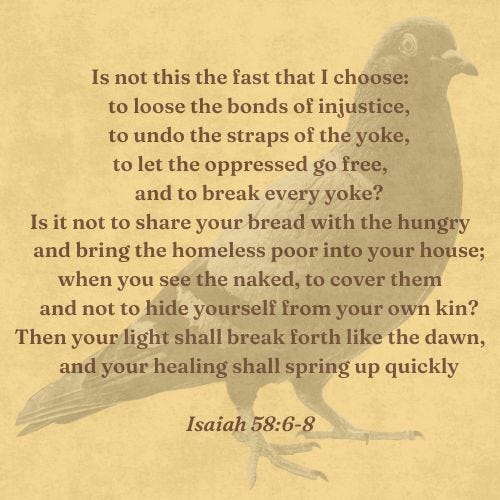
The prophets understood the absurdity of systemic poverty and called it out.
Isaiah (the Trito) doesn’t tell us to pick between charity and justice.
Feed the hungry. House the poor. If somebody has no clothing, for goodness sake give them some.
But even before that, God-via-Isaiah demands loosening the bonds of injustice.
And so I try to remind my 3:00am brain that feeding people is only a problem if we start believing that it is enough. Or, worse, it becomes performative.
I also need the reminder that the creation of a just society is for my own healing too. My wholeness is tied to my neighbour’s. It is not only altruistic if my spiritual wellness is on the line too.
Churches need people who will stock the shelves. We need people who will show up at City Hall. We need folks to become invested in one another’s flourishing. And we need to be praying all the while, returning to the things that sustain us spiritually so we can keep going. That’s the part that makes church different than social service organizations. So,
We will find another freezer.
A big one.
And we will fill it.
Our volunteers will keep showing up. Our staff will keep doing extraordinary things with barely enough. People will continue to donate money and cans because they care about their neighbours.
And I am profoundly grateful for all the people who make Nourish happen.
But I know as we figure out where that freezer will come from and where it can live (another logistical problem I am useless at solving), it will be hard not to feel confronted with what it represents.
Not just the magnificent capacity of people to care for one another.
But the infuriating reality that we have built an entire charitable infrastructure around the fact that far too many people cannot afford to eat.
The most faithful thing a food bank (and a church) can do is feed the person in front of us today while working like hell for a world where they no longer need us for food, but might still come for community, belonging, and spiritual encounter. 🐦
Wilderness Times is co-created with Broadview, an award-winning Canadian publication known for thoughtful journalism that attends to spirituality, justice and the questions that tug at our collective conscience.
Broadview is a registered charity and has made this Substack freely available because we believe that thoughtful, justice-seeking journalism should be accessible to everyone. Creating this space — and keeping it free — takes time, skill and resources. If this space nourishes you, please make a tax-deductible donation.
Your support empowers Broadview to tell more courageous stories and helps build a more just and compassionate world.

If this story resonated with you, you might appreciate more like it — and more often.
Broadview’s Best of the Week newsletter delivers a curated selection of award-winning journalism on current events shaped by faith, straight to your inbox every Friday.

At East End United Regional Ministry, we’ve adopted a model where advocacy happens as a community of faith. The programs offer services and community. The community of faith asks the government to do better.
No posts
Comments
Nothing yet. Say the first thing.
Sign in to join the conversation.