
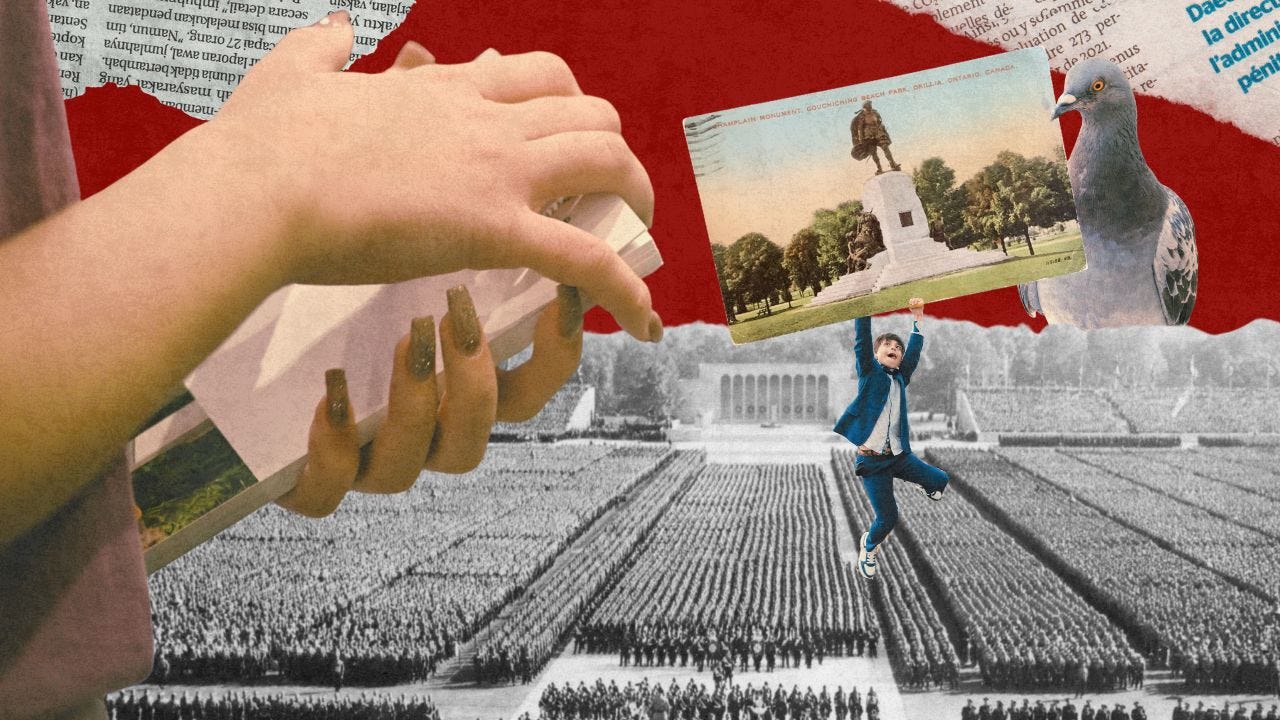
Oh boy. There’s some drama going down in my hometown.
I grew up near Orillia, about 140km north of Toronto. My parents worked in Orillia. I went to school in Orillia. Everything fun happened in Orillia. Unless you actually lived in Orillia. Then it was boring and you wanted to go to Barrie. But if you were a rural kid like me, Orillia is where everything worth doing was done.
When my brothers and I wanted to go swimming, my parents would take us to Couchiching Beach Park. I spent rather a lot of time skinning my knees attempting to climb a series of bronze statues of one time Governor of New France, Samuel de Champlain.
It never once occurred to me, as a kid, that there was anything strange about a fur trader and a missionary hanging out with an explorer while four Wendat men crouched at their feet.
I was too busy climbing.
I notice all that now. I’m embarrassed I didn’t notice it then.
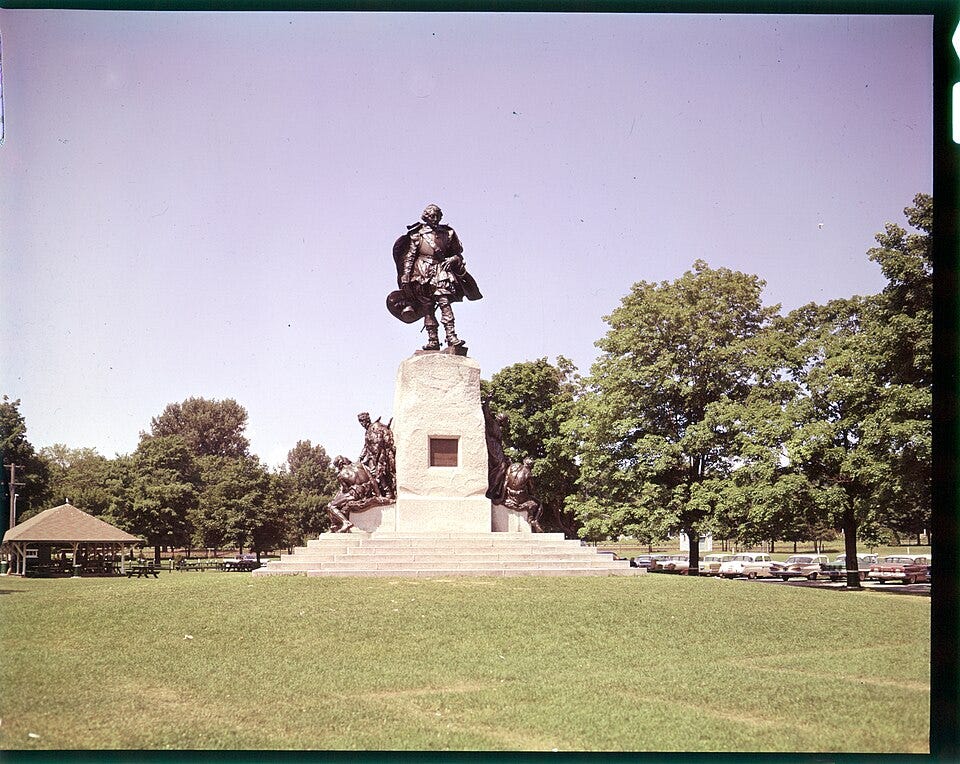
This monument has become something of a political flashpoint in town. Parks Canada removed the monument’s bronze figures in 2017 for conservation work, beginning a long process of consultation with the Chippewas of Rama First Nation about whether — and in what form — they might return.
And I could write a whole article just about that.
But this particular piece isn’t really about Champlain or a historical monument, although I promise the context is important.

Recently, the Dominion Society of Canada — a self-described nationalist organization but one the Canadian Anti-Hate Network flags as part of an organized white nationalist movement — has been travelling door to door in Orillia with a petition seeking to bring the statues back. Its founder says their goal is simply to restore Champlain’s monument and protect his legacy.
But the Dominion Society of Canada (DSC) is not a historical society. Its platform calls for scrapping the Multiculturalism Act, and ultimately for “remigration.” You probably don’t need me to decode that word. But just in case, it means deciding that certain Canadian families are not Canadian enough, and then designing a policy that would force them to leave.
The Champlain monument is being used as a wedge issue. But too many residents believe DSC is merely calling for the return of a locally beloved statue without realizing they are being pulled into a much larger movement involving who belongs in Canada.

This weekend, DSC gathered in Couchiching Beach Park before canvassing the town and distributing their leaflets. A crowd of local residents showed up with signs and shouted at the assembled DSC members to leave.
Reflecting on the day’s events, a local journalist wrote on his Facebook page that the protesters had been too polite — that the only language people like DSC understand is a fist, and that if they know they will be hit, they will stop coming. He also suggested that Hitler might not have gained so much power had more people been willing to punch Nazis in the face.
I find this proposed response to the violence of “remigration” — and yes, remigration is violence — both morally troubling and strategically disastrous. Never mind the complete contextual misunderstanding of 1930s Germany. And never mind that starting a brawl hands alt-right organizers exactly the validation they need to cast themselves as the reasonable ones.
But more than that, street violence doesn’t work.
Nazis were, in fact, punched. Communists, social democrats and Nazi paramilitaries fought regularly in the streets of Weimar Germany. That violence did not prevent Hitler’s rise to power. The Nazis created an atmosphere of disorder and fear, then exploited that fear by promising order.
This is not an argument for standing by while someone is being physically harmed. It certainly doesn't mean that every use of force is morally equivalent. But deliberately turning political confrontation into street violence is not effective resistance.

All of this reminds me of American theologian Walter Wink and what he called “Jesus’ Third Way.” Wink argued that domination usually presents only two options: the choice to fight back and the choice to submit. Jesus offers a third way — active, nonviolent resistance that refuses both humiliation and retaliation. It’s the way we witness in the resistance movements championed by Martin Luther King Jr. and Mahatma Gandhi.
Jesus’ journey toward the cross — the Passion story — is an example of truth exposing the lie of redemptive violence. Evil is never overcome with brutality and intimidation. But the myth of redemptive violence has become a pillar of our society and how it functions. It is neither new, nor old. It is the lie that there will ever be a “War to End All Wars”. It is the lie seen in the spectacle of military parades. It’s the lie of thinking that in the wake of a school shooting, the answer is to arm teachers and show them how to shoot first.
It is the desperate belief that when those who seek to cause division and harm descend on a small town, punching the wannabe fascists in the face might be the only worthy option.
More on Broadview:
White Jesus is grounded in colonialism. Black Jesus is rooted in liberation.
Catholic pacifists convicted of breaking into nuclear submarine base
The U.S. bishop who urged Christians to “prepare for martyrdom” explains why
The instinct for fight or flight is a human one, but Jesus (despite his oh-so-messy human-ness) chooses neither. There is nothing passive about the Passion. There is nothing complacent about the path to resurrection. Jesus’ refusal to confront the violence of empire on empire’s terms is an act of holy defiance.
The Third Way resists violence by refusing the choices Power (and those who seek power) have prepared for us. We do not have to crouch obediently at Power’s feet, but we should not become the thing we resist either.
Wink found this Third Way in Jesus’ instructions to turn the other cheek, surrender one’s cloak as well as the coat, and carry the occupying soldier’s burden not only one mile, but two. These were not commands to become more cooperative victims. They disrupted the expected performance of humiliation and forced the powerful to recognize the person they were attempting to reduce.

Fear draws a small, tight circle, but we can surround it with a bigger one. A circle of solidarity. Resisters can make noise and stand between DSC and the stack of pamphlets they came to hand out.
Organize. Boycott. Write actual, paper letters demanding political leaders do more to address the wounds these nationalist movements exploit — unaffordable housing, hunger, isolation, precarious work and the frustration that no one in power is listening.
This work is slow work. None of it is as satisfying as a punch to the nose.
One must keep showing up after the dramatic confrontation is over. Something must be built that is stable enough that frightened and angry people are less easily persuaded that their neighbour is the cause of their suffering.
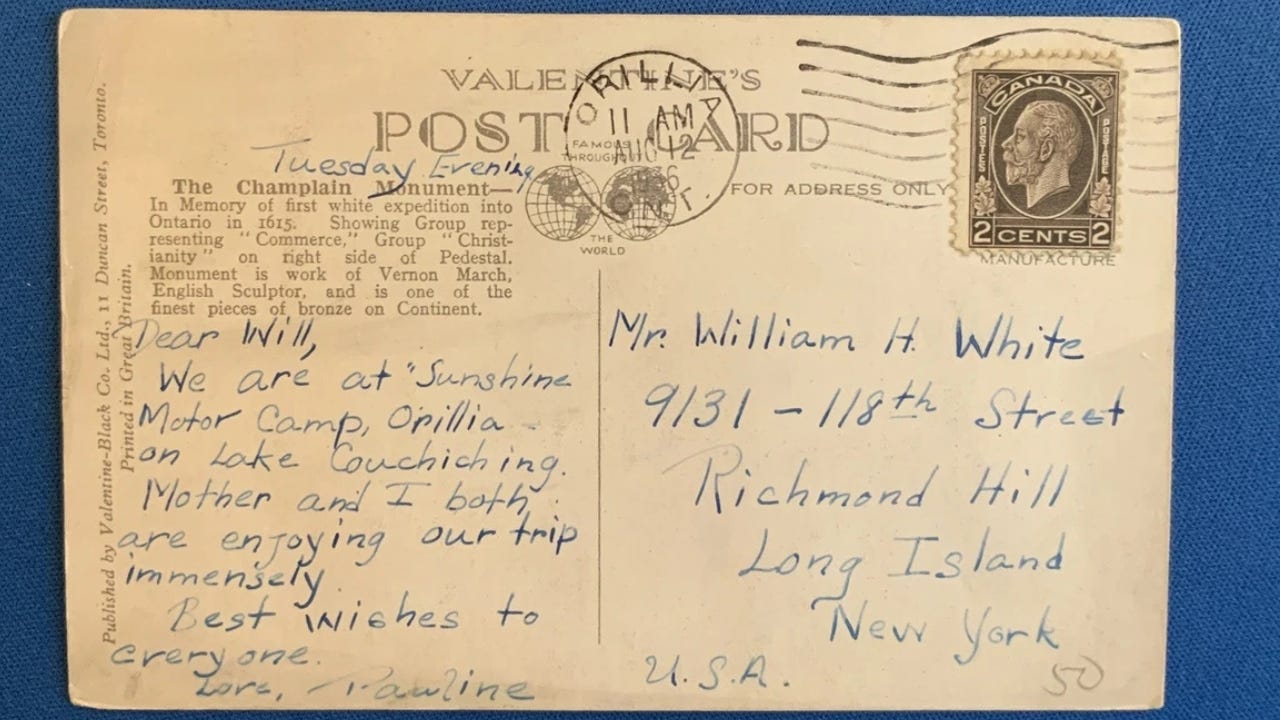
As a child, I didn’t think about the Champlain monument as anything other than something to climb. But now I notice who has been placed beneath whom, whose story has been cast in bronze, and whose dignity has been lowered and made into a decoration.
We should resist the Dominion Society of Canada, and those like them, with all the courage and imagination we have.
But not with our fists. 🐦
Wilderness Times is co-created with Broadview, an award-winning Canadian publication known for thoughtful journalism that attends to spirituality, justice and the questions that tug at our collective conscience.
Broadview is a registered charity and has made this Substack freely available because we believe that thoughtful, justice-seeking journalism should be accessible to everyone. Creating this space — and keeping it free — takes time, skill and resources. If this space nourishes you, please make a tax-deductible donation.
Your support empowers Broadview to tell more courageous stories and helps build a more just and compassionate world.

If this story resonated with you, you might appreciate more like it — and more often.
Broadview’s Best of the Week newsletter delivers a curated selection of award-winning journalism on current events shaped by faith, straight to your inbox every Friday.
What does active, nonviolent resistance look like where you live?
Does nonviolent resistance feel realistic to you — or does it ask too much of those being targeted?

No posts
Comments
Nothing yet. Say the first thing.
Sign in to join the conversation.