
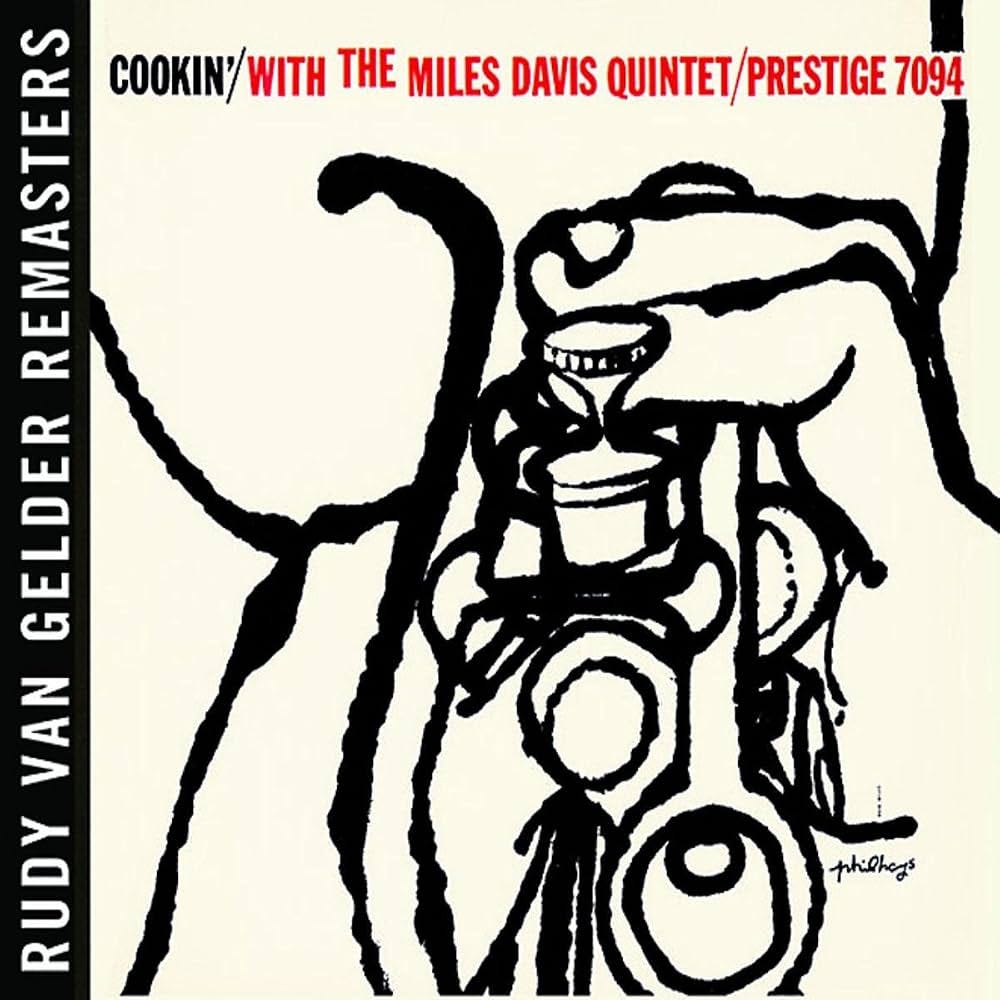
By the fall of 1956, Miles Davis already had his deal with Columbia in hand. The problem was he was still under contract with Prestige, and Bob Weinstock had no intention of letting him go before collecting the material they had agreed on. The solution they landed on was practical, almost blunt: two full sessions with Rudy Van Gelder in Hackensack, on May 11th and October 26th, 1956, in which the quintet ran through its live repertoire with barely a pause. No written arrangements, no rehearsals, and above all no second takes. Miles would call the tune, count it off, and tape would roll. Out of those two days of work came four albums, Cookin’, Relaxin’, Workin’ and Steamin’, released in stages through 1961. Cookin’ was the first to come out, in July 1957, and it’s arguably the one that captures most clearly where the band stood in those months. Weinstock, to be fair, was never really an obstacle for Miles. He was the one who backed him through the difficult years between 1951 and 1953, the ones marked by heroin. The two Hackensack marathons were less a punishment than a way of building up a stock of material to release over the following years.
Red Garland on piano, Paul Chambers on bass, Philly Joe Jones on drums, John Coltrane on tenor. The group now remembered as Miles’s first great quintet lasted barely eighteen months, undone in part by addiction among three of its members. Coltrane in particular was routinely rated below Sonny Rollins by critics of the day, and it would still be months before the detox that pushed him toward a language entirely his own. The lack of a safety net seems to have pushed everyone to their limit. With no do overs, every solo stayed exactly as played, imperfections included. That may be why Cookin’ still sounds today like a club set caught by accident rather than a record built in the editing room, an impression that, according to historian Jack Chambers, is precisely what keeps these albums alive.

Starting August 14th, the new reissue of Cookin’ with the Miles Davis Quintet is available, curated by Craft Recordings as part of the historic Original Jazz Classics series. You can already pre-order it here: https://i.craftrecordings.com/ojc-cookin
The album opens with “My Funny Valentine,” the standard Miles often used to open live sets: Harmon-muted trumpet, plenty of space, minimal backing from Garland and Chambers. This is Miles at his most lyrical, saying more by playing less. “Blues by Five” follows, a mid-tempo blues where the rhythm section takes shape and Coltrane comes in with a dry, almost nervous phrasing. The “Airegin / Tune Up” medley shows the group’s speed on faster tempos. “Airegin” was written by Sonny Rollins, not incidentally the saxophonist originally considered for the chair that went to Coltrane. The record closes with “When Lights Are Low” by Benny Carter, folding in the bridge from “Just Squeeze Me,” a detail that on early original pressings led to some mismatch between the tracklist printed on the sleeve and the one on the vinyl label, depending on the pressing.
The illustration is by Phil Hays, the design by Reid Miles, a name usually associated with Blue Note’s graphics, lent here for once to Prestige, a label that typically spent less on this side of things. As for the title, it comes from something Davis himself said at the end of the sessions: “After all, that’s what we did, came in and cooked.” There isn’t much more to add. They walked in, played, and this is what came out. Nearly seventy years on, Cookin’ remains one of the most direct ways to hear how that band actually sounded live, without overdubs or editing tricks getting in the way.
Comments
Nothing yet. Say the first thing.
Sign in to join the conversation.