
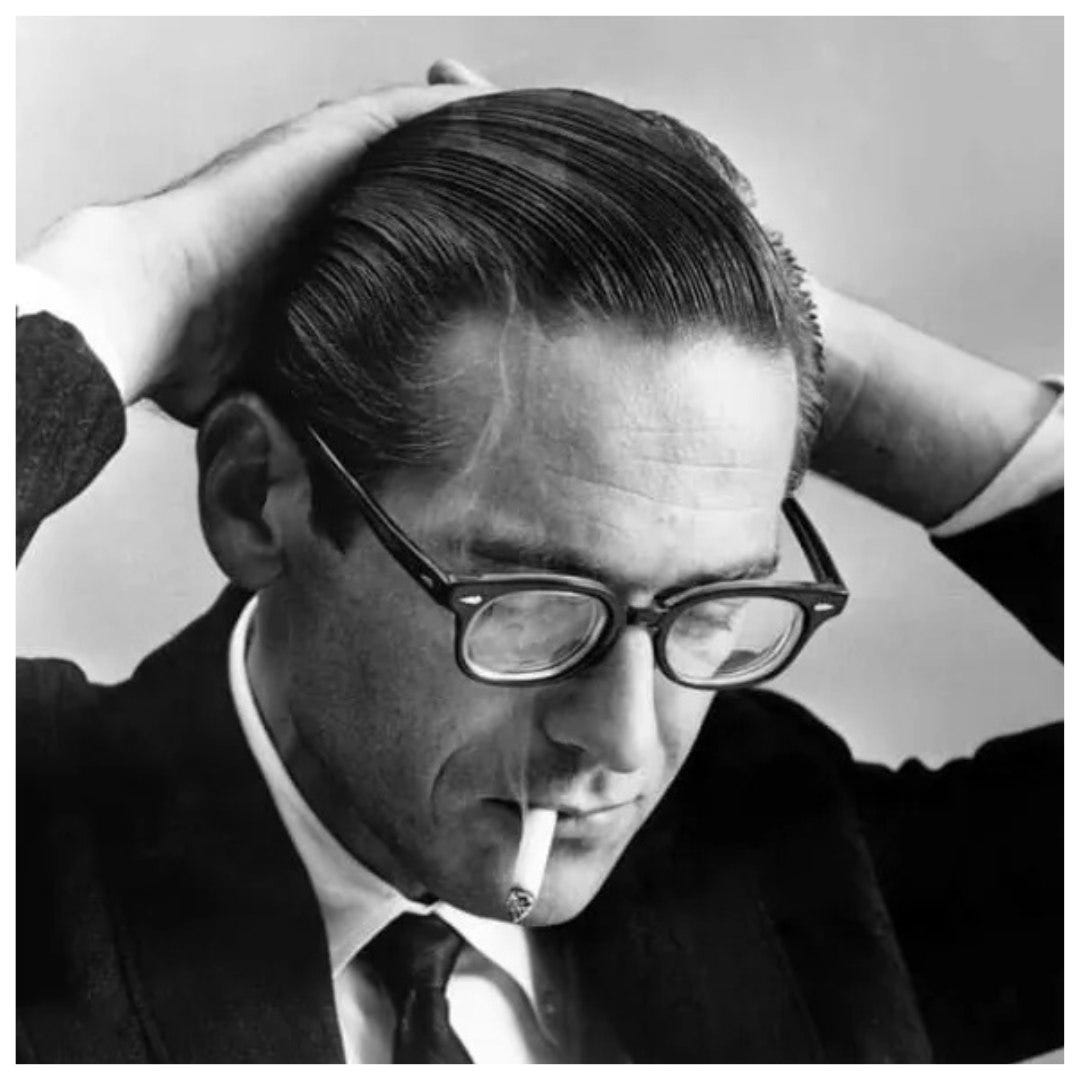
There are two video documents in which Bill Evans talks, at length and without haste, about the way he worked. The first is from 1966, the second from 1970. Placed side by side, they let us follow the same line of thought at two different moments: first as theory laid out in a television studio, then as practice observable during a private performance.
The best known of the two is “The Universal Mind of Bill Evans,” a 1966 television conversation between Bill Evans and his brother Harry, a composer and music professor at Louisiana State University. The program was produced within Steve Allen’s show and is built as a dialogue, interspersed with demonstrations at the piano.
The central point of the conversation is the one that gives the program its title: the idea of a “universal musical mind.” Evans argues that musical sensitivity is not the exclusive property of the professional musician; the judgment of a layman listener, he says, is no less valid than that of a professional. If anything, the professional, because of his constant involvement with the technical mechanics of music, has to make an effort to recover the naivety of listening that the layman already possesses naturally.
To illustrate his own method, Evans uses the song “Star Eyes”: he plays it at the piano and shows, step by step, how he builds a solo elaboration starting from the melody and the harmonic structure of the piece.
A second theme running through the conversation is the relationship between learning and improvisation. Evans describes the creative process as a sequence of technical problems to be tackled one at a time, at a very intense level of conscious concentration, until that work becomes automatic, secondary, subconscious. Only at that point, he says, can one truly improvise.
The conversation also includes a historical comparison with classical music: according to Evans, the music of Bach and Mozart left the performer wide margins of interpretive freedom, a space that gradually shrank once composers began writing out every single note on the score, bringing written music closer to a fixed text than to a track meant to be interpreted.
The second document dates back to October 1970 (other sources place it at the end of February of the same year) and comes from a different occasion: Evans’s trio, at the time made up of Eddie Gomez on bass and Marty Morell on drums, travels to Helsinki, to the home of Finnish composer Ilkka Kuusisto, for a private performance filmed by Finnish television. The house is on the island of Lauttasaari, a few minutes from the city center.
The footage alternates three interview segments with three live performances: “Emily,” “Alfie,” and “Nardis.” Other versions of the same evening, circulated later, show a wider repertoire that also includes pieces such as “If You Could See Me Now,” “’Round Midnight,” “Someday My Prince Will Come,” “A Sleepin’ Bee,” “You’re Gonna Hear from Me,” and “Re: Person I Knew.”
In the interview, Evans returns to some of the ideas already expressed in 1966, but in more direct language, less shaped for television. Asked how much intellect matters in playing jazz, he answers that intellect is only useful up to a point, the point of the student: it is the tool used to take materials apart and understand them, but it is not enough on its own to play, because there is no time during a performance for conscious reasoning. It takes years of practice for that knowledge to become automatic, to the point where one can “forget all of that and just play.”
Asked about his own style, described as spare, almost dry, Evans links it to a matter of personal taste: he says he plays for himself first, that he is the first listener of his own music, and that he does not like superfluous elements or unnecessary embellishment. He prefers, he explains, to state things as clearly and concisely as possible, without making the listener work harder than necessary to understand.
On how the trio builds pieces live, Evans explains that they agree in advance only on a basic harmonic structure; some passages settle over time, almost becoming an arrangement, but are sometimes deliberately altered to keep things fresh. After the theme is stated, he adds, none of the three knows in advance which direction the ideas will take or how the three instruments will interact.
Asked what he is ultimately looking for through music, he answers by describing a feeling rather than a precise plan: an attempt to show something, to himself first, that might then reach the listener and, in some way, enrich the listener’s life or make them feel better.
The two recordings tell the same underlying idea from two different angles. In 1966 Evans lays it out at length, with his brother Harry as interlocutor and a piano at hand for demonstrations. In 1970, in Helsinki, the same idea is compressed into a few sentences between one piece and the next, but it is the same idea: intellect as a tool for study, practice as the way to make what has been studied automatic, a search for clarity over the superfluous. The concert that follows the interview lets listeners hear that principle applied in real time, piece after piece.
Thanks for reading Wiki Jazz! This post is public so feel free to share it.
Comments
Nothing yet. Say the first thing.
Sign in to join the conversation.