
Madonna is back with her new album, Confessions II, a spiritual sequel to her landmark 2005 album, Confessions on a Dance Floor. In the second installment of this two-part essay series, I turn from Madonna the visual artist to Madonna the musician—and how she unexpectedly became an artist I return to again and again.
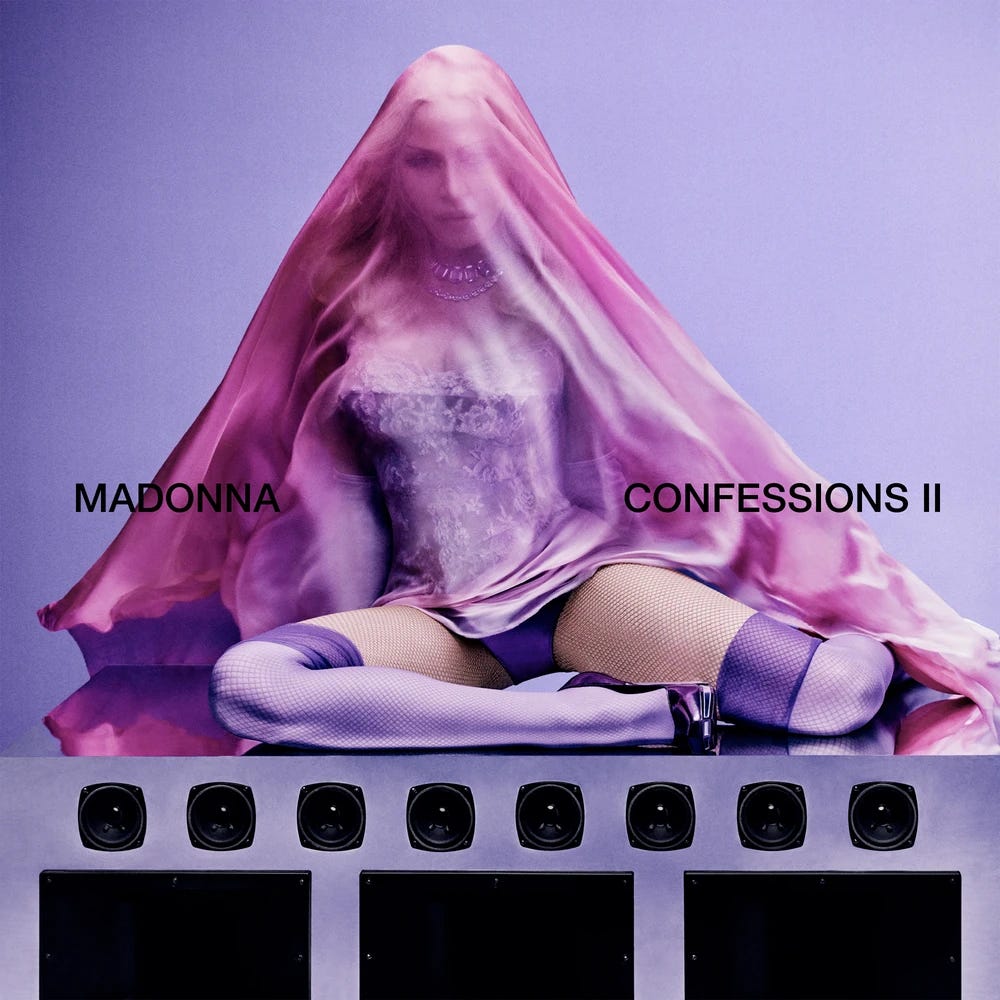
If anyone knows how to open an album, it’s Madonna.
In her signature whisper, Madonna begins Confessions II on a gracious note, thanking listeners for joining her on this latest musical endeavor before making a confession of her own: sometimes she simply likes to hide in the shadows and create a new persona. She has spent nearly five decades proving she can become whomever she wants.
With Madonna back in the pop zeitgeist—not that she ever truly left—I’m reminded that I discovered her at what many considered a transitional moment in her career. I was too young to absorb the explosion of her music and celebrity in the 1980s, and still too young to fully understand the cultural impact of “Vogue” or the boundary-pushing provocations of Erotica.
By the mid-1990s, after a decade spent redefining pop music, fashion, and fame, Madonna had something to prove. My Madonna consciousness has always been framed by the image of her as the venerable underdog with impeccable blonde hair.
Growing up, my music tastes revolved around Whitney Houston, Janet Jackson, and Mary J. Blige. They, and many contemporary R&B stars of the time, shaped my understanding of popular music. Madonna was always there at the periphery, somewhat far removed from what I listened to on my Discman or on the radio. Loving Madonna carried its own coded baggage. She had long been embraced as a gay icon, and at that age I wasn't ready for what that might say about me.
I met Madonna when her new sound for Bedtime Stories was produced by Babyface and Dallas Austin. During this era, Madonna suddenly felt cool with her kohl-rimmed eyes, bleach-blonde hair, and nose piercing. I recognized “Take A Bow” as a sumptuous music video on VH1, and it played during the cliffhanger finale of season one of Friends. "Human Nature" drew from the same hip-hop and R&B vocabulary that felt familiar to me and it was against the grain of what one might expect from a pop artist of the time (I’ve watched that video more times than I can count). Bedtime Stories re-established Madonna as an artist capable of far more than being a consumable, hyper-famous sex fantasy. It was her moment to showcase herself as an artist with depth, range, and a vision beyond the limitations of what it meant to be Madonna.
Confessions II opens with "I Feel So Free," a declaration from an artist ready to step out of the shadows. Compare that to the anxious ticking clock of "Hung Up," whose central refrain insists that "time goes by so slowly"—a lyric Madonna recorded while she was only in her forties. Listening to the two albums twenty years apart, I’m struck by how differently time sounds. She's still aware of its limits. Shifting definitions of fame, new tides in music trends, health scares, and the deaths of family members and artistic peers have almost certainly reshaped her relationship to time. The first Confessions looked backward from the middle of an already extraordinary twenty year career. The second looks back at a longer, fuller life lived and her own legacy as something to reckon with. That accumulated experience gives Confessions II a different emotional register. Madonna still wants to dance, but now we understand more acutely why dancing matters.
Like its predecessor, Confessions II is structured like a DJ set. A driving opener gives way to a slower groove before accelerating into a run of dance anthems and ending on a more contemplative note. The songs bleed into one another rather than arriving with hard stops, making the album feel like a single continuous experience. Revisiting an earlier sound this late in a career could easily become an exercise in nostalgia, but Madonna resists that temptation. With Stuart Price returning as co-executive producer alongside newer collaborators including Arca, Andrew Watt, Cirkut, and PARISI, Confessions II treats its predecessor less as a blueprint than a conversation with a former artistic self. The sonic DNA is familiar, but the emotional perspective has changed.
"One Step Away" functions as the album's artistic manifesto. "People think that dance music is superficial," Madonna opines, before insisting that the dance floor is "a ritualistic space where movement replaces language." It's a fitting summary of a career spent arguing that dance music isn't escapism but total expression. Throughout Confessions II, the production is remarkably layered. House rhythms collide with trance, EDM, and electronic textures. The songs are built for movement. Beneath the propulsive beats are ruminations on freedom, grief, memory, faith, and survival.
One of the album’s greatest pleasures is how dense these arrangements feel without being overstuffed. Strings appear with zesty bass lines, whispered vocals, house pianos, trance synths, spoken-word passages, and sharp electronic percussion. Every track seems to reveal another layer on repeated listens.
Dance music has long been dismissed as deeply unserious, much in the same way that the audiences most devoted to it, women and queer communities, have been marginalized. Madonna has spent decades rejecting that idea.
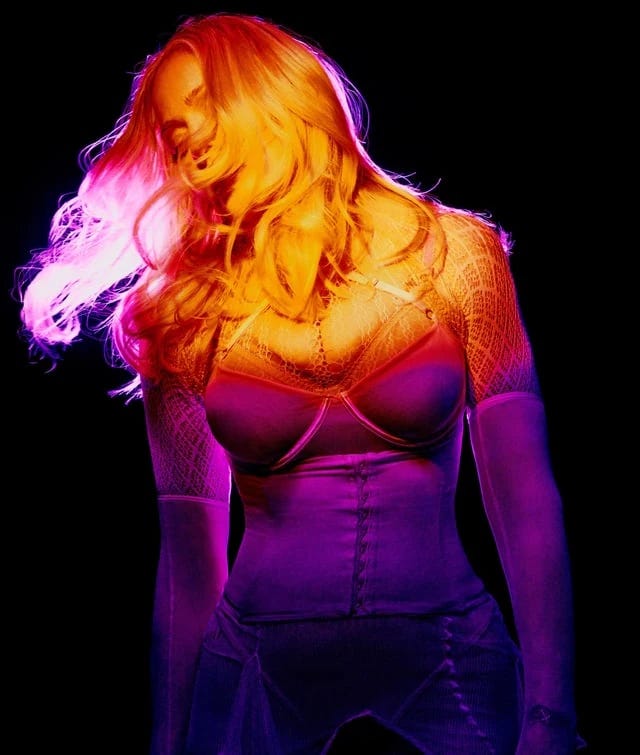
“Bring Your Love” pairs Madonna with Sabrina Carpenter, another intergenerational collaboration in her career. Carpenter is a fitting choice. Like Madonna before her, she understands the pleasures of performance, camp, and Old Hollywood glamour. The song’s hard-charging clap melts seamlessly into the riotous “Danceteria,” the album’s centerpiece. More than a celebration of an infamous downtown club, it’s an origin story. Madonna revisits the New York that birthed her, recalling nights spent at Danceteria alongside figures like Debi Mazar, Martin Burgoyne, Keith Haring, and Mark Kamins. The result is both dance anthem and oral history. Madonna has outlived many of the people she names, giving the song an undercurrent of melancholy beneath its delicious beat. Its spoken-word roll call inevitably recalls “Vogue,” but it also feels like an artist preserving a world that only survives because she continues telling its story.
Towards the album's final act, two songs stand out in the best possible way. "School" feels like a dark rave orchestrated by Mistress Dita from the Erotica era. As much as Madonna has taught generations of artists to follow in her footsteps, she remains a student. The lyric, "'Cause, baby, I'm not your mother / I'd rather be your lover," knowingly echoes “I’d Rather Be Your Lover” from Bedtime Stories, reminding us that Madonna's dialogue with the past isn't limited to Confessions on a Dance Floor.
That most adventurous expression comes next with "My Sins Are My Savior," featuring Stromae. The song feels like a collage assembled from disparate corners of pop history. The cool monotone precision from Army of Lovers' "My Army of Lovers” is mixed with the throbbing bass of Suzanne Vega's "Tom's Diner." French spoken word drifts through the mix. Rather than simply quoting her influences, Madonna absorbs them into something unmistakably her own.
As she did on the original Confessions, Madonna ends the album on a quieter, more poetic note. "The Test," featuring her daughter Lourdes "Lola" Leon, explores the complicated space between mothers and daughters, while "L.E.S. Girl" returns her to the streets of the Lower East Side where her artistic life first began. In these closing moments, Madonna never feels compelled to prove herself as a vocalist. She whispers, coos, and talk-sings her way through songs that are primed for atmosphere over vocal gymnastics. That's always been her real gift. Madonna's artistry has never depended on technical virtuosity, but on her ability to build sonic worlds that listeners want to inhabit—and return to.
I sometimes wonder if I discovered Madonna at exactly the right time. I imagine how electric it must have been to witness The Girlie Show or The Confessions Tour in real time or to pick up an original copy of the Sex book. I didn’t inherit Madonna from the beginning. I met her in the middle of one of her many reinventions.
Maybe that's why, to my ears, Confessions II is one of the best albums of the year. Confessions II feels less like an attempt to reinvent something that worked in the past than a reminder that being expressed on a dance floor remains a worthwhile artistic pursuit. I spent years believing Madonna wasn't for me. It turns out I simply hadn't met the right version of her yet.
A free subscription includes:
✓ Weekly essays delivered to your inbox
✓ Access to Notes and community discussions
✓ Occasional interviews and special features
A paid subscription gets you:
✓ Subscriber-only essays and series
✓ Select archive access to earlier pieces
✓ Recommendations, lists, and cultural deep dives
If you’ve been reading for a while, subscribing is the most direct way to support the work—and stay close to it.
Comments
Nothing yet. Say the first thing.
Sign in to join the conversation.