

Instalment two of six on how Canada defines a “Canadian program.” This one covers certification by the Canadian Audio-Visual Certification Office (CAVCO) - which results in qualification for tax credits - real money.
I’ve spent thirty-five years inside Canada’s certification system and I have opinions about all of it. Those opinions are for another day.
This series just explains how the system actually works - who administers what, what each pathway requires, and what each is worth. I want to tell you why a producer picks one regime over another, where the incentives lie, and where they quietly diverge from their stated cultural purpose.
That’s what gets you ready for the harder conversation - whether any of this works, or needs fixing, or needs to be torn up. That conversation is coming, elsewhere.
Instalment one ended with a badge that costs little and pays nothing: the CRTC's C-number - a certification system all about meeting broadcaster obligations around their support for Canadian content.
This instalment is about another badge, one that actually involves access to money. CAVCO, the Canadian Audio-Visual Certification Office, is the federal gatekeeper standing between a film or television production and Canada's film and television tax credits. If you get certified by CAVCO, the Canada Revenue Agency cuts a cheque. If you don’t, you're just another show that happened to get made here.
But before any of that, there's a wrinkle that’s important to note: CAVCO doesn't just administer one certification regime - it administers two. They’re designed differently, they are philosophically distinct, they have different objectives and requirements, they pay-out differently to producers, and a single production can never qualify for both.
The first is the Canadian Film or Video Production Tax Credit (CPTC). It runs on an ownership test: Canadian-owned production company, Canadian copyright ownership, a minimum share of Canadian creative personnel. Meet the test, and the producer gets a refundable tax credit worth up to 15% of the budget.1
The second is the Production Services Tax Credit (PSTC). It runs no ownership test at all: a foreign-owned production, led by foreign nationals, with foreign-owned copyright qualifies the same as anything else. In practice, that's why Hollywood productions come north, paying in Canadian dollars, hiring Canadian crews and working out of Canadian studios, chasing the labour credit rather than the ownership one. The credit is smaller, 16% of Canadian labour costs, but there's no cap on how much a production can claim.2
As noted, a single production cannot collect both, and this is not a technicality. The CPTC is a reward targeted towards Canadian producers who produce film and television content which they own: the company has to hold the copyright, control the creative decisions, and keep a real financial stake in how the production performs. The CPTC exists to serve Canadian cultural policy, which means it is built to benefit Canadian producers specifically, not producers in general.
The PSTC, in contrast, is a reward for Canadians producing film and television content for someone else: the Canadian crew and Canadian companies are simply providing their services, not owning the result, and the credit makes no attempt to serve a cultural policy at all … its objectives are solely economic..
And the value of the credits? The CPTC throws off a richer return than the PSTC - and that’s intentional. A credit meant to advance Canadian cultural policy cannot pay a foreign-owned production the same as, or more than, a Canadian-owned one; if it did, it would be subsidizing Hollywood's use of Canadian labour more generously than it subsidizes Canadians building their own industry, which no government could sell as a legitimate cultural policy. So a production company has to pick one regime and stay in it.
This sounds abstract until you put real titles next to it.
Schitt’s Creek is the textbook CPTC production: shot in and around Toronto, owned by a Canadian company, Canadian creative team running the show, eligible for Canadian content tax credits because it actually qualified as Canadian content, not because Toronto stood in for somewhere else. Same goes for Kim’s Convenience, a Toronto-set, Toronto-shot, Canadian-owned sitcom about a Regent Park family. Both shows are “Canadian” - at least the way the CPTC defines it - owned here, made here, profits flow here.
Deadpool, on the other hand, is a textbook PSTC production. Twentieth Century Fox owns it. The story is set in New York. None of the creative decisions were made in Canada. But it was shot in Vancouver, using Vancouver crews and Vancouver soundstages, because the PSTC and its provincial counterpart’s top-up made that labour cheaper than shooting the film in Los Angeles. The Handmaid’s Tale follows the same pattern: an American-owned production, based on a Canadian novel but controlled by MGM and Hulu, shot almost entirely in and around Cambridge (my home town so it gets a shout-out here - woo!) and Toronto for the same reason. Vancouver and Toronto get the jobs, the spending, and the soundstage bookings either way.
Thanks for reading White Paper Black Coffee! This post is public so feel free to share it.
The value of these credits, when taken together, are not a rounding error on the government’s financial statements.
The CPTC and its provincial counterparts contribute close to a billion dollars a year to Canadian television production alone, before counting feature films: $951 million in combined federal and provincial tax credits financed Canadian television production in the most recent reporting year, English and French combined.3 That's the minimum price tag of the "Canadian content" credit, the money that flows specifically to productions that cleared CAVCO's ownership and labour content test. Stack the federal CPTC with its provincial counterparts (Ontario and BC both offer 35 percent on top of the federal rate) and a producer can cover a serious share of a production's budget before a single dollar from a theatre, a broadcaster, or a streamer is secured, in either the domestic or international context.
The PSTC's cost to the public purse is a separate, and, for this series' purposes, a secondary question. It funds a different thing entirely: the foreign-owned, foreign-copyrighted productions that never claim to be "Canadian" in the first place, currently running at $5.32 billion in production spend attracted to Canada annually.4 One might legitimately ask whether Canada gets good value for its PSTC film subsidies generally... but it isn't public money spent on the question this series is asking, which is what "Canadian" means and the value of that designation. The CPTC's billion dollars buys an answer to that question. The PSTC's spending doesn't try to.
Wherever public money is attached to a cultural definition, someone will eventually ask not “how do I tell a Canadian story” but “how do I qualify.”
Here’s what makes this different from most government subsidies: a producer can build a financing plan around the CPTC before a single frame is shot. The federal credit and its provincial counterparts aren’t discretionary grants a producer applies for and hopes to win. They’re formula-driven, statutory entitlements. If a production meets the ownership, spend, and labour content tests, the credits are owed, not awarded. That predictability is worth more to a producer than the dollar figure alone suggests, because it means the credits can be budgeted, borrowed against, and built into a financing plan from day one, rather than treated as contingent funds that show up if the producer gets lucky.5
Here’s an over-simplified example: take a $10 million scripted Canadian television production shot in Ontario, with a reasonably typical 60% of the budget (i.e. $6 million) going to eligible Canadian labour.
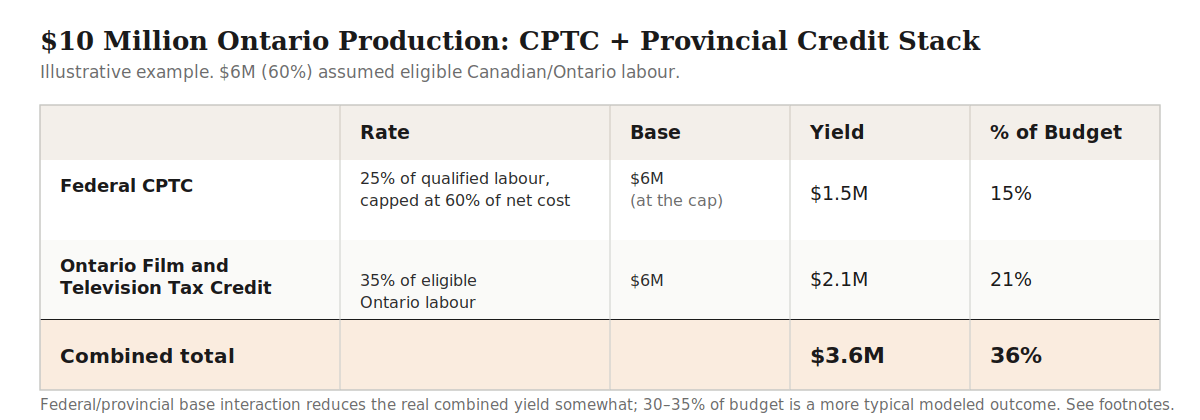
In practice, the federal and provincial bases interact, since government assistance from provincial credits are netted out of the cost figure used to calculate the federal. That netting brings the real combined yield down from the 36%, but production accountants and financiers routinely model this kind of production in the 30% to 35% of budget range once the interaction is accounted for. Either way, the arithmetic is the same: a Canadian producer can start financing conversations with roughly a third of the budget already covered, before a single dollar is secured from other domestic and international industry participants and/or financiers (distributors, sales agents, broadcasters, streamers, banks, private equity, regional funds, government subsidies, etc.). You can see that tax credits are not subsidies that offer producers a few extra dollars around the margins. In fact, they’re the foundation on which the rest of the financing structure is built.
The CPTC exists because the thing it replaced was a catastrophe, a catastrophe worth describing not for nostalgia but because it’s the cleanest example this series will find of something worth watching for throughout: a well-meaning cultural policy, built to encourage Canadian storytelling, getting gamed by people who had no interest in Canadian storytelling at all. It was comically naive in its design, and tragically predictable in its outcome. Every certification regime this series covers runs some version of the same risk. This one just ran it first, and ran it worst.
In 1974, Ottawa raised the Capital Cost Allowance for Canadian feature films from 60%to 100%: an investor could deduct the entire amount invested in a certified Canadian film from taxable income in the year it was spent, whether or not the film was ever finished, distributed, or seen by a single paying customer. Hundreds of doctors, dentists, lawyers, and business owners piled in, not because they had any interest in Canadian cinema (though it was impressive material for banter at fancy cocktail parties) but because a promoter could hand them a full and immediate write-off on money they were otherwise going to lose to the taxman anyway.
Production went from three features in 1974 to a peak of 77 in 1979, and the results told you exactly what the incentive was actually rewarding: a horror boom that ran from Cannibal Girls through Prom Night and Terror Train, and a run of teen sex comedies that peaked with Porky’s, the era’s biggest commercial hit, films built for cheap production and easy foreign resale, not for anyone’s idea of Canadian culture.6
Along the way, a cottage industry of investment brokers, tax lawyers, and accountants installed themselves between the investor’s cheque and the producer’s budget, and by most contemporary accounts they were the ones who actually got rich: production budgets were inflated less by artistic design or creative necessity than by the fees owed to the people who structured and sold the shelters’ limited partnership units.7
By 1980, the pattern had become impossible for the government to ignore: more than half of the 66 feature films produced in Canada in 1979 were never released to audiences at all.8 In other words, the tax deduction had already been banked but the film was optional!
“… a well-meaning cultural policy, built to encourage Canadian storytelling, getting gamed by people who had no interest in Canadian storytelling at all.”
The CPTC, introduced in 1995, was the structural fix: a credit pegged to qualified labour expenditure rather than capital invested, refundable to the producer rather than deductible by the investor, and requiring an actual completed, distributed production rather than an investment existing only on paper. It closed the loophole that let a producer collect a write-off without ever making a film. What it didn’t close, and what no formula can fully close, is the underlying incentive: wherever public money is attached to a cultural definition, someone will eventually ask not “how do I tell a Canadian story” but “how do I qualify.” That cynical question doesn’t disappear when the mechanism gets smarter. It just gets quieter, and harder to spot. Whether it’s still being asked inside today’s CPTC and PSTC, dressed up in a points system instead of a shell company, is exactly my concern.
It will come as no surprise that many of Canada’s competitors don’t bother with a CPTC-style content test of nationality at all, and the reason isn’t a design oversight. A jurisdiction only builds a domestic content test into its film incentive if it’s trying to grow a domestic industry that “tells its own stories”. Most American states aren’t trying to do that. Georgia, for instance, offers a 30% credit with no content test whatsoever because Georgia isn’t in the business of cultivating a Georgian film industry with Georgian ownership and Georgian stories; it’s in the business of hosting other people’s productions and collecting and taxing the labour spend. The same is true across most of the American incentive map: the credit exists to attract production, period, with no cultural mandate attached because no cultural mandate was ever the point.
The UK and Ireland are the exceptions that prove the rule, and worth noting for what they share with Canada: both run a cultural points test similar to CAVCO’s, because both are, like Canada, trying to protect something more specific than “production activity happened here.” They just fold that test into one program instead of splitting it the way Canada does. Canada’s insistence on keeping a real ownership test alongside a separate, no-questions-asked service credit is pretty unique, and the split itself says something: Canada is one of a small number of jurisdictions that still treats “who gets to tell the story” as a question worth asking at all, rather than folding it into a general economic development file.
Instalment three crosses a border: official treaty co-productions, where a Canadian producer can claim full domestic status (and access Canadian tax credits and other government assistance) on a film made jointly with a partner in places like France, Israel, South Africa, Brazil and North Macedonia. Our next question is: what happens when “Canadian enough” has to satisfy two governments instead of one.
The CPTC credit is worth 25% of “qualified labour expenditure”, where “qualified labour expenditure” is itself capped at 60% of the production's net cost (production cost minus any other government assistance received). That works out to an effective ceiling of 15% of total production cost (25% × 60%).
The PSTC is calculated as 16 percent of “qualified Canadian labour expenditure” — the wages and remuneration paid to Canadian residents or taxable Canadian corporations for services rendered in Canada toward the production. Unlike the CPTC, this amount is not capped as a percentage of the overall production budget; a production can claim 16 percent of Canadian labour costs regardless of how large a share of the total budget those costs represent.
Canadian Media Producers Association, Profile 2025: An Economic Report on the Screen-Based Media Production Industry in Canada (Summary Edition), p. 9, “Financing Canadian Television in 2024/25 by Language.” Federal and provincial tax credits combined contributed $682 million to English-language Canadian television financing ($2.17 billion total) and $269 million to French-language Canadian television financing ($0.99 billion total), for a combined $951 million. Profile 2025 does not break this figure out by CPTC versus PSTC; treating it as essentially a CPTC number reflects the fact that CMPA’s “Canadian television production” category is drawn overwhelmingly from CAVCO/CPTC-certified productions, not a figure CMPA itself attributes to CPTC alone. Provincial “Canadian content” tax credit rates cited here (35 percent basic rate in both Ontario and British Columbia, stacking on top of the federal CPTC) are drawn separately from Dentons LLP, Producing in Canada: A Guide to Canadian Film, Television and Interactive Digital Media Incentive Programs (September 2023 edition).
Canadian Media Producers Association, Profile 2025: An Economic Report on the Screen-Based Media Production Industry in Canada (released April 2026, covering fiscal year 2024/25), as reported in “Hollywood Production Canada Rebounded 2025 From Dual Strikes Impact,” The Hollywood Reporter, April 21, 2026. Foreign location and service (FLS) production volume in Canada rose 9.5 percent year-over-year to CA$5.32 billion, driven primarily by a 12.1 percent increase in foreign TV series production to CA$3.42 billion.
The CPTC and provincial “Canadian content” credits are refundable and statutory, calculated per the formulas in section 125.4 of the Income Tax Act, section 1106 of the Income Tax Regulations, and their provincial equivalents (e.g., the Ontario Film and Television Tax Credit, administered by Ontario Creates), rather than discretionary or competitive funding programs; this is what allows producers to model and finance against the credits in advance of production.
Named titles and production volume: Canuxploitation, “The Primer”; The Canadian Encyclopedia, “Tax Shelter Films”; TIFF Canadian Film Encyclopedia, “Capital Cost Allowance/The Tax Shelter Years: 1975 to 1982,” which lists Porky’s(1981) among the era’s biggest commercial successes internationally.
TIFF Canadian Film Encyclopedia, “Capital Cost Allowance/The Tax Shelter Years: 1975 to 1982”.
TIFF Canadian Film Encyclopedia, “Capital Cost Allowance/The Tax Shelter Years: 1975 to 1982,” citing Peter Urquhart, “You Should Know Something — Anything — About This Movie. You Paid for It,” Canadian Journal of Film Studies, Vol. 12, No. 2 (Fall 2003).
Comments
Nothing yet. Say the first thing.
Sign in to join the conversation.