

Instalment 3 of six on how Canada defines a “Canadian program.” This one covers Canada’s international co-production treaty regime - what it is, and why a producer would choose it over a purely domestic certification option (CRTC or CAVCO) in the first place.
I’ve spent thirty-five years inside Canada’s certification system and I have opinions about all of it. Those opinions are for another day. This series just explains how the system actually works - who administers what, what each pathway requires, and what each is worth. I want to tell you why a producer picks one regime over another, where the incentives lie, and where they quietly diverge from their stated cultural purpose. That’s what gets you ready for the harder conversation - whether any of this works, or needs fixing, or needs to be torn up. That conversation is coming, elsewhere.
The series’ first two instalments were, underneath the paperwork, running essentially the same test through two different agencies. The CRTC’s C-number process counts points under a ten-point test. CAVCO’s Part A & B process counts the same points with the same test but, if requirements are met, results in a cheque. Each asks whether enough of the production costs and crew is Canadian. Meet the tests for costs and crew and - poof - you’re “Canadian.”
Treaty co-production asks something else: in lieu of a points test, certification asks whether the producers from two (or more) countries share in the project’s production, financing, and ownership in proportion to what each contributed - this time with Telefilm Canada’s Co-Production Office responsible for assessing and issuing a co-production certificate for the Canadian side of the equation.
Structuring and papering a treaty co-production is a much more complex and expensive exercise than a straight CAVCO application. So why would anyone do it? Producers take it on because co-production structures can solve financing, casting, and budget problems that a domestic certification can't.
Financing is the most obvious of the three. National treatment means the production is recognized as fully Canadian at home and fully French, and/or Irish, and/or German, and/or Australian, at the same time. It’s like quantum mechanics(!), and it makes the production’s budget eligible for the incentive stacks and domestic cultural support systems of each co-producing country.
Two governments, two funding ecosystems, one production budget — and neither side has to pretend the other doesn't exist to get its cheques signed.
Take a real example. Qualify a feature under the “Film and Video Co-production Agreement Between the Government of Canada and the Government of the Kingdom of Denmark,” and you and your Danish co-producer can draw on all of the Canadian incentives on the Canadian share - the CPTC and provincial tax credits (Instalment Two), Telefilm’s Canada Feature Film Fund ($106.3 million in production and development funding in 2024/25),1 the Canada Media Fund ($346 million for the 2025/26 fiscal year),2 elevated broadcast licence fees (Instalment One), and provincial agencies like Ontario Creates and SODEC (Quebec) - and the full run of Danish support on the Danish share - the Danish Film Institute, the pan-Nordic Nordisk Film & TV Fond, etc. Two governments, two funding ecosystems, one production budget - with neither side needing to pretend the other doesn’t exist to get its cheques.
Then there’s who can be in front of and behind the camera. On a wholly Canadian CAVCO production, either the director or the screenwriter, and at least one of the two lead performers, must be Canadian citizens or permanent residents - and the six-of-ten points minimum leaves little room to attach an internationally acclaimed director or A-list actor without risking certification itself. A treaty co-production removes much of that constraint. Because the production is recognized as national in both countries at once, the director’s chair and the lead roles can go to a Canadian or a national of the co-producing country. And where that co-producing partner is itself an EU member state, the treaty typically extends the same treatment to nationals of any other EU member state as well. So on a Danish co-production, a German director or an Italian lead performer counts as fully eligible Danish talent. That’s a considerably wider casting pool than a Canadian producer working alone would ever have access to - and often the difference between a cast that can justify the budget and attract the financing that is required.
There’s more room, too, in where the money actually gets spent. In the absence of a co-production, both the CRTC’s C-number regime and CAVCO’s certification for the domestic tax credit requires a large majority of production spending to be paid to Canadians or in Canada (75% of production service costs to Canadians, and at least 75% of post-production/lab costs for Canadian-rendered services), full stop. A treaty co-production spreads those spending requirements across Canada and the co-producing country(ies) instead, in proportion to each side’s financial contribution. None of this is unlimited, and the proportions are fixed by the treaty and audited closely. But compared to a wholly domestic production, where obligations focus on Canadian spend, a treaty co-production gives producers real room to put the budget where the production actually needs it to go.
None of that comes free, and the cost is as much structural as it is financial. Two or more government agencies run their own reviews and apply their own process. Two or more sets of treaty terms have to reconcile with each other. And because money and copyright are split proportionally rather than owned by one producer, the deal needs its own administrative layer on top - a collection agreement and an independent collection agent, just to pay everyone out in the agreed recoupment and profit participation order.
Each co-producer also brings its own counsel, accountants, tax advisors, and financing bank - complete with the bank’s own counsel and fees. Every additional co-producer adds a full professional-services roster, not just a signature, and the fees scale up accordingly.
Most of those costs are fixed, largely indifferent to whether the budget is $2 million or $20 million - which is why treaty co-productions tend to cluster at the higher end of the budget continuum. Below a certain budget, the transaction costs simply outweigh what the structure buys you.
The traffic runs from prize-worthy to disastrous to simply forgettable, and the treaty doesn't distinguish between them.
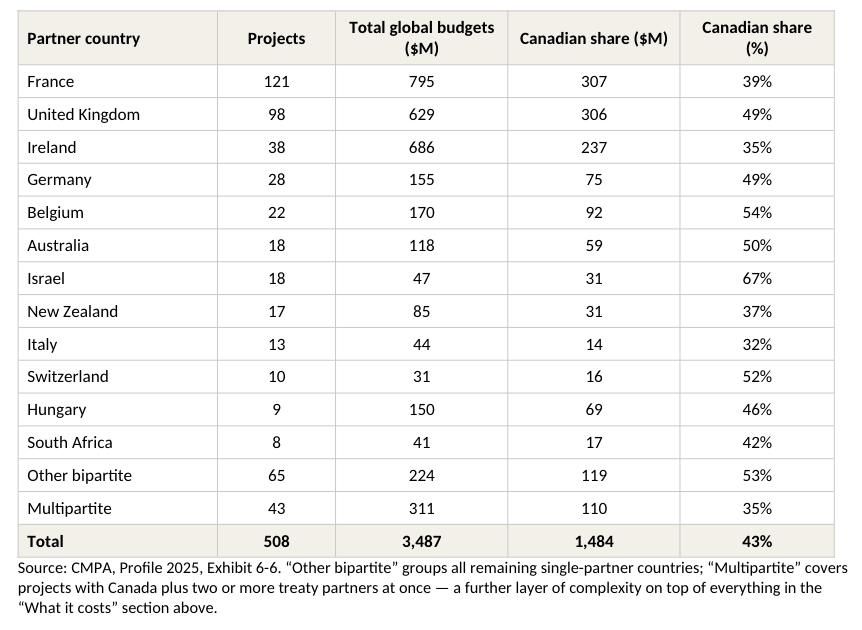
Over the past decade, Canada certified 508 treaty co-productions with total global budgets of $3.5 billion, of which $1.5 billion (43%) was the Canadian share.3 This is big business. Five countries account for well over half of that activity: France, the United Kingdom, Ireland, Germany, and Belgium alone made up 307 of the 508 projects.
The output runs from prize-worthy to disastrous to simply forgettable, and the treaty doesn’t distinguish between them. Room (Canada-Ireland) won Brie Larson a Best Actress Oscar off four nominations and nine Canadian Screen Awards. Brooklyn (Ireland-UK-Canada) picked up three Oscar nominations including Best Picture. Being Julia (Canada-UK-Hungary), produced by Robert Lantos and directed by Istvan Szabo, earned Annette Bening a Best Actress Oscar nomination and a Golden Globe win.
At the other end: Resident Evil: Welcome to Raccoon City (Canada-Germany) is a franchise entry nobody will remember fondly, and The Death and Life of John F. Donovan (Canada-U.K.) is a genuine catastrophe – an expensive, star-loaded mess that shed an entire Jessica Chastain performance in the edit and landed at 19% on Rotten Tomatoes. And a long trail of treaty co-productions never aim higher than a paint-by-numbers Christmas romance, destined for a seasonal broadcast slot or a streamer’s bulk-buy and nothing more.
Not all of these drew on Telefilm or provincial agency funding – those are separate, competitive applications – but every one of them cleared the same proportionality test and carries the same certificate, CPTC tax credit eligibility included.
One small bit of foreshadowing: nothing about this certification requires that a production be about Canada, or relevant to who we are as a people or a nation, to earn that certificate. The treaty asks only whether the money, the copyright, and the credit were shared in the right proportion. Whether the result adds anything to how Canadians see or understand themselves is a different question - and perhaps not one this certification pathway was ever built to answer.
Thanks for reading White Paper Black Coffee! This post is public so feel free to share it.
CMPA, Profile 2025, Box 3 (“Telefilm Canada”). The $106.3 million figure covers production, development, and theatrical documentary programs specifically. Telefilm’s total ongoing support in 2024/25, including promotional and marketing activity, was $144.5 million.
Canada Media Fund, per Goodmans, So You Want to Produce in Canada, eh? (Aug. 2025). CMF's Convergent Stream funds treaty co-productions on the same basis as 10/10-point domestic productions.
CMPA, Profile 2025, Exhibit 6-6, “Audiovisual treaty coproduction partner countries, 2015/16-2024/25,” ranked by number of projects (all release windows). Ten-year cumulative data.
Comments
Nothing yet. Say the first thing.
Sign in to join the conversation.