
Whispers of Her Soul is a reader-supported publication.
If you'd like to help write the essays still waiting to be written,
becoming a paid subscriber makes that possible.
There are decisions that look very simple when somebody else has to live with them.
Leave him. Quit the job. Tell the truth. Walk away.
The advice is usually sound. The person offering it is rarely the one who has to wake up the next morning and live with what follows.
We like knowing what kind of person we are: honest, loyal, brave, independent. We speak up. We leave when we are disrespected. We would never tolerate that.
Then we meet somebody who did tolerate it and wonder what is wrong with them.
A woman remains with a man who hurts her. Another woman hears the story and knows she would have left the first time.
Perhaps she would have.
But she is answering with the life she has now.
She may have her own income, parents who would take her in, friends who would help, somewhere to put the children if she has to leave tonight.
The woman she is judging may have none of those things.
Leaving may mean losing her home, being cut off by her family, fighting for her children with money she does not have, or provoking a man she is already frightened of.
The observer imagines leaving. The woman inside the marriage has to live through everything that comes after.
She stayed because the children were asleep upstairs, the apology sounded different this time, and she had nowhere obvious to take them that night.
Then there were six good weeks. Another explosion. Money she was quietly trying to save. A birthday. A sick child. Another promise.
Years later, somebody hears the whole story in ten minutes and cannot understand why she stayed for ten years.
We judge ten years as one decision because we did not have to live the days between them.
We also know how the story ended.
“She should have left after he lied the third time.”
Yes. You know there was going to be a fourth.
She didn’t.
She was standing after the third with somebody she loved promising that he finally understood what he was about to lose.
Looking back, we know things people could not have known while they were making the choice.
I have done this too. I have looked at somebody’s life and thought, Why are you still there? Why are you allowing this?
It took me longer to ask what I actually knew about the choices available to them.
Money changes these judgments more than we like to admit.
A missed salary is an inconvenience to one person and a disaster to another. Both may care just as much about dignity. Only one can afford to prove it on Tuesday morning.
“I would never let a boss speak to me like that.”
He used to think the same.
Then one morning his manager tears into him in front of the whole team. Not criticism. Humiliation. Everyone suddenly becomes very interested in their screens.
For a few seconds he imagines standing up, saying exactly what he thinks, and walking out.
But the school fees are due on Friday. The mortgage payment is coming. People at home depend on the salary arriving where it always does.
So he stays.
He says, “Understood,” finishes the meeting, and drives home hating himself for the word.
Later, someone hears the story and wonders why he allowed another man to speak to him that way.
He may wonder too.
Some people really do walk out. Some tell the truth and lose the job. People under similar pressure still make different choices.
Character matters.
But some of us have simply never had to find out how much ours can carry.
We take enormous moral credit for battles we were never asked to fight.
At 5:40 in the morning, a woman wakes because somebody has parked beside her.
For a second she forgets where she is.
Then she sees the steering wheel.
She folds the blanket, pushes it into the boot, washes in a petrol-station bathroom and changes into a blouse in the back seat. Before she walks into work, she smooths the creases with her hands.
At 8:30, she is at her desk.
“Morning.”
“Morning.”
Nobody asks why she is always the first one in.
Three months ago she had a flat.
The relationship ended. One income disappeared. The rent was impossible alone. Her savings lasted until they didn’t.
That was all it took.
Not every questionable decision comes from being trapped. Sometimes pressure gives us a respectable explanation for something we also want to do.
A man has always considered himself honest. His business is close to collapse. Twenty employees depend on it, and the bank will refuse another loan if the accounts reveal how badly the company is doing.
So he changes the figures.
Not by much, he tells himself. Just enough to secure the loan. The next contract will fix everything.
Six months earlier, if you had asked him whether falsifying financial records was corruption, he would not have hesitated.
Now the word feels unfair.
He tells himself he is protecting twenty jobs. He is also terrified of losing the company and having to admit that he failed.
He may genuinely be trying to save other people. He may also be trying to save himself.
Both can be true.
Fear can influence a decision without making it right. Need can narrow somebody’s options without removing responsibility. Sometimes “I had no choice” means something closer to “I could not bear the other choices.”
Understanding someone is not the same as excusing them.
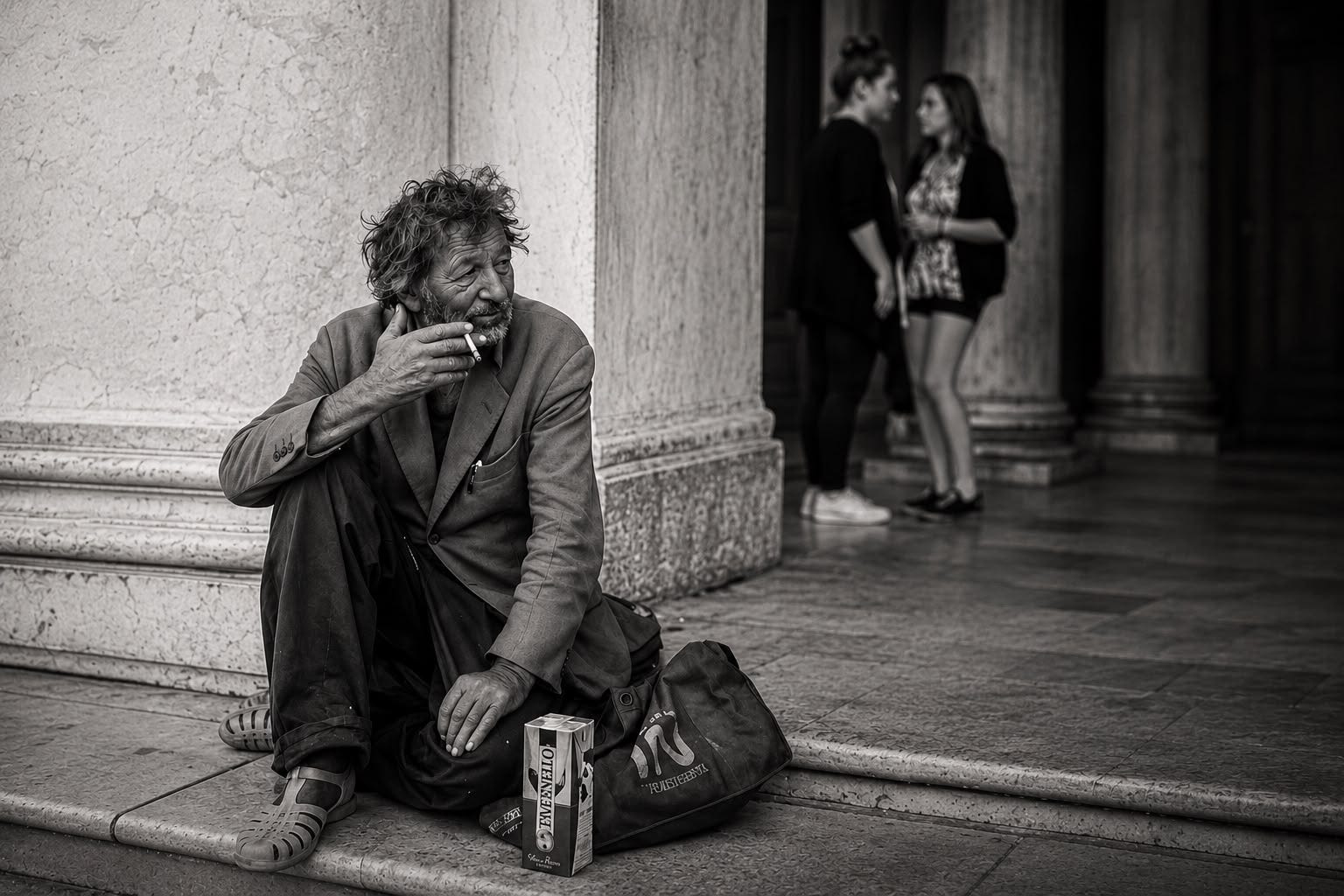
His clothes are filthy. His hair has not been washed in days. He stands outside a supermarket asking strangers for money.
Most people avoid looking at him.
Four years earlier, he had a job, a flat, and a wife he loved. They had waited years for a child.
She died giving birth.
The baby died too.
For a while, he still went to work.
Then sleep became impossible. Someone gave him pills. At first they helped him get through the night. Then they helped him get through the day.
Eventually, getting through the day became the whole day.
He lied. He stole. He hurt people who tried to help him.
None of that disappears because we know what happened to him.
But the stranger walking past sees only the dishevelled man asking for money.
Not the husband he was.
Not the father he had just become.
Not the life he had before grief took it from him.
And then there are decisions where nobody has done anything wrong.
A man has spent years caring for his wife as her dementia gets worse. When they were both healthy, she made him promise that he would never put her in a care home.
He meant it.
Now she has wandered outside twice in the middle of the night. He has lifted her from the bathroom floor more than once. He hides the car keys. He leaves the hallway light on now and sleeps lightly because every sound wakes him.
Some mornings she knows exactly who he is. Other mornings she looks frightened when he comes close.
Their children disagree. One thinks he is giving up too soon. Another thinks he waited too long.
A doctor tells him she now needs care he cannot safely provide at home.
He signs the papers.
Then he sits in the car outside for a long time before turning the key.
He has broken a promise to the woman he loves because keeping it may no longer be safe for her.
What exactly was the brave choice?
Sometimes there isn’t one.
There are two painful choices, and later somebody who never had to make either one tells you which one you should have chosen.
We look at somebody who stayed and think, I would never.
Then life occasionally introduces us to the version of ourselves that had to.
That does not mean every decision deserves sympathy.
People make excuses. Fear can become a reason never to act. A difficult past can explain behaviour without giving somebody the right to keep hurting other people.
Empathy does not require us to become foolish.
But neither should we decide what a choice says about somebody without knowing what it cost, what they knew at the time, or what would have happened if they chose differently.
The harder reckoning comes when we do something we once judged in somebody else.
The question is no longer, How could anybody do that?
It becomes, What was I telling myself when I did?
Sometimes the answer is uncomfortable. I was frightened. I needed the money. I did not want to lose them. I knew better and did it anyway. I had real reasons, and I also used those reasons to avoid looking too closely at motives I liked less.
There is maturity in being able to admit that without turning yourself into either the hero or the monster.
I was under pressure, and I still made a choice.
Both can be true.
Once you have seriously disappointed yourself, certainty about other people becomes harder.
One failure does not erase everything decent about a person. Suffering does not give anyone permission to keep hurting other people either.
There are things I still believe I would never do.
I hope I am right.
But I no longer confuse conviction with evidence.
We know ourselves through what we have already survived. We do not know who we become under hunger, fear, power, or loss until one of them is finally ours.
I still want to be the person who holds the line. I am just less willing to congratulate myself before I have had to.
Because it is one thing to know what you believe when the cost is theoretical.
It is another thing entirely when the cost is yours.
Every Paid Subscriber brings me one step closer to the independent life I am
building for me and my son.
And if you’re here simply to read, I’ll never take your time for granted.
And if these essays mean something to you I would be honored to have you with us. It matters more than you might realize.

Your support helps me keep writing and keep building. Come be part of this journey with me. With love, Aaliya ❤️🌹


I am Aaliya, the woman behind Whispers of Her Soul.
After more than 25 years of trauma, I chose to write.
Not because writing erased the pain, but because it gave me back my voice.
I write so someone else might feel less alone, and remember that even after pain, life can still become their own.
Comments
Nothing yet. Say the first thing.
Sign in to join the conversation.