
Disclosure: I’m an idiot, and if you make any investment decisions based on my ramblings, you’re an even bigger idiot.
LibertyStream Infrastructure Partners is on the leading edge of a new technology, Direct Lithium Extraction or DLE, that will disrupt the global lithium supply chain. I see a path to the US becoming the global low-cost provider of battery grade lithium carbonate: all that remains is some tech commercialization, time, and a fair chunk of capital. If the US is good at one thing, it is raising gobs of capital for the latest globally important tech.
DLE lithium from US brines will be to battery metals what shale oil was to the global energy market, except to really make the analogy work, shale oil would need lower lifting costs than KSA crude. I think this is going to be huge - yuge, I say! Aussie spodumene miners could be in trouble within a decade.
As y’all will have noticed by now, the cadence of my publishing is like the lag time of federal monetary policy: long and variable. The threshold for me to write something up is:
A compelling thesis. You are only going to hear about my very best ideas.
A thesis that isn’t well covered elsewhere.
Since you last heard from me, I have dug into tons of stocks, but I am finding I don’t come across many ideas that pass the above two filters. You could argue that today’s piece doesn’t pass filter #2, and you could be right – and that is, in fact, why I haven’t shared my thoughts here previously. I have been enthusiastic about Liberty for a while now, but others have already covered it. See, for example, a Premski guest post on AlmostMongolian, and @stoneybagpipes on ceo.ca.
However, my friend Mart asked me to come on his pod again to talk about Liberty, among other topics. As I was doing some prep for that call, I figured I may as well share it, so here you go.
I am hopefully going to give you enough detail to understand the thesis and do some napkin math, but if you want a deep dive, check out Premski’s work.
The high level business opportunity is as simple as it is brilliant: extract lithium from shale oil wastewater after it is produced but before it is re-injected into salt water disposal (SWD) wells.
All oil wells, from onshore conventional to deep water offshore to shale oil, produce some water (brine) along with the oil, known as “produced water”. The water-to-oil ratio tends to increase as wells age and fields mature. In the prolific Permian shale oil basin in Texas and New Mexico, an average of ~3 bbl of water is produced for every bbl of oil, and that number is going up over time. That brine, which contains low concentrations of lithium, is transported in pipelines away from the producing well to injection sites, where it is re-injected deep underground.
Liberty plans to extract lithium from that produced water, and in fact they’ve been doing exactly that, at increasing scale, since early 2024.
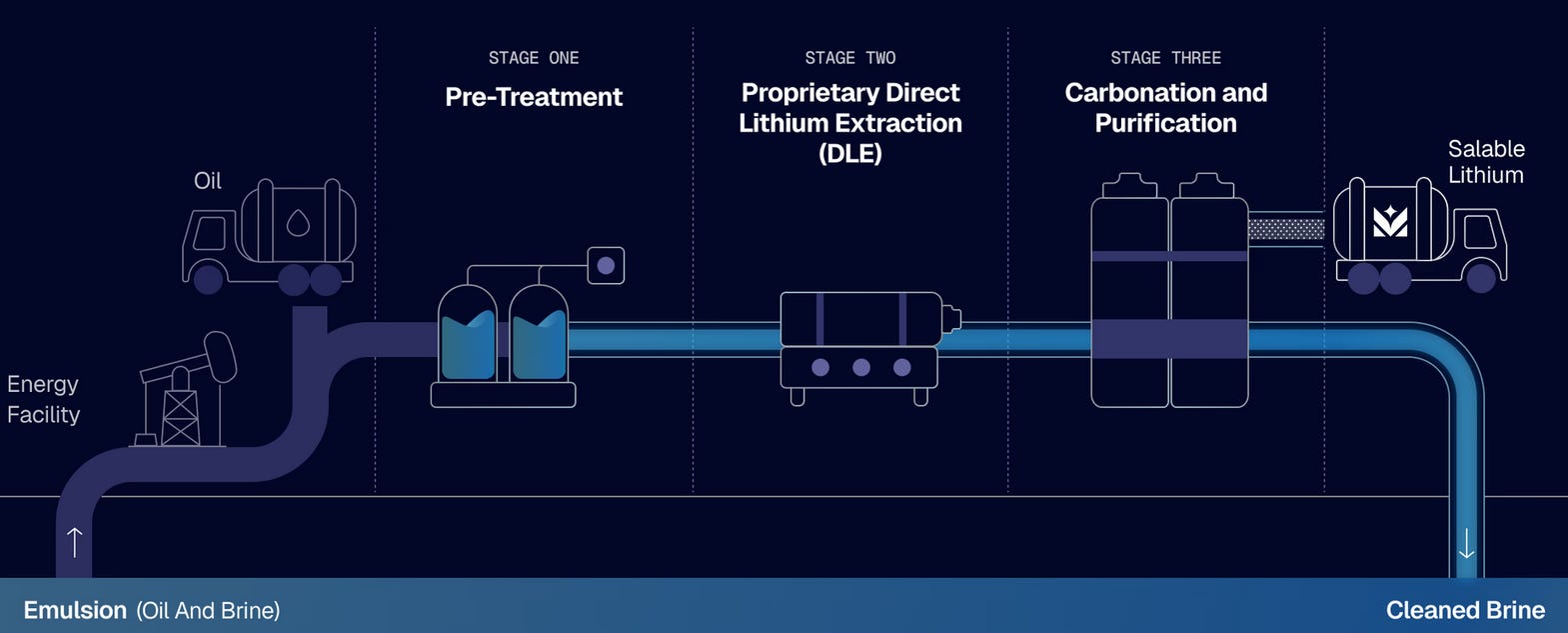
The beauty of this approach is this lithium “mine” has a near zero footprint: no new wells are drilled, no new pipelines are required, and no new waste is created.
Currently ~50% of global lithium production comes from Aussie hard rock mines, which involve digging great bloody holes in the ground and all the environmental and financial costs of turning spodumene containing rock into lithium carbonate. The other major source of lithium is evaporation ponds in South America, which in addition to producing large amounts of waste materials, requires large amounts of fresh water in extremely arid desert locations.
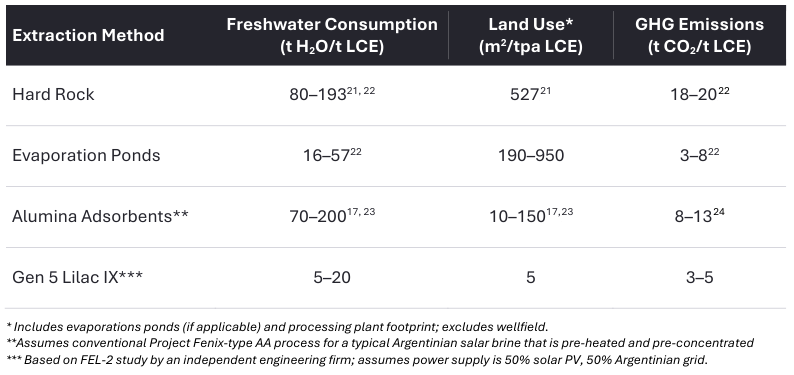
Not only does Liberty do away with most of these environmental costs with the wave of a magic wand, but Liberty saves on the capex of drilling wells and building pipelines, and Liberty has no lifting costs or re-injection costs. Liberty’s capex and opex have huge advantages over any other existing or planned lithium producer on the planet.
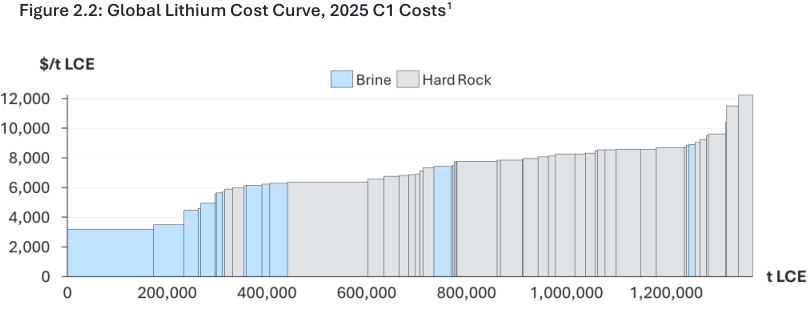
At build-out Liberty is expected to have opex at $4k or lower, putting it at the very low end of the global cost curve.
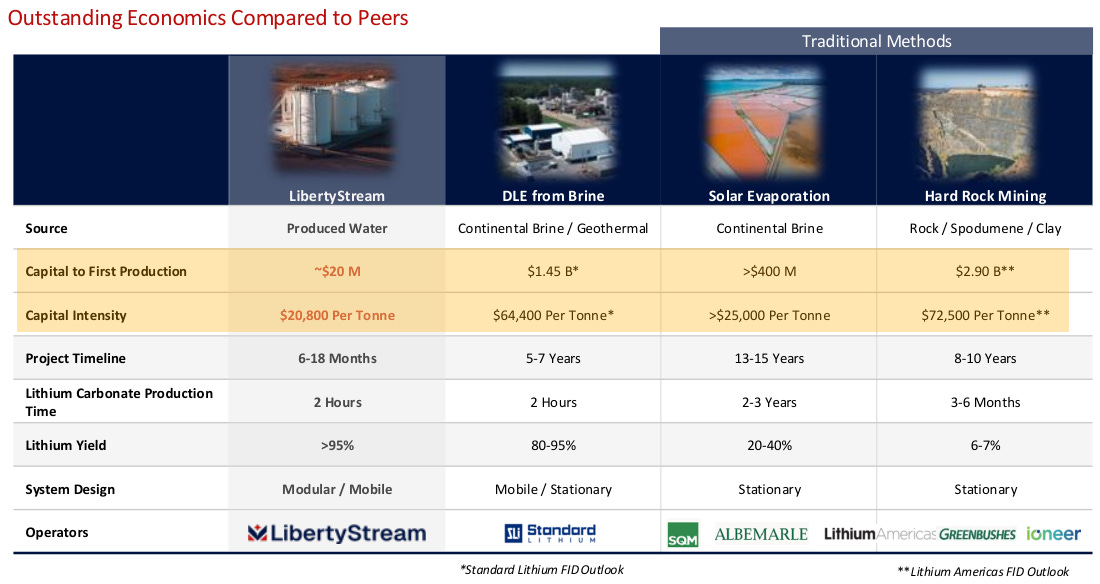
Hard rock and other US lithium brine projects have startup capex two orders of magnitude higher, and volume adjusted, Liberty’s capex is still 1/3 of US brines and Aussie hardrock (not counting the refinery!) - easily the lowest capex intensity globally.
If that isn’t enough to convince you, another advantage is permitting. Since Liberty is only installing a modest amount of tanks and equipment at already permitted SWD facilities, additional required permitting is minimal and easily acquired.
In summary, Liberty’s key advantages are:
Most credible player in the Permian.
Extremely low initial capex.
Opex near lowest globally.
Tiny environmental footprint and easy permitting.
Unless you live in a cave, you know that global lithium refining is dominated by China (85%, no bueno) and demand is expected to grow at a torrid pace.
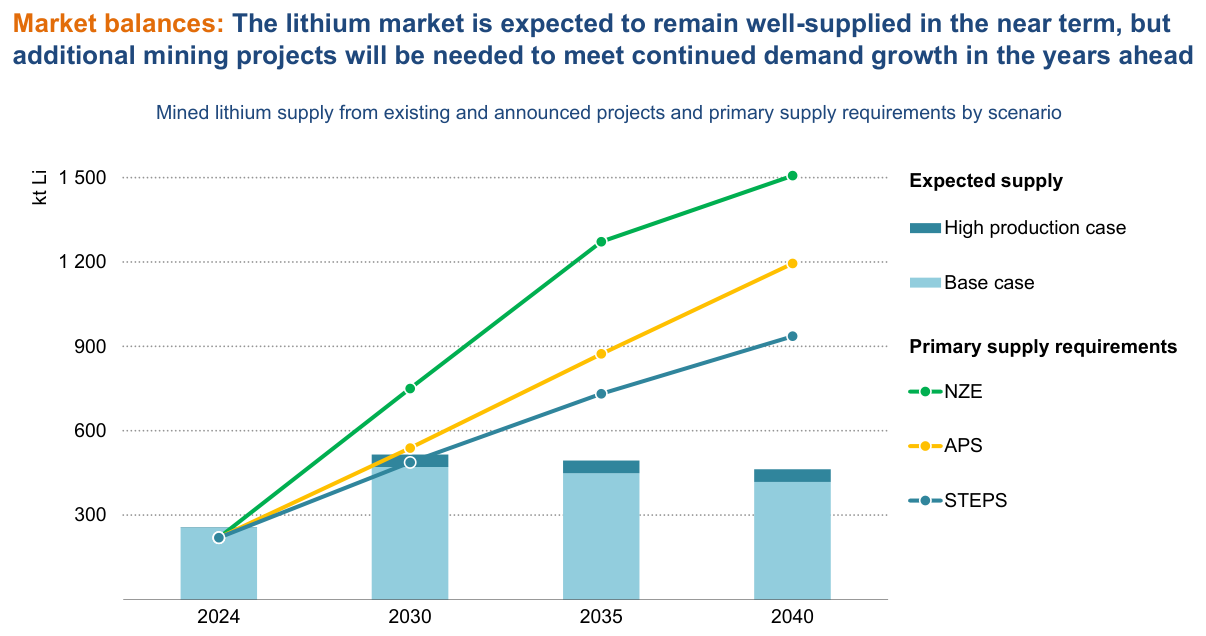
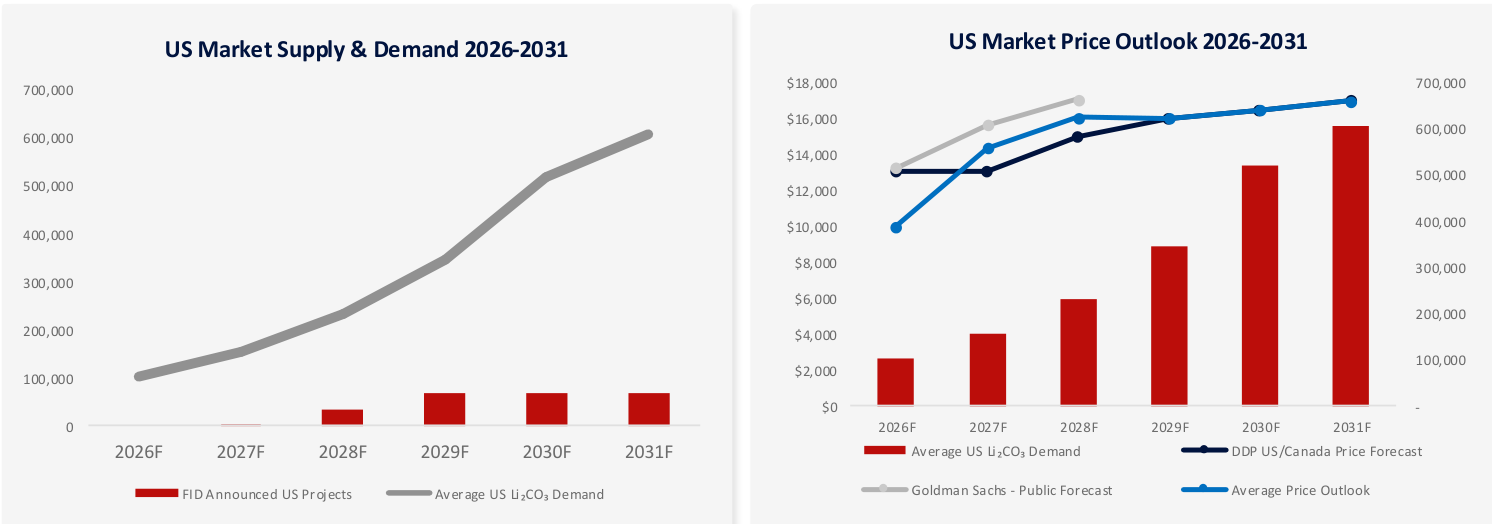
Global supply dynamics are one thing, but possibly even more important is security of supply. Lithium is a critical input the the future energy system, and Western nations have become extremely concerned about their dependence on Chinese refining. American source lithium will be in high demand and is expected to be awarded a premium price.
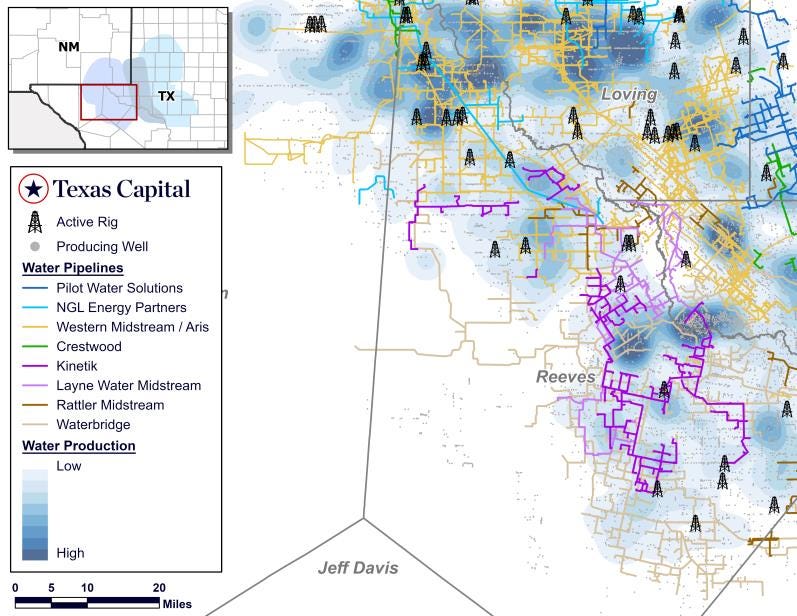
Handling and disposing of oilfield produced water has become a specialized sector: “Water Midstream”. Players in the water management sector have built a network of water pipelines throughout oil fields to transport produced water to SWD facilities.
At the SWD facilities, the produced water is stored in tanks before injection into disposal wells. Liberty taps into those tanks to pull the water into their tanks for lithium extraction before returning it.
Liberty has developed a proprietary ion exchange sorbent material (“media”) designed to capture Li+ ions at extremely low concentration. Liberty’s tanks are filled with brine and then the media is agitated in the stationary water for about an hour (Permian), extracting >95% of the lithium.
Lithium is found in Permian brines at ~30 ppm; no one else can perform DLE on such low concentrations (with one possible exception, see below). All competitors use stationary media over which the lithium-containing brine is flushed, and none of them can economically process 30 ppm Permian brines. The low concentrations are still highly economic for Liberty because of their low capex, low opex, and high volumes of available brine.
The reason Liberty’s opex isn’t cheaper than lowest cost DLE competitors despite their inherent advantages, is because Liberty’s design has higher reagent (caustic soda) requirements. The initial opex will decrease as Liberty builds-out, just from the economics of buying/transporting caustic soda at scale. Further decreases will be achieved when Liberty scales up and builds their own reagent plant. Producing caustic soda from the brine in the pre-treatment stage has the potential to decrease opex even further.
Once the lithium is extracted, it moves to an on-site refinery where it is processed to 99%+ purity lithium carbonate (actual purity dependent upon specific client specification). The purity is about more than just the lithium carbonate concentration as specific applications have unique tolerances for other impurities, and refining will be customized for specific clients.
In the field in Texas, Liberty has been extracting lithium from Permian brines at increasing scale since August 2024. Scale was increased until they were processing 10,000+ bbl/d. On December 1, 2025 Liberty announced a total of 350,000 bbl of brine had been processed, and they had successfully commissioned their small (demonstration) onsite lithium carbonate refinery.
The next steps are to refine further quantities, send samples to third-party laboratories for testing and validation, and then ship samples to prospective customers in advance of signing offtakes.
Based on 17 months of real world in-the-field testing, the tech is mostly proven and de-risked. They have plans to move to a larger custom designed tank, but otherwise commercial scale just means more tanks.
There are a number of companies chasing various forms of DLE, but only one (Element3) claims the ability to target the low lithium concentrations found in the Permian, but they use an older aluminum Layered Double Hydroxide (LDH) adsorbent. This technology has been around since the 1990s and for various technological reasons has never seen wide spread adoption.
Liberty plans to cut deals with all the Permian and Bakken water midstreamers. Their work to date in the Permian has been with a single unnamed water partner. The first supply deal they sign is expected to be a 50:50 JV with a water partner: the partner will supply the water along with half the capex for a 50% economic stake in the project.
That first deal will likely be the best terms any water processor will get. Future deals will likely either be a JV at better terms for Liberty, or a simple tariff deal where Liberty pays a per barrel charge for “borrowing” the water for a couple hours. The second option will appeal to the majority of water partners, who will prefer a “capital light” deal, and this ultimately will offer better economics to Liberty.
Liberty has the advantage in the Permian, and has the opportunity to lock up a large amount of the available brine. Once established on site with the water processors, and integrated into their networks, Liberty will be very hard to displace.
Big.
Liberty’s first focus is the Permian. While lithium concentrations are lowest in the Permian, produced water volumes are by far the largest, and that makes for the largest source of lithium. Also, the SWD facilities in the Permian are huge, which suits Liberty’s approach of building facilities, including refineries, at each SWD site.
Adding production in the Bakken looks to maybe be a 2028 story. The Bakken has lithium concentrations ~2x the Permian, but volumes are 1/10th, and disposal sites are much smaller. Capex in the Bakken is 25% higher because the facilities need to be inside structures to handle the cold winter temperatures.
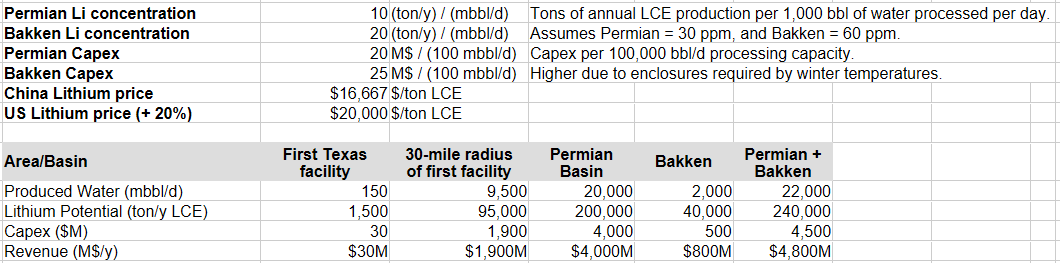
The total contained lithium in today’s produced water across both the Permian and Bakken is around a quarter of a million tons LCE (lithium carbonate equivalent) per year. For various reasons, not all of the lithium will be captured, but if even 50% of it is, then we’re talking about a $2.4 billion/year market. Based on supply/demand, there is probably upside potential to the lithium price, so things could get even crazier.
Like I said, big.
Battery grade lithium carbonate pricing has been on a wild ride since Covid. After peaking at US$80,000/ton in November 2022, it fell -89% to ~US$8,500 in June of 2025. It has since more than doubled to ~US$17,000/ton, with GFEX 2026 futures contracts trading even higher.
No one knows where the price goes from here, although longer term, up and to the right seems the most probable path.
We also don’t know the details of the offtake agreements Liberty will sign. They may have fixed prices, or they may reference China spot price with a US-source premium and an inflation-protected floor. We do, however, expect that offtakes will be long term (5-10 years) and will offer downside protection either via a fixed price or a floor price.
Long term contracts with downside floors will enable excellent earnings visibility which will be very beneficial for earnings multiples and cost of capital (more on both of those later). It will also enable Liberty to weather any downside volatility in the lithium price. Liberty is in a very strong position with the demand for US source lithium far outstripping supply, so there is room to be optimistic here.
For our purposes here, I will assume a price of current China spot + 20%, or US$20,000/ton.
Given the low capex and opex, the economics are compelling.
The first 150,000 bbl/d facility is expected to cost US$30M and should be constructed in 2026. It should produce 1,500 ton/y LCE. At US$20,000/ton, that is US$30M in sales. While long term operating costs are expected near US$4k/ton, initial opex will be more like US$6k/ton, so we’re talking US$18M in EBITDA, returning the startup capex in EBITDA in under 2 years.
There are two parts to the lithium carbonate production: extraction and refining. The extraction is relatively capital light and opex heavy, while the refining is relatively capital heavy and opex light.
As the total system grows, opex is expected to fall from an initial $6,000/ton to $4,000/ton. $6,000 to ~$5,300 will come just from scaling up, but lowering opex to $4,000 will require building a reagent plant at a cost in the vicinity of $50M.
Capex/ton of refining capacity falls as size increases, so larger sites will be slightly more capital efficient.
Let’s look at the economics of a single location. Below I model a single 100,000 bbl/d location with 100% equity capital, no debt. This is how a water partner who wants equity will look at it. I am only modeling for 10 years, but a facility will likely last far longer than that.
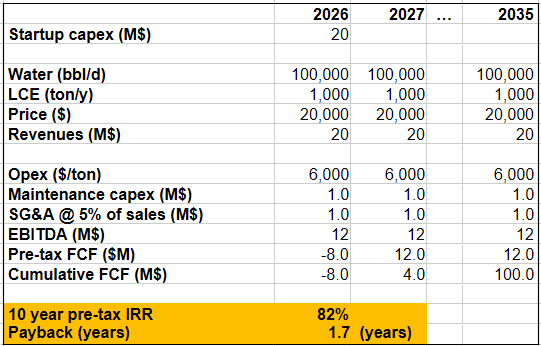
Even with $6,000/ton opex, pre-tax IRR is north of 80% with a 1.7 year payback. I am comfortable saying the economics look “compelling”.
Some water partners will want a “capital light” deal, so let’s look at those economics. I will use $0.05/bbl as the tariff Liberty will pay to process produced water delivered by a partner who has no equity.
As an example, I’ll use NGL Energy Partners, the largest independent produced water operator in the US. I’ve used data from their FY25 10K (period ending 31mar2025). It isn’t a perfect model as they don’t break down Adjusted EBITDA by basin, so these numbers are for their entire operation, not just the Permian, but good enough for our purposes.
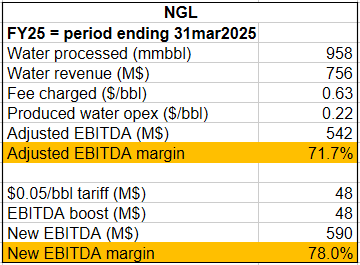
If Liberty had extracted lithium from all of NGL’s produced water in FY25, and paid 5 cents for each barrel, that would have added $48M of 100% margin income, boosting their Adjusted EBITDA by 6.3% - all for doing nothing but permitting Liberty to do their thing. Not a bad deal.
I do not anticipate Liberty will have difficulty in signing up water partners.
With aims to build out a battery industry, North Dakota has been very supportive of Liberty’s efforts, and various grants have so far contributed US$3.7M to Liberty’s kitty.
The US is serious about domestic critical mineral production is general, and lithium in particular. Liberty has applied for multiple DoE grants/loans ranging from $30M to 10-figures, with notice of awards (or not) expected in 2026.
Initial water partners are expected to contribute half the required capex of the first plants.
Liberty recently closed a 3x oversubscribed LIFE offering, raising C$10M.
The first 150,000 bbl/d facility has capex requirements of ~US$30M. Once a water partner is chosen and an offtake or two is signed, given the compelling economics, I expect Liberty will have multiple options for the modest financing required.
Once the first facility is operating and economics are proven at scale, I think Liberty will be able to debt finance much of its future capital requirements.
Mart asked me what my valuation was looking like and I answered:
I ran a detailed Monte Carlo sim and the answer was: “big”.
Whirly being helpful, as always.
When it had a market cap of ~C$90M, it was a classic example of “if you need a spreadsheet to prove it is cheap, it’s not cheap enough”. Remember the context: a TAM of multiple $billions and a long term gross margin of 77% at current pricing. I didn’t need no fancy spreadsheet to tell me to load the boat with LIB, but just ‘cus I’m such a great guy, I’ll walk you through one way to come up with a rough valuation.
It is worth emphasizing that Liberty looks to be a high quality business, much better than your typical miner:
Produces a product (US source lithium) that promises to be in a supply deficit for a long time.
High ROIC, and low non-growth capex requirements.
Low production risk.
Low environmental liability risk.
Low jurisdiction risk.
Long-term, downside-protected sales agreements afford excellent earnings visibility.
All of which implies a higher valuation multiple and cheaper credit.
One complication is estimating what share of water deals will be JVs, and what share will be tariff-based. It matters because the economics to Liberty are quite different under those two models. In a JV scenario, Liberty’s capital requirements are halved and cost of capital should be less given the JV partner “halo”, both of which would enable a faster build-out and earnings growth. That said, I think a rigorous modeling of this is both beyond my smooth-brained abilities and would have large enough error bars to make it pointless. The one thing we think we do know, is that most water partners will want capital light deals, so I will just wave my arms in the air and assume 75% of deals are tariff-based, and 25% are JVs (conservatively not increasing build-out speed). I will run economics for those two scenarios and then blend them for a final result.

For my full valuation model, I’ve made a few assumptions:
Processing capacity is 200,000 bbl/d at year-end 2026, 500,000 year-end 2027, and then doubles every year for a while. I believe this is realistic and significantly less than internal Liberty ambitions.
Liberty finances most of its capex requirements with debt at a 10% yield. If Liberty is successful with its request for US government grants/loans, this could be conservative.
Liberty signs offtakes at a price of at least the current China price +20%, which is currently ~US$20,000/ton.
Opex starts at US$6,000/ton, but Liberty reaches their goal of $4k/ton opex within 5 years, which requires a $50M capex investment in a reagent plant. This is the one place where I am perhaps being a bit aggressive.
Three-quarters of water deals are tariff-based, and one-quarter are 50:50 JVs.
Ultimately Liberty is awarded at least a 15x PE multiple. Comps are ALB with a 20-year average PE of 20, and SQM with a 20-year average PE of 27. SQM should get a jurisdiction (Chile) discount, but a boost for less mining risk. Liberty could easily trade at a premium due to US jurisdiction, high growth rate, and no mining risk, so 15x could prove to be pretty conservative.
Annual maintenance capex is 5% of startup capex.
SG&A is 5% of total revenues.
100% of operating cashflow is used to supplement debt to finance the build-out.
SBC expands the share count at 5%/year.
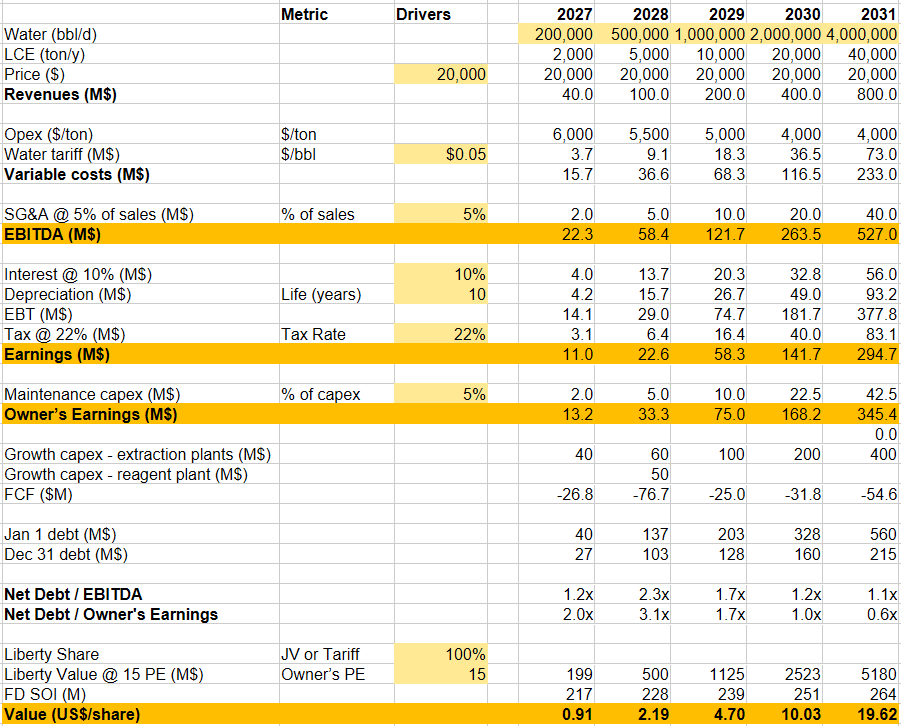
That, however, is not the whole story. As discussed earlier, we expect a mix of JV and tariff-based water deals, but don’t know exactly how it will shake out. I am assuming ¾ will be tariff-based and ¼ will be JVs; after calculating a valuation for those two scenarios I combine them into a “blended” valuation.
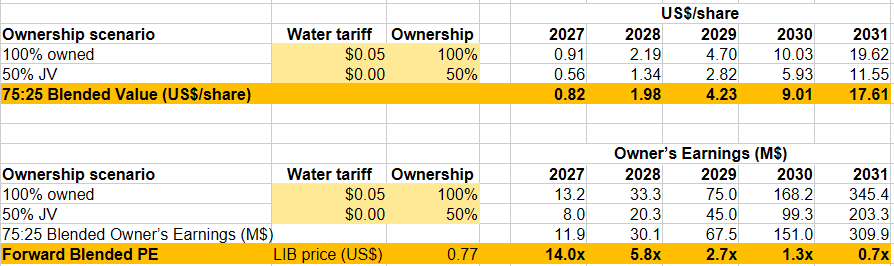
It would be a mistake to look at that 2027 14x number and think we are nearing fair value. The market is forward looking, and will not price Liberty in 2027 based on 2027 earnings. With a 2.7x 2-year forward P/E it would be absurdly cheap for a company growing earnings at a triple-digit rate.
If you, dear reader, like this story and think you might want to get long, I suggest you think about your strategy very carefully.
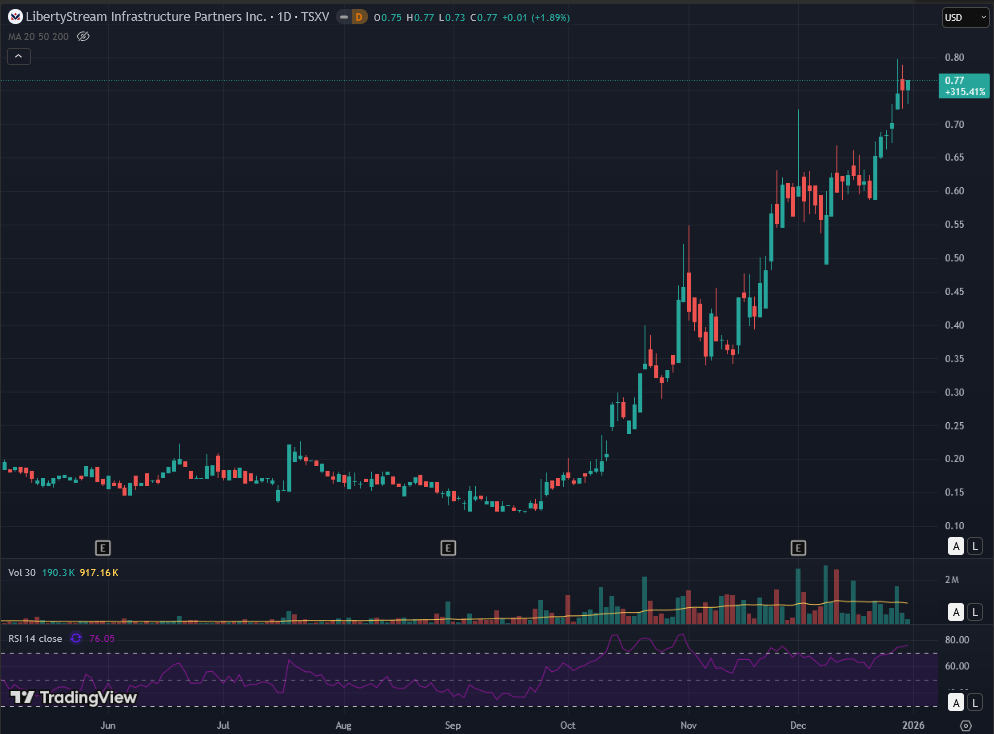
The stock has been on a tear – a 6-bagger in just over 3 months. My cost basis is C$0.49, so it is easy for me to be bullish, but looking at the chart you have to think it is due for a nasty pullback. And I don’t disagree.
There are a few obvious risks that could hit the stock in the short term:
Liberty currently has no on-site ability to analyze the purity of the lithium carbonate they produce. The results from the lab could disappoint, requiring adjusting some refinery knobs and trying again.
The lithium price, which has been rallying, could collapse.
While I think it quite unlikely, if the company doesn’t sign a water partner and at least one offtake in Q1, or Q2 at the latest, the stock will get hit, possibly quite hard.
On the flip side, in December the company did a C$10M raise at $0.65 (with 3-year warrants!), and not only did the stock not trade down to the raise price, it has since rallied +60% above it. The raise was reportedly 3x oversubscribed with anchor institutional investor Pathfinder taking down another chunk. I don’t think I’ve ever seen a stock perform so well after a raise, especially one with warrants. The stock has momentum, and the bulls are very much in control, as they say.
Additionally, we’ve potentially got a number of catalysts coming, some as soon as this month, all of which could goose the stock.
If you like the thesis, it is really hard to know what to do here, but personally if I didn’t own any, I would be careful about YOLOing into my entire position right now.
Catalysts, catalysts, catalysts, everybody wants catalysts. Especially with pre-revenue microcaps trading on the Venture Exchange. Well, you’re in luck, Liberty has catalysts aplenty. In a rough, kinda, sorta chronological order:
Ordering of equipment for first commercial scale facility (deposits already being placed).
Independent lab analyses of lithium carbonate from demonstration refinery in Texas (1Q26).
Samples sent to prospective customers (1Q26).
Formal announcement of JV with first Permian water partner (1Q26).
Signed offtake(s) for first (non-battery) customer(s) (1H26).
Loans/grants from DoE (1Q26 and 2H26).
Start of construction of first commercial facility (2H26).
More water partner agreements/JVs (CY26).
Re-domiciling company to the US (2H26).
Moving stock listing to Nasdaq (2H26).
Commissioning of first commercial scale facility (1Q27).
Shipment of first product to offtake partners (1H27).
Production growth exceeds my projections.
Lithium price continues to rise.
The DoE comes through with significant funding.
As a high-quality fast-growing US-based lithium producer, the earnings multiple awarded could be way higher than 15x.
Technology fails to scale.
Opex proves to be much higher than expected.
Water partners are either not interested or demand too high a tariff.
US shale production falls catastrophically.
Lithium price falls, and/or Liberty signs offtakes at low prices.
Only available financing options prove to be highly dilutive.
Competitive technology proves superior.
There are a couple upside opportunities for Liberty that I am just going to mention in passing:
There is increasing regulatory pressure in Texas to “clean up” the produced water so it is suitable for agricultural uses, and Liberty could play a role in that.
There are lithium-in-produced-water opportunities outside the US. KSA anyone? Rumours are Liberty has already been approached.
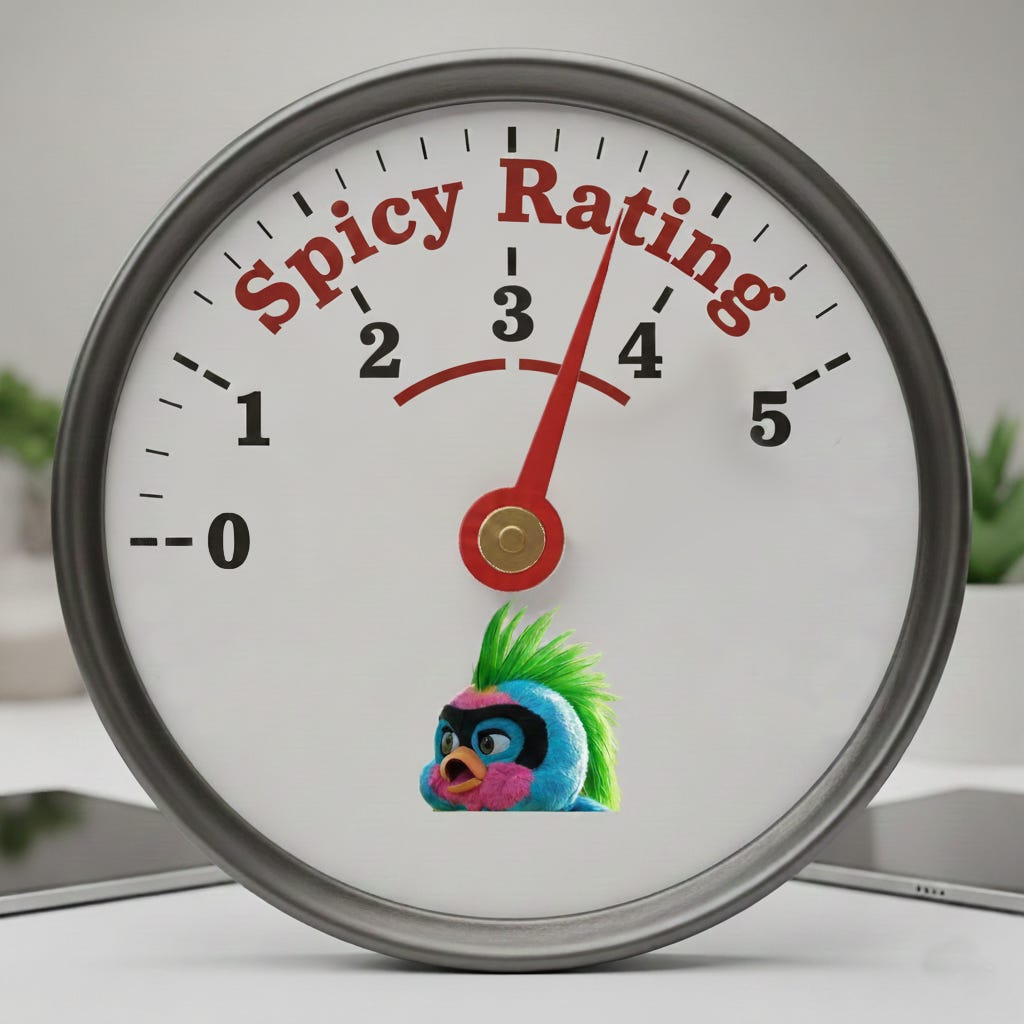
Liberty gets a 3.5 out of 5 Spicy Rating™.
Company is pre-revenue, with material sales still a year away.
Liberty is under-capitalized. More financing, either equity or debt or both, should be expected.
Tech is largely de-risked. Minimal “mining” risk.
High confidence in both demand and feedstock supply.
Competitors exist, but Liberty appears the front runner, at least in the Permian.
Liquidity isn’t amazing, but also not bad, with recent ADV around half a million Canadian dollarettes.
Stock has been on a tear, an air pocket should be expected.
I’m long. Bigly. Duh.
As usual, my mate Uzo helped very much bigly with my efforts at a valuation.
No posts
Comments
Nothing yet. Say the first thing.
Sign in to join the conversation.