
I really didn’t plan for this to be The Comstock Blog, but here we are with my third piece in six months. Last week Comstock executed a capital raise that was … controversial, shall we say. After the raise, 10Q, earning call, and chat with Corrado, it took me some time to digest everything, but now that I have done so, you’re getting a short update to save me from typing my thoughts in multiple online forums and DMs.
Comstock has been badly under-capitalized since the dinosaurs roamed, which inevitably led to a toxic mix of converts, promissory notes, and earn outs on the balance sheet. Additionally, various financial obligations were continually being satisfied by newly minted stock, providing a constant drip of supply onto the market.
It was a viscous cycle as no long term creditors or fund managers had any interest in that balance sheet, so ongoing funding requirements meant more toxic converts, and around and ‘round we went. There was hope last August that SBC was going to break us out of that trap, but alas, it is now clear that SBC is either unable or unwilling to close.
On 12aug2025 Comstock, with Titan Partners as sole bookrunner, sold 13.3M shares at a price of $2.25, raising $30M before Titan exacted their pound of flesh. Titan was also granted the option of selling up to 2M more shares in the next 30 days, and given the raise appears heavily oversubscribed (possibly up to 3x), this option will almost certainly be taken up. SOI was 35.9M before the raise, so this was a 30% dilution at a $115M valuation. An ouching indeed.
There was a fair bit of disappointment, sometimes colourfully expressed, shared on the interwebs after the raise was announced. A raise was widely expected as Comstock parent was running on fumes and Metals needed at least $4M this month for equipment orders required to keep the first industry-scale plant on schedule. That said, this raise was significantly larger than expected, and was priced with a larger discount than hoped. I personally expected more like $10M with price closer to a 3-handle.
Comstock needed ~$11M to finish the first Metals plant and expanded storage, and probably another ~10 months of cash burn to get through to positive cash flow, so $18M just to keep the lights on and build the plant. Given $LODE’s current low valuation and only a $4M immediate need to keep Metals on schedule, Corrado first tried to raise less than $10M from high quality investors (read: fund managers) who would buy (and hold!) equity rather than toxic converts, and would not demand warrants. But they pushed back:
No, $10M is too low. You need to clean up your balance sheet and have enough cash left over to be assured of no further raises before Metals becomes cash flow positive.
$30M allows completely cleaning up the balance sheet: all the debt, notes, and even off-balance sheet commitments associated with prior acquisitions, are gone. It also provides ample liquidity to build the first Metals’ plant and get a start on the second one. This size of a raise will expedite the first plant reaching a 100 kton/y nameplate and significantly speed up the second plant.
The $30M in of itself isn’t necessarily a bad thing - there is plenty of benefits, and I see it as a significant de-risking event. But it sure hurts to price it at $2.25. To be honest, I don’t actually understand how the sausage is made, but I’m told that if we wanted to avoid more toxic financing and sell stock to large AUM, diamond-hand, actively managed equity funds, this was the price. IMO, this raise was left too late, and Comstock had its back against the wall – they needed to raise very soon – and the investors knew that and had the leverage here.

Now the Band-Aid has been ripped off, and the toxic financing cycle is broken. Metals is well funded through the first plant becoming operational, and I believe we have good visibility to FCF in Q2/Q3 of next year.
Unless you think another dilutive raise is coming, which I don’t, the details of this raise is largely irrelevant for the forward view. And I believe the view forward is unequivocally better after the raise: the spectre of dilution is gone as is Metals’ financing risk. The numbers in my last update need to be adjusted for this dilution, but also CF needs to be brought forward, and the build-out schedule needs to be expedited. And as I discuss below, the competitive landscape is shaping up better than expected, and Metals is now positioned to expand aggressively in the US, grabbing a significantly larger market share than I previously anticipated. A bit of give-and-take on the overall valuation, but the big picture of the thesis is largely unchanged. I’ll put some numbers to this in a bit.
Since Metals announced the Master Services Agreement (MSA) with RWE, they’ve obviously been busy signing more MSAs despite the lack of news releases. In July a Ladenburg Thalmann research report mentioned three new MSAs by name, and during the Q2 earnings call Corrado mentioned two more: NextEra and Florida Light & Power. Corrado also mentioned receiving panels from Pennsylvania, Ohio, Louisiana and Texas. So lots of new customers and MSAs, we just don’t know how many yet.
The 2Q25 10Q reports ~$1M in deferred revenue, and that tells us Metals accepted around 2,000 tons of panels in the quarter. So despite the plant not being built yet, those are not insignificant volumes that are being shipped to Metals for storage prior to recycling.
It is important to note a couple things:
Metals received a significant new county permit in May 2025, for storage expansion, on a nearly adjacent site to the processing facility.
Utilities are technically still exposed to environmental liability for stored panels, so some utilities will not ship panels to Metals until the plant is running and they can guarantee an expeditious issue of a certification of destruction.
Regulatory bodies are generally unhappy about panels being stored for more than a year (Metals has received a bit of relief on this for now), so Metals needs to carefully manage pre-production storage while still serving customer’s immediate needs.
For the above reasons, we should not interpreted the rate of growth in stored panel as representing the maximum current supply.
SolarCycle is deemed to be Metals’ strongest competitor. They have a recycling facility in Texas and plan (planned?) to build a large recycling + PV glass manufacturing facility in Georgia. Why are utilities shipping panels from Florida and Texas to Metals way up in Nevada, you might ask? And so you should – it costs $250+/ton to ship from Florida.
It seems SolarCycle is in a spot of trouble. I believe their main focus is the manufacture of PV grade glass, with the PV recycling designed to supply the feedstock. The economics of manufacturing glass in the US is tough enough, but they are very much impacted by Trump’s removal of solar subsidies.
There are signs SolarCycle is struggling:
They planned to raise $344M for the glass plant + recycling facility, but I can find no evidence they closed on any of that. Third parties later reported a total of $500M in capex requirements.
The recycling plant was supposed to be operational by mid-2025, but I can find no evidence of that happening.
Construction of the glass plant was halted in June due to “a potential funding shortage”.
They’re laying off workers at their Texas recycling facility.
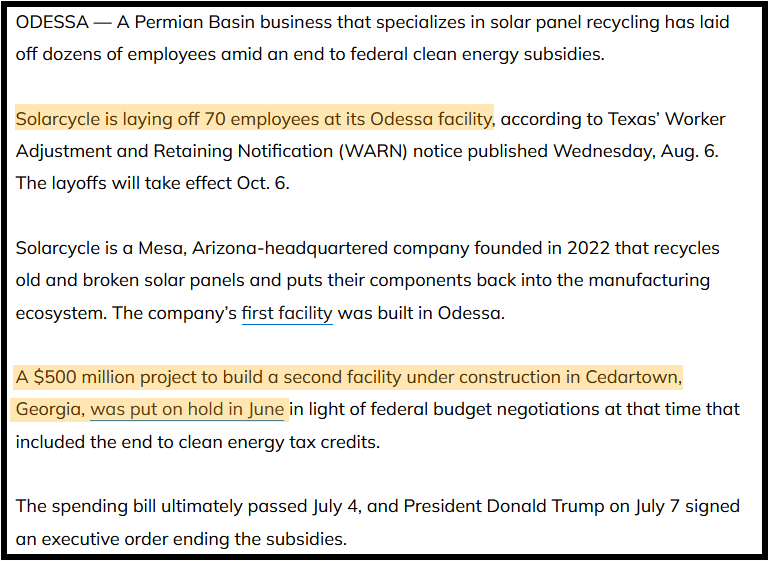
So Metal’s strongest competitor looks to be in financial distress, has apparently stopped work on their new recycling plant, and is laying off workers at their existing plant.
Right now, the market looks wide open for Metals to step in and aggressively grab market share and lock up key locations. It is worth noting that the loss of the PV subsidies won’t impact Metals until today’s panels reach end-of-life in 20 years or so.
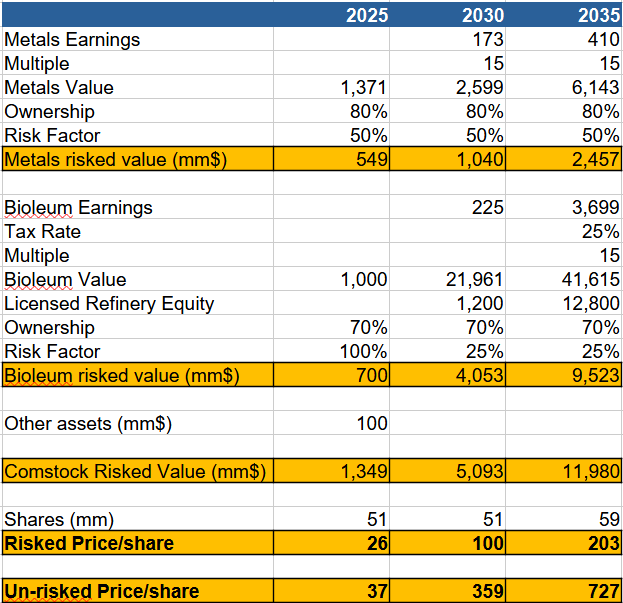
As a thought experiment, I made a couple modifications to my model:
Move up plant #1 to June 2026 at 100k ton/y.
Add a new plant every 12 months.
Increase market share to 50%.
This significantly increases the value of Metals even after dilution, but not by enough to offset the dilution of my unchanged Bioleum value. My 2030 per share value drops by 23% to $100. Given the error bars on my numbers, this may struggle to reach statistical significance. If you’ve got room to average down here, your end result may be flat.
The raise sucked. Dilution is never fun, and this one was particularly painful.
What matters now is the view forward, and I argue it is unequivocally better.
Fully diluted forward per share valuation is lower than pre-raise, but still a huge multi-bagger.
Comstock has a $115M market cap, an $85M EV ($70M inclusive of Bioleum cash), $100+M of non-core hard assets for sale, the Metals business about to inflect to cash generation, and an implied $700M+ ownership in Bioleum. You do the math.
I am long LODE 0.00%↑ and have added significantly since the raise.
No posts
Comments
Nothing yet. Say the first thing.
Sign in to join the conversation.